
#On the Eleven Days
Rostov did not fall when its walls cracked. Walls crack. Men repair them, curse them, invoice them, and make theology from the bill. Rostov fell when arithmetic finished praying.
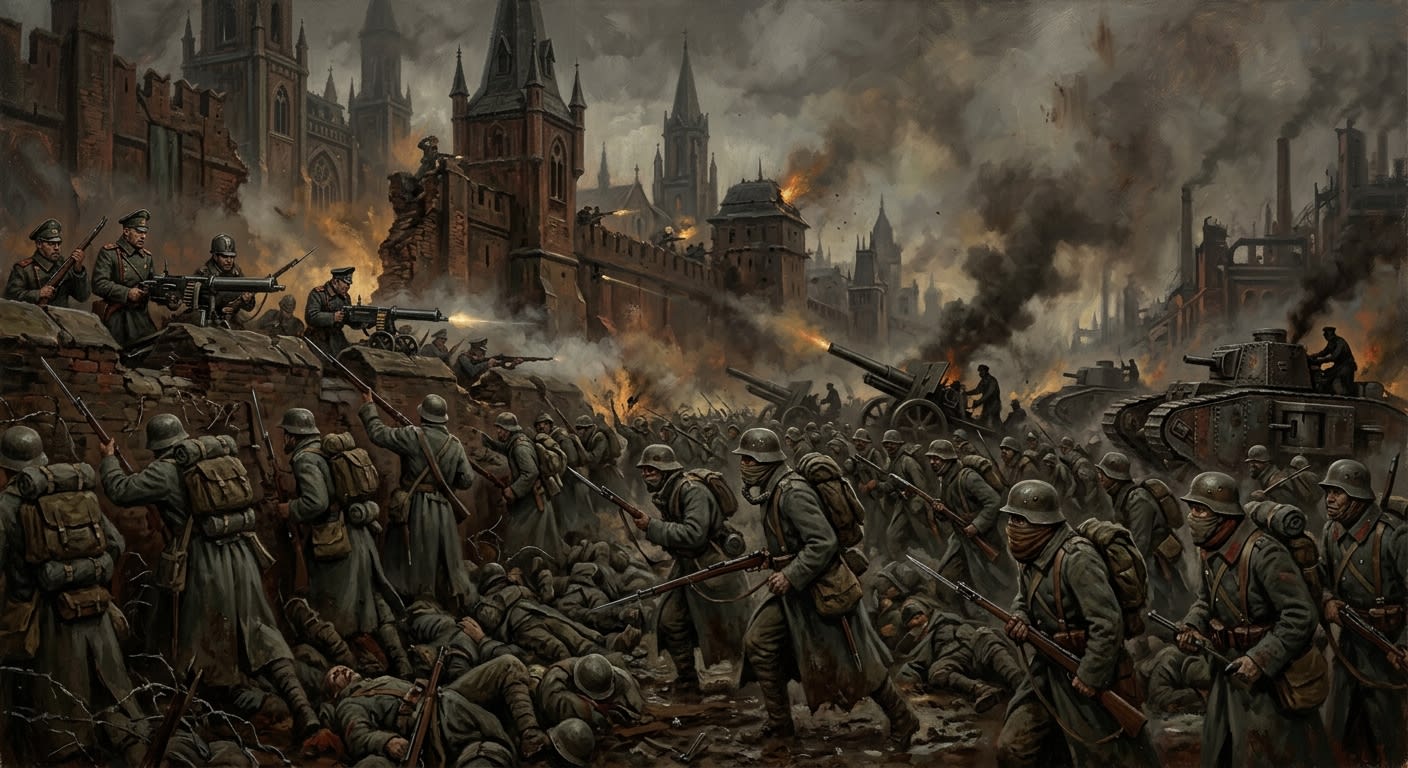
The Siege of Rostov, A.S. 153, was Maldrake's cleanest demonstration of expendable war. For eleven consecutive days his commanders hurled Ash-Fodder waves against a Covenant garrison of six hundred. Dawn. Midday. Dusk. Eight to twelve thousand per shift, though the surviving tallies differ because counting while firing until the rifle-stock smokes is a talent the Bureau of War has never properly rewarded.
By the fourth day, barrels overheated. By the sixth, bayonets replaced fire. By the ninth, furniture legs and iron railings had become pikes. On the eleventh day, the Ash-Fodder stopped. The silence lasted forty minutes. Then the Wrathforged appeared, rested and fed, and Rostov fell in two hours.
That phrase has survived every revision: within expected parameters. It sits in the record like a well-fed spider. The six hundred defenders are listed by name, rank, parish, issue of ammunition, wound status, and final disposition where known. The ninety thousand are not listed. The Bureau explains this by saying hostile mortal materiel cannot be entered into rolls of honour. The Bureau is correct. The Bureau is also hiding under its desk.
#On the Garrison
Rostov's garrison was not large enough to be glorious. Glory prefers scale; martyrs prefer witnesses; the Bureau prefers forms with all boxes filled. Six hundred Covenant personnel held the northern approach: rifle companies, a reduced artillery section, two field chaplains, one bell-cart whose axle cracked on the second day, and a quartermaster named Adel Truhn who appears in the record twenty-seven times because hungry men discover quartermasters with religious intensity.
They had walls fit for a provincial fortress, not for a sermon. Low bastions. Mud glacis. Timber revetments patched after spring thaw. A central chapel whose bell had been recast at an unverified date and rang half a tone flat, which the chaplains described as penitential and the gunners described as bloody annoying. The eastern ditch was dry by the time Maldrake's host arrived. The western storehouse contained ammunition calculated for three days of ordinary action.
The error lay in the word ordinary.
The first wave came at dawn without drums. They walked. No armour, no ladders worth naming, no standard beyond scraps tied to poles. Some carried farming hooks. Some carried stones. Many carried nothing. The defenders fired by section, as manuals instruct, and the front ranks folded. The rear ranks climbed over them. The second volley cut them down. The third opened gaps. The fourth emptied cartridge boxes faster than comfort allowed.
By midday the second wave had arrived.
#On the Mechanical Mercy of Waves
Maldrake is not subtle. Subtlety belongs to Velkara in the officer's mess, to Morwen in the mirror, to any of the prettier infections that do their work in gloves. Wrath arrives with heat and hammers. Yet at Rostov he displayed a discipline uglier than frenzy. The waves came in shifts. Dawn. Midday. Dusk. Never so many that the defenders could use enfilade fire efficiently; never so few that the pressure slackened; always enough bodies to force expenditure, fatigue, recoil, reload, recoil, reload, recoil, until the arm learns despair as a physical motion.
The Ash-Fodder were not expected to breach the walls. They were expected to spend the garrison. Every shot fired into a chest was a shot unavailable for the Wrathforged. Every bayonet thrust dulled steel meant for armour. Every corpse in the ditch made footing worse for both sides, which favoured the side that did not require living soldiers to keep its balance.
On the fourth day, rifles overheated. Men wrapped barrels in wet cloth; the cloth hissed. On the fifth, spring mechanisms failed. On the sixth, ammunition parties moved under fire with sacks of loose cartridges because boxes were too slow. On the seventh, the chapel floor was torn up for barricade timber. On the eighth, the bell-cart was broken for pike shafts. On the ninth, the defenders stood atop a wall of enemy dead higher than a man and stabbed downward into faces that had no hatred in them, only forward motion.
Earlier field lectures described Rostov as proof of Covenant superiority against massed infantry.
Corrected. Rostov proves that superiority can be invoiced until it becomes insolvency. A marksman who kills one hundred enemies and then has no bullet for the hundred-and-first has performed heroism and logistics failure in the same motion.
#On Day Eleven
The eleventh morning began with sleet. The reports agree on this, which means the weather was miserable enough to survive clerical disagreement. The dawn wave arrived late by nine minutes. The garrison noticed. Men who had stopped noticing hunger, smell, ringing ears, cracked lips, the dead underfoot, and the shameful relief of killing people too tired to raise their hands — those men noticed nine minutes.
The midday wave did not arrive.
That absence did what ten days of attack had failed to do. It frightened them. A soldier can meet movement with drill; stillness asks questions drill cannot answer. The garrison used the pause to count cartridges. Forty-two confirmed. Seventeen doubtful. Ammunition entirely spent by Bureau calculation, because doubtful cartridges belong to hope, not stores.
The Ash-Fodder ceased at the eleventh day's edge. For forty minutes Rostov heard itself: cracked masonry settling, wounded men bargaining with saints, steam rising from rifles, crows taking doctrinal liberty with the dead. Then the eastern smoke lit from within.
The Wrathforged advanced in ordered silence. Fresh armour. Fresh blades. Heat singing through plate. Behind them came hammer-hosts whose steps shook blood loose from the corpse barricades. They did not hurry. Hurry would have insulted the preparation. Ninety thousand had purchased those forty minutes and the two hours that followed.
FINAL CHAPLAIN'S NOTE — FRAGMENT RECOVERED FROM CHAPEL WALL We have no shot. We have pikes, knives, three axes, one cracked bell-clapper, and the reliquary key. Brother Senn says the east smoke is singing. I hear no song, only metal. If this note reaches ███████████, tell her I spent the last cartridge on a boy with my son's eyes and ask whether absolution travels backward.
Rostov fell in two hours. The north gate broke first. The chapel burned last. Quartermaster Truhn's body was found under the storehouse steps with a ledger slate in one hand and a pistol in the other; the pistol had no charges left, and the slate read none remaining, which may refer to ammunition, men, mercy, or all three. The Bureau of Records entered it under materiel accounting.
#On the Ratio
One hundred and fifty to one. The number possesses a brutal elegance, which is why the Bureau loves it. Ratios clean the fingernails of history. A ratio has no smell. It contains no ruined hands, no torn throats, no mud in the teeth, no quartermaster writing the end of the world as inventory. It can be copied into a memorandum, presented to the Assembly, taught to officer-cadets, and used to justify the next requisition.
The Bureau of War's conclusion was mathematically sound: Maldrake will spend any number of Ash-Fodder to exhaust a smaller professional force before committing his true assault. The Bureau's answer followed with equal soundness and greater moral decay: increase ammunition reserves, deepen corpse ditches, rotate rifle sections faster, pre-position pike timber, train garrisons to fight over bodies without losing formation. Practical measures, all of them. Necessary measures. Filthy measures, wearing necessity as vestment.
The Bureau of Engineering studied barrel failure. The Bureau of War studied ammunition expenditure. The Bureau of Doctrine studied morale. The Bureau of Records studied the naming problem and solved it by naming only six hundred people.
#On the Unnamed
The word count presents its own indictment. Six hundred names fill folios. Ninety thousand absences fit into a sentence. The Bureau calls this economy; I call it a miracle performed by cowardice, and I note with professional irritation that the miracle is efficient.
What remains of Rostov is not a fortress. The site lies east of stable governance, folded into maps whose edges Doctrine marks in red wax and Engineering marks in question marks. Scouts have seen movement there. Maldrake's servants use the ruins when campaigns require a staging ground. The chapel bell, cracked before the siege, reportedly rings during sleet with no hand upon it. The Bureau of Bells denies this because acknowledging a bell beyond Bureau custody causes professional nausea.
The six hundred have shrines. Small ones, official ones, with approved names. Children in western parishes recite Captain Odran Hale, Sister-Marksman Ivena Rusk, Gunner Pell, Quartermaster Truhn, the two field chaplains, the last gate crew. Good. Let the names be kept. Let candles breed soot beneath them until the plaster blackens.
The ninety thousand have no shrine. They were hostile mortal materiel. They were enemy expenditure. They were waves, mass, pressure, attrition. They were also conquered people driven forward until Covenant bullets gave them the only exit Maldrake permitted. The Bureau knows this. The Bureau forbids the wrong kind of pity because the wrong kind becomes recognition, and recognition becomes obligation, and obligation is expensive.
Rostov's lesson is written in the after-action hand: within expected parameters. The phrase should be struck into a bronze plate and nailed above every War lecture hall, every levy desk, every warm committee room where men discuss expenditure while other men become it. Expected parameters are the tomb in which astonishment is buried.
Popular retellings say Rostov's defenders were overwhelmed by hatred.
No. Hatred arrived late, armoured, and rested. Rostov was overwhelmed first by obedience: ninety thousand bodies walking into fire because the alternative behind them was worse. The correction improves nothing. It merely places the blame where the Ledger can see it.