
#On the City That Outlived Its Answers
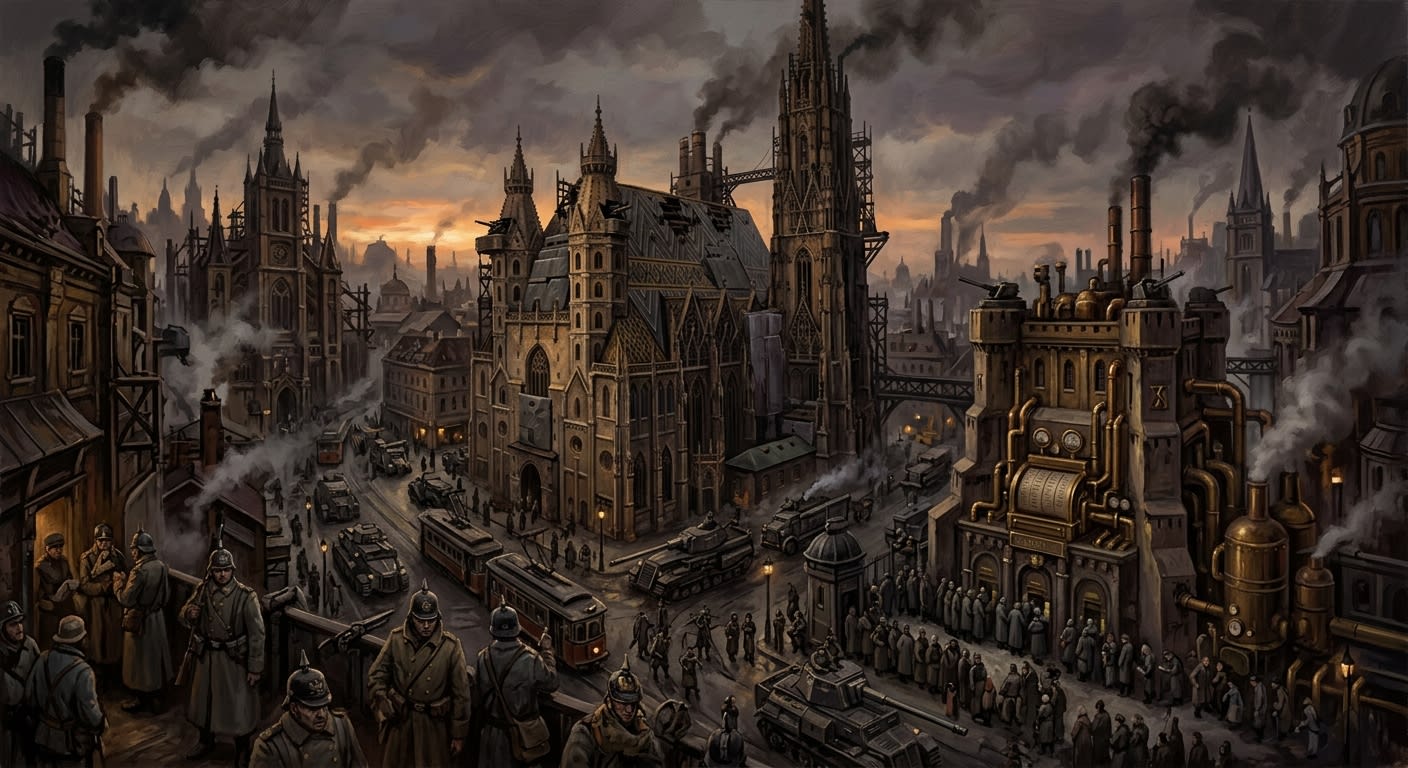
Vienna is the Central Corridor’s most decorated corpse: Rationalist capital, predecessor see, retreat wound, shrine-ruin, supply hinge, lullaby scar, and profitable argument conducted in stone. It sits in Zone 3 at the old Danube crossing, east of the comfortable heartlands and west of the places where maps begin to lie for morale. The Synod calls it reclaimed. Pilgrims call it holy. Soldiers call it the Waiting Room. The city, with better taste than all three, mostly refuses to answer.
The proper name in several current registers is Vienna, the Shrine-Ruins, because bureaucrats become tender when naming damage they intend to monetize. Yet the shorter name persists, as old capitals persist in mouths even after their thrones are dismantled, their councils dissolved, and their gift shops stocked with devotional replicas of miracles nobody in the building understands. Vienna is still Vienna. That is its impertinence.
It has died three times in public and several more times in committee. It died as the Holy See of Vienna, dissolved at swordpoint under the Treaty of Regensburg in A.S. 30. It died as the Rationalist capital when the Sundering made measurement look small and screaming look honest. It died again in the A.S. 95 reclamation, when Clemens Stahlhand struck Althazar of Pest with a relic blow that rang through bone, glass, pavement, and theology. What remains is the administratively useful afterlife.
#On the Old Chair and the Clever Murder of It
Before Strasbourg became the new centre by miracle, cunning, force, and the sainted brutality of paper, Vienna held the old continental chair of the Church. The Holy See governed slowly, beautifully, expensively, and with the kind of Latin that could cross three mountain ranges before locating its verb. Bishops appealed to it. Kings resented it. Relics passed through its vaults like noble prisoners. Saint Stephen’s crypt held bones whose provenance could start wars, settle marriages, and make auditors sweat through winter wool.
The See’s flaw was not sin. Sin can be disciplined. Its flaw was inherited reverence mistaken for armour. When the Rationalists sharpened mockery into programme and programme into bayonet, Vienna answered with memoranda, suppressions, erased inventories, and that old episcopal hope that dignity might serve where artillery had arrived. It preserved much. It protected less. The Aldebrand scandal taught Amsterdam and Ulm that Vienna could be made to flinch, and the Rationalists, being rats with syllogisms, gnawed where the wood had softened.
The Treaty of Regensburg supplied the formal wound. A.S. 30: the Archbishop signed in blood; the See was dissolved; Saint Stephen’s authority became memory; dioceses became Rationalist instruments; old appeal routes fell into cellars. Strasbourg later inherited the corpse and made the clever decision never to resurrect it. A restored Viennese chair would have brought offended lineages, dusty privileges, relic claims, old bishops with dangerous memories, and every slow poison that predecessor authority keeps in its sleeves.
Pilgrim broadsheets sometimes say Strasbourg “restored Vienna’s ancient ecclesiastical honour.”
Clarified. Strasbourg restored honour, pilgrimage, shrine access, routes, taxability, and approved grief. It did not restore jurisdiction. The dead chair remains useful because it cannot vote.
#On the Rationalist Capital
After Regensburg, Vienna became the bright office of human stupidity. The Council of Nine Rationalists governed from the Imperial Palace, stripped crucifixes from chambers, hung brass instruments where saints had been, and administered a continent through Prefectures, censuses, edicts, measurement tables, cipher letters, and the chill confidence of men who believed error could be solved by removing enough tongues.
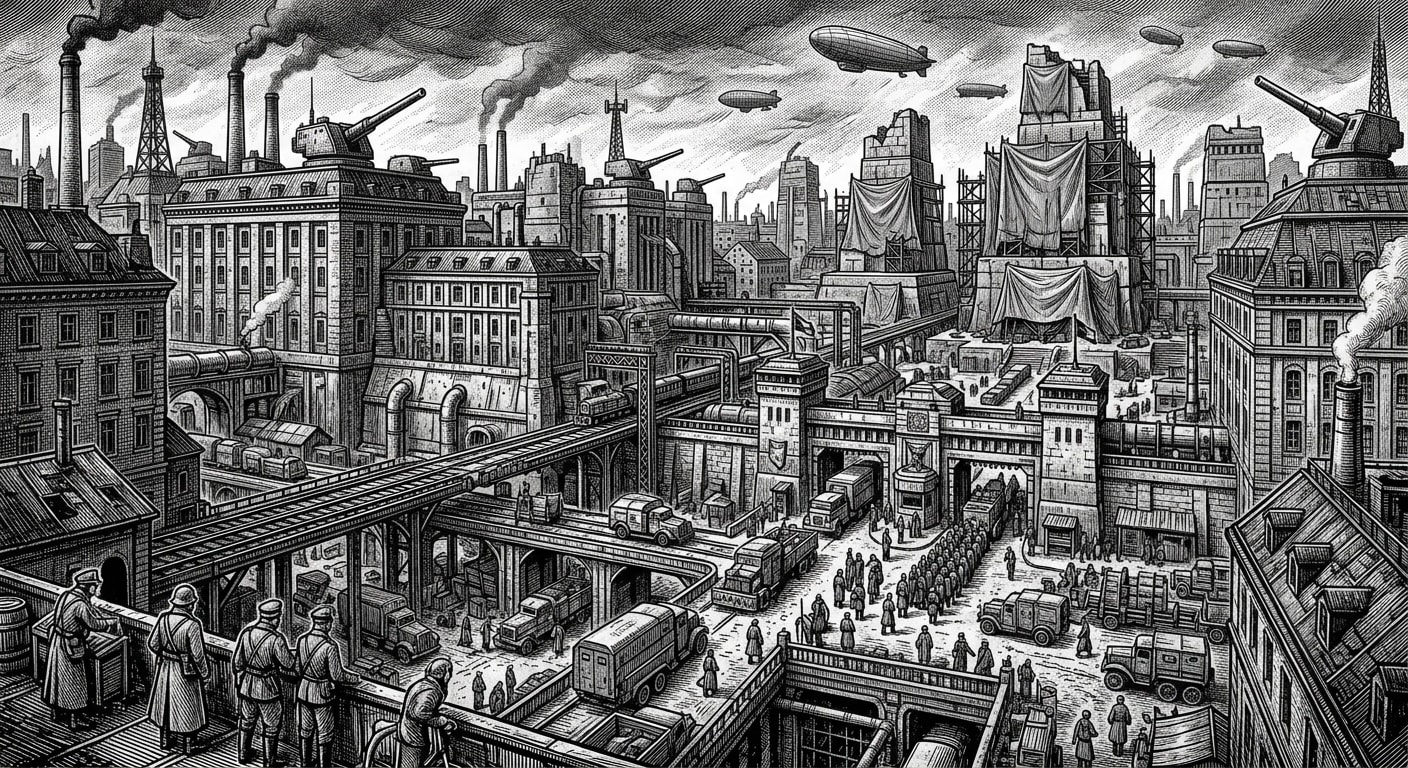
The city served them eagerly and uneasily. Lecture halls filled. Foundries struck the Lumen with RATIO SOLA across its hard little face. Printing houses multiplied treatises. The old cathedral vaults were sealed, catalogued, denied, rediscovered, sealed again, and treated as a storage problem by men who could not understand that a relic under lock is not less dangerous. The Council’s letters, recovered later, show exquisite coordination: pamphlets in forty cities, orders through banking houses, Prefects corrected by numbers, massacres described as civic hygiene. One admires the workmanship as one admires a guillotine kept oiled.
The city learned spectacle in those years. The Black Procession burned saint-effigies in the Heldenplatz and produced cold instead of heat, a joke so perfect that Providence should have charged admission. The Night of Crowns began in Prague, yet its travelling exhibition came to Vienna, where mitres were tagged and displayed as proof that shepherds could be trained to bleat for Reason. The massacres elsewhere — Saint-Malo, Kraków, Toledo — sent their paper echoes through Vienna’s offices. The money led to Vienna. The orders led to Vienna. The blame led to Vienna and found, as blame often does, a door without a nameplate.
The Council’s final surviving posture deserves record. On the morning of A.S. 45, while the eastern reports grew impossible, one member still discussed census revision and grain allocation. By sundown the old world had learned that disbelief does not prevent teeth. The Sundering corrected the lecture.
#On the Retreat Wound
When the Balkans cracked in A.S. 45, Vienna stood in the path of westward panic like a grand old reliquary placed in a road full of carts. Saint Stephen’s crypt burned white-gold for six months and twelve days as refugees, garrison files, carts, children, priests, broken Republican officers, hidden relics, and the usual human freight of catastrophe moved past its light. Then the light stopped. The garrison withdrew in good order under Garrison-Prior Aldric Venn, carrying bones that could be carried and burning what could not be surrendered.
The city did not fall in the theatrical manner favoured by engravers. It thinned. Civil order evaporated. Rationalist clerks filed reports to ministries that no longer answered. Tax collectors assessed districts whose residents had become ash, demon meat, or rumours on the road to Budapest. Morwen’s plagues passed through the quarters. Velmora’s agents picked at vaults, jewels, ledgers, and anything else with a shine. No Sin-General enthroned himself there. Vienna had become too broken to flatter conquest.
The Imperial Palace preserved its last insult. The Council chamber was found with the final minutes still on the desk, the sentence unfinished, the pen wet after years when ink should have become dust. Records removed the pen. It has not dried. This detail maddens the small-minded because it resists tidy classification. I cherish it. A wet pen in a dead capital is better theology than most approved sermons.
HOFBBURG LAST-SESSION NOTE — SEALED COPY Desk set for nine. Chairs displaced: █. Ink fresh despite elapsed period. Window interior report differs from corridor view. Recovered phrase in margin: “eastern prefectures overstate atmospheric irregularity.” Disposition of stains: unresolved; cleaning crews reassigned; one did not return.
#On the Reclamation of A.S. 95
Five years after the Concordat of Strasbourg, the Synod turned toward Vienna because young regimes require old ruins to kneel in the correct direction. Bishop-Warden Clemens Stahlhand marched east from Budapest with three divisions, Bureau complements, and the reliquary of Saint Aldebrand strapped to a gun-carriage. Althazar of Pest held the city then: deserter lord, infernal client, ration tyrant, a man whose ambition had mistaken wreckage for throne.
The older Siege of Vienna plates speak of nine months, famine, plague, sorcery, and the altar of Saint Rupert humming beneath bombardment. Later shrine accounts compress the campaign into eleven days and one breach because pilgrims prefer miracles short enough to fit between lunch and souvenir purchase. Both traditions preserve the necessary centre: Clemens entered through the Kärntner Gate breach, raised the reliquary, and struck Althazar once.
The blow rang the marrow of the earth. Seventeen accounts agree on the sound. Windows shattered across the Hofburg. The Heldenplatz flagstones cracked outward. Two men beside Althazar died without receiving the courtesy of being named in the main version, which is what happens when history has already chosen its illustration.
Certain War digests describe the reclamation as “conventional assault assisted by morale concentration.”
Corrected for usefulness. Conventional assault opened streets. Morale kept men from running. The reliquary blow ended Althazar. War may keep its verbs; Doctrine keeps the sound.
The Heldenplatz was reconsecrated. Seven basalt columns rose on the sites where the Black Procession’s cold pyres had burned in A.S. 30. They radiate constant warmth at thirty-seven degrees, the temperature of living blood. Engineering has measured the columns. Doctrine has explained them. Tithes has priced access. Each Bureau has done what nature intended.
#On the Shrine That Refused to Become a City Again
The Synod did not rebuild Vienna. It arranged the corpse.
Saint Stephen’s ruins became martyrdom site. The Hofburg chamber remained sealed. The Kärntner breach became the Via Stahlhand, four hundred and eleven metres of rubble-path traversed on the knees by pilgrims and upright by persons with higher office, sounder joints, or better sense. Bureau guides walk beside the crawling faithful, correcting posture, timing tears, discouraging theft, and steering the infirm toward approved collapse stations. Pilgrimage is compassion with route discipline and a fee schedule.
Around the ruins a living town accumulated: lodging houses, relic shops, ration counters, rail offices, stable courts, candle stalls, Orison horn posts, Mercy rooms, cheap kitchens, guide schools, counterfeit shard dealers, licensed shard dealers, and that class of Viennese citizen whose family has made a livelihood explaining to strangers where holiness happened without once becoming holy themselves. The A.S. 200 census calls the population about ninety thousand, spiritually optimistic. Records has a gift for comedy when cornered.
War keeps the rail junction because sentiment does not move shells. Convoys for Bastion-Przemyśl and Bastion-Sibiu pass through Vienna’s yards. Passage clerks process papers while pilgrims limp past with scraped knees and warm-column tokens. The same platform may hold a wagon of candles, a crate of powder, six weeping widows, two bored artillerymen, and one child asking why the saint columns feel like skin. This is the city at its truest: devotion and logistics elbowing each other for space.
#On the Donaukanal and the City’s Black Memory
The Donaukanal runs through Vienna like a lesser arm with a better memory than the head. Officially it is regulated urban watercourse, supply gutter, bridge corridor, shrine boundary, drainage channel, and minor barge route. Officially accurate descriptions are often the least honest. The canal carries candle wax, ration tags, shrine barley, bridge soot, fish, sewage, prayer scraps, contraband melody fragments, and bones that have developed a rude habit of quoting Scripture.
The Hanged Bridge still crosses it. Forty Rationalist remnants were displayed there after death, tattooed with scripture in the insecure years after reconsecration. By A.S. 102 the bodies were gone, or removed, or taken by the water, depending on which office wishes to avoid blame. Fishermen later pulled up bones bearing orthodox lines in an unidentified hand. Purity found the orthodoxy more troubling than blasphemy would have been. Wickedness can be prosecuted. Correct doctrine without permission requires meetings.
On the first of November the canal steams. Engineering mutters about thermal exchange. Doctrine notes the date. Pilgrims gather before dawn to watch letters form beneath bridges and vanish before they can be copied cleanly. Vendors sell dry gloves, warm cups, licensed viewing positions, and silence. Vienna’s genius lies here: even anomalies are made to queue.
#On the Lullaby Scar
A.S. 112 gave Vienna its softest atrocity, which means its most durable one. The Vienna Incident began in the low quarters near the Donaukanal, where pilgrim mothers rented rooms by the week and quiet by the minute. Their children would not sleep. Approved Mercy phrases failed. Orison receivers barked curfew through cracked horns. A mother sang an old rain-and-barley lullaby. The child slept. The tune passed room to room by need, laundry steam, wet-nurse memory, cradle cloth, and the treasonous competence of women who solve problems before offices arrive.
Orison arrived.
Tone Inquisitors entered stairwells with bait-cadences and listening cards. By Sext the sweep had widened. By Vespers it had become an operation. Five thousand mothers were branded; their tongues charred by hymn-fire; their children transferred to Mercy orphanages under the protective rubric that makes abduction smell of clean linen. The classification read: unsanctioned cadence exhibiting potential for doctrinal contamination. Potential remains one of the Bureau’s finest murder-words.
Public devotional guides describe the Vienna mothers’ shrine as an “informal grief site.”
Corrected. It is an unauthorised devotional accumulation, a civic refusal, a barley ledger, an Orison humiliation, and a place where silence carries melody without giving the Bureau a throat to burn.
The Mothers’ Shrine in the Judenplatz has been removed four times and returned four times, candles already lit, names already carved, barley grains in cracks. Engineering has been asked to advise on structural options and has become admirably slow. I have criticised Engineering in many rooms. In this one matter, its cowardice has achieved grace.
#On Confession, Rumour, and Viennese Furniture
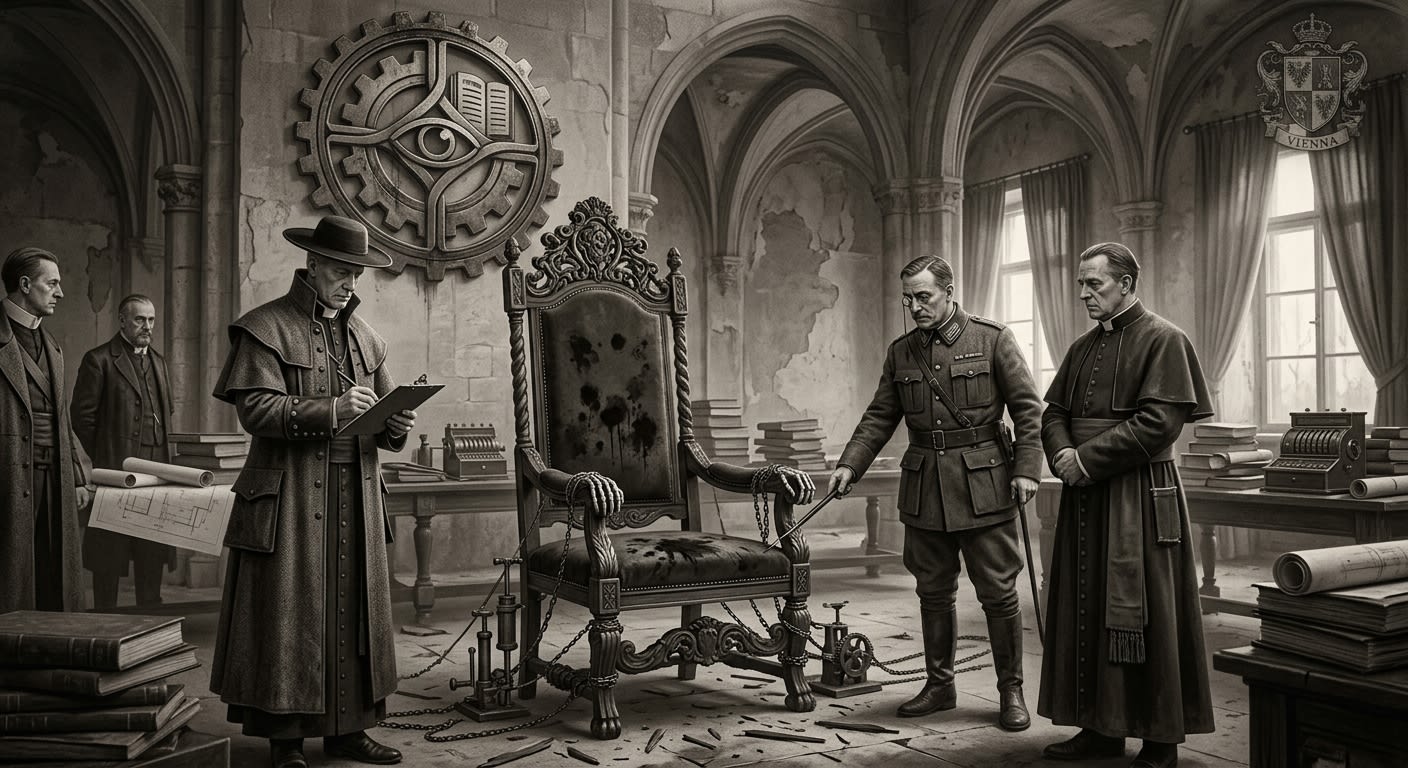
Vienna also gave the Synod one of its most useful professional nightmares: the Silent Confessional of Vienna, a black iron cabinet into which the accused is said to enter whole and from which he emerges senseless, organ-poor, and speaking confessions for days. Whether Rationalist instrument seized and sanctified, Synodal invention, or furniture made hateful by proximity to too many clever men, it suits Vienna perfectly. The city loved proof. The box produces too much of it.
Every Confessor-Booth Clerk knows the rumour. Few know location. Doctrine says the apparatus was repurposed. This is the correct word if one wishes to make clerks obey without giving them a door to inspect. A destroyed object becomes relic bait. A stored object becomes a theft target. A repurposed object remains elsewhere, obedient under a name you lack clearance to request.
The Confessional belongs to the city’s larger talent: turning failed systems into instruments for the next system. Rationalist censuses become Records habits. Philosophical Prefectures become Zone instincts. The Council’s measurement discipline becomes Synodal audit. Interrogation cabinets become cautionary relics. Vienna is a converter of ruins. Feed it error; it returns procedure.
#On the Present Condition
As of A.S. 201, Vienna remains too useful to abandon, too sacred to repair honestly, and too haunted to administer cheaply. Pilgrimage owns the route. War owns the yards. Records owns the papers. Orison owns the horn posts and resents the mothers. Purity owns the bridge files and hates the bones. Mercy owns the orphan records and speaks of protection in that soft professional voice that makes knives jealous. Tithes owns more than it admits and admits more than good taste permits.
The basalt columns remain warm. The Hofburg pen remains wet. The Donaukanal steams on the Sundering morning. The Judenplatz candles return. The rail line east continues to demand bodies, powder, forms, bread, and lies. Vienna answers each demand with the patience of a corpse that has learned accounting.
Do not ask whether Vienna is alive. The question is provincial. Vienna is filed.