
#On the Office That Had No Destinations
The Bureau of Settlement began as a room. In A.S. 92, two years after the Concordat of Strasbourg gave the Synod its constitution and its unruly provinces, the successor officials governing Strasbourg installed Kaspar Thenm, late warden of the South Gaol Annex, as first officer of a Provisional Settlement Office. He received a desk, three clerks and a seal borrowed from the Bureau of Records. His mandate covered the "temporary disposition of displaced civilian persons under Synod protection." It promised nobody bread, a roof or admission.
Records could already write a name. A written name proves that a person exists. It does not find that person a place to sleep, and the early theocracy suffered more from that gap than from any heresy of the decade. Registration answers who. Disposition answers where, and crowds throw stones over where.
Thenm's first rosters were built for where: household head, dependents, trade, origin, imposed destination, ration class, spiritual condition, livestock, tools, infirmities, disputed children. In his early columns he crossed out cell, block and yard, and wrote in parish, quarter and camp. The words changed. The same hand kept the keys.
#On the Three Columns at the Outer Mills
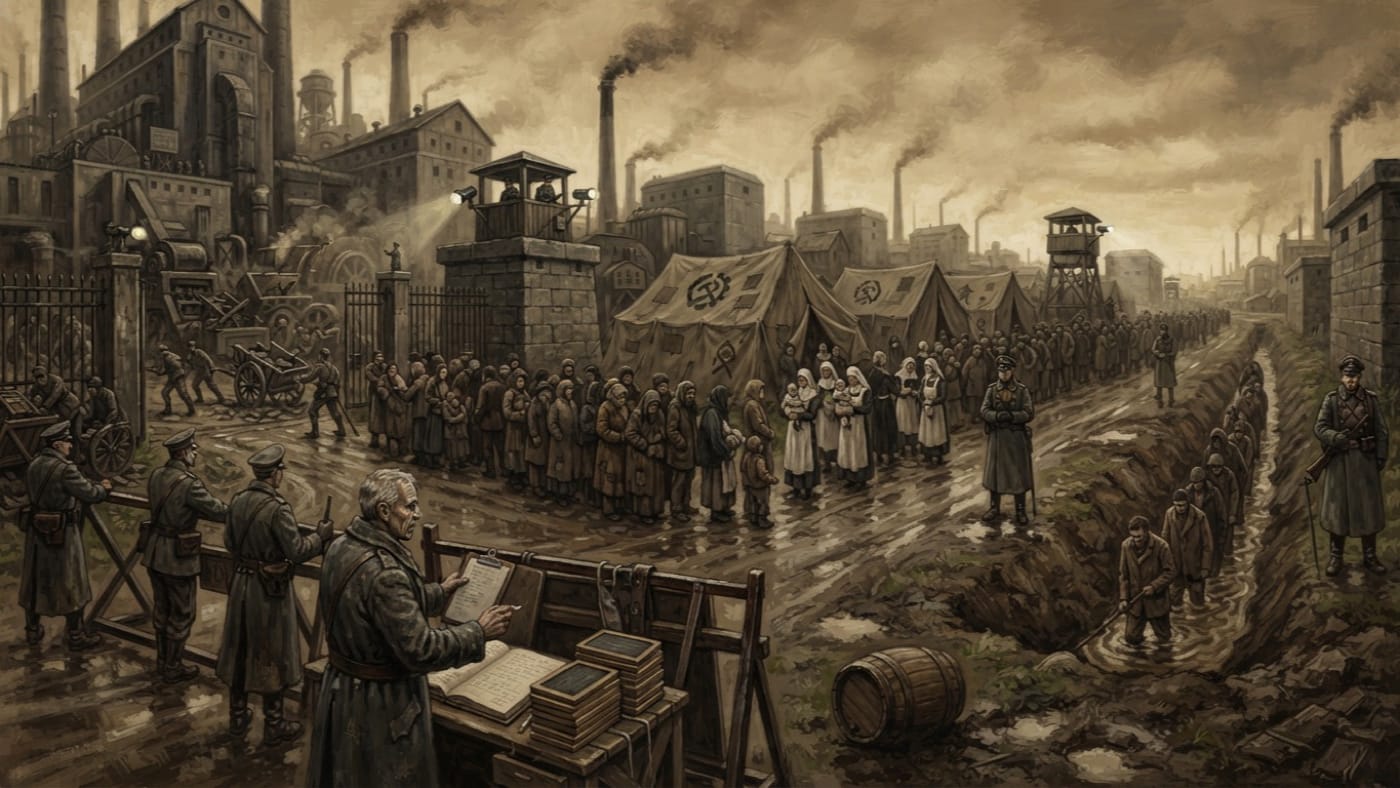
In A.S. 93 the western roads into the capital clogged. Three columns of displaced persons converged outside Strasbourg's outer mills and stopped. Each had been promised priority entry, and each promise had come from a different office. The surviving account does not name those offices. I will not name them either, though my suspicions would fill a vespers. Three priorities at one gate add up to none. The columns understood this arithmetic faster than the people who had promised them entry, and they refused to move.
The reader is waiting for the cavalry. The Settlement Office sent its officer, four guards, twenty blank slates and a barrel of watered beer.
Four guards cannot hold three columns. Any warden who has counted a yard at dusk knows the ratio at which a locked gate becomes a suggestion, and Thenm had counted many yards. He made no attempt to hold the crowd. He sorted it: first by trade, then by age, then by how many children in each household could walk without help. That last test is pure warden's cunning. A child who has to be carried slows a column, ties up an adult's arms, and turns a family into a dead weight on any road.
The slates were blank when they arrived. Nobody recorded what was chalked on them.
Those who could repair wheels were sent to the mills. Those with sick infants were sent to the Mercy tents. Those with no trade and no papers were assigned ditch-work along the western drainage cut. The beer was handed out last.
No riot occurred.
#On the Three Roads Out of the Crowd
Look at the destinations as a clerk must, without weeping on the ledger.
The mills. On a road choked with broken carts, a man who can true a wheel is worth more at a mill than in a queue. His skill earned his household a place next to the work that needed him. The account does not say whether it also earned him entry to the city, wages or a roof. A destination is not a dwelling.
The Mercy tents. A sick infant can spread contagion and makes noise. Worse, it is the one sight most likely to turn a sullen crowd into a righteous one. Thenm sent the infants, and presumably whoever carried them, to the ward-sisters, whose tents were already a ledger with canvas stretched over it. Mercy matches bowls to bodies, and that day it received more bodies.
The ditch. Those with no trade and no papers went to the western drainage cut. Nobody needed their skills, and nobody could verify their names. The ditch needed neither. It needed backs. It also kept those backs outside the gate, at work, in view of the guards, and too tired by evening to argue about the morning's priorities.
Note what the sorting leaves out. The account names three destinations. It does not say where the cooper went, or the widow who had papers but no trade, or the old man who had a trade and a fever. It does not say how age was applied, or what happened to a household with plenty of walking children and soaked papers. Every column held more conditions than three roads could carry, and the record carries only the three roads.
The work on the road came to this: knowing how to fix a wheel, having an infant with a cough and lacking papers each became grounds for sending people to different places. No source records that anyone was asked whether they wished to go. There were four guards and twenty slates. The beer came last, after everyone had moved, because a warden knows to pay on completion.
#On the Clerks Who Removed the Beer
At some point after the road cleared (the file does not say how long after), the clerks of Records turned Thenm's decision into a standing rule: Emergency Disposition Table 4-B.
Here the documentary floor gives way. I hold no complete transcription of the table. No drafting clerk is named, no countersignatory, no year of issue and no shelfmark, and no original has been produced for my inspection. The designation is unexplained. I have heard junior clerks invent meanings for the 4 and the B, and I have watched them corrected. The surviving account gives the table's parentage and one substantive edit. Records removed the barrel of beer from the official account, because Records distrusts methods that cannot be indexed. The ditch stayed.
Compare what each kept. The beer was the only thing offered on that road. Everything else was imposed. It was crude, watered pay for having moved, and it did not survive the conversion into a table. The ditch was where the state sent people it could neither identify nor use, and that survived.
A field decision is one man's act, answerable to the people who watched him make it. Thenm on the road could see the infant and the fevered old man and the soaked papers. He could adjust, or fail to, with his own eyes on the crowd. A table is answerable to nobody present, and that is its whole purpose. Regularising a decision means making it repeatable without the officer, without the crowd and without the barrel. A wheel-wright, a cough and a missing paper become rows. The ditch becomes a provision. The file does not count how often the table was used afterwards. Its form tells us it was meant to be used again.
Early celebratory pamphlets credited Thenm with inventing the Zone Permit.
Corrected. Thenm issued sleeping chits, ration-location tallies and route-denial scraps stamped with a gaol mark. Table 4-B is a Records regularisation of a single road decision of his, made after the fact by clerks whose names are not recorded. Neither instrument is the Zone Permit, and no surviving file establishes a line of descent from this table to any later permit clause.
#On What the Table Left Behind
Thenm died of exhaustion in A.S. 94, still in office, with his early methods still in use around him. The pressures that had produced Table 4-B did not die with him. Records wanted names. The Bureau of Tithes wanted households fixed to grain that could be taxed. The military administration, which would later receive its full charter as the Bureau of War, wanted beds and labour near its depots. Settlement stood between those appetites with a borrowed seal and the habits of a warden.
The later Zone Permit and the Assignors who carry Settlement's maps inherited his way of working: the destination imposed, the reason written down, the person moved. That much of Thenm's method plainly survived, because it can still be seen in any district office. Whether a given permit rule comes from Table 4-B in particular, no file within my reach establishes. I will not invent a family tree for a document that has never shown me its own face.
The table's revision history is unknown. The Records index entries I have consulted neither certify it as in force nor record its repeal. In A.S. 201 it sits in the condition the Synod reserves for most of its founding instruments: cited often, read rarely and revoked never, because revoking it would first require finding it.