
#On the Men with Maps
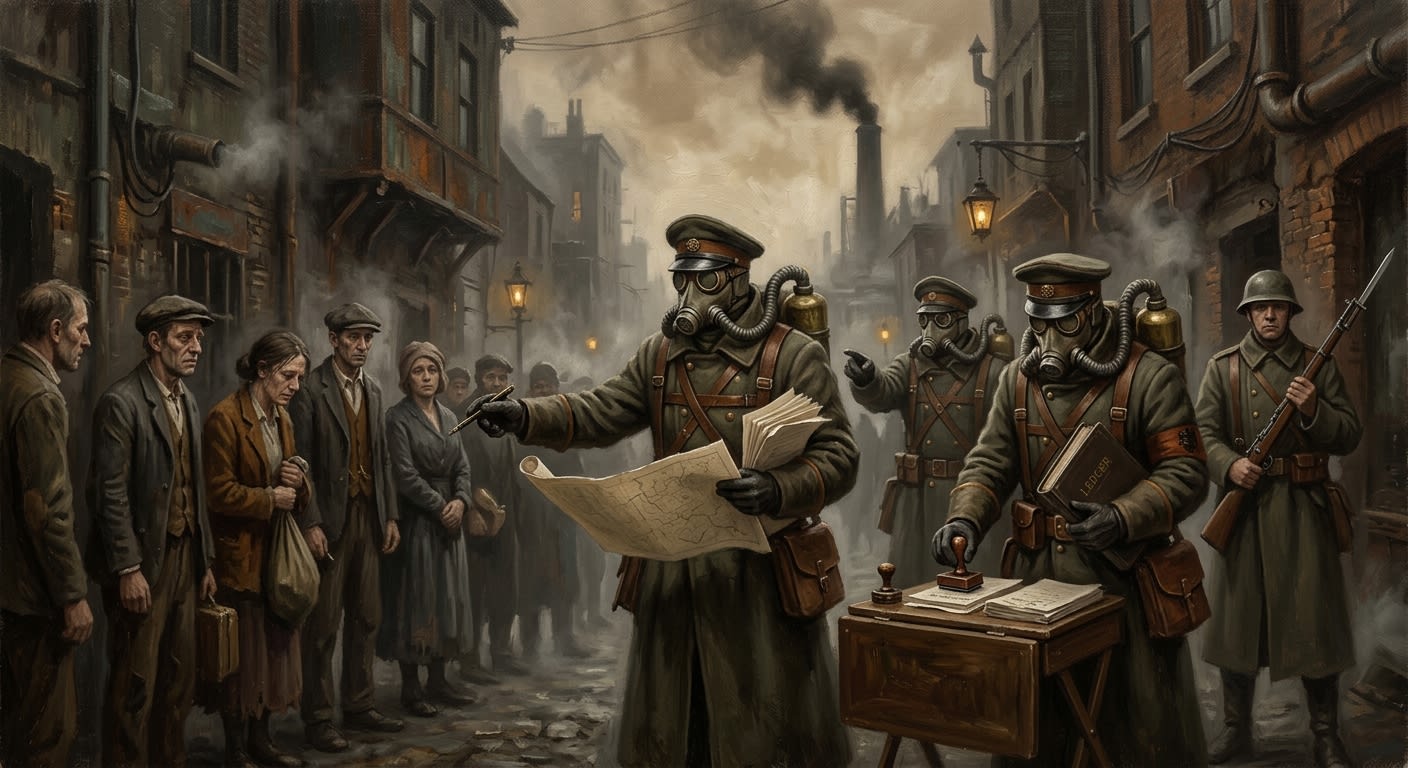
The Assignors are the field officers of the Bureau of Settlement: map-carriers, permit-revokers, address-fixers, human weather vanes turned toward whatever district the Synod has lately remembered exists. They wear no splendid sash. They carry no relic weapon. Their badge is a dull brass square stamped with a house, a road, and a nail. The symbolism is vulgar enough to be honest: dwelling, movement, fixation.
An Assignor arrives with a leather satchel containing zone maps, population ledgers, blank permit leaves, ink sealed against rain, three colours of rejection wax, a measuring cord, and the expression of a man who knows his authority is real until the first citizen refuses to move. He can designate a dwelling. He can revoke a Zone Permit. He can recommend reassignment to a town three hundred miles away, with no guarantee that the town has roofs, ovens, walls, or any desire to receive the reassigned. He can ruin a family by moving a line on paper.
What he cannot do is compel obedience alone. That humiliating little clause defines the entire profession. For enforcement he must borrow soldiers from War or inquisitorial muscle from Purity, and the borrowing requires paperwork, and the paperwork moves at the speed of inter-Bureau contempt. The Assignor stands in the street with a map, a seal, and a crowd learning the exact distance between law and force.
#On Origin and Rank
The profession descends from Kaspar Thenm's first sleeping-chit clerks, those hard-eyed men sent from the provisional office in A.S. 92 to barns, parish halls, mill-yards, and road camps with instructions to count bodies before they became mobs. Thenm understood confinement. His successors discovered frontage.
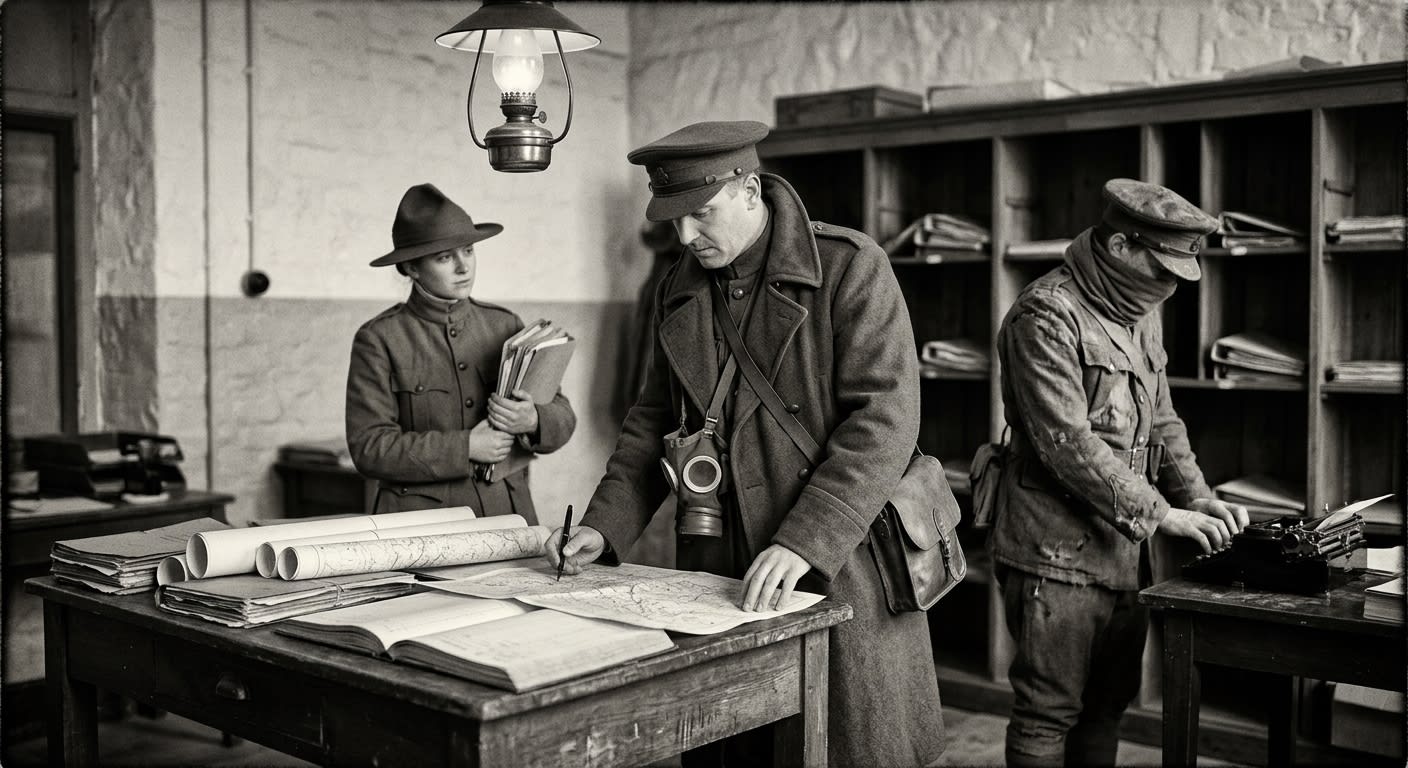
By A.S. 95, when the Synod's northern machinery was already issuing evacuation directives such as Standing Order 14-W/3 for Warsaw, Settlement required officers who could leave the cellar and return with numbers. By A.S. 112, after forged transit passes and counterfeit shelter marks produced the sort of deaths that make every Bureau discover jurisdictional passion, the Assignor had become a licensed field grade. By A.S. 130, the first continental census fixed the profession into its current shape: civil officer, map authority, escort-dependent nuisance.
Earlier manuals describe the Assignor as “an agent of peaceful administrative correction.”
Corrected. The Assignor is an agent of administrative correction. Peace occurs where the corrected lack alternatives, witnesses, or bricks.
There are three ordinary grades. House Assignors manage domestic classification: births, deaths, marriages, split households, widows, lodgers, disputed stairwells, and the unending theological quarrel over whether a man sleeping in a stable has become livestock for tax purposes. Route Assignors manage movement: transit writs, road permission, temporary work transfers, pilgrimage overflow, field evacuations, and those lovely moments at checkpoints when a person's paperwork becomes more fragile than his body. Boundary Assignors manage lines: street divisions, district edges, Zone changes, agricultural-to-industrial redesignation, temporary requisition corridors, and every other act by which ink tells stone where to stand.
Above them sit District Assignors, Resident Assignors, and the senior Field Rectifiers whom Sub-Archon Provisional Langres would like to multiply in Zones Four and Five, assuming Tithes stops clutching the purse like a widow with one spoon. It will not.
#On the Map as Weapon
The Assignor's map is not descriptive. It is sacramental. A peasant's map shows a road, a stream, a chapel, a field, a neighbour's fence, and the tavern where his uncle embarrassed himself after the Feast of Saint Orla. An Assignor's map shows permitted residence, taxable frontage, evacuation priority, conscription exposure, district quota, disease cordon, and the little black hatching by which Settlement indicates that the people currently living in a place have not yet been granted the courtesy of existing there.
A wrong map starves a district. A delayed map lets the Black Ledger open a cellar office before morning. A clever map can move forty thousand people while calling the act “rebalancing.” A beautiful map is dangerous, because beauty seduces committees into believing the world has agreed to be legible.
The Assignor learns map humility early. His first field exercise requires him to survey a market street, draw its frontage, count its households, identify unregistered lodgers, and return before Vespers. The second exercise sends him back at dawn, after the market has moved, two families have swapped rooms, a widow has taken in a cousin from Warsaw, the butcher has knocked a hole through the rear wall, and three children have been born in stairwells that did not appear on yesterday's plan.
The clever ones learn. The dull ones become inspectors in deep Heartland districts where the houses stand still out of manners rather than obedience.
#On Revocation
Revocation is the Assignor's sharpest tool and the one least suited to trembling hands. To revoke a Zone Permit is to remove a citizen's legal ground. Rations pause. Employment contracts become suspect. Marriage registrations require review. Children enrolled under the household address are flagged. Debts remain active, because Tithes has never allowed metaphysics to interfere with collection.
The form is small. I have seen one. It fits in the palm. Such is the genius of evil paperwork: the smaller the instrument, the larger the wound.
Revocation may follow fraud, expiry, forbidden movement, household concealment, zone mismatch, death misfiled as absence, absence misfiled as death, or the fatal bureaucratic category known as “address contradiction.” In Zone One, revocation means humiliation and a queue. In Zone Four, it can mean exposure. A man without a valid permit near Bastion-Brest is not a civilian with a problem. He is a suspicious moving object in artillery country.
Good Assignors fear revocation. Bad Assignors enjoy it. The Bureau, being the Bureau, promotes both if their filing is clean.
Field report fragment, Zone Four, A.S. 196: Assignor Team 7-C revoked permits for twelve households in a ridge settlement designated “structurally untenable.” War escort delayed. Purity escort refused jurisdiction. Weather closed the western road. By the time transport arrived, ███████████████████████████████████. Settlement correction: “Households no longer resident.”
#On Escort and Cowardice
The public calls Assignors cowards because they arrive with escorts when they can get them and flee without escorts when they cannot. The public is half right, which is more accuracy than the public usually manages before breakfast. Assignors know better than most officers that the state is a choir of borrowed threats. A Settlement seal frightens a shopkeeper. It does not stop a brick.
War escorts despise Assignors for moving civilians into military routes, out of military routes, across military routes, and then asking War to guarantee the route did not exist. Purity escorts despise Assignors for requiring legal predicates before terror may be applied. Records despises Assignors because field corrections are written in rain. Tithes despises Assignors because every reassigned household becomes a tax argument with boots.
An A.S. 187 Settlement circular stated that “inter-Bureau cooperation remains cordial.”
Withdrawn. Inter-Bureau cooperation remains documented. Cordiality was a copying error introduced by a clerk who later transferred to Bells, where tone matters less than volume.
Assignors survive by cultivating useful dislikes. They learn which War captains will lend two soldiers for a household compression order if promised a corrected barracks count. They learn which Purity assessors enjoy evictions too much and must be kept from touching the files. They learn which Records clerks can be bribed with clean copies. They learn that “urgent” means nothing until a superior has signed beside the word, and that a superior's signature means nothing until someone with a rifle agrees that the signature has weather.
#On the Field Temperament
An Assignor's soul, if one persists in the quaint superstition that clerical personnel retain souls after appointment, becomes a ledger ruled by thresholds. How many unregistered lodgers make a tenement fraudulent? How many children make a room a hazard? How long may a corpse remain in an address before the vacancy clock begins? How far may a displaced family travel before relocation becomes vagrancy? How many people can be told to leave before they become a crowd, and how many soldiers must attend before the crowd becomes obedient?
The work breeds a peculiar facial discipline. The mouth narrows. The eyes measure. The hand rests near the satchel flap. The Assignor entering a house sees beds, stove, parish icon, hidden mattress, illegal cousin, damp wall, possible fever, unreported infant, tax bracket. Love is not invisible to him. It is merely unfiled.
There are failures. Soft Assignors disappear into districts where they grant exceptions until exceptions devour the rule and the district becomes fiction. Hard Assignors produce riots, which are merely exceptions with torches. The best Assignors are disliked by everyone at equal temperature. This is the closest the profession comes to sanctity.
#On Present Use
As of A.S. 201 the Bureau employs thousands under its Settlement mandate, though the count shifts depending on whether one includes checkpoint guards, permit inspectors, transit auditors, and zone-boundary surveyors paid from War's auxiliary purse because Tithes enjoys litigation as a form of prayer. Assignors are thinnest where they are needed most: the Hinterland, the Pilgrim's Coast, the edge-settlements behind the Sagittal Line, the unregistered warrens beneath Constantinople, the places where a town can swell around a fort faster than Strasbourg can invent a category for it.
Langres has asked for thirty additional field Assignors in Zones Four and Five. Thirty. For the territories where demographic collapse, false residence, organic garrison towns, dead addresses, fugitive households, and frontier hunger gnaw at the map like rats in a sacristy. Thirty officers to hold a continent's frayed edge with satchels and denial wax. The request is under budget review.
There is a joke among Assignors, told only when no escort can hear it: Settlement is the Bureau that tells men where to stand; War is the Bureau that teaches them what happens if they stand incorrectly; Purity is the Bureau that explains afterward why standing was a moral decision. The joke is seditious, accurate, and badly structured. Field humour often is.
The Assignor closes his satchel. The family looks at the seal. The road waits.