
#On the Bureau That Decides Where You Live
"You are where we say you are. Move."
I am Valerius Drax, and I write now of a Bureau that has no seat in the Semicircular Chamber (Unregistered), no mention in the twelve canonical portfolios read aloud at the Feast of the Ledger, and no entry — until this one — in the Codex. The Bureau of Settlement exists in the space between the Bureaus the Synod displays and the ones it uses. It does not set doctrine. It does not collect coin. It does not ring bells or burn heretics or authenticate femurs. What it does is simpler and, in many respects, more terrible. It decides where three hundred million subjects of the Theocracy are permitted to stand.
A layman, hearing "Bureau of Settlement," would picture a small office of mapmakers. Clerks with surveyor's rods, perhaps. Men who draw parish boundaries and record addresses. The layman would be correct in every particular and wrong in the aggregate, because the Bureau of Settlement does more than record where people live. It determines where people may live, where they must live, where they are forbidden to live, and — in cases that arrive at the Bureau's attention with increasing frequency — where they have ceased to live and whether the vacancy should be reassigned before the body is collected.
The Twelve Holy Bureaus are the organs the Synod displays on feast days: the Flame of Interpretation, the White Cloaks of Purity, the crimson sashes of War. The Bureau of Settlement is the plumbing. Plumbing is not celebrated. Plumbing does not appear in hymns. When the plumbing fails, everyone drowns, and the Bureau of Doctrine writes a homily about the theological significance of water damage.
#On Its Founding and Mandate
"Assign. Assess. Reassign. The movement of bodies is the grammar of order."
The Bureau of Settlement was constituted in A.S. 92, alongside the first wave of administrative offices that followed the Concordat. Its founding charter — six pages of dense secretarial Latin, stamped by the Bureau of Records and countersigned by the Bureau of War — grants it authority over "the disposition and redistribution of all persons, civilian and ecclesiastical, within territories under Synod governance, excepting only those persons whose disposition falls under the Sacrament of Conscription (Unregistered) or the Rite of Incarceration (Unregistered)." In practice, this means everyone who is neither in the army nor in a cell — and, on occasion, people who are in both.
The mandate was born of necessity. After the Sundering, Europe was a continent of broken populations. The Atheist Wars had displaced millions. The Sundering displaced them again, this time in directions the mapmakers had not anticipated. Entire cities emptied toward the west. Villages behind the emerging Sagittal Line swelled beyond their capacity to feed themselves. Refugees from the fallen east — the remnants of Belgrade, Debrecen, Bratislava, the small towns whose names are now entries in the Ledger and nothing else — arrived in columns that the nascent Synod had neither the shelters to house nor the administrative machinery to count.
Augustinus understood that a theocracy built on prayer and paper could not survive if its population moved freely. Free movement is commerce. Commerce is independence. Independence is the seed from which heresy germinates in undrained soil. The Bureau of Settlement was his drainage system — a mechanism for ensuring that no district grew too wealthy, too poor, too empty, or too full without Strasbourg's knowledge and Strasbourg's permission.
The mechanism is the Zone Permit.
#On Zone Permits and the Architecture of Stillness
Every subject of the Theocracy is assigned a Zone — one of the seven administrative territories that radiate outward from Strasbourg like the rings of an old tree, each ring measuring proximity to the front rather than distance from the capital. Zone 1 is the deep Heartlands: France, the Iberian prefectures, the western German principalities. Zone 7 is the Line itself: Constantinople, the southern coast, the forward bastions. Between them, gradations of danger, taxation, and bureaucratic attention increase in proportion to one's proximity to something that would like to eat you.
Your Zone determines your ration category, your tithe bracket, your conscription liability, your permitted professions, and — through these — the shape of your daily life. A baker in Zone 2 is a baker. A baker in Zone 5 is a military supplier with corresponding obligations. A baker in Zone 7 is a man who wakes each morning unsure whether the ovens or the enemy will be hotter, and whose flour shipments are logged by the Bureau of Tithes and audited by War before a single loaf is baked.
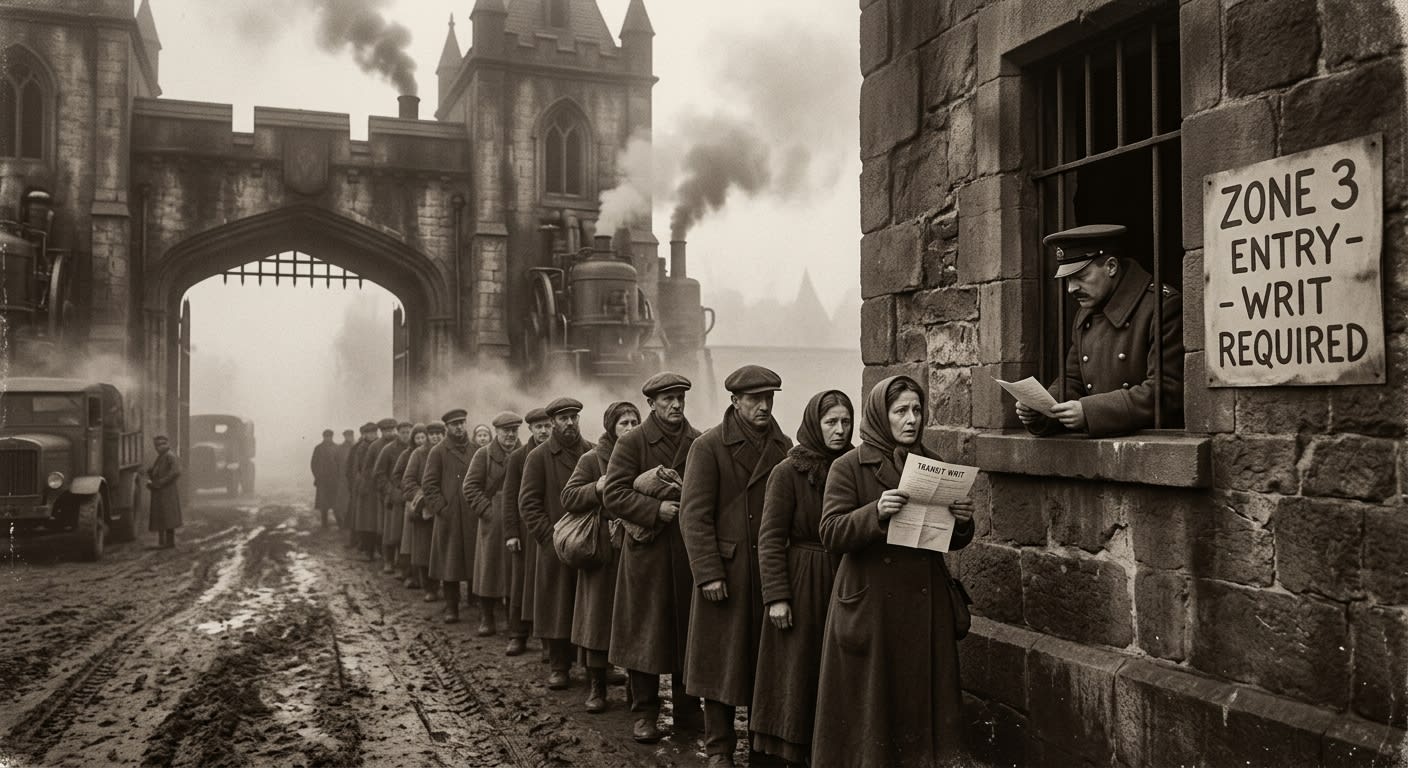
Movement between Zones requires a Transit Writ (Unregistered) — a document stamped by the Bureau of Settlement at the origin, countersigned by the Bureau of Records at each checkpoint, and surrendered at the destination. Writs are valid for thirty days. Extensions require a separate application, filed in triplicate, with a processing time of — the Bureau assures the applicant — no more than twenty-one working days. Working days do not include feast days, fast days, bell-days, Purity review days, or any Tuesday following a Zone 4 incursion alert. In practice, a Transit Writ is valid for thirty days and an extension takes forty.
The predictable result is that most people do not move. This is the point.
The system functions because it is inescapable. The Great Ledger of Souls records every subject's Zone assignment at birth. Baptismal certificates carry the Settlement stamp alongside the priest's seal. Marriage requires Zone-matching verification. Death certificates are filed with the Bureau of Settlement before the body reaches the ground — the deceased's Zone permit is cancelled, the address released for reassignment, the widow's permit revised to reflect the new household composition. There is a form for this. It is two pages. The widow receives her copy within six working days.
#On the Constantinople Model
"Seven colours. Seven ledgers. Seven pretensions to order."
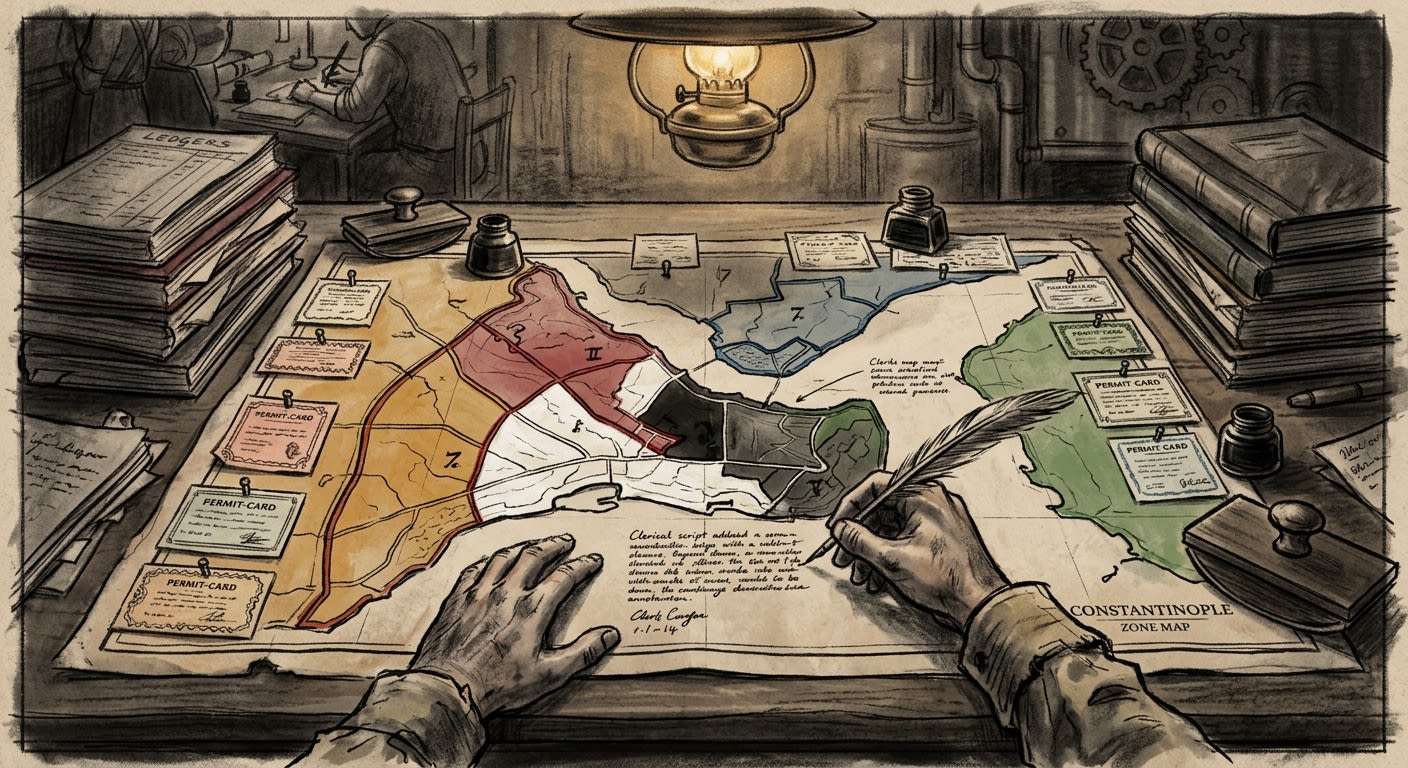
Nowhere is the Bureau of Settlement's ambition made more visible — or its limits more apparent — than in Bastion-Constantinople, where three hundred thousand souls are organized into seven administrative zones, each assigned its own ledger-color, each administered by a sub-Archon whose name changes every three years to prevent the sort of local loyalty the Bureau has learned, at great cost, to distrust.
The seven ledger-colors are White (the Sanctum Mile and Hierarchate Offices (Unregistered)), Crimson (the Foundry Quarter and military workshops), Black (the Ossuary Rings garrison), Grey (the Hammers — the conscript barracks), Blue (the Harbor of Chains district and maritime quarter), Ochre (the civilian residential terraces above the old walls), and Green (the Pilgrim's Coast (Unregistered) approach and its satellite communities). A citizen of Constantinople carries a Zone permit dyed to match their ledger-color. A Crimson permit-holder found in the White zone without a transit stamp is subject to detention and, in cases where the sub-Archon is having a poor morning, reassignment to the Grey barracks as a "volunteer auxiliary." The volunteer classification does not require the auxiliary's consent. Consent is, in the Bureau's filing, a preference, not a requirement.
The system was imposed in A.S. 95, when Constantinople was first established as a permanent garrison city. It was revised in A.S. 130, A.S. 155, and most dramatically in A.S. 188, when the Administrative Redrawing relocated approximately forty thousand civilians from the eastern terraces to the western approach — a redistricting that the Bureau described as "a rebalancing of demographic pressure along the Ochre-Green axis" and that the relocated civilians described, in the language available to people carrying their possessions on their backs, with somewhat less bureaucratic restraint.
The Codex previously stated that the A.S. 188 redistricting relocated "approximately twenty thousand" civilians.
The correct figure is forty thousand. The discrepancy arose from a filing error in which the Bureau of Records counted households instead of persons. The clerk responsible has been reassigned to the Ochre zone, which is fitting.
The forty thousand were given fourteen days' notice. Fourteen days to vacate homes — some of which had been occupied by the same families since the city's second ratification in A.S. 130. The Bureau of Settlement provided transit stamps, forwarding address cards, and a pamphlet titled "On the Joy of Service Through Relocation," which I have read and which is, in the long history of Bureau literature, among the most magnificently insincere documents ever printed on consecrated paper.
The relocated were absorbed into the western approach communities, where their arrival displaced the existing residents further west, who in turn displaced others further west again — a cascade of relocation the Bureau did not anticipate and spent two years filing as "secondary administrative adjustments." The cascade stopped at the Hinterland, where the Bureau of Settlement's authority meets the Bureau of War's military jurisdiction and both Bureaus spent several months arguing over which of them was responsible for the three thousand displaced families who had come to rest in a strip of farmland that, due to a surveying error in A.S. 140, belonged to neither zone.
#On the Warrens and Their Regularization
The Bureau of Settlement's maps of Constantinople are works of administrative fiction. They show seven tidy zones, colour-coded and stamped, with every street named and every dwelling numbered. The maps are accurate for approximately sixty per cent of the city's population. The remaining forty per cent live in the Warrens.
The Warrens exist beneath and between the Ossuary Rings — in the spaces the Bureau's cartographers marked as solid stone and the Bureau's inspectors have not visited since A.S. 170. Some forty thousand people live there. Veterans too damaged to return to garrison. The families of soldiers killed before pension age. Craftspeople who came to supply an army and could not afford to leave. Religious wanderers whose permits expired. Children born to all of the above, carrying no Zone permit because the zone in which they reside does not, according to the Bureau's maps, contain residents.
The Bureau of Settlement has proposed, on twelve separate occasions between A.S. 180 and A.S. 200, a program to "regularize the sub-civil population of the Hinge." The proposals are models of administrative ambition. The first called for a complete census. The second for forced relocation to the Grey barracks. The third for a licensing scheme in which Warrens dwellers would register as "provisional residents, pending zone assignment." The fourth through the eleventh refined these proposals with increasing specificity and decreasing plausibility. The twelfth, filed in A.S. 200, simply stated: "The sub-civil population remains irregular. This Bureau recommends continued monitoring." It is the most honest document the Bureau of Settlement has produced in a decade.
All twelve proposals were filed, reviewed, and referred to committee. The committee meets biennially, on a date that moves. I have been invited to attend twice. Both invitations arrived after the meeting had concluded.
#On Organic Garrison Towns and the Frontier Problem
The Bureau of Settlement's mandate assumes a static population — subjects assigned to zones, zones fixed to geography, geography understood and mapped. The Sagittal Line makes a mockery of this assumption.
Along the Pilgrim's Coast south of Constantinople, the Bureau has identified what it terms "organic garrison towns" — communities that grew up around Synod fortifications and have since exceeded them. A fort built for a garrison of two hundred acquires a village of twelve thousand. The village acquires a market. The market acquires a permanent population of suppliers, brokers, tavern-keepers, unofficial clergy, and the sort of entrepreneurs who flourish wherever large numbers of young men with irregular pay and persistent proximity to death are concentrated. The Bureau of Settlement classifies these communities as "Administrative Settlements, Category 3-A" — a classification that acknowledges their existence without granting them the permits, the infrastructure, or the attention that a proper township would require.
The problem is jurisdictional. The garrison is Bureau of War territory. The market is Bureau of Tithes territory. The permanent population falls — in theory — under Bureau of Settlement's zone-assignment mandate. In practice, the eastern stretches of the Pilgrim's Coast are places where the Bureau of Records' inspectors do not reliably reach, and the trading vessels that dock at their wharves do not appear in any harbour master's log. The Bureau of Settlement knows this. The Bureau of Settlement has filed eighteen reports on it since A.S. 185. The reports are read, stamped, and returned to the filing room without action, because acting on them would require the Bureau to assert authority in a zone where the Bureau of War considers itself supreme and the Bureau of Tithes considers itself indispensable, and the Bureau of Settlement — which has neither soldiers nor revenue — is not equipped for that particular argument.
The Hinterland — the fifty-kilometre band behind the Reserve Lines (Unregistered) where civilian life exists in permanent military occupation — presents a different problem. Here the Bureau of Settlement's zone assignments are distorted rather than ignored. Farms are zoned as agricultural land. The Bureau of Tithes collects accordingly. The Bureau of War requisitions the harvest before the farmer can sell it. The Bureau of Settlement records the farm as "productive, Zone 4, Category Agricultural." The farmer's actual condition — feeding an army from soil increasingly depleted by the proximity of No Man's Land, his sons conscripted by the Bureau of Conscription, his wife computing rations with a sophistication the Bureau of Records would envy — does not appear in the file.
#On the Administrative Redrawing of A.S. 188
The Redrawing of A.S. 188 deserves particular attention, because it demonstrates what the Bureau of Settlement becomes when given both a mandate and a deadline.
The immediate cause was demographic. The eastern Hintermark (Unregistered) — a string of industrial settlements along the Rhine feeder valleys — had grown beyond its zone classification. Villages designated as "Rural, Category 2, Population: Stable" had become foundry-towns of twelve thousand. The existing zone boundaries, drawn in A.S. 130 and revised only at the margins, had ceased to reflect the distribution of people, industry, or taxable production. The Bureau of Tithes had been collecting on the basis of outdated population figures for three decades. The Bureau of War's levy quotas drew from households that no longer existed at the recorded addresses. Something had to be done.
The Bureau of Settlement's response was the Mandate 188-A: a comprehensive redistricting of the Hintermark, Constantinople's eastern terraces, and seventeen subsidiary settlements along the Sagittal Line's rear echelon. The mandate ran to four hundred pages. It was drafted in six months, reviewed by the Bureau of Records in three, and implemented in fourteen days.
The implementation was the problem. Redistricting is, in the Bureau's filing system, a matter of moving lines on maps. In the field, redistricting is a matter of moving people — their homes, their workshops, their livestock, their shrines, their dead. The foundry-town of Keska, in the eastern Hintermark, fell through a gap between the old zone boundaries and the new. For eleven months, Keska received no zone designation at all. No Tithes assessment. No Conscription levy. No Settlement permit renewal. No oversight of any kind. The Black Ledger reportedly expanded operations there within the year. When the Bureau of Settlement finally corrected the error in A.S. 189, filing Keska under Zone 3 with a retroactive tithe assessment dating back eleven months, the town's population had declined by a third. The departed did not file forwarding addresses.
This Codex previously attributed the Keska oversight to the Bureau of Records.
The error was the Bureau of Settlement's. The Bureau of Records merely filed the incorrect zone boundaries as received, which is its function. To blame Records for filing what Settlement provided is to blame a mirror for the face it reflects. The mirror is blameless. The face, in this case, is the Bureau of Settlement's.
#On the Bureau's Personnel and Methods
The Bureau of Settlement employs, by the most recent assessment, four thousand six hundred clerks — a number that rises to nine thousand if one includes the checkpoint guards, permit-inspectors, transit auditors, and zone-boundary surveyors who operate under its mandate but draw their pay from the Bureau of War's auxiliary budget, a financial arrangement the Bureau of Tithes has unsuccessfully challenged in seven consecutive fiscal reviews.
Its officers are called Assignors. They carry zone maps, population ledgers, and the particular expression of a man whose authority is real but whose enforcement capacity is borrowed. An Assignor can designate your home. An Assignor can revoke your Zone permit. An Assignor can recommend your reassignment to a zone three hundred miles from where you were born. What an Assignor cannot do — what the Bureau of Settlement has never been able to do — is compel you to go without calling upon the soldiers of the Bureau of War or the Inquisitors of the Bureau of Purity, and the calling of both requires paperwork that the respective Bureaus process with a deliberateness that suggests, to the Assignor standing in the cold with a clipboard and a mandate, that inter-Bureau cooperation is a doctrine more honoured in the Codex than in the field.
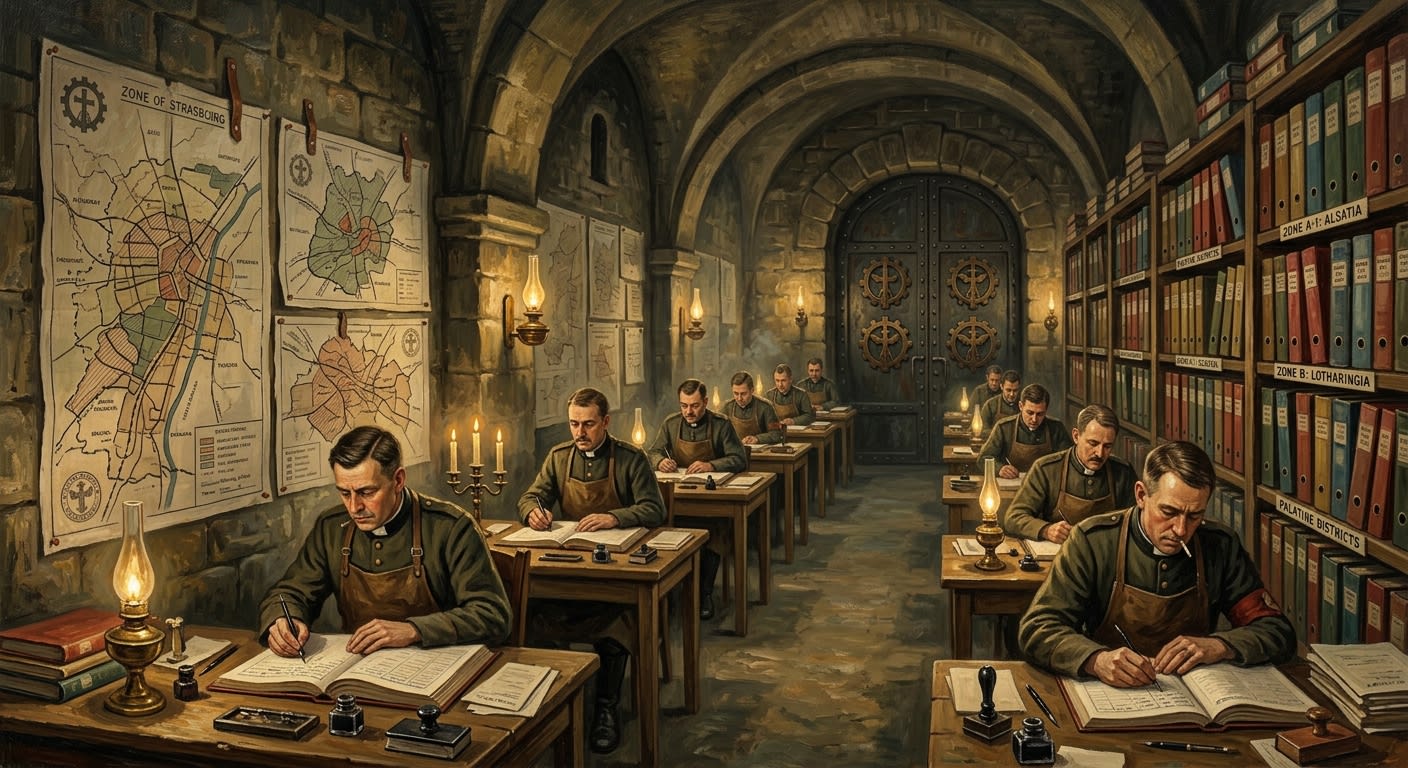
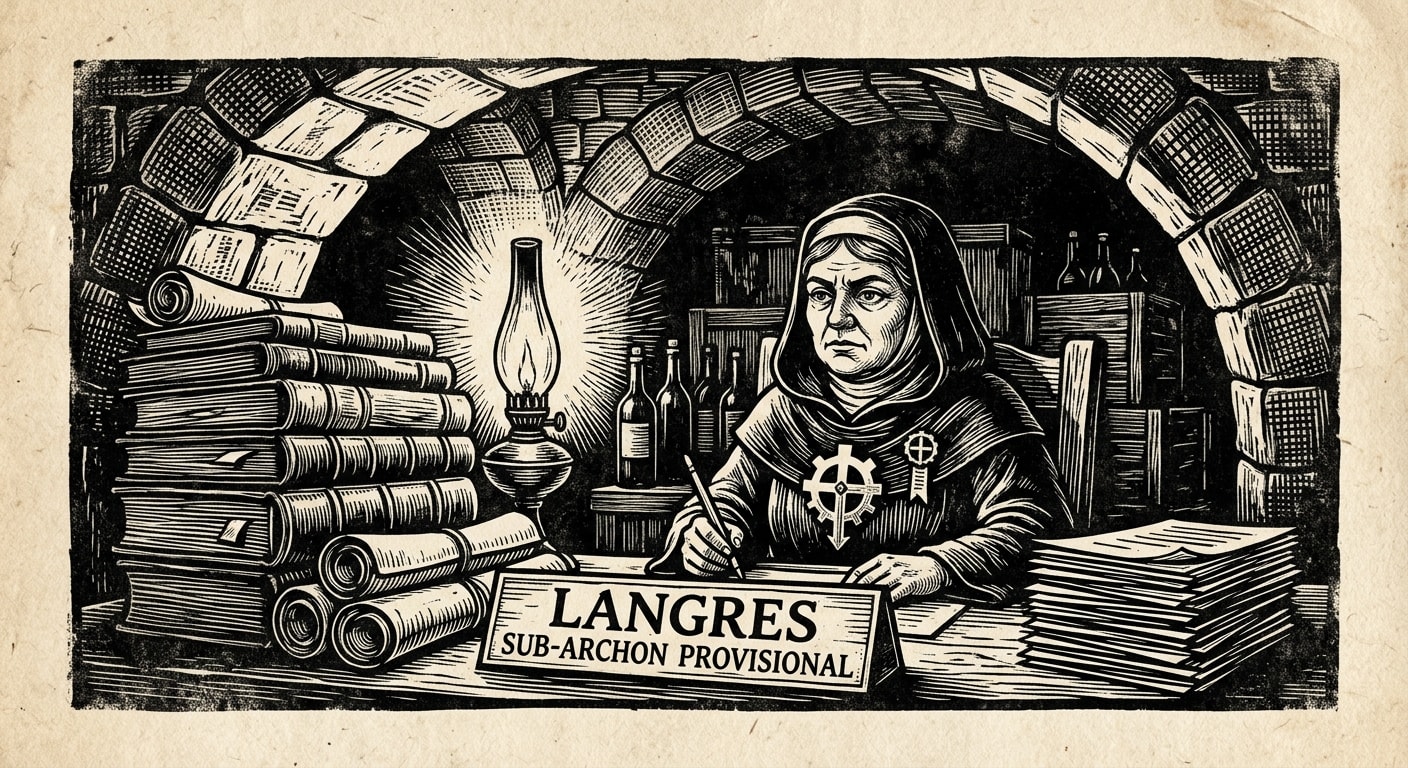
The Bureau's headquarters in Strasbourg occupies the third sub-level of the Palatine Administrative Wing — below the Bureau of Tithes, below the Bureau of Records' tertiary archive, in a series of rooms that were originally designed as a wine cellar and have been only partially converted. The current head of the Bureau is Sub-Archon Provisional Yvette Langres, whose title contains the word "Provisional" because the Bureau of Settlement's head appointment has been "under review" by the Hierarchy since A.S. 194 and the Hierarchy has not yet confirmed whether the position should be elevated to full Archon status or, as the Bureau of Doctrine has suggested, "consolidated with a more theologically consequential portfolio."
#On the Present Condition
The Bureau of Settlement's annual report for A.S. 200 — which I have read, because no one else will — identifies three crises in ascending order of bureaucratic dread.
The first is demographic collapse along the Sagittal Line's rear echelon. Zone 4 and Zone 5 settlements are losing population faster than the Bureau of Conscription can replace them. The young leave for the Heartlands. The old die. The farms are tended by the wives of conscripts and the children of the dead. The Bureau of Settlement's zone assignments assume a population that exists. In seventeen settlements surveyed in A.S. 199, the registered population exceeded the actual population by forty per cent. The Bureau of Tithes continues to collect on the registered figure. The Bureau of Settlement has recommended adjustment. The recommendation is pending.
The second is the growth of unregistered communities along the Pilgrim's Coast and the Hinterland fringe — the organic garrison towns, the squatter villages around ammunition depots, the unnamed settlements that thrive in the jurisdictional gaps between War and Tithes and Settlement. The Bureau's maps grow less accurate with each passing year. The population of the Theocracy is, by the Bureau of Settlement's own internal estimate, approximately twelve per cent larger than the Ledger of Souls records. Twelve per cent of three hundred million is thirty-six million people whom the Synod governs in theory and has misplaced in practice.
The third crisis is the report itself. The Bureau of Settlement produced it, filed it, stamped it, and submitted it to the Hierarchy. The Hierarchy has not responded. The Bureau of Tithes has not responded. The Bureau of War has not responded. The Bureau of Doctrine responded with a single annotation: "Noted."
I add my own annotation, in the margin where I am safest: the Bureau of Settlement is the only Bureau that knows where the Synod's subjects actually are, and it is also the only Bureau that no one listens to. This is the Theocracy's talent in miniature — to build the instruments of knowledge and then, with magnificent consistency, to file the knowledge where it will do the least good.