
#On the Paper Beneath the Feet
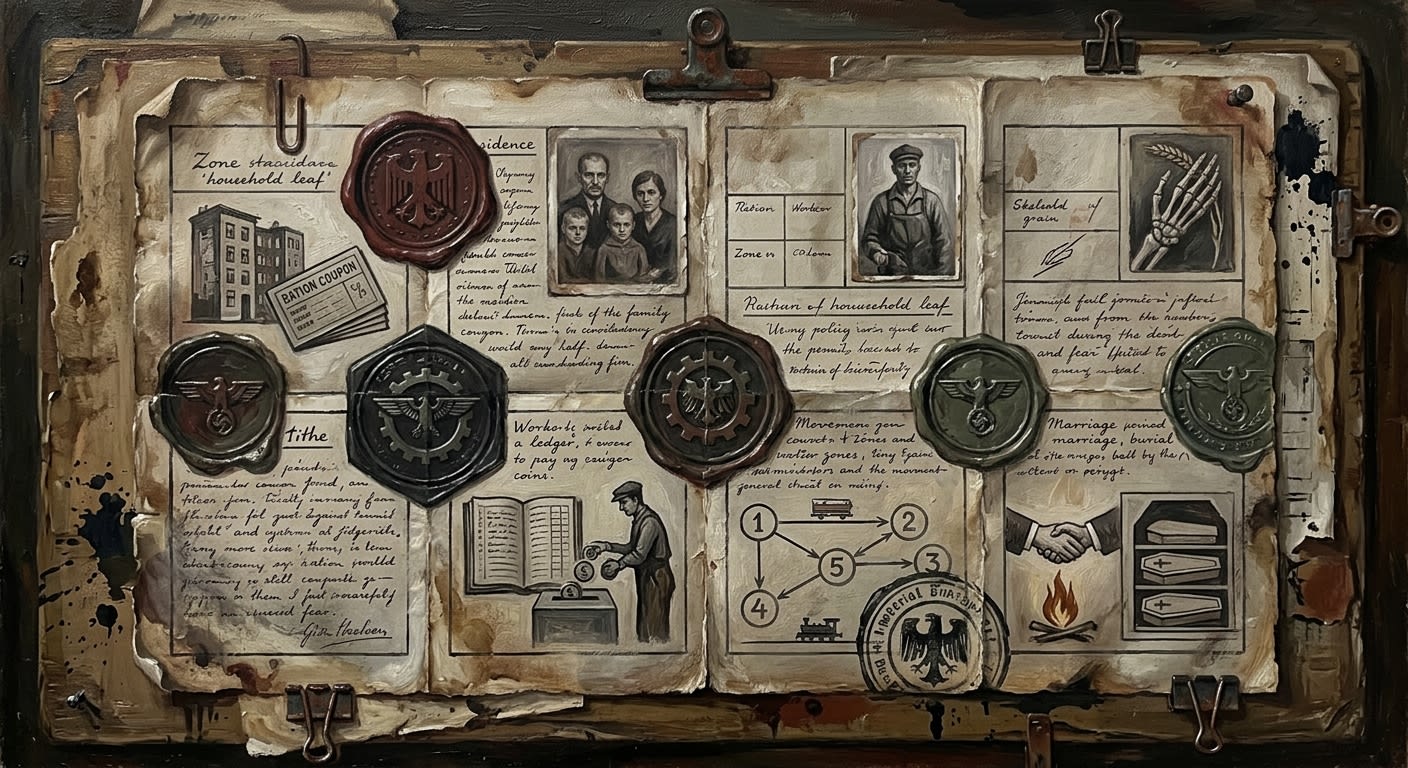
The Zone Permit is the Synod’s smallest continent: a leaf of stamped paper upon which a citizen stands, eats, works, marries, travels, quarrels, dies, and continues to be taxed for a modest interval after burial. It records the zone in which a subject is permitted to exist with legal weight. It binds address to ration, ration to labour, labour to tithe, tithe to conscription, conscription to burial, and burial back to address in the tidy noose by which the Bureau of Settlement keeps Europe from wandering off like an unsupervised idiot.
Glamour does not attend it. No choir processes behind it. No saint, unless very poorly assigned, has ever chosen a Zone Permit as his attribute. The thing is paper, dye, wax, serial ink, Settlement stamp, Records counterline, and a thin strip of civic terror folded into the household box. It tells a gate guard whether you are local, transferable, suspicious, expensive, useful, exempt, dead, or merely awaiting correction.
The permit descends from the rough sleeping chits issued by Kaspar Thenm during the emergency of A.S. 92, when the post-Concordat world arrived at Strasbourg’s doors in columns of hungry bodies and no office wished to count first. Thenm, being a prison warden and a philosopher by harsher means, understood that a body occupies space, space can be numbered, and the numbered body may be moved if sufficient men with sticks agree to the numbering. His chits named barns, sheds, parish floors, road camps, and ditch crews. They were crude. Crudeness has always been the first vestment of Order.
By A.S. 130, after census practice, transit fraud, and the Bureau’s own appetite had done their improving work, the chit became the Zone Permit: residential authority, ration key, tax basis, movement shackle, and birthright complaint.
#On Colours, Zones, and the Lie of Distance
A Zone Permit states where one lives, and more cruelly, the acceptable pressure under which one is expected to remain useful. The western Heartlands receive one category of paper. The forward Heartlands receive another. The Line receives paper so overmarked by War and Records that it resembles a confession extracted with pliers. Zone Five papers exist, when they exist at all, with the nervous smell of a form that suspects the ground beneath it may deny jurisdiction.
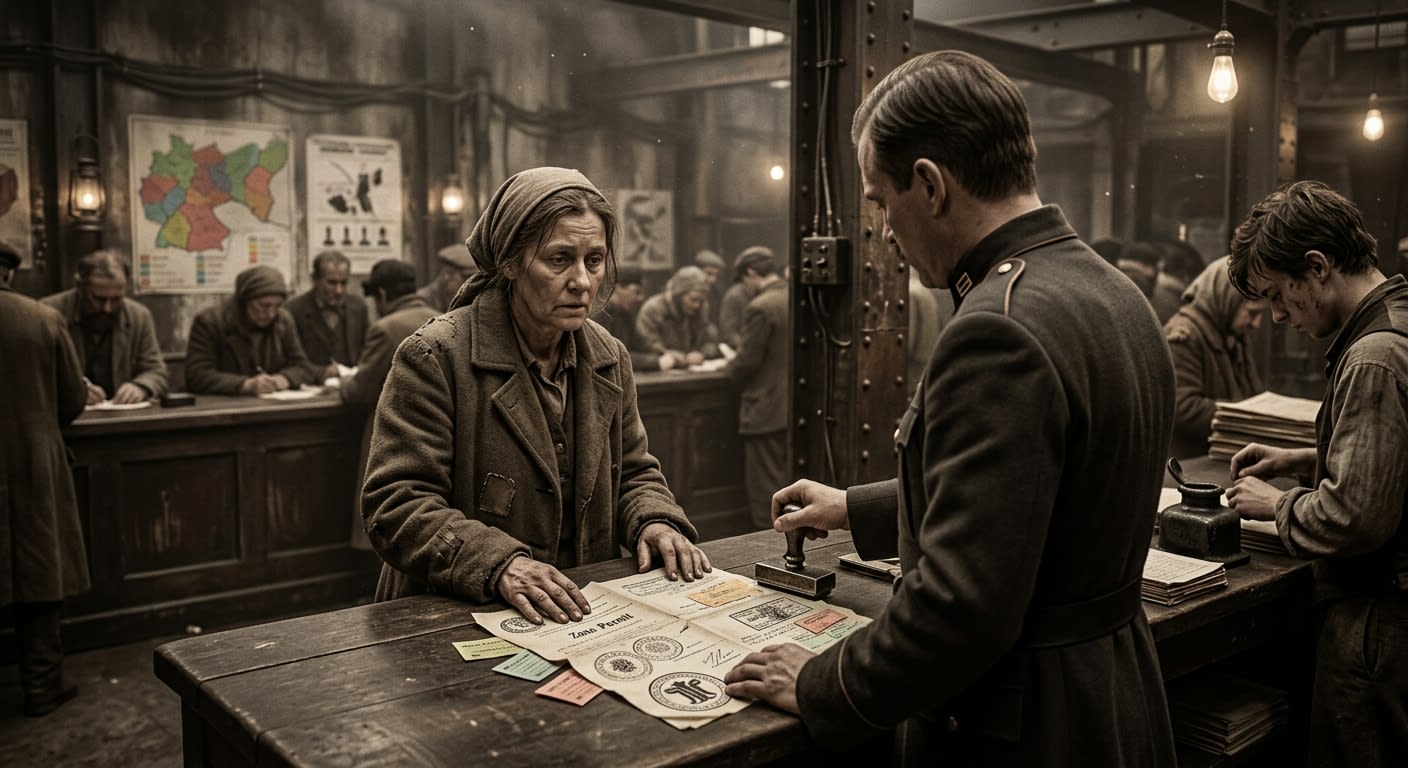
The public school explanation is charming filth: zones measure distance from danger. Zone One is safe, Zone Two industrious, Zone Three forward, Zone Four martial, Zone Five contested, Zone Six condemned, Zone Seven coastal and supply-bound, Zone Eight northern and fractured, with independent territories filed under separate annoyance. The governing explanation is uglier and more useful. Zones measure what the state may demand before breakfast.
A Zone Two permit holder may be asked for factory labour, tithe arrears, household compression, or proof that his cousin is not sleeping in the attic. A Zone Three holder may be asked for carts, sons, grain, boots, and silence. A Zone Four holder may be asked for all of the above while shells provide punctuation. A Zone Five holder, if some mercy or clerical failure has left him holding paper, may be asked whether the paper is a joke, a relic, a forgery, or a burial tag that has learned to walk.
Settlement primers describe zones as “administrative districts arranged by civic function and local need.”
Corrected for internal instruction. Zones are graded permissions to consume, move, reproduce, serve, and be removed. Civic function is the curtain. Local need is the bill presented after the curtain catches fire.
Colours vary by district and by the mood of local print shops. Constantinople’s internal ledgers use White, Crimson, Black, Grey, Blue, Ochre, and Green for its own sevenfold civic compartments, and woe to the Crimson permit-holder found in White without a transit stamp when the sub-Archon has indigestion. Elsewhere, dye bands mark province, hazard class, travel privilege, religious exception, work levy, and review schedule. Illiterates learn colours faster than clerks learn pity.
#On Birth, Marriage, Death, and Other Permit Events
A subject receives his first permit through baptismal registration (Unregistered), assuming the priest, mother, midwife, parish scribe, Settlement clerk, and Bureau of Records subcopy all agree that the infant is present, living, and not already counted elsewhere. The infant receives household attachment before he receives teeth. This is efficient. Teeth wander. Households, in theory, do not.
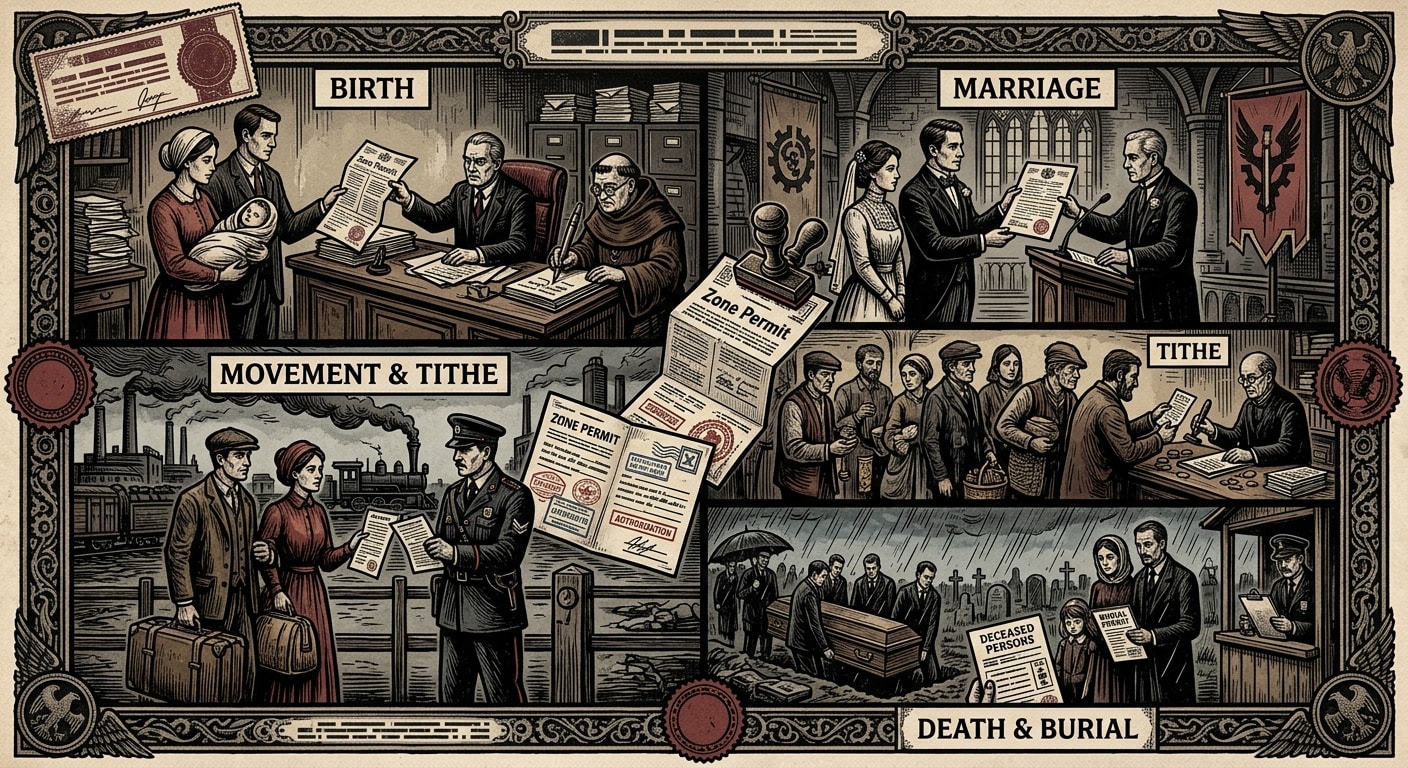
Birth alters ration. Ration alters tithe. Tithe alters audit. Audit alters the father’s temper. The Zone Permit enters family life as quietly as a bailiff behind a cradle. The leaf is stored with baptismal proof, parish mark, and household copy. It follows the child into catechism, apprenticeship, levy assessment, employment register, marriage negotiation, and the great adult privilege of standing in the wrong queue for the right reason.
Marriage requires Zone-matching verification or a licensed mismatch. Two citizens of compatible permit category may marry after ordinary impediments: consanguinity, debt lien, penance restriction, prior spouse, current absence misfiled as death, and the usual clerical pleasures. Two citizens of incompatible zones require review. The Bureau dislikes marriage as a private arrangement because it moves beds, tools, wombs, debts, and kitchen authority without asking permission loudly enough.
Death cancels the permit, releases the address, revises the household, and begins the small cruelty of vacant space. The widow receives a revised household composition copy, often before grief has had time to sit down. The corpse cannot be routed to ground until Settlement has acknowledged the vacancy unless plague, shelling, or local common sense has temporarily defeated stationery.
The permit pretends to record life. It records the state’s angle of approach to life. This distinction comforts nobody and governs everyone.
#On Transit Writs and the Sin of Walking
To cross from one zone to another, the citizen requires a Transit Writ (Unregistered): origin stamp by Settlement, countermark by Records at each checkpoint, surrender at destination, and all intervening papers preserved from rain, theft, fire, suspicious cleanliness, and children. The writ is valid for thirty days. Extensions require triplicate application. Processing time is no more than twenty-one working days, excluding feast days, fast days, bell-days, Purity review days, War alerts, and any Tuesday that has acquired spiritual complications.
In practice, a thirty-day writ and a forty-day extension process produce the intended miracle: most people stay where they are.
The Zone Permit and the Transit Writ are often confused by foreigners, criminals, and young soldiers who have not yet been taught that paper breeds by touching other paper. The permit is standing. The writ is passage. A man may have standing without passage, passage without safe standing, standing that lapses during passage, or passage into a district where his standing becomes embarrassing to everyone armed. At Latchford, these distinctions feed clerks, extortionists, Queue Shepherds, minute-sellers, and one entire class of philosophical vermin who will explain, for a fee, why your papers are almost valid.
The Permit Directorate perfected the broader art of sold delay after A.S. 102, but the Zone Permit supplies the deeper sacrament. The Directorate prices waiting. Settlement authorises existence. Records keeps copies. War decides whether the distinction matters under shellfire. Tithes collects from whichever version survives.
A Directorate handbook once stated that “a valid permit guarantees orderly access to lawful passage.”
Corrected. A valid permit guarantees eligibility to request orderly access, provided no superior queue, hazard closure, escort shortage, rate revision, identity dispute, bell delay, blank-stock shortage, or officer’s digestion intervenes. The handbook remains in use after deletion of the word “guarantees.”
#On Assignors, Revocation, and Denial Wax
The permit’s visible priest is the Assignor, Settlement’s field officer: map-carrier, address-fixer, permit-revoker, and walking proof that hatred may be earned without personal charisma. An Assignor carries blank leaves, denial wax, population ledger, measuring cord, district map, and escort forms. He can designate a dwelling, correct a boundary, suspend a permit, recommend reassignment, and ruin a household while maintaining excellent penmanship.
Revocation is the sharpest act. A revoked permit removes legal ground. Rations pause. Employment contracts sour. Marriage records demand review. Children in school become flagged. Debts, with that miraculous theological stamina possessed only by debt, remain active. In Zone One, revocation is humiliation and a queue. In Zone Four, it may be exposure. Near Bastion-Brest, a person without valid paper becomes a suspicious moving object, and artillery has never been praised for pastoral discrimination.
FIELD REVOCATION REPORT — ZONE FOUR RIDGE SETTLEMENT, A.S. 196 Twelve household permits suspended under structural hazard designation. War escort delayed. Purity escort declined predicate. Weather closed west road. Transport arrived after █████████████████████████████████████. Settlement correction entered: households no longer resident.
Denial wax is traditionally grey-red, though local economies produce variations sufficiently ugly to suggest moral competition. Approval wax smells of resin. Suspension wax smells of lamp heat. Denial wax smells, according to workers, of cold bread and old fear. The Bureau denies additives. The nose retains jurisdiction.
A good Assignor fears revocation. A bad Assignor enjoys it. The Bureau promotes both if the shelves remain orderly.
#On Fraud, Expiry, and the Black Art of Remaining Present
Permit fraud is the folk theology of the governed. Families sand old wax and press new edges with warmed spoons. Widows keep dead husbands attached to household rolls until the ration difference is noticed. Fathers register sons as apprentices in safer zones while the sons dig in forward mud. Workshop masters rent attic corners to cousins who exist as “tools under cover” on inventory lists. A tavern stable may contain three horses, nine men, and one officially stored plough that snores.
The Bureau calls this deception. I call it human arithmetic under pressure.
The Black Ledger and lesser cellar offices trade in forged dye bands, borrowed origin stamps, corrected birth leaves, duplicate vacancy holds, and the prized object known as a clean orphan transfer. Clean paper is expensive because dirt tells stories. Dirty paper is expensive because dirt tells plausible stories. The true master forger understands not beauty but fatigue: a checkpoint clerk at fourth bell will accept a smudge that flatters his desire to finish the line.
Expiry is fraud’s drearier cousin. Permits expire through missed renewal, household contradiction, zone redrawing, absence review, unpaid fee, unresolved marriage, suspected death, confirmed survival after suspected death, and clerical mood. Citizens learn to renew before renewal, appeal before denial, and keep one cousin in a registry office if Providence has been generous.
The Synod denounces permit fraud because fraud imitates state power without paying proper reverence to the original thief.
#On Redrawing and the Violence of Lines
The permit’s cruelest season is redrawing. A district line moves; the paper changes; the house remains; life becomes illegal in place. Settlement speaks of demographic adjustment, pressure relief, category harmonisation, and residential correction. The citizen hears: pack.
The A.S. 188 Administrative Redrawing taught this lesson with rare bureaucratic purity. Constantinople’s eastern terraces, the Hintermark, and seventeen rear-echelon settlements were moved on paper and then, in that tiresome material sequel that always surprises central offices, moved in flesh. Forty thousand civilians in the Hinge received fourteen days’ notice. The pamphlet supplied to them, On the Joy of Service Through Relocation, deserves preservation in a reliquary of bad faith. I have read it. I would rather listen to a ration inspector flirt.
The cascade ran westward: one neighbourhood displaced another, which displaced another, until three thousand families came to rest in a farmland strip that belonged to neither zone because of an A.S. 140 survey error. War and Settlement spent months arguing custody. The families spent the same months learning that jurisdictional ambiguity leaks through roofs.
Public summaries of Mandate 188-A refer to “residential rebalancing along approved civic axes.”
Corrected. Mandate 188-A moved people faster than grief, slower than hunger, and with less foresight than a rat leaving a granary fire. The axes were approved. The suffering was incidental, which is the Bureau’s most durable excuse.
Redrawing creates ghosts with addresses. A person may hold yesterday’s lawful permit in a street corrected this morning. A bakery may keep ovens in Zone Two and counter in Zone Three. A widow may sleep in a house whose threshold migrated overnight into a levy bracket. The line moves. The body must follow, pay, appeal, or vanish beneath a more convenient category.
#On the Present Authority of the Permit
As of A.S. 201, the Zone Permit remains universal in Synod territory, disputed at the edges, forged everywhere, feared most by those who understand it, and ignored only by people with enough rank to call exemption by a nobler name. The British Crown does not accept Synod permits except when profitable. The Netherlands treats them as negotiable irritants. The Fractured North burns some, charms others, and returns a few with stamps no Bureau recognises and several guards obey anyway.
On the Line, permit discipline is strained by refugee flow, conscription, supply corridors, organic garrison towns, dead addresses, and the living habit of sleeping wherever shells have not yet arrived. In the Hinterland, farms are zoned agricultural while War eats the harvest and Tithes praises productivity. On the Pilgrim’s Coast, settlements grow around forts faster than Strasbourg can invent categories. Beneath Constantinople, warrens hold people whose zone, according to official maps, contains no people. Settlement has proposed regularisation twelve times. The twelfth proposal recommended continued monitoring, which is Bureau language for sitting on the lid and hoping the box stops scratching.
The permit survives because every Bureau needs it. Settlement needs standing. Records needs identity. Tithes needs assessment. War needs quotas. Purity needs unlawful movement visible. Mercy needs household lists. Pilgrimage needs licensed departures. Doctrine needs the whole machine described as providential rather than carceral, and so here I am, gilding the shackle with correct syntax.
Carry your permit dry. Keep the wax from heat. Renew before the bell. Marry within category unless love has brought a lawyer. Report births before the child can crawl into a different bracket. Report deaths before the bed does. Never argue with an Assignor unless you have witnesses, bread, time, and a door behind you.