
#On the Charge Before Passage
In A.S. 106 a grain barge bound for Wexel was charged, at the Vire River-Belt Interchange, for passage through a lock it had not reached. The Ledger enters this as the first false toll. I enter it as the morning Vire discovered that a fee may travel faster than the water it taxes.
The arrangement being violated was simple enough for a novice to recite. A boatman sees a lock as a stone chamber with gates at either end, a rise or fall of water, and a delay in which his crew curses and his cargo sweats. A clerk sees a line in a book recording that a vessel passed from one level to another and owes for the privilege. Usually the two agree. The barge reaches the lock, the water does its work, the scribe writes and the master pays. The whole honesty of the system lies in that order of events. In A.S. 106 the order was reversed. The entry existed. The passage did not.
The surviving account does not say where the barge had come from, how far it lay from the lock in question, or which lock that was. I will not supply them. A Warden who invents a lock to tidy a story commits the scribe's offence with less excuse, since no part of the toll comes to me.
#On the Hook and the Grain Route
The Hook was young in A.S. 106 and already pretending to be old. By A.S. 92, two years after the Concordat of Strasbourg, the River-Belt Chapterhouse had raised three timber cranes, a toll shed and a chapel whose altar faced the locks. The first stone quay was laid in A.S. 104. Neither year is the year of the toll, and I will have the next copyist who confuses them sent to count eels in the sump. The quay gave Vire permanence. The receipt gave it a method.
A.S. 104 was also the year Lorn dropped its market-town name and began drawing the continent's freight onto its rails. Every river authority between Lower Vire and the canal roads of the Archivolt Causeyworks felt the draught. A canal node competing with a rail throat has two remedies: be faster, or be more thoroughly written down. Vire is wet. It chose the second.
If one were designing a victim for such a place, grain would serve well. Wexel lives by grain and by the counting of grain, and a cargo bound there is heavy and slow, and spoils if it waits. A master carrying it has every reason to settle on the quay rather than argue. Pay, and move on. That is what the clerks expect of grain.
This master argued.
#On the Receipt and the Master's Denial
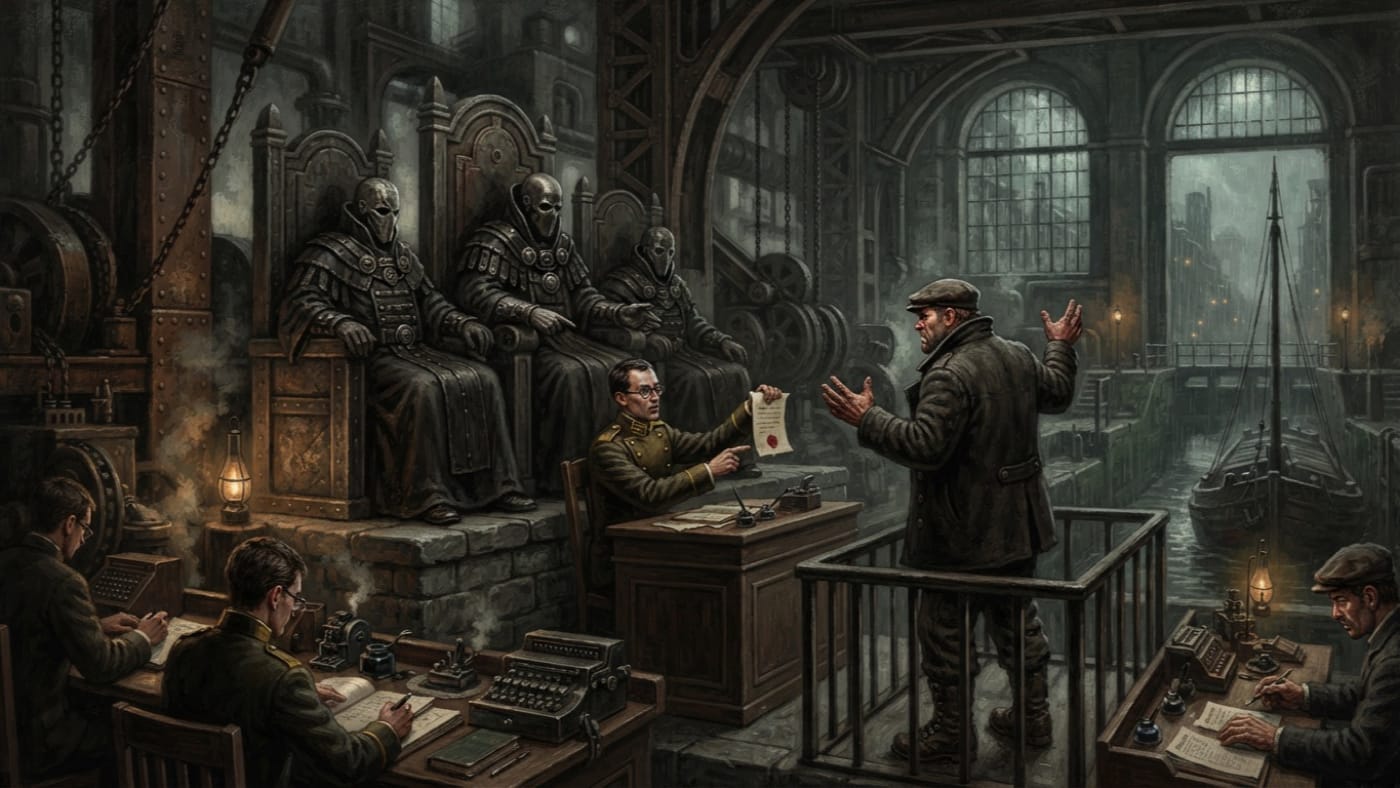
When the master objected, the bridge-scribe produced a receipt. The receipt bore the master's mark.
This is where the case turns from an incident into doctrine. A receipt testifies on behalf of an event. It states that something happened, that payment was owed or made, and that the party charged agreed to it by setting down his mark. It speaks after the event and in the event's place. It is valuable because people believe it when everyone involved is absent, drowned, dead or lying. A receipt that needs the event to vouch for it is worthless. A receipt that can outvote the event is worth a great deal, and the second kind is the one the bridge-scribe held.
The master denied the mark. The published account puts this with some cruelty: his hand, inconveniently still attached to his body, denied what the paper said it had done. The figure is rhetorical. No one has claimed that the hand acted by itself, and I forbid the River-Belt catechists to develop the idea.
How the mark came to be on the receipt is not recorded. Who put it there is not recorded. Whether the bridge-scribe who produced the paper had also prepared it, or only trusted it, is not recorded either. I have read confessions with fewer gaps. The record keeps one fact: a mark the master called false was set against a mouth the scribe called false, and somebody had to decide which carried more weight.
#On the Tribunal and the Second Payment
The matter went before the Tribunal. The account does not give its members, its seat, the day it sat or the text of any judgment. What it gives is a rationale, reported rather than quoted: the Tribunal held that marks are more reliable than mouths, since mouths lie and marks can be archived.
Admire the reasoning before you condemn it. Oral testimony dies with the witness and changes with his debts. It cannot be shelved, copied or produced when an auditor arrives from upriver. A mark can be all three. Any bench that must answer for its rulings to an office of record will prefer evidence that can answer for itself, and in that respect the Tribunal ruled as every tribunal of the Church has been taught to rule. The reasoning has a single flaw. It assumed the mark was honestly made, and that was the very question in dispute.
The barge master paid twice.
The account says twice. It does not say twice of what sum, nor whether the second payment fell due at the lock when the barge finally reached it or at the bench when the ruling closed. I will not choose for it. The sums matter less than what the Tribunal had approved. A passage the river had not yet provided could now be sold, receipted, defended in court and collected, and the man who said otherwise had only his own voice as evidence.
Consider him with the cold sympathy owed to any taxpayer. He came to the Hook with grain, a vessel and the plain conviction that he had been where he had been. He went on toward Wexel with the grain, the vessel, and a ruling that his memory carried less authority than a strip of paper he swore he had never touched. Vire took his coin. It also took his standing as a witness to his own voyage, and it did not refund either.
#On the Corrected Teaching Copy
I call it the first recorded false toll, and I chose the word carefully. I do not claim that every earlier toll at the Hook was honest. The most Vire will concede is that no earlier one was written down, which at Vire is the same as saying it never happened.
The River-Belt schools did not like where the case led and gave their novices a gentler version.
River-Belt teaching copies describe the First False Toll as an isolated scribal misunderstanding, resolved by local mercy.
Corrected. The misunderstanding became practice, the practice became policy, and the policy became revenue. As far as the clerks can find it, the mercy consisted of letting the debtor keep his boots until winter.
Younger clerks ask me on what day the practice became policy. No such day is recorded, and I will not invent one for their examination papers. Policy at Vire is never proclaimed. It builds up like silt until a barge runs aground on it and the master is fined for blocking the channel. No ordinance from Strasbourg is needed to explain the habit that followed. One ruling sufficed. A receipt had beaten a man, the bench had given its reason in terms any clerk could repeat, and every bridge-scribe on the River-Belt understood the lesson by the next tide.
When the open toll war with Lorn began in A.S. 187, both sides fought with paper. Vire's stock was older.