
#On the Nature of the Place
"Procedure is mercy. Mercy is sound." — Palatine Yard Command Inscription, Main Freight Arch
I have inspected thirty-seven Synod installations in my tenure as Warden. I have stood in cities that stink of blood, of relic-ash, of the particular despair that collects in refugee camps like water in a heel-print. Lorn stinks of iron. Iron and brake-smoke and hot machine oil and the acrid bite of coal dust, and beneath all of it — as an undertone, the way a bass viol sits beneath a choir — the smell of ink. Because Lorn is, at bottom, a filing system that happens to contain two hundred and ten thousand human beings and twelve converging rail lines, and the filing system came first.
The Queue Road delivers the continent's freight to the threshold of the forward zones. The Rope-Ferry Chain hauls it across the rivers. But the thing that converts the raw mass of Synod logistics — the grain, the munitions, the conscripts, the relic-payroll, the stamped paper, the sealed crates of saint-bone — into directed motion is this city. Lorn sits at the convergence of three supply corridors on the Heartlands fringe, where the safe territories end and the forward zones begin, and it does to cargo what the Bureau of Records does to citizens: assigns it a number, a destination, a hymn, and a schedule, and sends it east to die on time.
#On the Founding and the Silent Derailment
"The schedule must never look wrong." — Yard Provost's Manual, Chapter One, Line One
Lorn was born A.S. 104, fourteen years after the Concordat, when the Bureau of War required a switching point between the three corridors that fed the Sagittal Line. An older market town occupied the junction — a pleasant enough settlement of grain merchants, blacksmiths, and a small Benedictine chapel. The Bureau requisitioned the town on a Tuesday. By Friday the chapel had been converted into a dispatch office. By the following month the grain merchants had been absorbed into the ration convoys and the blacksmiths were forging switch-points instead of ploughshares. The market town's name vanished from the Ledger; the word Lorn appeared — an old dialect term meaning "lost" or "given up," which the Bureau of Doctrine later interpreted as "surrendered to divine purpose," a reading that satisfies no etymologist alive.
The first tracks were laid on slag fill. The first switches were hand-thrown by crews of twelve. The first manifest was a single page, handwritten, listing seven wagons of flour bound for Bastion-Constantinople. By A.S. 110, the year of the First Continental Levy, the single page had become a basilica full of clerks, the seven wagons had become seven hundred departures per day, and the twelve-man crew had become a guild, a union, a cantor corps, and a tribunal — because the Synod cannot build a tool without building an institution around it, and the institution cannot exist without building a court to adjudicate its own sins.
The first catastrophe arrived in A.S. 112 — eight years after founding. A night crew of forty-one men routed a munitions train onto a siding that, according to every manifest, did not exist. The train entered the siding at full dispatch speed. The siding ended at a slag wall. None of the forty-one survived. None of them screamed. The investigation found that every switch had been thrown correctly, every measure sung to specification, and every manifest stamp genuine. The siding was real. The manifests said otherwise. Bureau of Records filed the incident as "terrain reclassification error, non-recurring."
The Bureau of Bells drew a different conclusion. Bell Marshal Gerren Stahl — the first to hold the title — proposed that no switch should be thrown, no signal given, no dispatch ordered without a voiced hymnal measure sung aloud by a certified cantor. The logic was impeccable in its ecclesiastical way: if procedure is sung, procedure cannot be falsified without audible evidence. If every action has a hymn, every failure has a heresy. The Yard accepted. The cantors arrived. Within a season, Lorn had become the only city on the continent where industrial accidents were treated as doctrinal offences, which is to say: the same as everywhere else, but with better paperwork.
The dead of the Silent Derailment were logged, sanctified, and filed. Their names appear in the Manifest Basilica's memorial register, which is consulted annually, revised quarterly, and — according to three separate whistleblowers whose names I cannot publish because the Bureau of Shadows has classified them — edited whenever the names become inconvenient.
Earlier dispatches attributed the Silent Derailment to sabotage by the Rationalist remnant cell known as the Unmeasured. This attribution was incorrect.
The Bureau of Doctrine has determined that the incident resulted from "accumulated procedural drift in an unsanctioned tonal environment." The Unmeasured were executed regardless, on the grounds that their existence constituted a separate offence. The Bureau is nothing if not efficient.
#On the Geography and the Yard
"Twelve throats. One schedule. Two hundred thousand hostages." — Switchmen's Union broadsheet, confiscated A.S. 198
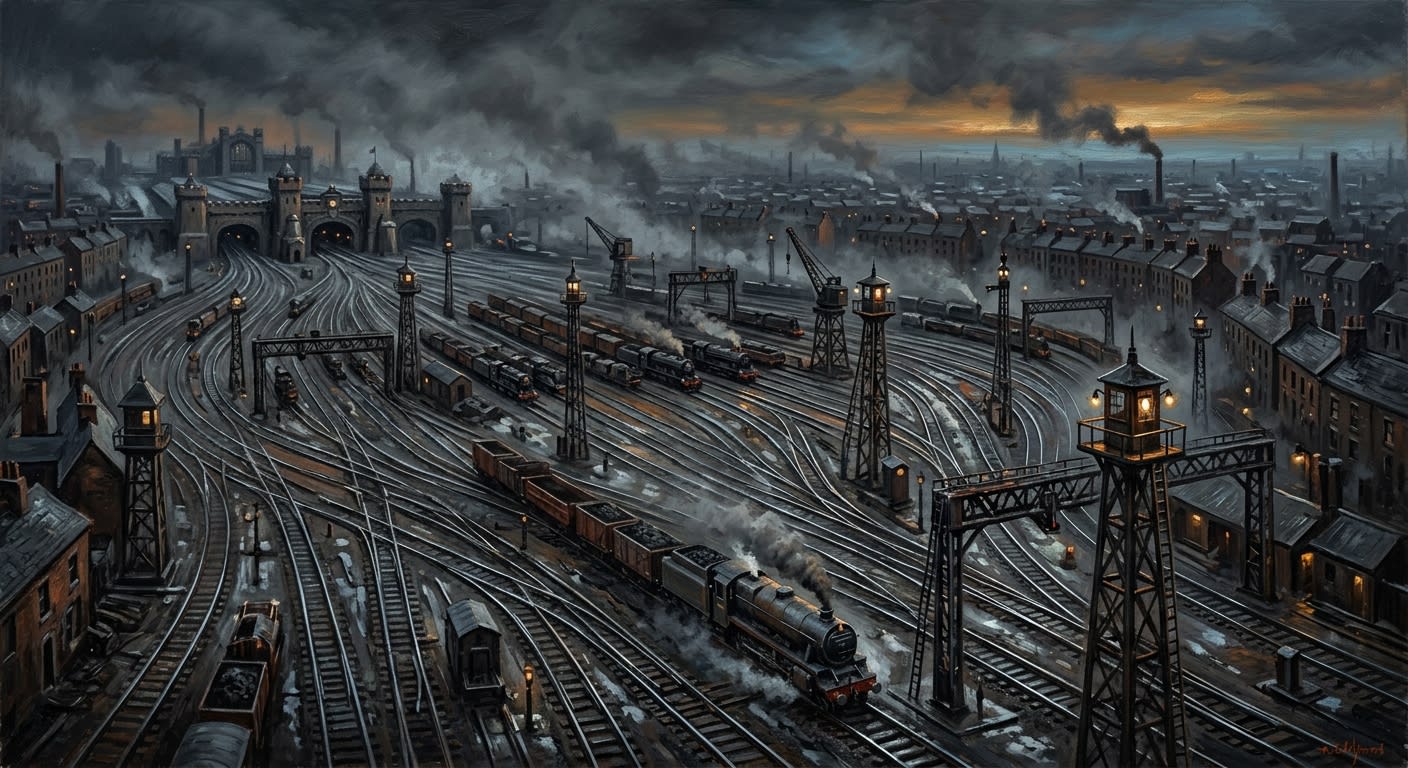
Lorn sprawls across a basin of slag berms and rail-cut gullies on the Heartlands fringe, where low rolling hills of industrial waste form a grey amphitheatre around the central rail sea. The Palatine Yard — the switching fields themselves — occupies the basin floor: a vast iron plain of points, crossings, shunting sidings, and signal towers stretching three miles east to west and one mile north to south. Twelve converging lines enter the yard through three fortified approaches — the Palatine Gate to the west, the Tri-Span Bridge to the south, and the Needle to the east. Every rail line on the continent that carries freight toward the Sagittal Line passes through this yard, or through a yard that answers to this yard, or through a yard that pretends it does not answer to this yard but whose manifest clerks know better.
The city is ringed around the yard like a congregation around an altar. Catwalk grids lace the upper levels. Crane decks cast shadows like gallows. Below the surface, the Hush Tunnels thread through the slag fill — service corridors from the original construction, expanded by unofficial hands into a warren of passages that the Manifest Basilica denies exist with the same conviction that the Bureau of Shadows denies itself.
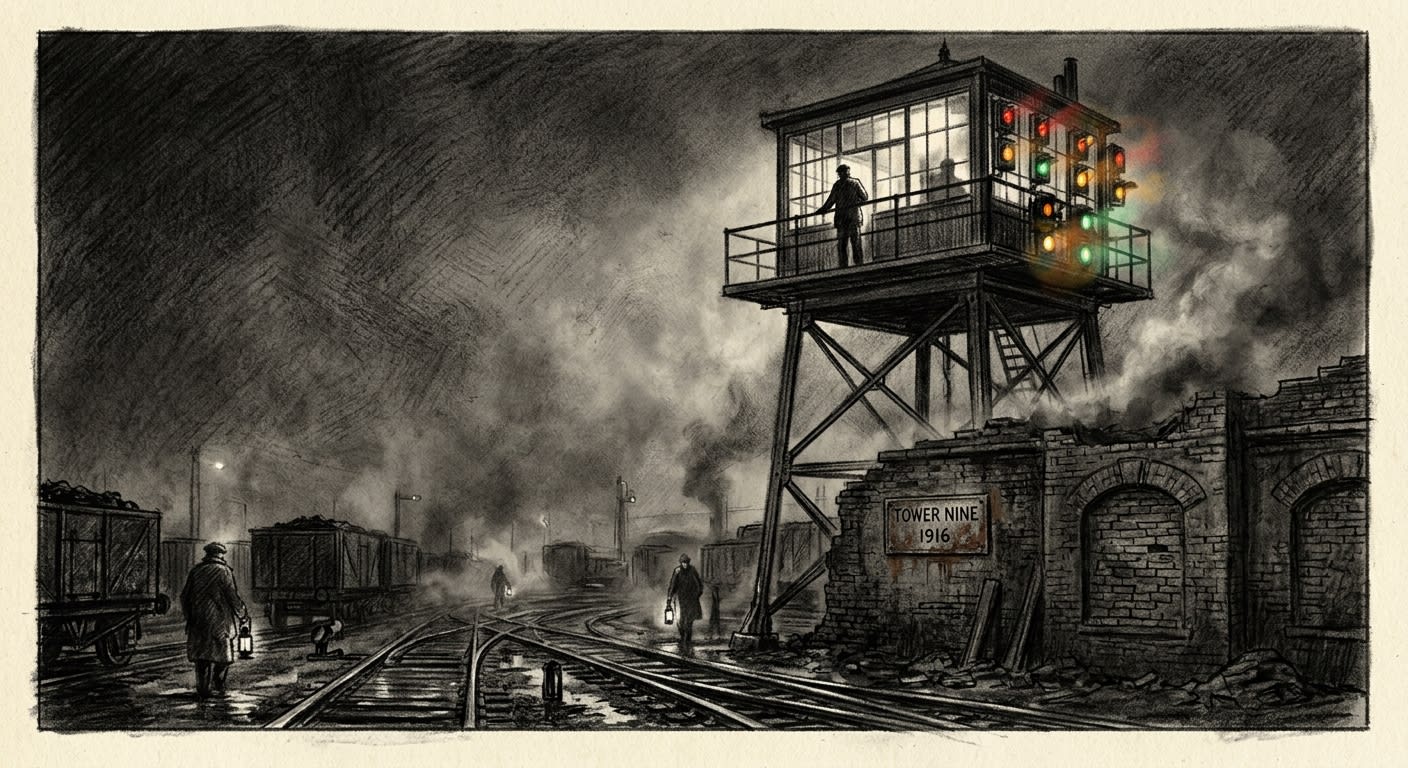
The districts stack outward from the yard in concentric rings of diminishing importance and increasing desperation. The Manifest Basilica — Lorn's administrative cathedral — occupies the western approach, a building of soot-brick and riveted plate that smells of ink, glue, old paper, and the particular anxiety of clerks who know that a stamping error can be reclassified as heresy. Cantor Walk runs along the northern perimeter, a corridor of guild halls where the bell-line routing cantors maintain their instruments, their hymn codes, and their magnificent contempt for anyone who cannot hold a measure. The Switch-Towers rise from the yard floor — elevated control cages of iron and glass where the tower callers sit above the points, throwing switches by bell-order, eating cold meals, and watching the yard with the focused attention of men who know that a missed count has killed before and will kill again.
Cinderrow Wards house the workers — two hundred thousand of them, give or take, in tenements of soot-brick that smell like boiled cabbage and coal. The Payroll Spur Vaults occupy a guarded siding on the eastern edge: sealed cars of relic-payroll, munitions consignments, and crates bearing stamps that no manifest clerk is permitted to read aloud. And the Scrap Basilica — the shipbreaking yards where condemned rolling stock is cut apart, melted, reshaped, and blessed back into service — sprawls across the southern slag berms, a cathedral of rust and acid and the particular theology that holds all iron sacred if notarized.
The weather in Lorn is industrial. Dawn brings bell fog — a mingling of steam and coal haze that muffles sound and turns the yard into a grey ocean studded with tower-lamps. Lightning favours the iron lattice of the switch-towers with a regularity that the Bureau of Rites has classified as "meteorologically consistent with divine attention." Frost-lock freezes the points in winter. Grease fires bloom in summer. The wind carries coal dust that settles on every surface, including lungs, which is why brake-smoke lung kills more Lorn workers than accidents, though accidents are logged and lungs are not.

#On the Manifest Basilica and the Paper the Creator
"If it isn't stamped, it didn't move." — Manifest Basilica inscription
The Manifest Basilica is the administrative heart of Lorn: a building that processes more paper per day than the Bureau of Records annex in Strasbourg — a claim the Bureau disputes, though the Bureau's own filing system cannot produce the counter-evidence because it was, at some point, misfiled. Every departure, every arrival, every reroute, every delay, every cargo swap, every personnel transfer, and every accident within the yard passes through the Basilica's stamping halls. Seven hundred clerks work in shifts that rotate by bell-order. Each clerk processes between forty and ninety manifests per shift. Each manifest requires between three and eleven stamps depending on cargo classification. A misplaced stamp delays a train. A missing stamp cancels one. A forged stamp — a forged master-manifest — is treason, punishable by the Yard Tribunal with a severity that makes the Bureau of Purity look gentle, because at least the Bureau of Purity destroys heretics for theological reasons, whereas the Yard Tribunal destroys forgers for disrupting the schedule, and the schedule is the closer god.
Prefect Halden Wry commands the Basilica. He is a thin man whose hands are permanently ink-stained and whose smile appears exclusively when a stamp lands on paper with satisfactory force. He has held the position for eleven years. In that time, manifest accuracy has risen to ninety-seven percent, clerk turnover has risen to forty percent annually, and the number of "corrected manifests" — documents retroactively revised to match outcomes that did not match predictions — has risen to a figure the Bureau of Records has classified as "statistically appropriate." Wry does not forge manifests. He corrects them. The distinction, in Lorn, is the difference between a promotion and a siding.
#On the Bell Marshal and the Sung Procedure
The Cantor Corps of Lorn is the Bureau of Bells' finest industrial installation — and its most controversial. Bell Marshal Sister-Calder, whose voice sounds like a crosscut saw dragged across a church bell, maintains a corps of one hundred and twelve certified cantors who regulate every action in the yard by sung measure. A switch cannot be thrown without a voiced hymnal count. A signal cannot be given without a tonal authorization. A departure cannot proceed without a dispatch litany sung by the full platform crew — route code, cargo blessing, and procedural invocation rendered in four-part harmony at a volume sufficient to be logged by the nearest tower caller.
The theology is straightforward: sound is truth, silence is error, and error kills. The practice is rather more tangled. A cantor who misses a measure is responsible for whatever follows — a derailment, a misroute, a collision. The responsibility is not metaphorical. Cantor Corps disciplinary records show fourteen cantors dismissed for "procedure lapse" in the past three years; nine were reassigned to forward trench positions; two were charged with manslaughter by the Yard Tribunal. The remaining three are listed as "transferred" to a facility whose name appears nowhere in the Bureau of Bells' published registries.
The cantors and the switchmen despise each other with a purity of sentiment that would impress Morwen herself. The Switchmen's Union — called "The Thrown Hand" — holds that its members throw the switches, know the yard, and bear the risk, while the cantors merely sing. The cantors hold that the switchmen are interchangeable labour while the voice is doctrine. Both are correct. Both are also trapped, because the Yard Palatine needs both of them, and the Yard Palatine's principal management technique is ensuring that they hate each other too much to cooperate against him.
#On the Needle and the Chokepoint
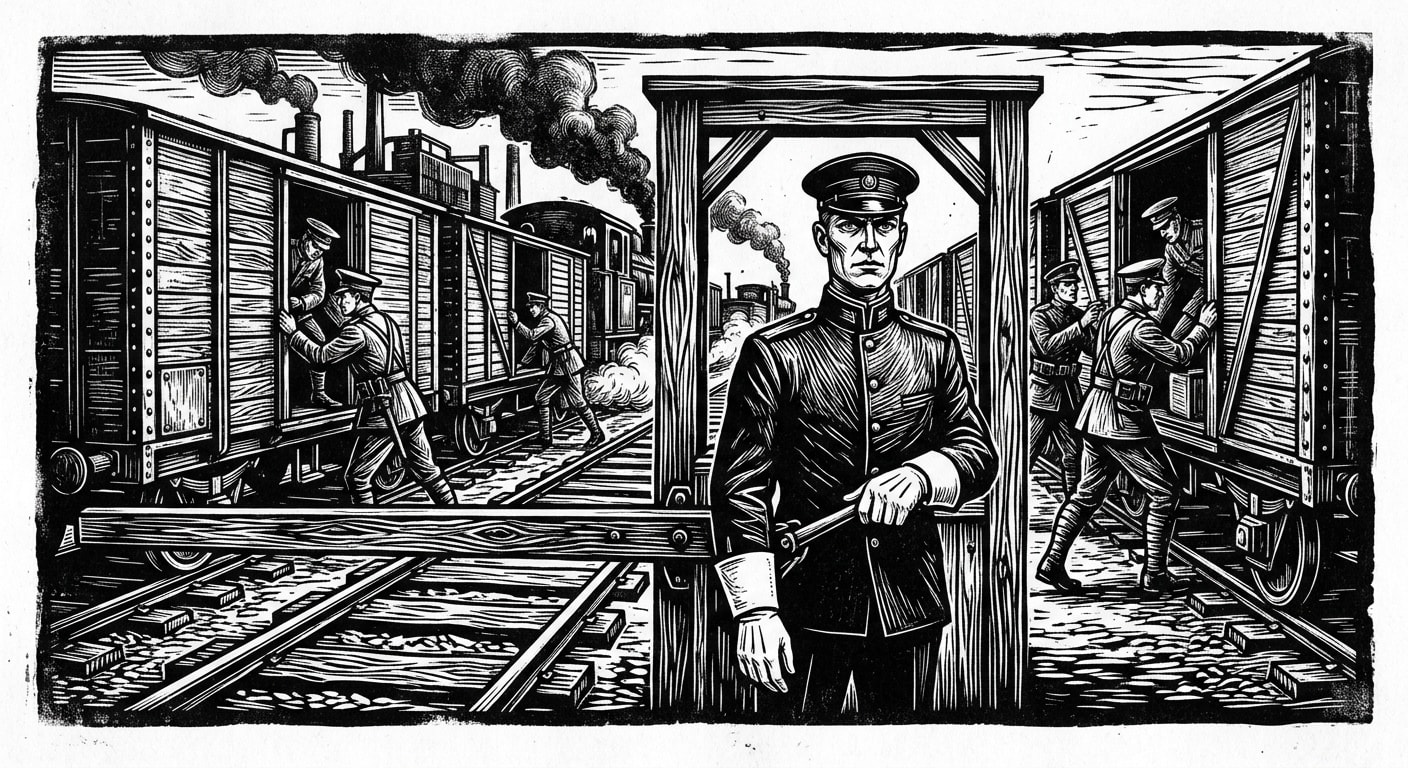
The Needle is the eastern exit — the single-track inspection gate through which every eastbound train must pass before reaching the Sagittal Line corridors. One line. One gate. One chokepoint that controls the entire city's rhythm.
The logic of the Needle is military: a single controlled passage makes inspection absolute. Every seal is checked. Every manifest is verified. Every cargo car is opened, searched, and resealed by provost teams who answer to Yard Palatine Kessel directly. The practical consequence is a bottleneck that backs up traffic through the entire yard, creating delays that cascade westward through the corridors like a stone dropped into standing water. Priority windows — the timed slots that allow specific trains to pass through the Needle without full inspection — are the most valuable currency in Lorn, worth more than coin, more than ration chits, more than the route tokens the Switchmen's Union trades like scripture. A priority window is time. Time is freight. Freight is war. War is everything.
Yard Palatine Odrin Kessel controls the Needle. He is a man of immaculate gloves and careful speech who has never been observed stepping on gravel — a peculiarity his staff attributes to fastidiousness and his enemies attribute to an unwillingness to stand on anything that might shift beneath him. He has commanded Lorn for nine years. In that time, the Yard's throughput has increased by eleven percent, its accident rate has decreased by three percent, and the Payroll Spur Vaults have reported "losses" totalling a sum that three auditors have independently calculated to exceed the annual military budget of a medium-sized bastion.
Kessel does not steal. Kessel reroutes. The distinction is the same one that separates a canal from a theft of river — the water goes where it is told to go, and if it happens to irrigate fields that do not appear on any cadastral survey, the water is innocent and the fields are blessed.
#On the Hush Tunnels and the Under-Schedule
Beneath the Palatine Yard, in the old slag-fill foundations where the market town's cellars were buried under industrial waste a century ago, run the Hush Tunnels — a network of service corridors, smuggling routes, and unofficial passages that the Manifest Basilica denies, the Yard Palatine ignores, and the Switchmen's Union uses.
The tunnels follow no official map. Their markings — chalk symbols, wax scratches, rope knots — change overnight. Routes that were safe yesterday are dead ends today. The runners who navigate them charge in salt, stories, and silence: you pay, you walk, you do not describe what you walked through. The Hush Tunnel Runners are a cartel without a face: no leadership the provosts can name, no territory they can seize, no contraband they can catalogue because the contraband is movement itself — the ability to move freight, people, and information outside the schedule, beneath the hymns, beyond the stamps.
What moves through the tunnels: forged manifests, route-code slips, tower-lamp keys, bolt-cut copies of siding locks, unstamped relic consignments, and — on three occasions documented in reports I am not supposed to have read — human beings whose names had been struck from the Ledger and who could therefore, in the Bureau's understanding, no longer occupy space above ground. The tunnels are their afterlife. The Hush is their hymn.
#On the Hymn-Phase Slip
"If the yard answers your hymn, don't take that route." — Lorn switchman's proverb
The anomaly is classified "Category Two Localized Acoustic-Mechanical Disturbance" by the Bureau of Bells — a designation that covers everything from harmless echo-drift to the kind of incident that kills people and destroys the paperwork simultaneously.
The Hymn-Phase Slip presents as follows: a cantor sings the dispatch measure. The measure is correct. The tower caller repeats it. The repetition is correct. The switch throws clean. The signal clears. The train departs. And the train arrives somewhere that is not where it was sent — a siding that the manifests call empty, a junction that the maps call nonexistent, a track that was, according to every record in the Manifest Basilica, decommissioned six years ago and paved over.
The Slip intensifies around Tower Nine and the Tri-Span Bridge. Crews working the night shift report the yard becoming briefly unfamiliar — the same tracks, the same towers, the same lamps, but arranged wrong, as if the yard had been rebuilt by someone who had seen it once and was working from memory. Manifests smear as if wet. Echoes repeat a measure late. The tower lamps blink in sequences that do not correspond to any code in the Signal Manual.
Countermeasures exist but inspire no confidence: double-canting (two voices per measure), wax-sealing of switch housings, salt scattered on tower steps, and a "quiet minute" held before the Needle that is pure superstition and works roughly as often as prayer, which in this Theocracy is an argument in its favour.
The Silent Derailment of A.S. 112 is now attributed by three independent Bureau analysts — in reports the Bureau of Doctrine has sealed — to a Hymn-Phase Slip of sufficient magnitude to relocate an entire siding. The sealed clock tower from the old market town, bricked into Tower Nine's foundation, has been identified as the probable resonance source. No one has proposed excavating it. One does not excavate what one has sealed, for the seal itself is the confession that something required sealing, and that confession is the closest the Bureau comes to honesty.
#On the Present Condition
"Routes make men. Audits unmake them." — Lorn proverb
The Palatine Switchyard of Lorn processes seven hundred departures per day, employs two hundred and ten thousand registered souls, and generates more manifest paper per annum than any installation outside Strasbourg. It feeds the Sagittal Line its ammunition, its rations, its conscripts, and its saints. It converts the Heartlands' production into the Line's consumption with an efficiency that the Bureau of War calls "exemplary" and the workers call "the grind." One day's rail connects it to the Grain-Gray Ration Parliament of Wexel, whose grain feeds the yard's workers and whose own schedules are slave to Lorn's dispatch bells. Two days' rail connects it to the Vire River-belt Interchange, a rival logistics hub with which Lorn maintains a toll war, a schedule war, and — in the estimation of three successive inquisitorial teams — a fraud war conducted entirely through competing manifests.
The relic-payroll reroute scandal of A.S. 199 has tightened the screws. Three sealed crates of relic-payroll consigned to Bastion-Przemyśl were logged through the Needle, stamped at every checkpoint, blessed by a Cantor, and arrived at their destination empty. The seals were intact. The stamps were genuine. The Cantor's measure was flawless. The crates were empty. Yard Palatine Kessel produced an audit trail seventeen pages long demonstrating that the crates had never contained anything, which is an impressive document given that the Bureau of War's loading manifest — signed by a colonel who is now stationed at Bastion-Brest, which in logistical terms is a punishment — recorded the contents in detail.
The Switchmen's Union is preparing a slowdown. The Bell Marshal is preparing a purge. The Manifest Basilica is preparing a revision. The Hush Tunnel Runners are preparing to move more freight under the schedule than above it. And somewhere in Strasbourg, a woman named Inquisitor-Regent Veyl Hark is reviewing Tower Nine's bell codes, the Payroll Spur logs, and the sealed reports on the Hymn-Phase Slip, and when she arrives — she will arrive; Strasbourg's patience has a rhythm of its own — the schedule will, for the first time in Lorn's history, be required to account for itself.
This dispatch originally described the Palatine Switchyard's safety record as "beyond reproach."
The Bureau of Doctrine has revised this assessment to "consistent with operational parameters." The difference between "beyond reproach" and "consistent with operational parameters" is approximately forty-one dead men in a slag wall. The revision is noted. The schedule continues.
The low chord that the yard produces at night — a bass vibration felt in the teeth, in the ribs, in the iron of the switch housings themselves — has intensified since A.S. 199. The workers attribute it to the sealed clock tower in Tower Nine's foundation. The Bureau of Bells attributes it to "subterranean acoustic resonance consistent with geological settling." Both attributions are wrong. The chord is the yard singing to itself. The yard has always sung to itself. The question the Bureau of Bells cannot answer, and will not ask, is what the yard is singing about.