
#On the River Throat
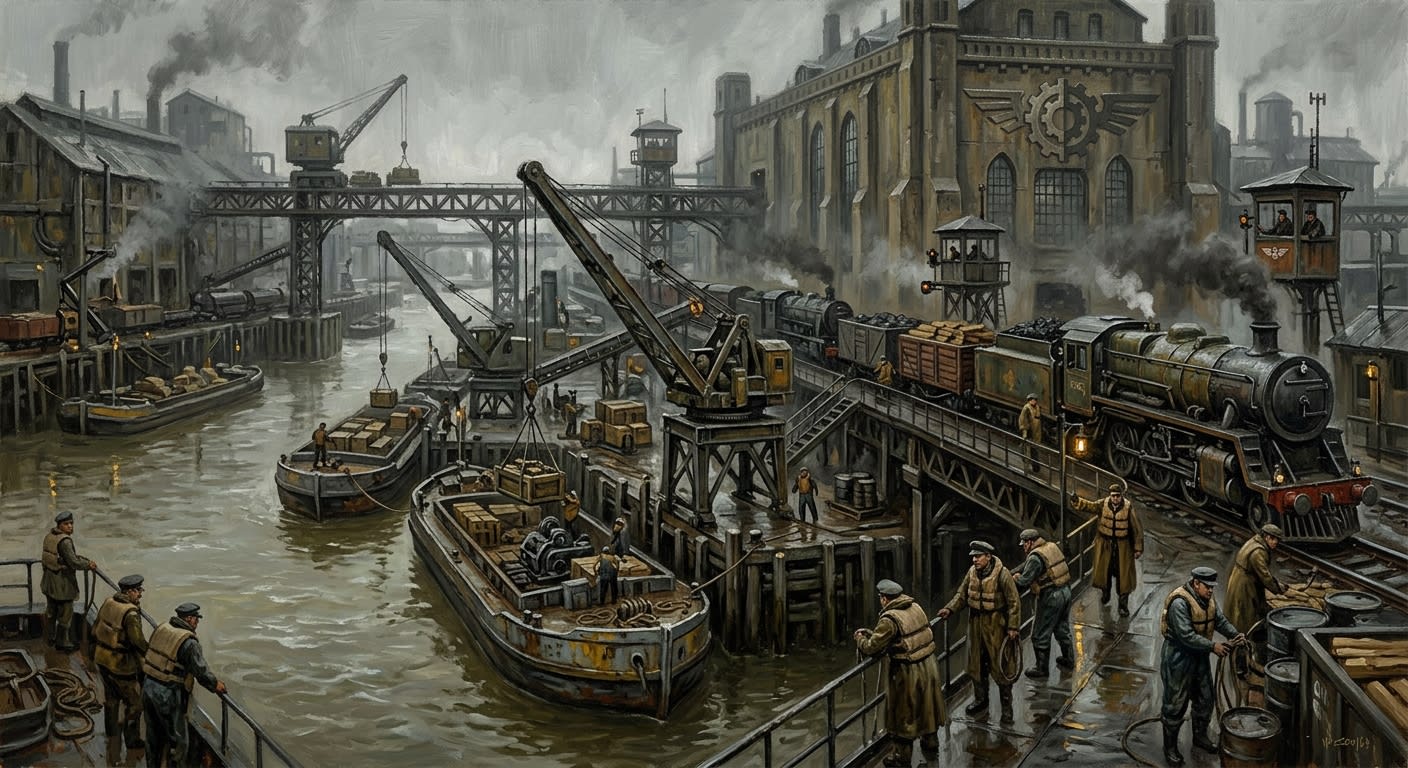
The Vire River-Belt Interchange is where barges learn to impersonate trains and trains learn to smell of bilge. It sits two days by rail from the Palatine Switchyard of Lorn, on the wet hinge between Lower Vire and the inland canal roads that feed the Archivolt Causeyworks. The clerks call it a rail-port hybrid. The boatmen call it the Hook. The dock children call it Mud-Saint because everything that enters is lowered, lifted, blessed, taxed, cursed, and stained.
Lorn converts freight into directed motion. Vire converts motion into fees. Coal, soap, food, paper, candle wax, salvage iron, bone-tagged dead, and certain bodies that are quiet enough to pass as cargo all move through its lock-rails. The Interchange’s genius lies in its indecency: every river cargo must become a manifest; every rail cargo must become a toll event; every toll event must become a dispute; every dispute must pass through a court that charges for benches.
The Bureau of Records insists that Vire exists to regularize river traffic. The Bureau of Tithes insists that Vire exists because water naturally flows toward assessment. The Bureau of War insists that Vire exists because Lorn cannot be trusted with all freight. All three claims are useful. None are clean.
#On the Founding and the First False Toll
The Interchange began as a barge turn below the old Vire lockfields, after the canal grid of Lower Vire hardened from drainage necessity into supply doctrine. By A.S. 92, two years after the Concordat, the River-Belt Chapterhouse (Unregistered) had built three timber cranes, one toll shed, and a chapel whose altar faced the locks rather than the east. This was considered symbolic by the pious and practical by anyone who had watched money float past.
The first stone quay was laid in A.S. 104, the same year Lorn’s market-town name vanished and the rail throat began swallowing the continent’s freight. The timing matters. Lorn’s rise frightened every river authority west of the forward zones. A single rail city with twelve converging lines could strangle canal revenues, humble lock wardens, and turn whole barge guilds into quaint illustrations in children’s primers. Vire answered with stone, cranes, toll seals, and fraud.
The first false toll was recorded in A.S. 106, when a grain barge bound for Wexel was charged passage through a lock it had not reached. The barge master objected. The bridge-scribe produced a receipt. The receipt bore the barge master’s mark. His hand, inconveniently attached to his body, denied the mark. The Tribunal ruled that marks are more reliable than mouths, since mouths lie and marks can be archived. The barge master paid twice. Vire had discovered its sacrament.
River-Belt teaching copies describe the First False Toll as an isolated scribal misunderstanding resolved by local mercy.
Corrected. The misunderstanding became policy, the policy became revenue, and the mercy consisted of allowing the debtor to keep his boots until winter.
#On the Docks, Locks, and Rail-Flood
Vire is built in strips: river below, crane deck above, rail above that, and the offices above everything, where officials may look down on water, labour, and evidence with equal comfort. The Lower Quays receive barges from the Vire and its wet tributaries: coal flatboats, soap-lye tanks, candlewax scows, corpse punts with black pennants, and covered boats whose pilots whistle too carefully. The Hook Cranes lift cargo into inspection cages. The rail-flood platforms sort it eastward toward Lorn or southward toward the canal roads.
The Lock Courts sit on the middle tier, a row of damp halls whose floors slope by design, so that floodwater, spilled ink, and inconvenient blood run toward drains in the same obedient direction. Cases are heard by Bridge-Scribes with waxed cuffs and excellent memories for fees. Appeals require stone tokens purchased from the same court that denied the first claim, which is circularity raised to civic architecture.
The Interchange’s chief marvel is the Chain-Gantry: six river cranes connected by hymn-timed gearhouses, each gearhouse served by a bell-card reader trained to hear the difference between lawful strain and profitable panic. When a barge load becomes rail freight, the gantry sings. When the gantry sings off-count, cargo falls. When cargo falls, someone discovers that insurance rates were miscopied. Vire has never wasted a disaster.
#On Lorn, Rivalry, and the Week the Schedule Lied
Lorn and Vire hate each other with the intimacy of cousins fighting over an inheritance neither earned. Lorn has rails, speed, and Bell arrogance. Vire has locks, tolls, and the river’s old habit of ignoring schedules. Lorn calls Vire a parasite on legitimate freight. Vire calls Lorn a soot-choked adolescent with delusions of centrality. Strasbourg calls both “indispensable,” which is how the Synod praises things it cannot yet safely destroy.
The toll war (Unregistered) began openly in A.S. 187 after Vire imposed a wet-transfer fee on cargo entering Lorn by canal-road exchange. Lorn retaliated by refusing priority windows to Vire-tagged consignments. Vire then began delaying Lorn-bound soap, grease, candle wax, and clean seal stock. Lorn’s Manifest Basilica answered by “correcting” arrival dates so delays became Vire’s fault before Vire committed them. The fraud war had achieved maturity.
The worst episode remains the Week the Schedule Lied (Unregistered). Seven Vire barges arrived at the Hook on dates their manifests had already passed. Three Lorn trains departed before their cargo was unloaded. A corpse convoy reached Lower Vire with death receipts dated tomorrow. Two Bridge-Scribes swore under oath that the river had flowed upstream for nine minutes, a claim rejected by Bureau of Engineering and accepted by every boatman who owed arrears. By week’s end, a tariff dispute had ended in an “accident” at the South Hook: one crane collapsed, one magistrate drowned in six inches of water, and the disputed fee schedule appeared in final form beneath his body, signed.
The signature was his. The hand was not recovered.
#On the Present Condition
As of A.S. 201, Vire thrives in the narrow gap between emergency and indictment. The Payroll Spur losses at Lorn have made every transfer node nervous. The Hush Tunnel Runners buy Vire lamp codes at inflated prices. The Thrown Hand watches the wet-transfer crews with professional envy. Lower Vire’s Bone-Tag clerks complain that bodies arriving from the Interchange have acquired toll stamps on their ribs. The Archivolt bridge-scribes accuse Vire of exporting forged stone tokens. Vire denies everything and raises handling fees.
The Fading Winter sharpened the local appetite for older paper. River licenses with pre-A.S. 199 ink now trade like relics. Newer permits are held over steam before acceptance, read aloud twice, and weighed on coin scales because Vire has learned that a fading document loses mass before it loses shame. This practice is not approved by Records. Records has copied it privately.
The Bureau of Records states that Vire’s manifest irregularities remain within tolerable bounds.
The bounds have been expanded six times since A.S. 199. A stable boundary that moves whenever approached is a clerk retreating with a ruler.
Vire’s masters prepare for the next round against Lorn: toll revisions, lock closures, witness rentals, drowned evidence, and that most sacred instrument of River-Belt governance, the missing page. If Veyl Hark reaches Lorn and asks where the false manifests learned to swim, every finger in the Interchange will point downstream, upstream, across the quay, into the fog, anywhere but toward the Lock Courts.