
#On the Designation
"The Rationalists abolished the parish and kept the parish register. They only changed the heading." — Drax, marginal gloss
The First Prefectural District survives in the Sacred Ledger as a single obligation. The published account of the Black Procession of A.S. 30 records that the Rationalist spectacle in Vienna was held during working hours and that attendance was compulsory for all citizens of the First Prefectural District. Take that clause away and the District disappears from every folio in my keeping. No charter has reached my desk. There is no map, no prefect's name, no census, no roll of absentees and no schedule of fines.
What the clause gives, it gives firmly. Rationalist Vienna had a civic district with a number and a title of administration. Its people were citizens, and the state could order them out of their workshops and into the street to watch it burn the saints. That is more than many parishes of the old Church can prove from their own registers. It is a good deal less than a Warden would like.
Rationalist administration governed Vienna before the Treaty. A.S. 30 is the year the District was summoned. The Ledger will not pretend it is the year the District was made.
#On Public Instruction
The Procession belonged to the Rationalist Prefecture of Public Instruction. Dr. Albrecht Klemm, an officer of that Prefecture, gave its principal address. Nothing in the record makes him master of the District, and I will not promote a dead atheist to make the narrative tidier. The Academy supplied the rest of the apparatus: columns of students in black gowns, and printed programmes that disposed of each saint's miracles in a paragraph apiece.
Instruction requires pupils. The District supplied them.
The arithmetic of the day is instructive. The Treaty of Regensburg had been signed three days earlier. The Republic was in the year of its formal constitution. Klemm would shortly use the word "liberation" eleven times in one speech. The European mind had been declared free of invisible authority, and a visible authority at once ordered that mind to report to the Ringstrasse on a working afternoon, in its coat, to be told so. The Rationalists had spent decades denouncing compulsory devotion. The first great festival of their new order was compulsory.
#On the Processional City
The Rationalists claimed to despise theatre, yet they chose their stage with a showman's instinct. Their route was the Ringstrasse, the boulevard that in the old world had carried the feast-day relics of Saint Rupert and the Blessed Adalheid. Their pyres stood in the Heldenplatz. Their Academy, whose students marched and whose programmes did the explaining, had been installed in the Cathedral of Saint Stephen. A boulevard of relics, a square of heroes, a cathedral turned into a lecture-hall: the Republic took over the sacred city room by room, as a bailiff takes over a debtor's house.
Where the First Prefectural District lay in all this, the record does not say. It names the places the citizens were made to witness. It does not name the streets they came from. A careless archivist would draw the District's border around the route and call it a survey. The route belonged to the Prefecture, and so did the square. No surviving document tells me whether any of those stones also lay inside the District's lines, and the Ledger does not survey by inference. The cold was recorded in the Heldenplatz. The record does not carry it into Saint Stephen's, or into any street of the District.
#On the Compulsory Witnesses
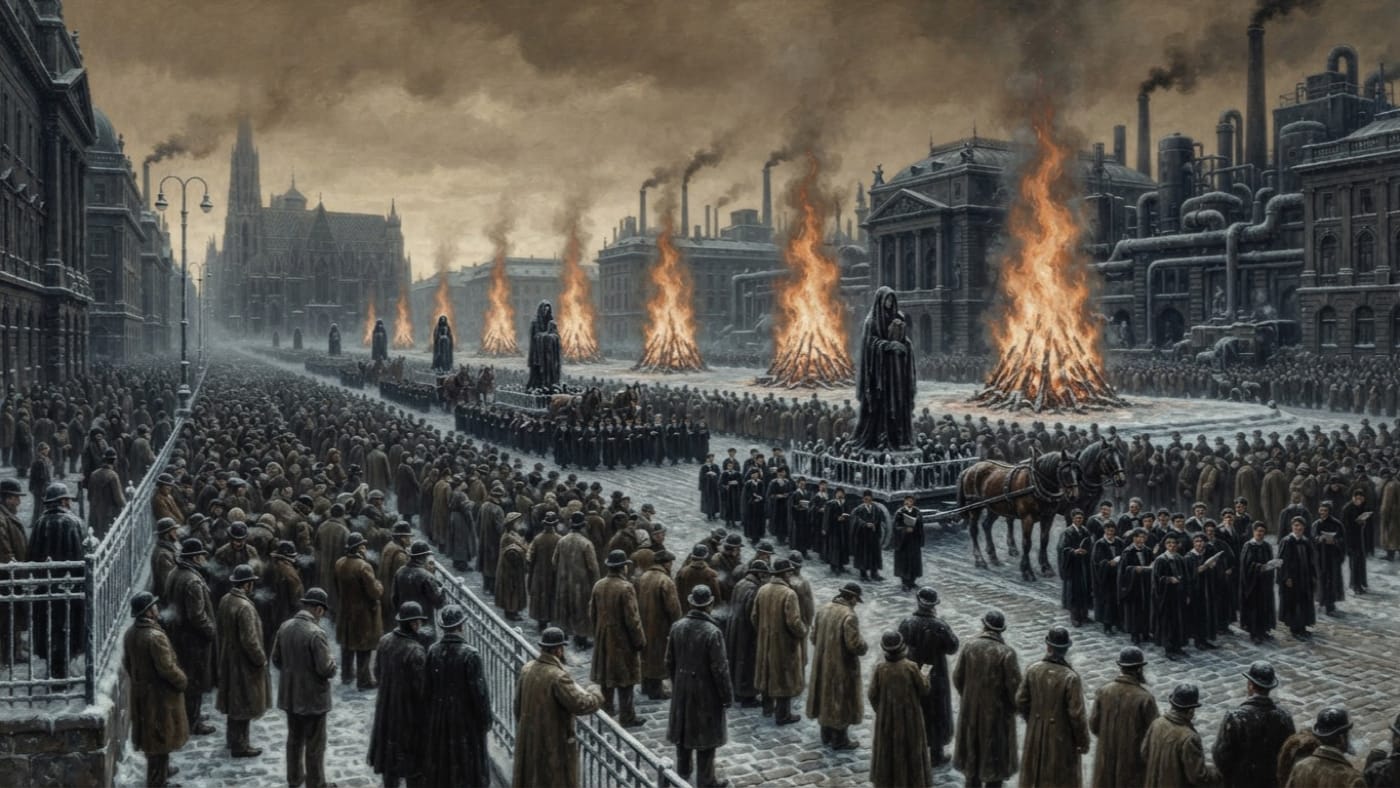
At the appointed hour the District's citizens left whatever work had them that afternoon. Draught-horses drew the platforms along the Ringstrasse. They carried forty-seven effigies of straw and plaster on wooden frames, one for each year of what the Rationalists called the Superstitious Epoch, each dressed in vestments taken from the churches of Vienna and hung with black mourning cloth. Behind each platform walked one of the Academy's black-gowned columns with programmes in hand, so that no citizen ran any risk of wonder. A broadsheet that morning had already called the effigies suitable "for public contemplation and subsequent incineration." The citizens were the public, and the contemplation was mandatory.
Seven pitch-fed pyres stood in the Heldenplatz. The torches went in and the pitch caught. For a short while the fires behaved like fires.
Then the heat went out of them.
The flames kept rising, and the effigies blackened and fell apart in the ordinary way. The light stayed but the warmth did not. The crowd had stepped back from seven bonfires. Now it began to press toward them, puzzled, while frost formed on coat-buttons six feet from open flame. Frostbite followed. Three people died of exposure in a public square in November, at a festival of reason they had been ordered to attend.
The Ledger must be exact about whose dead those were. The surviving account names one victim, a laundress with blackened fingertips, and gives her residence as the Third District. The crowd was therefore larger than the obligation. The summons fell on the First District, and others came as well, whether from curiosity or under some order the record does not preserve. No record assigns the three deaths to First District households, and I will not lay them there to tidy a sermon.
The Prefecture classified the event as an atmospheric anomaly and cancelled the second day of celebrations without giving a reason. The citizens of the First Prefectural District had been compelled to witness a miracle. Their government then informed them that they had witnessed weather. For the full account of the day, the speech and the effigies, the reader is directed to the Procession's own entry. This folio concerns only the people who were obliged to stand there.
#On the Retrospective Verdict
Two things must be kept in separate boxes. The first is what the crowd felt: fire that gave light and no heat, frost where warmth should have been, and three dead. That is the recorded phenomenon. The second is what the Bureau of Doctrine made of it, long afterward. It filed the event as a First-Order Portent, a Providential Warning, an Elemental Rebuke, in which the Creator permitted the fire and withheld its heat. That is the Bureau's interpretation. It is a fine one, and I have signed worse, but it remains an interpretation. The Bureau's filing, amendment and confirmation of that verdict belong to the history of the Procession. They are not events in the District's life, whatever that life later became.
The omens followed in their order. The sun failed in the Year Without Dawn, A.S. 32 (1742 CE). The Red Flood of the Danube came in A.S. 34 (1744 CE) and the Eastern Silence in A.S. 38 (1748 CE). On 1 November A.S. 45 (1755 CE) came the Sundering. The record does not tell me whether any citizen of the First Prefectural District linked the cold in the square to any of these. Nobody asked them. Nobody ever asked them anything. They were summoned.
Stamped Erratum — Warden of the Sacred Ledger: The published account of the Procession places the Red Flood "four years" after the Year Without Dawn and the Eastern Silence "eight years" after that. Strike both intervals. The Dawn failed in A.S. 32, the Flood came in A.S. 34 and the Silence in A.S. 38: two years, then four. Older tables that move the Procession itself to A.S. 124 are likewise void. It was A.S. 30. It was always A.S. 30.
#On the Surviving Designation
After the Sundering the Church came into the open unevenly. It withdrew and came out again, and the formal Synod was constituted only at the Concordat of Strasbourg in A.S. 90. Vienna was fought for and reclaimed in the Siege of Vienna of A.S. 95. In the same year the Heldenplatz was reconsecrated, and on the site of the seven pyres the Synod raised seven columns of black basalt that are warm to the hand in every season. Vienna-Ruins is now a shrine-town of some ninety thousand souls in Zone 3 of the Central Corridor. It is the last great supply stop before the Carpathian passes, crowded with pilgrims and with the officials who license them.
Of the First Prefectural District there is no further word. I find no decree abolishing it, no instrument renaming it and no Synodal ward that claims its streets by inheritance. The Ledger records neither its death nor its survival, and it will not forge either. The pilgrims who warm their hands on the columns may be standing inside its old lines, or a mile outside them. They do not know, and neither do I. The difference is that I have the decency to file my ignorance.