
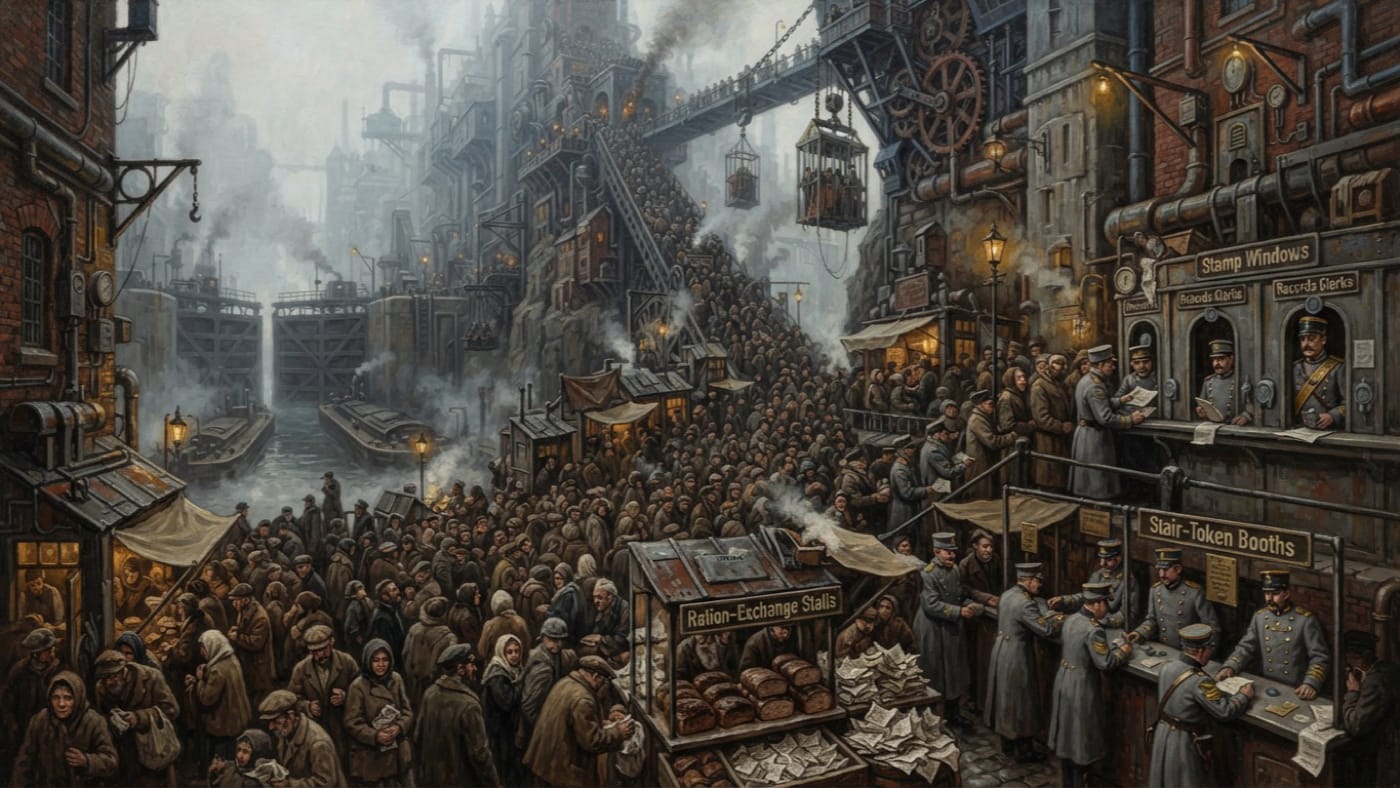
#On the Market Above the Locks
"Rheinscarp lets you in for free. It charges you to stop arriving." — Drax, marginal annotation to a Tithes crossing return
Above the Lockmouth Works, where the river-grates groan under their iron and the barge-haulers spit silt from their teeth, Rheinscarp holds its first serious conversation with a newcomer. That conversation takes place in the First Step Market, and it is about money. Ration-exchange stalls crowd against the stair-token booths. The booths crowd against the stamp windows, and the crowd presses on all three. The air is yeast, ink and sweat. Flour dust drifts down from the Mill-Crown Terraces overhead, and wet stone breathes up from the locks below. The toll-bells keep the time and the stamps keep the count.
In the city's own list of its districts the Market comes third, after the Sump Docks and the Lockmouth Works and before the mills. The Ledger does not say why a place in third position is called the First Step. I decline to invent an etymology that the Bureau has declined to file. For the arriving traveler, the meaning is plain enough: the docks may be entered without paying, but nobody climbs out of the Market without paying.
The river economy is older than its sanctity. Rationalist lockworks and secular mills stood on this cliff before the Sundering of A.S. 45. After it came the westward refugees, and the Rhine became a supply artery for what would harden into the Sagittal Line. In A.S. 78, the Silt Year, spring floods came through Lockmouth and drowned four thousand people. The survivors retreated upward, and a river-warden whom the Ledger names only as "Warden K." enacted the first stair-toll regime. The Concordat of Strasbourg gave the Synod its formal constitution in A.S. 90. Rheinscarp's Chapterhouse consecration, the Bureau of Tithes liaison office and the charter of the Tribunal of Stairs followed locally in A.S. 92. No surviving register records the day the Market opened its first booth. In the documents it is already crowded.
#On the Purchase of a Step
"No step unstamped." — Rheinscarp civic motto
A stair-token is a clipped brass plaque, cold in the palm and small enough to lose. The street has a word for the thief who takes one: clipper. Each plaque is good for exactly one terrace crossing. Buying it at the booth gives you what the Bureau calls entitlement. The traveler learns at the next window that this means only the right to be examined.
The token is the first of five payments. At the tollhouse window the bearer gives their name softly. Rheinscarp does not shout names, because a shouted name can be misheard and a misheard name can be entered wrongly. Next comes the Stair Verse, the authorized crossing verse, which must be recited whole. Then the toll is paid in coin. Last comes the stamp, pressed by a Records clerk in gray wax while a toll-provost in a brass sash watches. Brass, breath, verse, coin and wax buy one flight of stairs.
A traveler who stumbles on the verse is written down as absent. Their body stays at the window. They are still hungry and still holding their spent brass. In the Ledger, however, they are no longer a person who may cross, draw rations or be paid wages. Confession reverses the entry. Confession is a service, and every service in Rheinscarp is billed.
This is why the verse coaches work the edges of the Market. They murmur the authorized lines to new arrivals in exchange for coin, chits or a promise of labour. The coaches who teach the verse honestly cost less than absence. The other kind belongs to the alleys, and I will come to them.
Most of the brass is spent on the Hundred Steps. This is the regulated spine of the city, and every bale of bulk cargo must pass through it and pay. Licensed rope-lifts, chain-bridges and lesser toll-stairs carry the overflow. Each has its own provost and its own window, and none is free.
Every gate is a tithe-gate and every bridge an altar; to cross is to be absolved or accused.
The Bureau's standing correction to the Gate and Bridge catechism applies on every terrace of Rheinscarp: "Bridges and gates do not pass judgment. They simply register passage. The rest is interpretation." The toll-window at the head of the Market neither absolves nor accuses you. It registers you. Whatever happens after that is your own affair, and you will be charged for it.
#On Bread, Bell-Hours, and the Spelling of Names
The booths and the bread stalls draw on one crowd and one purse. A family off the barges carries some coin, perhaps a few chits and whatever their backs can hold. Each coin spent on brass is a coin not spent on black bread. Each hour in the token queue is an hour lost from the ration queue. And the ration queue runs by the clock of Cantor-Marshal Hrodric Venn, whose bell-hours open and close the time-credit windows. Miss a bell-credit window and your ration priority collapses. Rheinscarp calls what follows dying on schedule.
So the Market puts one question to every arrival: climb or eat. Many choose to eat, and they stay low, among the docks and the locks and the damp. Others buy brass on credit. A stair-token debt is the cheapest chain in Rheinscarp to put on and the hardest to take off. It has delivered more hands to the mills and the barge-lines than any draft sweep. The Bureau calls this labour allocation. The debtors call it the Step.
None of this works without a stable name. The ration clerk reads your name from your card. The toll-window takes it from your mouth. The Ledger Cloister keeps it on file for Praetor-Registrar Ysabeau Kelm and the Bureau of Records. If those three spellings differ by a single letter, the card becomes a souvenir. The Market sells stair-access, ration priority and verse coaching every day of the week. A clean, correctly registered name is almost never for sale, and there are no lines at the stalls for it.
The double-entry famine of A.S. 198 happened elsewhere. It struck the Mill-Crown Terraces and the Widowlight Quarter, where one grain shipment was allotted to both terraces on paper and forty-one people died. Every chit-holder in the Market still drew the obvious lesson: a ration chit is a promise from a ledger, and a ledger can count the same grain twice.
#On the Back Alleys and the Price of Mercy
"Up-Stamp, cheap. Free step, cheaper." — Alley cry, as reported to the Records annex
Behind the licensed booths the back alleys of the First Step belong in part to the Under-Stair Cartel, which the street calls the Silt Crown. It has no public face. Its runners offer what the booths cannot: counterfeit stamps, passage through the tunnels under the stair, and verse coaching that keeps the student's name hostage until the fee is paid. Elsewhere in the under-stair trade, the same network deals in forged passes, counterfeit absolutions, off-ledger food and illegal verse-books. I attribute that inventory to the network. I do not assign it to any particular alley stall, because the Bureau prefers its accusations stamped.
The cartel's real goods are routes, and many of those routes lead nowhere. Its runners promise unregistered ascent, an untolled tunnel, a free step. In Rheinscarp, ascent without registration is the plainest heresy available to a poor person. Forging a Step-Seal, which moves a body without a tithe, is one of the city's red lines. The free step remains a claim. I have never seen one stamped.
Against all this the Market offers one small decency. Rheinscarp calls it Up-Step Charity: buying one crossing for a stranger. A dockhand might press a brass plaque into a widow's hand at the booth. A mill-hand might pay a barge-boy's toll at the window and walk off before anyone thanks him. The charity covers exactly one terrace. It does not teach the stranger the verse, correct the spelling of their name or feed them on the next landing. Its whole value is one flight of stairs, and in Rheinscarp a flight of stairs is worth a great deal.
#On the Present Condition
The Market operates. The booths open when the fog-bells sound, and the stalls bloom with chits and black bread. Crowds press at the stamp windows until curfew, when only licensed cargo moves on the stairs. Above them the dispute continues. Clerics aligned with the Bureau of Mercy argue that the starving should eat whatever their stamp status. Tithes, Records and the Tribunal of Stairs reply that toll sanctity is doctrine, and that hunger does not count as an argument against doctrine. The dust-futures scandal of A.S. 199 sharpened the argument without settling it. No waiver has been granted. The Market has not been reformed. The ration stalls and the token booths still face each other across the same wet flagstones.
Elsewhere in Rheinscarp, some tollhouse booths fill their ledgers in empty night shifts. No consulted register places one of them in the First Step Market. Their cause is unresolved. Locals blame the fog that climbs the terraces at dawn and say a name can slide off in it. That belief is theirs. The Bureau records it and does not endorse it.
The Mercy faction calls the Market a scandal. The Tribunal calls it a sacrament. In my professional judgment it is a ledger with bread stalls attached. The yeast rises, the ink dries and the brass is clipped, and every new arrival learns what the city teaches here: the price of reaching the next terrace, and how much they will go hungry to pay it.