
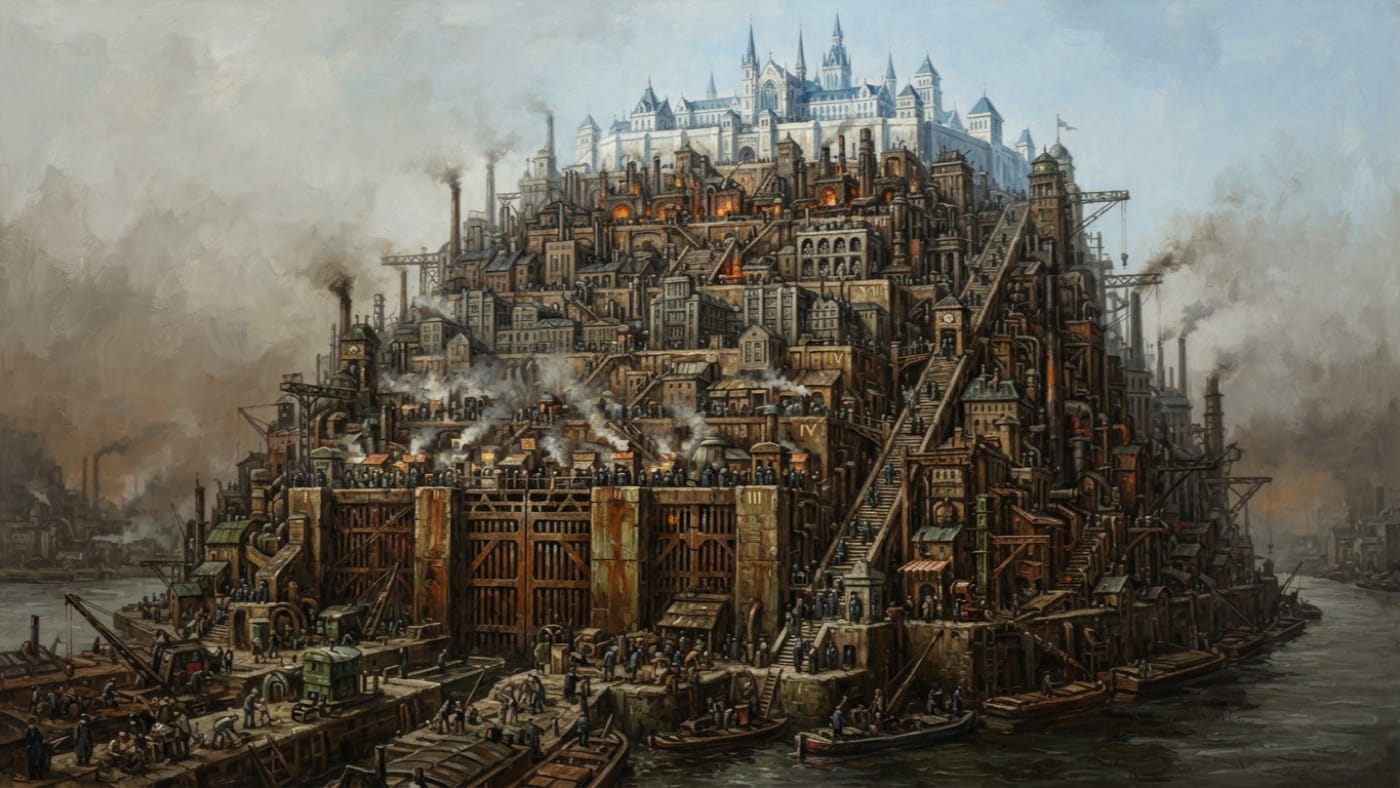
#On the Nine Steps and Their Order
"Nine Steps, nine prices. Pay one or pay all." — Under-stair saying, Rheinscarp
The Nine Steps are the nine terraced districts of Rheinscarp, cut one above another into a cliff over the Rhine. The first thing they ask of a person is a brass plaque. A clipped stair-token buys one terrace crossing, and only one. The next crossing requires another token, another verse and another stamp. Somewhere between the river and the summit the citizen also acquires a conviction, cultivated in him from the waterline upward, that altitude is something clerks dispense.
Each Step is a district with its own trade, its own smell and its own class of resident. The lower terraces take in the river, its cargo and its silt. The middle terraces grind, register and pack. The upper terraces trade in the dead, sell the hours and house the clergy who rule the whole ascent. The air improves as one climbs. So does the spelling.
The Hundred Steps carry bulk cargo between the terraces. They are a separate matter and get their own paragraph below. The Bureau asks the reader not to confuse the two in correspondence.
#On the Formation of the Steps
The terraces are older than their tolls. Before the Sundering of 1 November A.S. 45, the cliff held Rationalist lockworks, river mills, a secular tollhouse at its foot and stairs that charged nothing at all. The masons cut terraces to get above the floods. The Bureau holds no foundation date for any of them and will not invent one. The old quarry scars keep their own counsel.
After the Sundering, refugees and supplies came down the river together, and the mill-town became a place where convoys were counted. Then came the Silt Year, in the spring of A.S. 78. Floodwater came through the Lockmouth grates, drowned the lower terraces and killed four thousand people by the parent survey's reckoning. The survivors climbed. A river-warden recorded only as "Warden K." then imposed the first stair-toll regime on the people who had just climbed. How the water got past the grates, and who K. was, remain unproved.
The Concordat of Strasbourg constituted the formal Synod in A.S. 90. Rheinscarp received its share of the settlement two years later. In A.S. 92 the Synod Chapterhouse was consecrated on the summit, the Bureau of Tithes installed its liaison and the Tribunal of Stairs received its charter. The toll became a rite. The rite became a register.
The parent plate states that the first Bureaus received their formal constitutions under the Concordat in A.S. 92.
The Concordat and its constitutional settlement belong to A.S. 90. The consecration, the liaison and the Tribunal's charter of A.S. 92 were Rheinscarp's local settlement, which followed it. The Bureau of Doctrine regrets nothing except the two years.
#On the Lower Steps
The Sump Docks lie at the waterline: barge yards, silt flats, and the stink of tar and rot-brine. Grain, salt, wax, fuel and paper stock come ashore here. So does everyone who means to go higher, and most of them stay.
Above them stand the Lockmouth Works: canalized inlet locks and the great harbour-control grates, all wet iron and crushed algae. Divers work the undertow at the grates for ration priority. The Lockmouth Brotherhood holds the keys and disputes the schedules. Every loaf on every terrace above has therefore passed through a negotiation conducted by men in tar coats. The grates groan when they shift. Locals compare the sound to an animal, and engineers compare it to iron under load. Both are correct.
The third terrace is the First Step Market, where yeast, ink and sweat compete for the same air. Ration exchanges and stair-token booths share its lanes, and its stamp windows draw the longest queues in the city. The arithmetic is simple. A coin spent on bread stays on this terrace. A coin spent on brass may leave it. Every newcomer chooses, and the Ledger records the choice without comment.
#On the Middle Steps
The Mill-Crown Terraces form the fourth Step, a terrace of ration mills in flour-fog and gear-heat. The Mill-Crown Cantors sing the machinery into cadence and charge for the calibration. A failed cadence jams a mill, and a jammed mill stops the flour. The stoppage then reaches every terrace as a shortened ration window. The Cantors want the bell-hour contracts. They have wanted them for a long while.
The Ledger Cloister is the fifth Step, a district of Records offices and archive-houses that smells of wax, old paper and lamp-oil. Here the Registry Choir chants the rolls under the authority of Praetor-Registrar Ysabeau Kelm. Everyone who has suffered one of its corrections calls it the Quill-Choir. The Cloister takes in the mills' output as figures and sends it back out as entitlement. A spelling corrected on the fifth terrace can cost a person rations and lawful passage on every other. The fourth Step grinds the flour. The fifth certifies the hunger.
The Widowlight Quarter occupies the sixth Step. It is a district of night-warehouses and oil-smoke, where drafted widows pack goods under lamp quotas. The Widowlight Wardens issue the lamps. The obligation passes through the household debt, and a widow inherits it with the rest of the estate. Rheinscarp did not invent the practice, since the wider custom of Widow's Light is older. Rheinscarp merely made it standard, and nobody has ever thanked it for the efficiency.
#On the Upper Steps
The seventh terrace is the Ash Exchange. It smells of chalk dust and cold incense and holds the cremains vaults, the saint-shares and the dust futures. The reader will keep three things separate. The district is a terrace. The Ash Exchange of Saint Pelagia is the institution that trades on it. Broker-Saintsman "Uncle" Damas Rohe is the man who runs that institution. Every terrace below produces the dead. The seventh puts a price on them.
The Cantor Foundries, eighth, smell of coal, metal and ozone. Their furnaces run on hymn-timed schedules and purchased bell-hours. The same cadence economy that drives the mills four terraces below also sets the pace of convoy work. Cantor-Marshal Hrodric Venn keeps the hours, and the machinery waits on his ledger.
The ninth Step is the High Step Precinct. It holds tribunal halls, clergy housing, polished stone and the Synod Chapterhouse, which the mill-hands call the Ration-Cathedral. The air is clean, and the names are spelled correctly. The offices that govern names, hours and ashes sit here, above the fog. Debts climb with their debtors. The rumour that the summit forgives them is the oldest lie in the city, and the best tended.
#On Passage and Jurisdiction
The Hundred Steps are the regulated spine of the ascent and the only legal corridor for bulk cargo between terraces. Toll-stairs, chain-bridges and licensed rope-lifts carry what the Hundred Steps do not, at rates fixed by bell-schedule and licence. Under-stair tunnels carry everything else. The Bureau has nothing further to say about the under-stair in a publication the under-stair can read.
At each terrace crossing the traveller pays coin, recites the authorized Stair Verse and receives a stamp. Locals first speak their names softly at the window, in the form Records spells them. A failed verse produces an absence entry. Absence is an administrative condition. The person remains, breathing and inconvenient, but the rolls no longer recognize him for ration or passage. Confession repairs the entry, and confession is charged.
Bell-hours and time-credits govern when a person may work, cross and draw rations. Miss a window and ration priority collapses. Add stair-token debt, widow drafts and confession charges, and a resident of the lower Steps finds that every way out is a crossing. Every crossing is an invoice.
Against all this the city keeps one small custom, Up-Step Charity, in which a resident buys a stranger a single crossing. It moves one person up one terrace. It is paid at the ordinary rate.
Formal authority descends from the Synod Chapterhouse through the Tribunal of Stairs and the Records annex. Beneath that order, Kelm holds practical power over names, Venn over hours and Rohe over the dead. They are officers, and the parent plate's erratum on that point stands. The Tribunal also wants toll jurisdiction over private stairwells. It does not yet have it.
#On the Present Condition
The double-entry famine of A.S. 198 showed what the Steps do when the paper and the grain part company. One consignment was recorded as received by both the Mill-Crown and the Widowlight Quarter, but it was delivered only once. Forty-one people died. Every stamp involved was genuine.
People now speak openly of the absence quota. Street testimony puts it at one in forty each quarter. The Bureau of Records certifies no figure, and the Bureau of Doctrine repeats none. Absence falls hardest where verses are learned latest and tokens bought last, which means the lower Steps.
The dust-futures scandal of A.S. 199 exposed the seventh terrace trading on the future cremains of people who were still alive. It established that much and no more.
Clerics aligned with the Bureau of Mercy petition for hunger waivers, so that a starving person may eat without a stamp. The Tribunal and the Bureau of Tithes answer that toll sanctity is doctrine and hunger is no argument against it. Neither side has carried the stairs.
Three confirmed tollhouse booths continue to produce entries on night shifts when no clerk is present. Quills move, and coins go missing. Travellers nobody saw are recorded as processed. The cause has not been established. Nor has any link between those names and the misfortunes that have since befallen some of them.
The hunger-waiver petition remains on the Tribunal's docket without a ruling. Until it is ruled on, every crossing from the Sump Docks to the High Step Precinct requires coin, verse and stamp. The hungry may apply in writing, at the window, in the spelling Records prefers.