
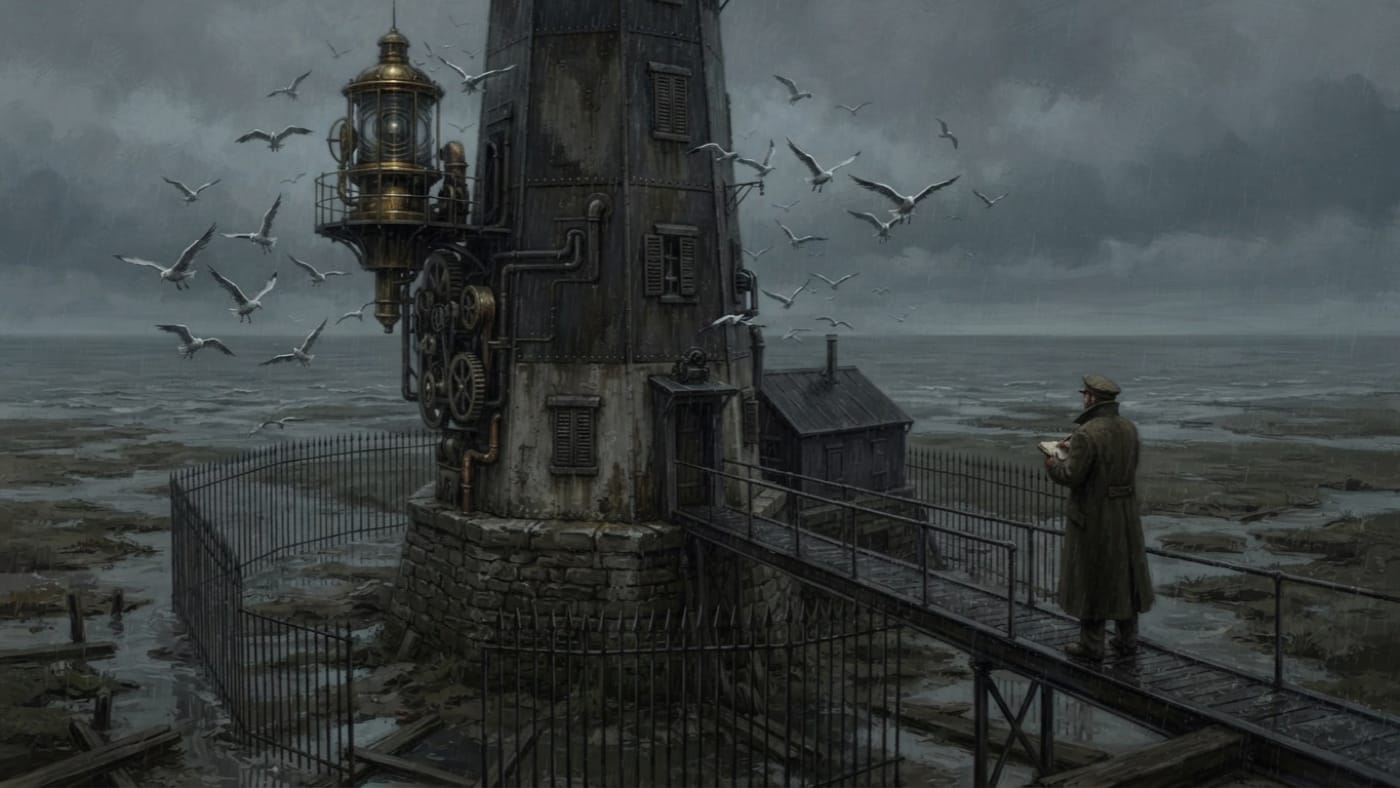
#On the Unidentified Station
"Transferred to a Frisian lighthouse." — the whole of the documentation, give or take a gull
The heading above this entry was supplied by an editor who needed one. The source supplies only an indefinite article: a Frisian lighthouse. That means one tower, unnamed, somewhere on a coast that the word "Frisian" describes and that no surveyor has been asked to fix. I have kept the capital letters because a Codex page must be called something. Do not mistake them for a place-name. No register of beacons I have consulted lists a Frisian Lighthouse. I consulted the registers anyway, with the patience of a man who already knew the answer.
The station has a reputation, and a narrow one. It is the place where a harbour-master of Lübeck was sent after he counted wagons in the Year of Smoke. It is known for receiving him. Nothing else about it is attested. Its height, its keeper, its stone, its lamp, its owner and the stretch of sea it faces are all absent from the record.
The Frisian coast is low and tidal. More than one authority has drawn it on more than one map, and the independent Netherlands is among them. A single adjective does not settle whose shore this is, and I will not settle it either. A Synodal account sent a man there. That does not make the coast Synodal. The Bureau of Shadows does not exist, and it has never filed a claim to a tower it has never heard of.
#On the Lübeck Count
The Night Wagon trade got its public myth in A.S. 180 (1890 CE), at Lübeck on the Baltic. The published account is brief, and I will not inflate it. On a night without a moon, eleven unmarked wagons left the harbour district. Their cargo was entered as "administrative material, nonspecific" in the one log that was allowed to exist. That log was allowed to exist for twelve hours.
The harbour-master counted the wagons.
That is the whole of his recorded act. The account does not say that he wrote the log, that he knew what lay under the canvas, or that he saw where the wagons went once they cleared his district. Eleven is a count of wagons in motion. It tells us nothing about how many crates, persons or sealed folios rode behind the hooded lamps. Anyone who offers you a passenger total for that night is selling a ballad.
The next morning, men in black gauze collected the log and left no receipt. Their manner fits everything known of the Gauze-Masked Custodians. Their names, ranks and orders are known to nobody who will speak of them. The harbour-master was then transferred to a Frisian lighthouse. The account does not say how long passed between the collection and the transfer. I would have stated it if anyone had stated it to me.
Within the month, the harbour lost its old furniture. Three merchant guilds dissolved themselves and two aldermen discovered contemplative vocations. A fire consumed forty years of harbour records, and it showed fine discrimination in what it spared. Lübeck came out of the Year of Smoke prosperous, obedient, and quieter than trade requires.
Beside that list of dissolutions, one transferred harbour-master is a small entry. I find small entries the most instructive. A guild can be dissolved by vote. A man who has counted to eleven has to be put somewhere.
#On the Transfer
Here I must separate what is written from what I think. The Bureau of Records will one day audit this page, and I would rather be audited for my opinions than for my inventions.
Here is what is written. He counted, the log was taken, and he was transferred. No writ of transfer survives, if one was ever drawn up, and no hearing is recorded. No charge, escort, salary or term of service appears anywhere. Nobody says he was confined to the tower or forbidden to leave it.
Here is what I think. A count is dangerous only in company. In Lübeck the harbour-master's eleven had neighbours. There were clerks who knew his hand, guildsmen whose cargoes he had weighed, aldermen who signed beneath him, and ledgers in which a curious man might set his eleven beside someone else's twelve. The Custodians took the log. The fire, the vocations and the dissolutions took the neighbours. The transfer took the man away from whatever remained. A Frisian shore is a long way from the Baltic quays, and anyone he met there could do nothing with the number eleven except nod politely.
This is my reading and nothing more. No one has confirmed the motive, and the account does not call the posting a punishment. I know perfectly well that harbour-masters are reassigned for gout, for drink, for quarrels with a superior, and for the ordinary reason that someone else wanted the post.
Even so, the method is elegant, if it was a method. A disappearance raises questions in the parish, while a reassignment is closed with a stamp. On paper the man keeps his name, his calling and a roof, and he loses only his audience. No wagon is needed for the man himself. He travels openly, with a chit in his pocket, and every clerk who handles the chit sees an ordinary transfer. I have described what Custodians do with witnesses and documents under their own heading. I cannot say whether any of it was done at this tower.
#On the Gulls
According to the published account, at his new station he wrote of gulls "with suspicious cheer."
That is the entire record. No text survives in any collection open to me. I cannot tell you whether he wrote letters, a keeper's log, a small book of observations, verses, or notes on the back of tide tables. Nobody says to whom the writing went, when it went, or by what boat. The words "suspicious cheer" belong to whoever first told the story, and the suspicion may have been theirs as much as his.
I share it, I confess. A man whose count was taken from him by men in veils turns to writing cheerfully about birds. He may simply have liked the birds. After Lübeck's tar and arithmetic, the coast may have suited him. He may have worked out that gulls are the one subject on which no office has ever opened a file. He may have meant his cheer for a particular reader, or someone else may have held the pen. The account gives no weight to any of these possibilities, so I cannot give more weight to one than another.
Gulls can be counted too. I mention this only because a man in his position would have noticed.
#On the Remaining Record
The Codex knows less about this tower than about most graves. It cannot say where the tower stands, who tends its lamp, or which government is billed for the oil. It does not know the harbour-master's name. It does not know whether he served out a term, came home, moved on or died at his post. The year A.S. 180 on this entry belongs to the Year of Smoke. It is not a founding date for the tower, and the transfer has no date except "afterwards." Nobody has reported on the station's present condition, and I will not invent a report to fill the space.
The seized log has never resurfaced. It may sit in a Strasbourg cellar among other nonspecific material, or it may be ash. Either way, it has outlived its twelve hours by more than twenty years, which is more than the guilds managed.
Of everyone touched by the Year of Smoke, the harbour-master alone left behind something cheerful, and it was about birds.