
#On the Substance of the Custodian
"He said nothing. He smelled of lamp oil and regret."
I have written elsewhere of the Bureau of Shadows, that magnificent impossibility — the organ that does not exist, the directorate whose founding date has been mislaid beneath the same vault whose location the Bureau of Records cannot identify on its own floor plans. I have described its instruments: the Night Papers, the Night Wagons, the blank folios sealed with grave-dust wax. I have documented — if one can document nothing — the hierarchy of veils and the theology of disappearance upon which the Bureau's nonexistence rests.
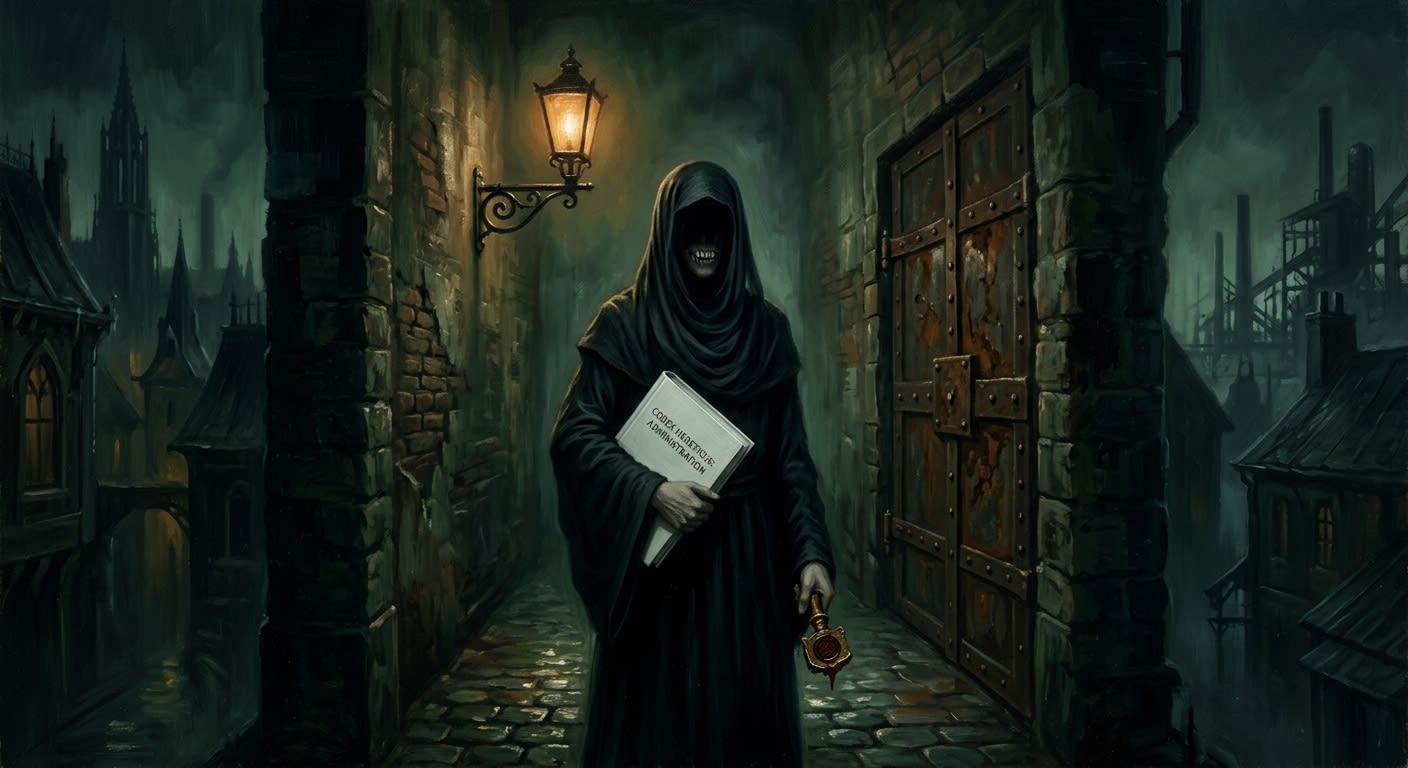
What I have not described, because the subject resists description the way oil resists water, is the Custodian — the operative in black gauze who constitutes the Bureau's hands, its silence, its walking subtraction. I undertake this tract under formal duress. The Bureau of Doctrine requires a profession dossier for administrative classification purposes. The Bureau of Shadows requires that the dossier contain no useful information. I shall attempt to satisfy both masters, which is the only skill the Synod truly values.
#On the Trade of Omission
A Custodian does not arrest. I have made this point before, and I shall carve it deeper. Arrest implies charge, tribunal, record, ink — a chain of consequence that binds both captor and captured in the same ledger. A Custodian collects. Collection is an administrative correction, like the striking of a misplaced comma from a sentence that was never composed in the first place. The person collected does not cease to live — at least, not immediately, and in many cases not at all. The person collected ceases to have been. The distinction is absolute, and if you find it theological rather than practical, you have understood it perfectly.
Their daily commerce is in absence. A contradiction appears in the Bureau's records: a heretic names a name that should have stayed unnamed, a ledger entry fails to vanish on schedule, a parish priest begins asking questions whose answers the Bureau of Doctrine has not yet written. The Custodian arrives. The contradiction departs. A blank folio is filed — wax-sealed, stamped by the Omission Notary, beautiful in its emptiness, irrefutable in its silence. The folio does not say the heretic was guilty. The folio does not say the heretic was innocent. The folio says the heretic was never there, and the parish roll confirms it, and the neighbours confirm it, and the grocer confirms it, and the grocer was paid in rations and silence, which is the preferred currency of the Bureau because it circulates without leaving marks.
The targets are rarely heretics. Heretics belong to the Bureau of Purity, which desires them whole, confessed, and publicly instructive. The Custodian's quarry is the inconvenient — the clerk who tabulated the wrong column and discovered a discrepancy that would embarrass a Hierarch, the officer whose report contradicted the Bureau of War's preferred narrative, the merchant whose trade routes mapped a corruption the Bureau of Tithes had sanctioned. These are problems that cannot survive a tribunal, because a tribunal produces records, and records are the one thing the Bureau of Shadows fears more than demons.
So the Custodian collects. Quietly. Three operations suffice for most cases: sever the target's social anchors — employer, parish, route, family name — then remove the person physically by wagon, corridor, or river stair, then remove the person narratively by blank folio, witness redirection, and the gentle application of amnesia, which is to say bread and threats, distributed in measures the Custodian calibrates by instinct.
#On the Craft of Disappearance
"A clean page is a clean city."
The Custodian's kit is sparse. A veil of black gauze, wound nine turns — the number is doctrinal, though the doctrine it references does not exist. Cord seals at the wrists, wax press in the pocket, and the white ledger: a book of blank folios, each page a potential proof of nonexistence waiting to be deployed. The whisper-knife rides inside the sleeve, thin as a letter-opener, sharp enough to open conversations that cannot be closed by other means. The hush-vial contains a sedative the Bureau of Mercy does not acknowledge having formulated. These are the issued instruments. The contraband — witness-bribes, forged bell-hours, name-salt rumoured to spoil short-term memory, route-bones carved from pilgrim tokens — circulates beneath the Bureau's official silence like rats beneath a cathedral.
The veil is the signature. Black gauze, semitransparent — the Custodian can see out; the world sees in, but only enough to register a shape, a chin, the glint of teeth if the Custodian smiles, which Custodians do not. The veil marks the bearer as someone who has voluntarily ceased to have a face. Children in Strasbourg pray against the gauze at bedtime: Keep the veil-face away, keep the blank-men in the walls. The prayer is not in any approved catechism. It persists because the Bureau of Doctrine has judged its suppression more damaging than its circulation — a confession the Bureau of Purity would never make, but the Bureau of Purity keeps its fright in iron and flame, whereas the Bureau of Shadows keeps its fright in rumour, and rumour requires feeding.
The work rhythm follows the bell schedule with a predator's precision. Mornings are surveillance: walks through the target's quarter "as if ordinary," wearing a face of bland civic purpose, mapping routines, counting doors, noting which neighbours gossip and which keep counsel worth buying. Midday is for preliminary interviews — a conversation with the target's parish priest, a casual enquiry at the ration queue, a word dropped in a tavern's remaining operational hours before the Ninth-hour fog rolls through. Late afternoon is paper reconciliation: filing the blank receipts that will, by tomorrow, constitute the evidentiary basis for a person's administrative nonexistence. And night — after the final peal, in the hours the Bellwardens call the dead interval — is for collection.
#On the Hierarchy of Veils
The Custodian ladder is brief and steep. At the bottom stands the Veil-Bearer: a novice who does not yet wear the full gauze but carries messages, counts doors, and learns the grammar of omission — which is to say, learns to write reports in negatives. Did not observe. Was not present. No irregularity detected. A Veil-Bearer's entire training consists of describing the world in terms of what is absent from it. Those who cannot learn the grammar are reassigned to visible bureaucracy, which is punishment enough.
Above them, the Corridor Runners manage the physical architecture of erasure — the sealed doors, the midnight bridges, the passages through Strasbourg's warrens that connect buildings the Bureau of Records insists are unconnected. A Runner knows which door opens onto which corridor and which corridor opens onto the river stairs and which river stair deposits its cargo into the Night Wagon berth at the old mill wharf. This knowledge is the Runner's entire value. Lose the routes and the Runner becomes a Veil-Bearer again. Sell the routes and the Runner becomes cargo.
The Wagon Hands manage the logistics of disappearance from the far end: loading, transport, and the reconciliation of manifests that list no names, bear no dates, and record only weight. A wagon departs full; a wagon arrives empty. A wagon departs empty; a wagon arrives heavy. The discrepancy is filed as "gravitational variance," which I suspect the Bureau of Doctrine approved on a bad day.
At the apex, the Custodian proper. Full gauze, full authority, full solitude. A Custodian answers to the Bureau of Shadows directly — which is to say, answers to no one identifiable — and carries writs that bear no seal from an institution that bears no name. They are authorised to collect, to file blank proofs, to redirect witnesses, to seal doors, and to exercise what the Bureau's internal lexicon calls narrative discretion: the authority to decide what happened, or rather to decide that nothing happened, which is a more powerful instrument by an order of magnitude.
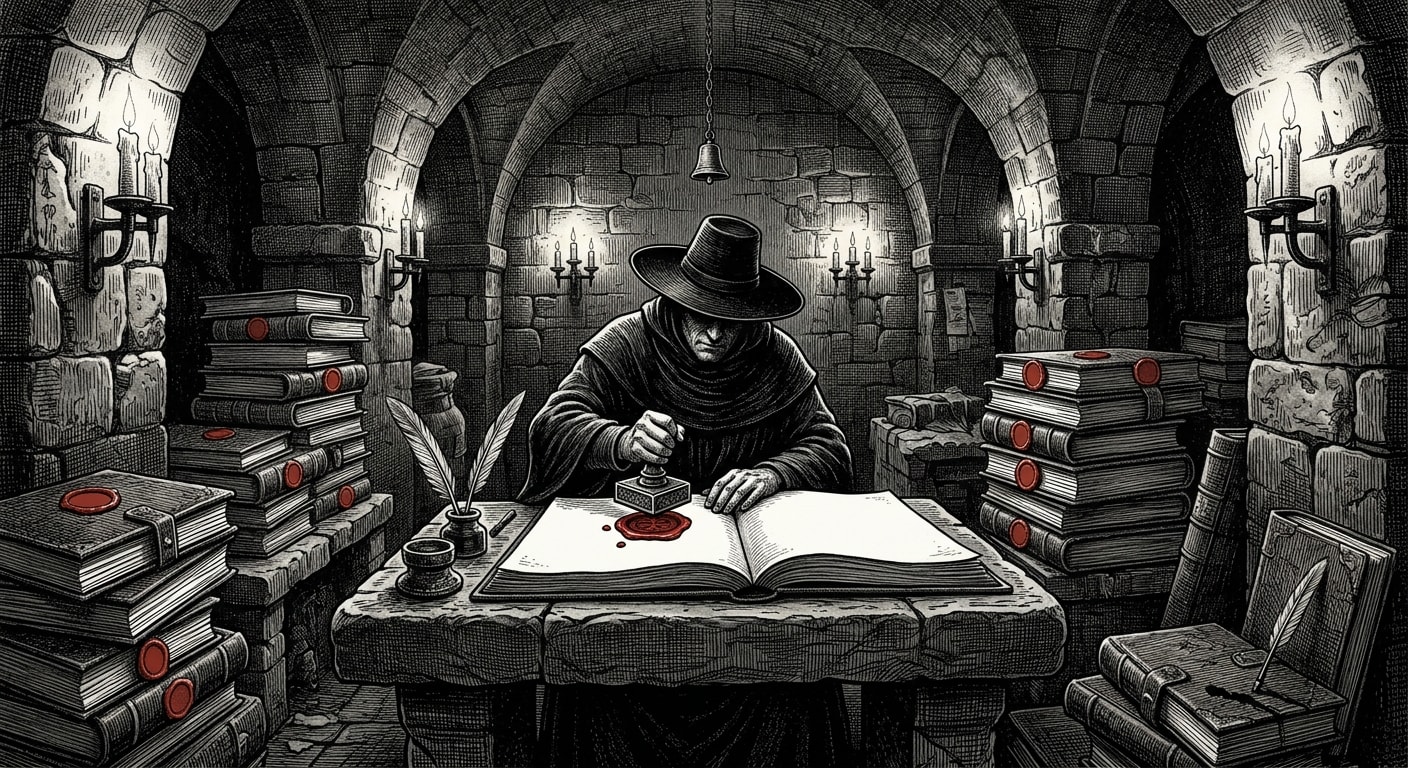
And above even the Custodian — rumoured, denied, confirmed by the quality of silence that follows the denial — the Omission Notary. The one who stamps the blank page. The one whose wax press transforms emptiness into doctrine. An Omission Notary does not collect. An Omission Notary certifies. The difference is the difference between killing a man and erasing the word "man" from the language. I have met an Omission Notary. I believe I have met an Omission Notary. The person I met denied being an Omission Notary, denied being a person, and denied being met. The meeting was, by all available metrics, a masterpiece of administrative fiction.
#On the Madness of the Blank
"If no record, no crime."
Earlier editions of this Codex classified the Gauze-Masked Custodian under "Bureau of Purity — Adjunct Operations."
The Bureau of Purity has requested, in writing, that this classification be stricken. The Bureau of Shadows has requested nothing, because it does not communicate requests, and because it does not exist. The Custodian is hereby reclassified under "Administrative Archetype — Nonexistent." The Bureau of Doctrine approves this paradox on doctrinal grounds I am not authorised to enumerate.
The profession devours its practitioners from the inside. The physical hazards are unremarkable — night violence, stairwell falls, sedative mishandling, the occasional encounter with something in the corridors that the Bureau of Records classifies as "atmospheric disturbance, nonrecurring." The true cost is cognitive. A Custodian spends a career describing the world in negatives, filing proofs of nonexistence, moving through rooms where every conversation is an act of careful omission. After sufficient years — and the threshold varies; the Bureau, I am told, tracks it with a precision that borders on the clinical — the Custodian's own sense of existence begins to erode. Friends forget to invite them. Neighbours cannot recall their faces. Lovers drift into the arms of people whose names survive the morning.
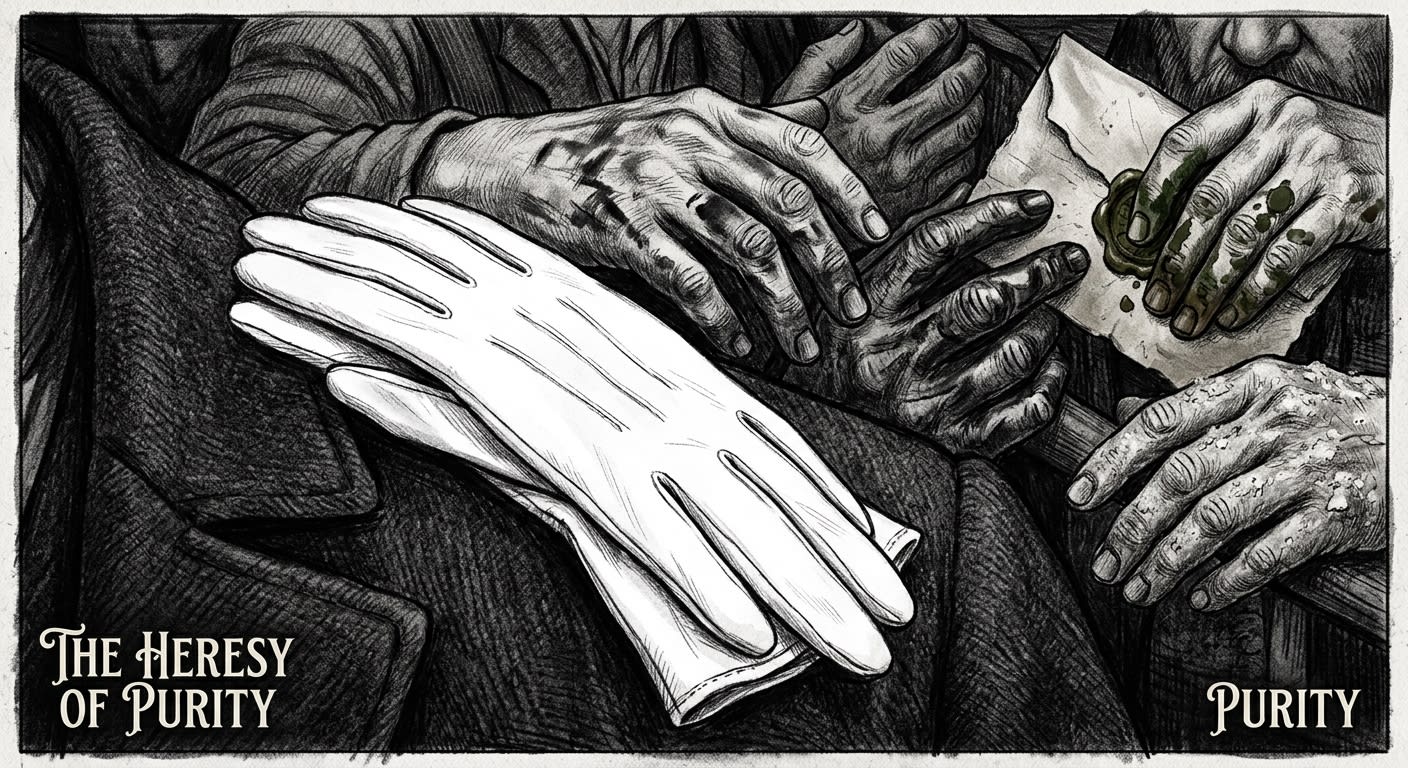
The Custodians call this going blank. It is the profession's terminal condition: you erase enough of the world and the world begins to return the favour. Old Custodians — the few who survive to become old — are indistinguishable from ghosts. They speak in negatives. They flinch from written names. They wash their gloves compulsively, as if the cleanliness were a sacrament against the void they have spent decades feeding.
There are superstitions. A Custodian never writes their full name — the horror story circulates in every cohort: a Custodian wrote his name once, privately, in a journal he kept against regulations, and within a week the world had agreed the name was misspelled and always had been. He spent his remaining years answering to a name that was not his own, unable to correct the error because the correction would require him to produce the journal, and the journal would prove he had kept records, and keeping records is the one sin the Bureau of Shadows does not forgive.
A bell sliver is sewn into the gauze — the sliver keeps the Lie from "answering" the silence, though what "the Lie" means and how silence can be "answered" are questions the Bureau of Doctrine has filed under Pending Review Since A.S. 134. Gloves are washed in salt after each shift. The blank-book is counted at dawn — every folio must match; a missing blank is a blank that has been used without authorisation, and unauthorised absence is, paradoxically, the most visible thing in the Bureau's vocabulary.
#On the Present Condition
The Bureau of Shadows does not exist. Its Custodians do not patrol Strasbourg's midnight bridges. They do not seal doors in the trenches. They do not file blank proofs in bastion capitals from Brest to Constantinople. They do not maintain the architecture of disappearance that permits the Synod to revise its truths without the inconvenience of acknowledging the revision.
And yet the gauze persists. The veils are seen — or rather, the veils are not seen, which is how one knows they are there — in every queue, every curfew, every midnight fog. Children still pray against the blank-men. Merchants still flinch at clean gloves. Rebels still vanish between one sentence and the next, their names erased from parish rolls before the ink of their arrest — I beg your pardon, their collection — has dried on a page that does not exist.
I am required to state that this profession archetype has been filed for administrative classification purposes only. I am required to note that no individual matching this description has been confirmed by any Bureau, including the Bureau whose nonexistence I have spent this entire tract confirming. I am required to file this document under headings the Bureau of Records can locate, and to trust that the Bureau of Shadows — which does not exist — will annotate my margins in due course.
The blank page has been stamped. The wax is cooling. I shall say no more — because there is nothing more to say, and because the Custodian seated in my office's second chair, the one I do not recall having placed there, has indicated by the angle of his gauze that my continued productivity is preferred to my continued curiosity.
Nihil obstat. Nothing was written. Nothing was read.