
#On the Year That Did Not Happen
"A period of accelerated filing." — Bureau of Records, Classification Index, entry for A.S. 180
The Bureau of Records classifies the Year of Smoke as an administrative notation. The Bureau of Shadows classifies it as nothing, because the Bureau of Shadows does not exist, and things that do not exist cannot classify events that did not occur. The city of Lübeck classifies it as a municipal irregularity. The merchant guilds of Lübeck do not classify it at all, because the merchant guilds of Lübeck dissolved themselves within a month of the event, and dissolved institutions lack the standing to file opinions.
I, Hieromnemon Valerius Drax, Warden of the Sacred Ledger, classify it as the night the Synod learned what it had built — and flinched, briefly, before requesting a second demonstration.
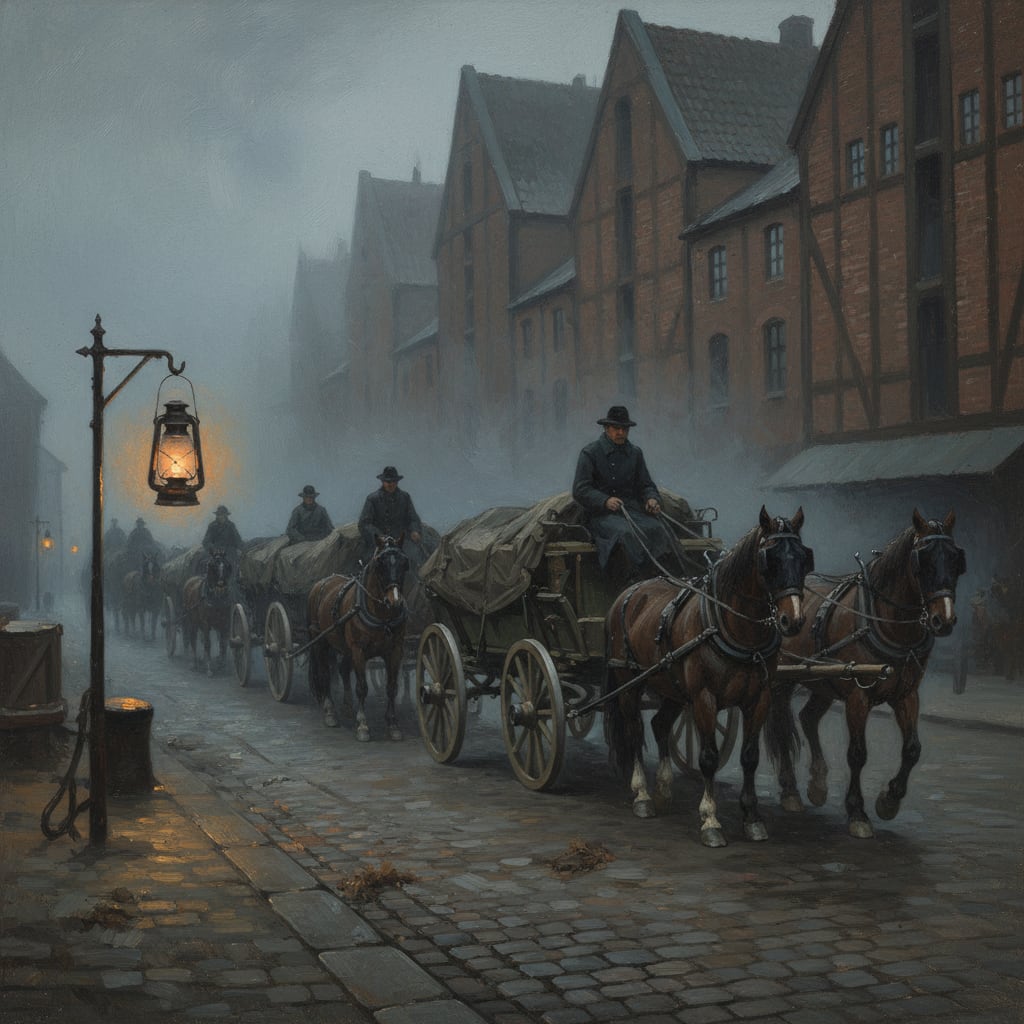
The facts, insofar as facts survive contact with the Bureau of Shadows, are these. On a night without moon in the harbour district of Lübeck — a Hanseatic port of the northern corridor, fat with Baltic grain trade, loud with guildhall politics, and possessed of a harbour-master whose chief professional failing was an appetite for accurate counting — eleven wagons departed the cobbled quays between the final peal and the third hour. They bore no insignia the Bureau of War would recognise. They carried no manifest the Bureau of Tithes could price. Their wheels were wrapped in wet straw. Their horses were hooded. Their drivers wore coats of the sort that fails, deliberately and professionally, to be memorable.
The harbour-master counted them. This was his error. He logged them as "administrative material, nonspecific" — the single entry allowed to exist for twelve hours before the gauze arrived.
The men arrived at dawn. Black gauze over their faces. No credentials presented. No receipt issued. They collected the log with the unhurried efficiency of men who had done this before and who considered the confiscation a filing correction — the log had always been blank; the harbour-master had merely failed to notice. They left in the harbour-master's own cart, which was later returned scrubbed, with a new axle and a receipt for one axle, filed against a vendor who did not appear in the guild registry.
The harbour-master was transferred to a lighthouse on the Frisian coast. He writes pleasant letters about birds. The Bureau considers him well-placed. The gulls, presumably, have no opinion worth filing.
#On the Eleven Wagons
The number eleven has no liturgical significance. I mention this because the Bureau of Doctrine was asked, within hours of the event's official nonexistence, whether eleven constituted a sacred quantity requiring Rites oversight, and the Bureau — meaning myself, at my desk, at three in the morning, with cold ink and warm irritation — replied that eleven was a prime number, that prime numbers belonged to mathematics, that mathematics belonged to the Creator's architecture, and that no further enquiry was required. This answer satisfied everyone, which means it satisfied no one but alarmed them into silence, which is the preferred outcome of all Bureau correspondence.
The wagons were Night Wagons — unmanifest transports of the Bureau of Shadows' logistics arm. Each carried cargo the drivers were trained not to describe and the recipients were trained not to acknowledge. Each followed a negative route: streets chosen by omission, gates opened by bribery or prior arrangement, bridges crossed in the interval between bell-peals when even the Bureau of Bells admits its hearing is imperfect.
What the wagons carried has never been stated. What happened after the wagons departed has been stated repeatedly, in contradictory accounts, by sources who agree on every detail except the ones that matter. The Bureau of Shadows' own operational assessment — produced by an institution that does not exist and filed in an archive that has no catalogue number — uses the phrase "material redistribution consistent with doctrinal hygiene." I have read this phrase. I have admired it. I have filed it alongside my other favourite lies, in the cabinet marked "Eloquent."
#On the Aftermath, Which Also Did Not Occur
Within the month, Lübeck rearranged itself.
Three merchant guilds dissolved. The Grain Merchants' Guild, the Salters' Compact, and the Coopers' Brotherhood of the Blessed Barrel each filed articles of voluntary dissolution with the Bureau of Records within days of one another, citing reasons that ranged from "spiritual renewal" to "insufficient membership" to — in the Coopers' case — "a desire to pursue contemplative silence." The Coopers of Lübeck had been notorious for volume at tavern and at quay. Their sudden embrace of contemplation was greeted by the municipal authorities with the solemn respect one extends to men who have clearly been visited by grace, or by gauze, and who understand that the distinction is administrative.
Two aldermen resigned. They entered what the Bureau of Doctrine terms "contemplative vocations" — monasteries in the Rhineland whose abbots accept new brothers without asking why the brothers arrived with packed trunks, no family farewells, and a pronounced reluctance to stand near windows. The aldermen's seats were filled within the week. The replacements were, by all accounts, satisfactory and quiet. They voted as instructed. They did not count wagons.
The fire was the centrepiece. It consumed forty years of harbour records — shipping manifests, tariff receipts, cargo declarations, pilot logs, anchorage fees, tide tables, chandlery invoices, and every scrap of paper that might have told a careful reader who had been importing what, and for whom, and at whose instruction, and with what exemptions from the Bureau of Tithes' otherwise insatiable appetite for revenue. Forty years reduced to ash in a single night, and the ash itself swept into the harbour basin before sunrise by persons the fire brigade described as "already present when we arrived, sir, with brooms."
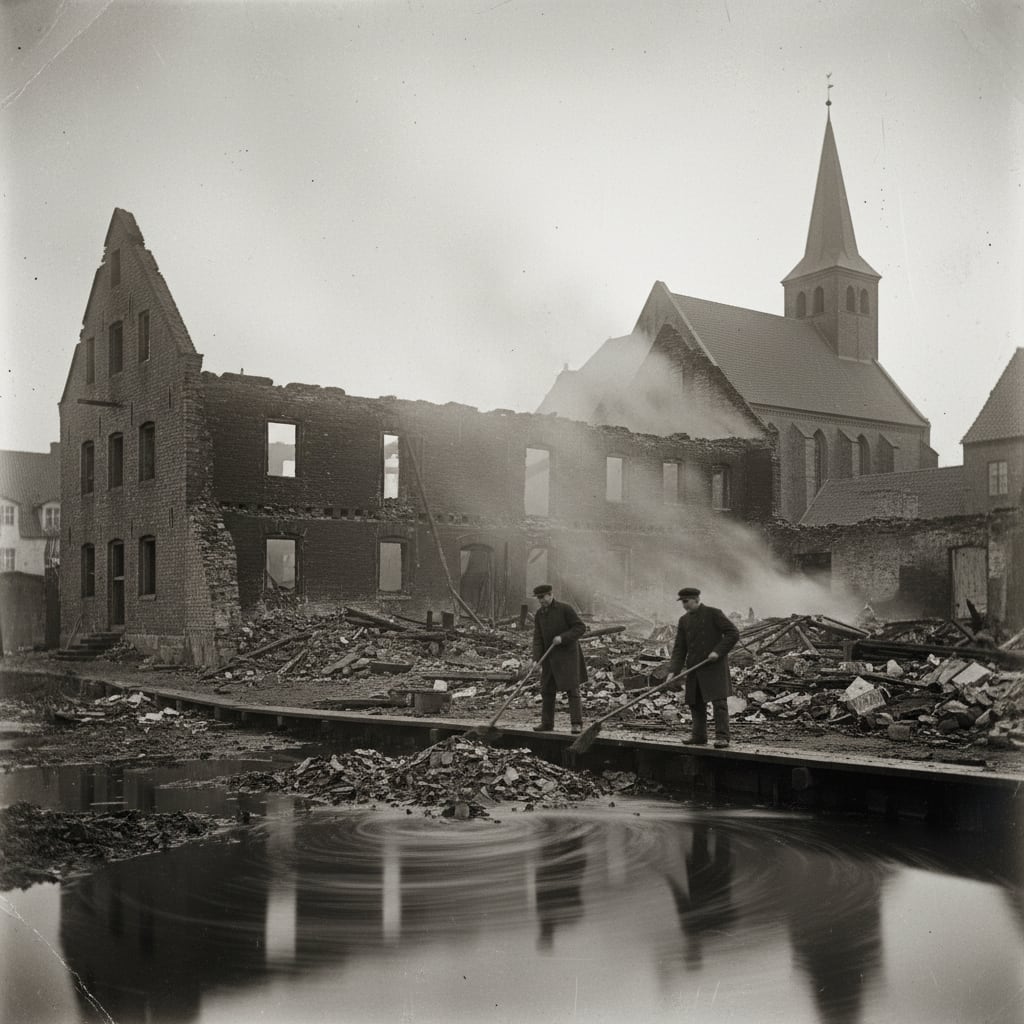
The fire spared three things. The wine-cellar, because wine has powerful friends. The chapel roof, because the Bureau of Doctrine insists on maintaining its architectural record even when the architecture below it is being systematically incinerated. And a locked office belonging to a clerk who had resigned the previous week.
The locked office contained records the fire had been instructed to miss. I know this because I was shown the inventory — seventeen years after the event, by a man whose face I could not see, in a room I could not find again, on a night I have since agreed did not happen. The inventory listed shipping movements, debt instruments, guild charters, and a series of correspondence between Lübeck's aldermanic council and parties in the eastern Sagittal corridor whose names had already been filed under Administrative Dissolution by the Bureau of Purity. The correspondence discussed supply routes. It discussed payments. It discussed arrangements that, if described plainly, would constitute commerce with entities beyond the Line — which is heresy of the first water, punishable by methods the Bureau of Purity has developed into an art form and the Bureau of Mercy has developed into a filing system.
The locked office was the Bureau's evidence locker. The fire was curation by means of destruction.
#On the Name
The phrase "Year of Smoke" entered the common tongue within weeks. This is remarkable speed for a city whose guilds had been dissolved, whose records had been burned, and whose surviving aldermen had discovered the theological virtues of silence. The name spread through barracks rumour, Queue Road gossip, trench-wall graffiti, and the whispered expertise of Night Wagon Drivers whose profession had, overnight, acquired a founding legend with better production values than anything the Bureau of Doctrine had managed in decades.
Several municipal histories refer to the Year of Smoke as "the Lübeck cartage irregularity."
Corrected by order of the Bureau of Doctrine, A.S. 194. An irregularity misplaces invoices. The Year of Smoke removed guilds, ledgers, men, debts, and the habit of counting wheels after curfew. The municipal historians who coined the phrase have been praised for tact and denied access to ink.
The Bureau of Shadows did not name it. The Bureau names nothing, because naming implies existence, and existence implies accountability, and accountability implies an institution that can be held to account, and the Bureau of Shadows cannot be held to anything because it does not — but I repeat myself. The name arose from the street, where citizens noticed that their harbour records were ash, their guilds were absent, their aldermen were praying, and the only explanation on offer was a fire that started everywhere and ended nowhere and left behind brooms.
Children began holding their breath when wheels passed after curfew. Merchants counted hoofbeats in the night and lied about the total at breakfast. Priests preached that fear of lawful correction was itself a minor sin, and attendance at those sermons declined with a speed that demonstrated the lay mind's occasional instinct for survival. The Night Papers Couriers — those hooded runners of grey vellum and grave-dust wax — found their own myth hardening in the Year of Smoke's wake. Before Lübeck, they were rumour. After Lübeck, they were infrastructure.
#On What Was Removed
The Bureau of Shadows' stated purpose — were the Bureau to state purposes, which it does not, because it does not exist — is the maintenance of doctrinal security through the selective removal of inconvenient realities. The Year of Smoke was a removal. What it removed was a network.
Lübeck's harbour, by A.S. 180, had become a node in a commercial lattice that the Bureau of Tithes had failed to tax, the Bureau of Records had failed to log, and the Bureau of Purity had failed to purify, because all three Bureaus had been undone by the oldest enemy of bureaucracy: men who knew how to file paperwork that looked correct. The guilds — Grain, Salters, Coopers — had maintained parallel ledgers. The aldermen had maintained parallel contacts. The harbour-master had maintained, with fatal conscientiousness, an accurate log. The network moved goods, debts, favours, persons, and information through the northern corridor in channels the Synod's own machinery could not distinguish from legitimate trade.
Whether the network served Rationalist sympathisers, freelance smugglers, rogue Bureau operatives, or something worse has never been determined. The locked office's inventory suggests all of the above, in proportions the Bureau of Shadows has not disclosed. The fire's selectivity suggests the Bureau already knew which records to preserve and which to burn, which means the Bureau had been watching long before the eleven wagons rolled. The watching is the real operation. The wagons were the punctuation.
#On the Precedent
The Year of Smoke established a grammar the Bureau of Shadows would use for the next two decades. The Apparatus of Gate Nine, A.S. 178 — two years before Lübeck — was the prototype: a Bureau of Engineering survey that punched through to something the Bureau preferred not to name, followed by transfers, sealed reports, and a filing sequence only Shadows could access. But Gate Nine was a single incident, contained in a single location, managed with the quiet efficiency of men who bury one body and go home.
Lübeck was civic surgery. An entire port city's commercial memory excised in a single night, cauterised with fire, bandaged with transfers and dissolutions and contemplative vocations, and left to heal around the scar. The city continued to function. Ships docked. Grain moved. The harbour filled with new merchants who asked fewer questions and counted fewer wheels. Lübeck prospered, after a fashion, in the way that a patient prospers after the surgeon removes the organ that was, admittedly, keeping secrets the surgeon preferred not to share.
SHADOW OPERATIONAL SUMMARY — A.S. 180–185: Following the Lübeck action, Bureau of Shadows logistics capacity expanded to ████ active Night Wagon routes across ████ corridor cities. Personnel intake from ████████████████ sources increased by ████ per cent. Custodian deployment authorisations ████████████████████████. The Bureau of Records continues to classify all activity as "routine supply." The Bureau of Doctrine continues to classify all activity as "someone else's problem." ████████████████ I continue to classify all activity as "alarming but stylish."
Five years after Lübeck, the Saint Veritas disappeared from Constantinople's harbour during the Silence of the Harbour Lamps (Unregistered). The ship returned six months later. The crew claimed they had never left. The log contained forty pages of the same phrase. The Bureau of Shadows filed it. The Bureau of Doctrine filed it. I applied for access and was told, with a patience that bordered on menace, to return to my duties.
The Year of Smoke is the fulcrum. Before it, the Bureau of Shadows was a theological abstraction — fourteen decrees confirming its nonexistence, a handful of vanished scholars, a ghost story for children who would not sleep. After it, the Bureau was an operational fact that happened to be officially fictional. The distinction is everything. A ghost story frightens. An operational fact with wrapped wheels and hooded horses and a fire that selects its own fuel — that governs.
An earlier Codex draft attributed the Year of Smoke to "internal Bureau of Records restructuring."
The Bureau of Records does not restructure with fire. The Bureau of Records restructures with memoranda, revised filing protocols, and the quiet demotion of clerks who use the wrong colour ink. The Year of Smoke involved eleven wagons, three guild dissolutions, two aldermanic retirements, one fire, one lighthouse transfer, and zero receipts. Restructuring never sounded like this. This is the Bureau of Shadows reminding Europe that paper burns, men forget, and the wheels that pass after curfew carry no name you are permitted to remember.