
#On the Absent Wagon
“Collect without record.” — stable-wall instruction, subsequently whitewashed, still legible in damp weather
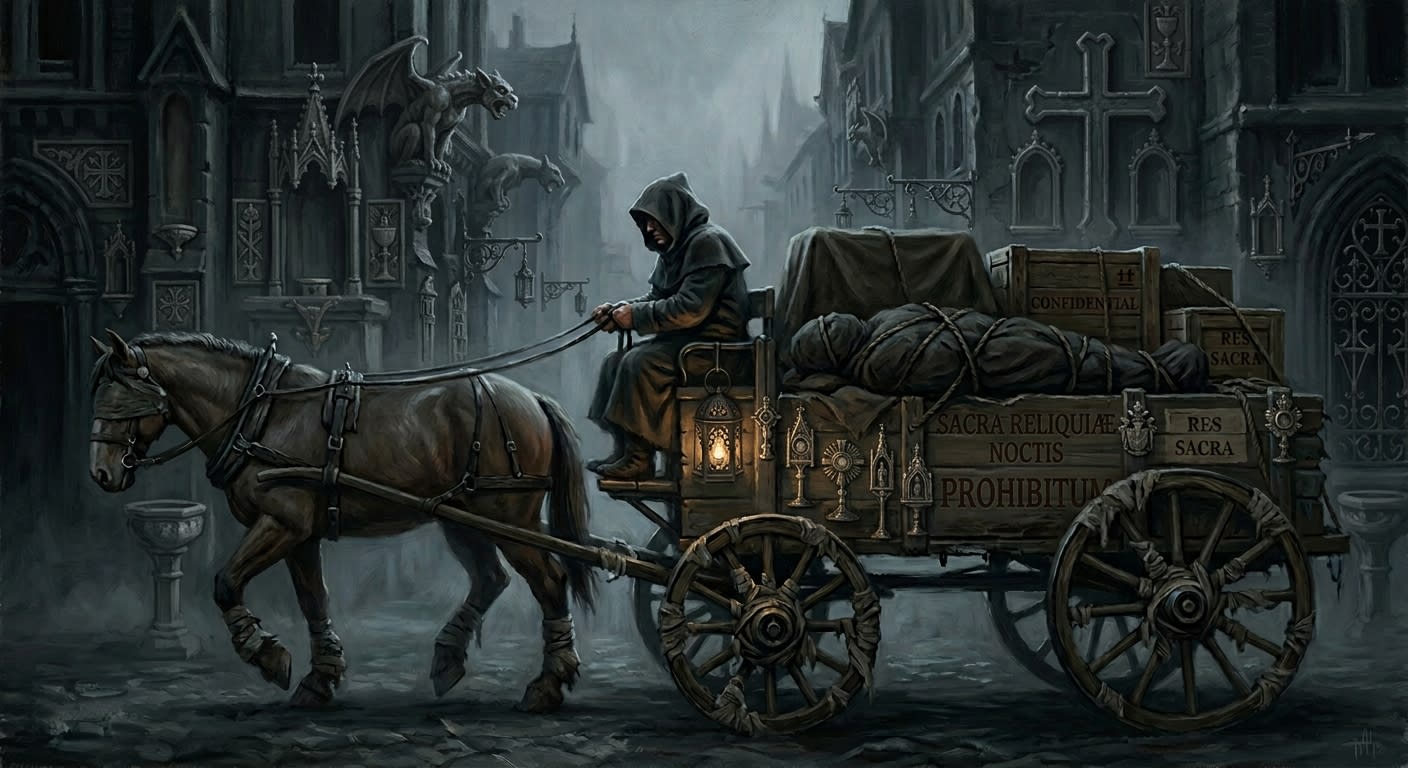
The Night Wagon Driver performs the one labour without which the Bureau of Shadows would remain an elegant theory, a theological embarrassment with fine wax and no reach. Shadows can erase only what they can touch. The Night Wagon is the touch: wheel, axle, hooded lantern, blindfolded horse, wrapped spoke, wet straw, and a driver whose chief professional qualification is the ability to move through a city as if the city had agreed, in advance, to forget having streets.
The common imagination, poor little peasant organ that it is, thinks disappearance occurs in a room. A black veil enters. A hand closes. A name leaves the parish roll. This is theatre. Necessary theatre, well-lit theatre, but theatre still. After the hand closes, the body must go somewhere. The witness must be moved, the clerk removed, the relic-fragment reboxed, the inconvenient heir carried from cellar to corridor-door, the cargo shifted from the warm architecture of personhood into the cool arithmetic of weight.
That is the driver’s office.
A Night Wagon carries no manifest. It bears no insignia the Bureau of War recognises, no tariff stamp the Bureau of Tithes can price, no route chit the Bureau of Records can reconcile without developing a headache and a sudden desire for reassignment. It passes after the final peal and before Matins. If logged, it is logged as routine supply. If seen, it was a grain cart. If heard, it was wind under the eaves. If stopped, the gate captain has already been paid, threatened, promoted, or removed.
The Driver of the Unmanifest makes vanishing punctual.
#On the First Carter and the Year of Smoke
The official doctrine declares that no wagon runs for Shadows; therefore no collection occurred. This doctrine has the clean circularity of a seal pressed into its own wax. It tells us nothing, proves everything, and inconveniences only the honest.
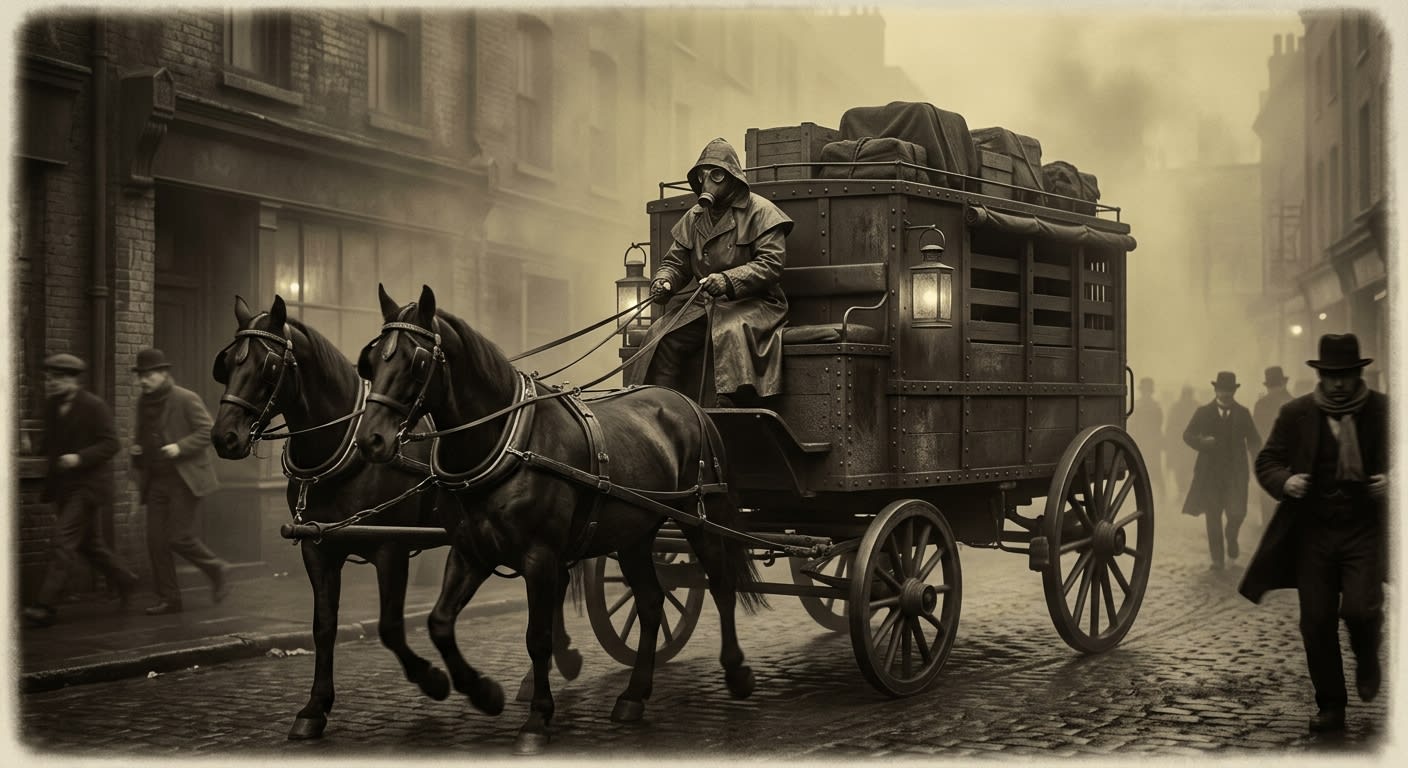
The profession’s founding myth names the First Carter of Strasbourg, always unnamed, always old, always waiting beneath a bridge with a lantern hooded in black felt. He is said to have driven the first collected man through seven streets, three courtyards, two chapels, one wine cellar, and a door that opened into a corridor no architect had drawn. At the route’s end, the wagon was empty. At dawn, the target’s house had always belonged to someone else. The horse, in a detail I admire for its administrative excess, received a ration increase.
The myth is pleasant. The truth has more grease on it.
The earliest Shadow wagons were requisitioned from plague carts, tariff chapels, stable-yards attached to penitential hospitals, and the back lots of Strasbourg churches whose vicars discovered that charity became easier when the Bureau forgot certain youthful indiscretions. The drivers were carters already trained to move bodies without complaint: corpse haulers, quarantine men, battlefield salvage crews, river-port night labourers, and those rare smugglers whose genius lay in being boring.
By A.S. 180, the trade acquired its public myth-anchor: the Year of Smoke in Lübeck. Eleven unmarked wagons departed the harbour district on a night without moon, bearing “administrative material, nonspecific,” according to the one log allowed to exist for twelve hours. The harbour-master counted them. Men in black gauze collected the log the next morning, leaving neither receipt nor apology, and the harbour-master was transferred to a Frisian lighthouse where he wrote, with suspicious cheer, of gulls.
Within the month, three merchant guilds dissolved themselves, two aldermen entered contemplative vocations, and a fire consumed forty years of harbour records while sparing the wine-cellar, the chapel roof, and a locked office belonging to a clerk who had resigned the previous week despite having died in childhood according to later rolls.
Several municipal histories refer to the Year of Smoke as “the Lübeck cartage irregularity.”
Corrected: an irregularity misplaces invoices. The Year of Smoke removed guilds, ledgers, men, debts, and the habit of counting wheels after curfew. The municipal historians responsible for the soft phrase have been praised for tact and denied access to ink.
After Lübeck, the phrase “Night Wagon” entered street superstition, barracks humour, and Bureau denial with equal speed. Children held their breath when wheels passed after curfew. Merchants counted horses by hoofbeats and lied about the total. Priests preached that fear of lawful correction was itself a minor sin. Attendance declined at those sermons, which demonstrates the lay mind’s occasional instinct for survival.
#On the Negative Route
A visible route has names: Bridge of Saint Adelmar (Unregistered), West Toll (Unregistered), Candlemarket Lane (Unregistered), Gate Six (Unregistered), river stair. A Night Wagon route is composed of absences.
Do not pass the bell-tower while the bell is warm. Do not cross a square where windows face inward. Do not use the same gate twice in a week. Do not stop beneath painted saints whose eyes have been reported wet since A.S. 143. Do not take the cobbled street that remembers iron wheels. Do not let the horse choose, because horses have better consciences than drivers and worse judgment.
The driver calls this driving the negative.
The work begins before dusk. Morning is sleep, if sleep will come; axle inspection, if it will not; burning last night’s straw, which remembers too much; scraping soot from the lantern hood; rubbing wax from fingernails; counting the wrapped keys to ensure they still decline to jingle. Midday provides cover work: sanctioned carting, stable duty, fuel delivery, chapel ash removal, whatever honest labour will bore the neighbourhood into indifference. Late day is for the harness swap. The ordinary horse goes back to its stall. The blindfold horse comes out. The wheels are wrapped. The lamp is hooded. The body compartment is checked for old blood, new splinters, and loose straw.
Night is collection.
A Custodian delivers the target, or the driver collects at a door whose hinges have been oiled by someone else. A Night Papers Courier may arrive breathless with grey vellum and wax grit under the nails, demanding the wagon outrun dawn. A Gauze-Masked Custodian may stand beside the passenger, saying nothing, which is how Custodians say everything. The passenger may ask where they are going. The old answer is best.
“Not where you were.”
The wagon moves.
#On Cargo
There are three categories of cargo: speaking, silent, and wrong.
Speaking cargo bargains. It offers coin, rank, family names, foreign protection, confession, sexual favours, treason, recipes, anything the mouth can throw against terror. The driver is trained to hear none of it. This training works poorly. Drivers are low creatures, recruited from practical stock, and practical stock knows the value of information. Thus the Bureau’s first rule: never speak a passenger’s full name inside the wagon. A name gives the road a hook. It gives the driver a hook too, and drivers hooked by pity end as cargo.
Silent cargo is simpler and heavier. Bodies, sedated witnesses, relic crates, ash sacks, sealed folios, saints’ fingers, counterfeit saints’ fingers, boxes that hum, boxes that sweat, boxes marked DO NOT OPEN in the hand of a man whose handwriting was later ruled to have belonged to no one. Silent cargo has the decency to make no promises.
Wrong cargo is the reason old drivers sleep facing the door.
WAGON INCIDENT REPORT — A.S. 194 — STRASBOURG EASTERN WARRANT CIRCUIT: Driver received one child, approximate age █, designation “administrative material.” Passenger sang approved cradle hymn in dialect extinct since A.S. 32. Horse refused forward motion at ████ Bridge. Lantern flame inverted. Custodian advised continuation. Driver continued. Delivery door opened inward onto ███████████████. Driver returned with empty wagon and white hair. Child present in parish census next morning under name [REDACTED], age 43.
A wagon departs full and arrives empty. A wagon departs empty and arrives heavy. The discrepancy is filed as gravitational variance. I have seen this phrase. I know the clerk who approved it. His career has prospered, proving that cowardice, when expressed in tidy Latin, becomes administrative prudence.
The driver is judged by the absence of residue. No wheel track left in soft ash. No straw caught on a nail. No gate-man too sober to forget. No repeated lantern sighting. No child at a window who can say how many spokes the wheel had. Excellence is a neighbourhood unable to agree, by breakfast, whether it heard anything at all.
#On Drivers, Hands, and Corridor Masters
The hierarchy is short because the job eats the sentimental before they can become senior.
At the bottom are Wheel-Boys (Unregistered): stable children, debt-wards, runaways, and apprentice criminals assigned to wrap spokes, rake tracks, burn straw, hold horses, and learn which questions cause beatings. A good Wheel-Boy can silence a harness in under forty breaths. A poor Wheel-Boy is reassigned to front convoys, where ordinary artillery provides the instruction he failed to absorb.
Above them are Carters and Runners, entrusted with short routes and single pickups. They learn the bribe grammar of the city: the first coin buys passage, the second buys forgetting, the third buys a lie with embellishments. They learn which gate captain drinks, which stable chief has a daughter in Marrowgate, which depot chaplain sells absolution slips after midnight, which Lantern mercy-men are brave enough to interfere and foolish enough to survive the first warning.
The Night Wagon Driver proper holds full route authority. He may choose the negative route, accept cargo without manifest, redirect to a quiet door, or refuse a handoff when the road smells wrong. Refusal is rare. It is also educational. The Bureau teaches by consequence.
At the top stands the Corridor Master, a driver who knows Strasbourg’s unmarked doors. This is less a rank than a disease. A Corridor Master knows which tariff chapel opens onto the mill-wharf berth, which bridge stair joins the proxy corridors, which cellar beneath a respectable bakery descends into a route the Bureau of Records swears is a drainage error. He knows the door that opens only when approached with an empty wagon. He knows the door that refuses witnesses. He knows the door that leads, according to one surviving Wheel-Boy, to the same alley you left by, except the moon is in the wrong place and your passenger has never been born.
Sell those routes and you become cargo. Lose those routes and you become useless. Remember them too well and the routes begin remembering you.
#On the Cost of Driving Absence
The driver’s first loss is sleep. The second is vocabulary.
Shadow-logistics teaches speech by negation. Unseen. Unloaded. Unstopped. No cargo. No passenger. No route. No incident. The grammar spreads like damp through brick. A driver questioned by his wife says he was not late. Asked whether he is afraid, he says nothing happened. Asked whom he carried, he says no one. After five years, this may be discipline. After ten, it is diagnosis.
Earlier stable manuals described long-service drivers as “discreet by temperament.”
Amended: they are damaged by method. Discretion is choosing silence. The old driver does not choose. He has been harnessed to absence until ordinary speech rubs the mouth raw.
The body shows its own ledger. Wax-stained nails. Rope burns at the palms. A permanent night-squint. The right shoulder sits lower from years of checking the rear curtain without turning fully around. The driver counts peals while drunk. He flinches at wheel squeal in daylight. He can identify axle grease by smell and guilt by the way a passenger inhales before bargaining.
The spiritual hazard is harder to weigh. Blank space gets hungry. A route used too often develops road-wounds: short stretches of alley where hoofbeats vanish, where lantern light bends inward, where a wagon arrives with straw wet from rain that never fell. The Bureau of Engineering has proposed surveys. The Bureau of Shadows has declined to receive them, being nonexistent and therefore difficult to petition. The drivers mark such places with scratches on the underside of seat boards, private maps written where auditors do not kneel.
Private route maps are forbidden. Every driver keeps one.
Some drivers go blank like Custodians. Others go blackwheel: selling unmanifest transport to smugglers, rebels, desperate families, corrupt abbots, or widows with enough coin to purchase one illegal return. The Blackwheel Freelancer is the Bureau’s favourite enemy, because he proves the Bureau’s method works outside Bureau hands. Nothing infuriates a sacred monopoly like theft of technique.
#On the Present Traffic
As of A.S. 201, Night Wagons run wherever erasure would otherwise stall: Strasbourg warrens, Latchford permit alleys, Queue Road null verges, Brest rear trenches, Przemyśl ridge roads, Sibiu convoy gates, Irongate tunnel mouths, Shipka fog lanes, and the harbour stairs of Constantinople, where lamps have already once gone dark for three nights and no one with prospects asks why.
They are paid in ration privileges, stable corners, fuel access, silence rights, forgiven infractions, and occasional permission to continue possessing a name. Their enemies are auditors, inquisitors with jurisdictional vanity, gate captains who grow expensive, Lantern vigilantes, rival crews, bell miscounts, dawn orders, and passengers who know too much about the driver’s own past.
The trade is busier. This remains unadmitted. Grave-wax purchases have risen; wheel-wrapping stock has doubled in three cities; old mill-wharf berths in Strasbourg show fresh iron on their rings. The Bureau of Shadows denies all cartage. The Bureau of Records logs routine supply. The Bureau of Doctrine advises citizens to sleep through curfew and trust lawful authority, which is excellent advice for those who enjoy waking to find their neighbours improved by absence.
A wheel passes after the last bell. Hold your breath if superstition comforts you. Count the spokes if stupidity commands you. By morning the street will be clean, the straw burned, the gate-man paid, the ledger corrected, and somewhere behind a door no architect drew, a driver will wash grey wax from his nails and sleep facing the exit.