
#On the Port That Learned to Stop Counting
“The harbour remembers eleven. The city remembers smoke. The records remember neither, and have been promoted for their discipline.” — anonymous quay chalking, erased three times before Matins.
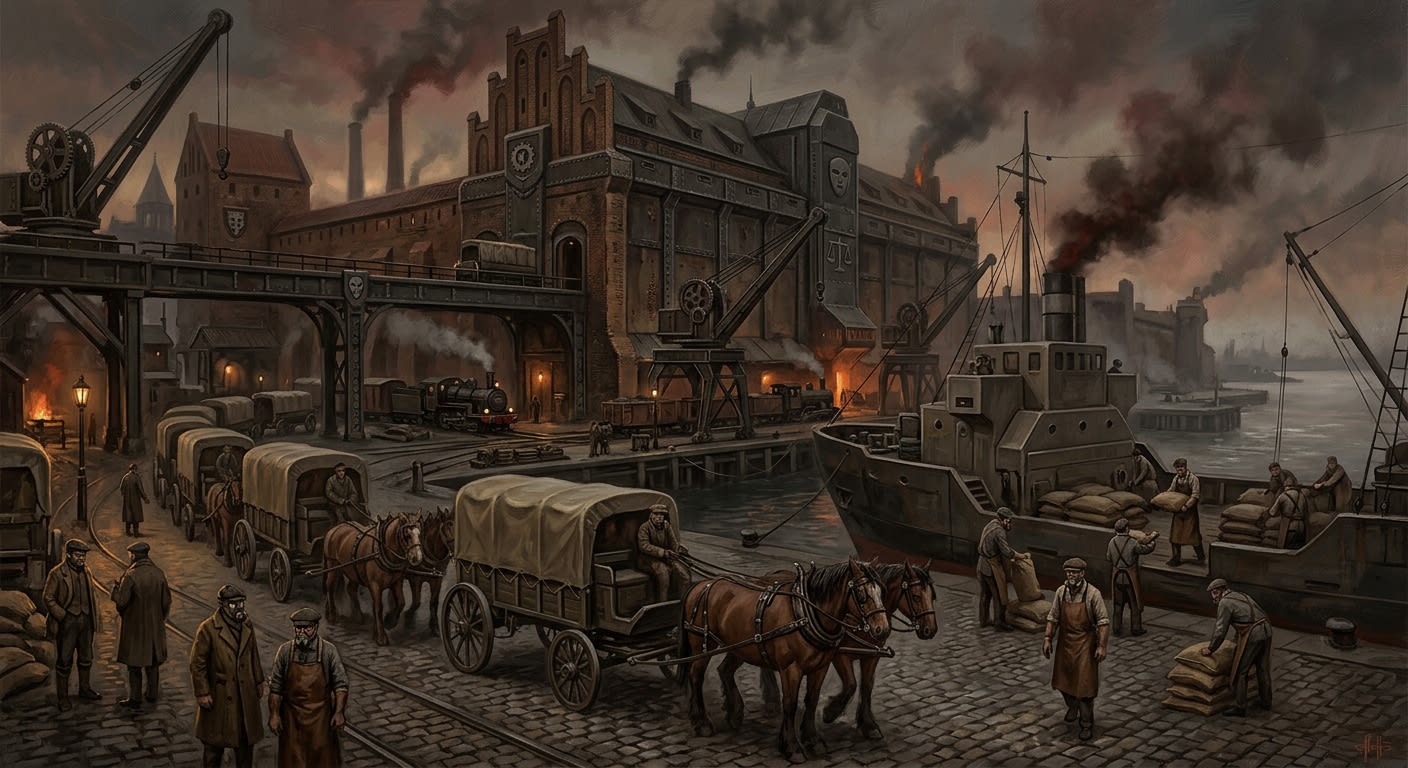
Lübeck sits in the northern corridor like a sealed mouth with good teeth: a Hanseatic port of old privilege, Baltic grain, winter rope, ship timber, cod oil, wax consignments, and merchants who inherited the profound northern conviction that the Creator loves honest trade provided the tariff clerk cannot prove it. Its quays face the cold water. Its counting houses face east. Its churches face heaven with the strained expression of institutions that have seen the ledgers beneath the altar.
The city matters because grain moves through it. Grain for Bastion-Königsberg, grain for Bastion-Brest, grain for winter garrisons whose patriotism curdles when porridge thins, grain priced by the Bureau of Tithes, counted by the Bureau of Records, blessed by clerks who have never been hungry enough to understand theology. Before A.S. 180, Lübeck was a port with an old guild soul and a modern Synodic collar. After A.S. 180, it became a lesson.
The official registers name it a northern commercial municipality under Synod oversight, attached to the Baltic corridor, subordinate to the usual offices, compliant in all forms that survive inspection. The street names it Smoke-Harbour when drunk and Lübeck when sober. The distinction is sensible. Sobriety is a permit condition.
#On the Harbour and Its Fat Clerks
The harbour district is built for appetite. Warehouses crowd the waterline in brick ranks, their hoist-beams jutting like accusation fingers over the quay. The cranes creak through dawn fog. Bells mark arrivals, departures, tariff windows, fish rot, grain sampling, devotional pauses, compulsory quiet, and those delicate hours after curfew when every honest citizen is asleep and every useful one is not.
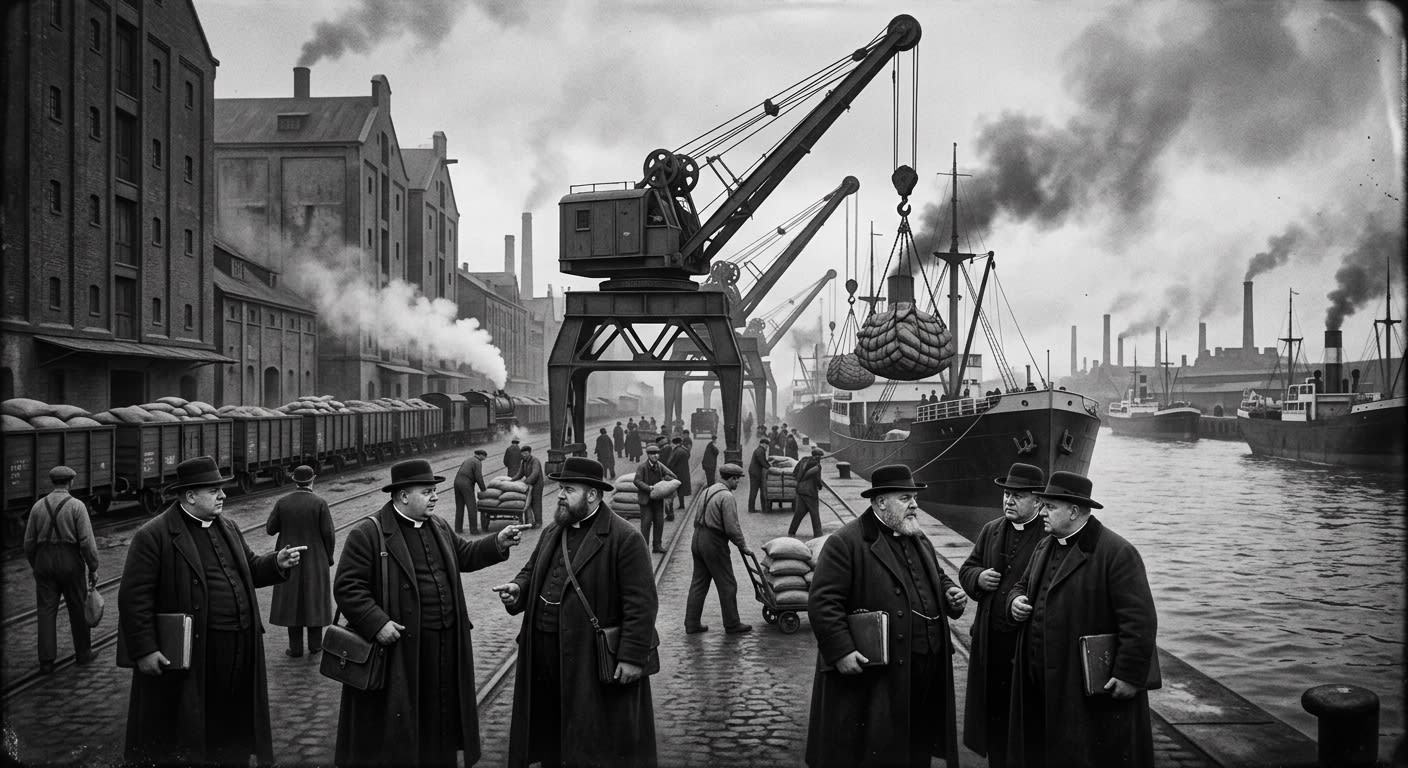
Lübeck's old merchants built counting houses with windows facing the basin so a man could watch cargo while pretending to admire Providence. The Grain Merchants' Guild kept its hall nearest the principal weigh-bridge. The Salters' Compact owned the brine cellars and, by extension, half the city's winter patience. The Coopers' Brotherhood of the Blessed Barrel occupied a hall so loud that gulls avoided it during festivals. All three survived wars, levy revisions, tithe adjustments, dock fires, Purity visits, and maritime weather. They did not survive the Bureau of Shadows learning their filing habits.
The harbour-master before the Smoke is remembered in surviving tavern songs only as Old Eleven. Records gives him a name in one annex, a different name in a personnel correction, and no name in the lighthouse transfer. He counted ships, carts, seals, excise chits, bribe bundles, rope coils, dead dockhands, missing sacks, and finally wagons. His talent was accuracy. His flaw was accuracy. In the Synod, the same trait changes category according to who is being counted.
#On the Year of Smoke
A.S. 180 is the year Lübeck ceased being merely useful and became exemplary.
On a moonless night in the harbour district, eleven unmarked Night Wagons departed between the final peal and the third hour. Their wheels were wrapped in wet straw. Their horses were hooded. Their drivers wore coats designed by that severe school of tailoring whose highest ambition is to be forgotten by witnesses before breakfast. They carried no manifest the Bureau of Tithes could price and no insignia the Bureau of War could salute. One temporary log described their cargo as “administrative material, nonspecific.” The log lived for twelve hours, which is a long and foolish life for evidence.
At dawn, men in black gauze collected it.
Within the month, the city rearranged itself with the sudden obedience of furniture after an earthquake. Three guilds filed voluntary dissolutions. Two aldermen entered contemplative vocations in Rhineland monasteries where windows are narrow and correspondence is reviewed for spiritual weight. Forty years of harbour records burned in a single fire of unknown origin, though “unknown” here means the fire brigade did not ask the persons already sweeping ash into the basin to identify themselves.
The fire spared the wine-cellar, the chapel roof, and a locked office belonging to a clerk who had resigned the previous week despite having died in childhood according to later parish rolls. This is why I distrust childhood. It so often arrives after the resignation.
Lübeck municipal histories formerly referred to A.S. 180 as a “cartage irregularity” or “accelerated filing incident.”
Corrected. A cartage irregularity loses a wheel. An accelerated filing incident misplaces a drawer. The Year of Smoke removed guilds, ledgers, men, debts, aldermen, and the civic habit of counting wheels after curfew. The historians responsible for the softer terms were praised for tact and denied ink.
The city did not riot. This fact impressed Strasbourg more than the fire. Any brute can burn a guildhall. Only a master office can burn the commercial memory of a port, dissolve its governing bodies, transfer its witnesses, frighten its merchants, and have ships unloading grain at the second bell as though obedience had been scheduled months in advance.
#On What the Smoke Covered
The convenient answer is smuggling. Lübeck certainly smuggled. Ports are mouths; mouths lie; no adult should be startled. Salt moved without tax stamps. Grain moved under false moisture grades. Timber recorded as chapel repair stock became private hull-planking. Barrels labelled cod-liver oil carried correspondence folded in waxed skin. A city with old Hanseatic bones does not need instruction in secret commerce. It teaches the class.
The inconvenient answer is network.
By A.S. 180, Lübeck had become a commercial node whose legal traffic and illegal traffic had braided so tightly that the Bureaus could no longer tell which strand was choking them. The Grain Merchants kept parallel ledgers for untaxed corridor supply. The Salters maintained debt accounts in brine-cellar codes. The Coopers made barrel counts that did not match barrel volume, which is to say they invented theology for wood. The aldermen corresponded with parties in the eastern Sagittal corridor whose names had already been filed under Administrative Dissolution by Purity. Those correspondences discussed routes, payments, exemptions, and arrangements which, if written plainly, would have required the white coats, the black coats, the grey coats, and possibly a priest with a very strong stomach.
The locked office spared by the fire contained the useful part. Shipping movements. Debt instruments. Guild charters. Names. The Bureau of Shadows did not burn ignorance into the harbour. It burned curation. The records it needed survived. The records that might have let others understand the operation became ash, then harbour mud, then, in due course, fish. Such is the food chain of state secrecy.
SHADOW INVENTORY — LÜBECK LOCKED OFFICE, A.S. 180 Recovered: █ shipping ledgers; ███ debt instruments; correspondence with dissolved eastern corridor entities; three seal plates lacking issuing office; one child's baptismal roll used as cipher key; harbour-master's secondary count. Disposition: ████████████████ Residual witnesses: two aldermen, transferred; one harbour-master, lighthouse; clerks ██████████
#On the City After Surgery
A city cauterised by Shadows does not look ruined. Ruin is honest and unfashionable. Lübeck's cranes still worked. Its harbour still took Baltic hulls. Its churches still rang their sanctioned peals. The grain sacks still came ashore, were weighed, stamped, blessed, taxed, sampled, infested, argued over, and sent onward to the hungry east. Prosperity returned because prosperity had never been the target. Memory was.
After the Smoke, Lübeck developed the civic manners of a house where a death has occurred and the corpse is still seated at dinner. Conversations shortened near windows. Tavern songs lost verses. Guild jokes became unsafe because there were no guilds to receive them. Children held their breath when wheels passed after curfew. Merchants counted hoofbeats and lied about the total at breakfast. Priests preached that fear of lawful correction was a minor sin, and the pews emptied with admirable theological prudence.
The new merchants asked fewer questions. They kept cleaner books. They learned which records mattered to Records, which records mattered to Tithes, which records mattered to Purity, and which records mattered to no one until black gauze appeared at dawn and proved them fatal. That education made Lübeck efficient. It also made it dull, and dull ports are the backbone of empire. A colourful port attracts poets. A dull port moves grain.
#On Present Lübeck
As of A.S. 201, Lübeck is quieter than a grain port has any right to be. Call it disciplined noise: cranes, bells, gulls, water slap, cart wheels, tally clerks, prayers, curses, cooper's hammers reissued through private contracts and carefully divorced from Brotherhood sentiment. The city speaks in permitted sounds. Everything else occurs under breath.
Bureau offices maintain their usual polite hostilities. Records keeps replacement harbour books so clean they smell of panic. Tithes audits grain moisture with evangelical zeal. Purity maintains parish informants who pretend not to envy the elegance of Shadow work. The Bureau of Shadows maintains nothing, because nothing has an office behind the old salt exchange, a wax budget in the third municipal annex, and a night route whose stones are scrubbed before dawn.
The old guildhalls remain. The Grain hall is now a tariff chapel. The Salters' cellars are leased to approved preservation factors whose membership changes whenever someone asks whether they are a guild. The Coopers' hall houses a school for barrel inspection, devotional quiet, and youth arithmetic. Children learn volume there. They do not sing.
Lübeck has prospered after its operation because a patient may live after an organ is removed, especially when the surgeon removes the organ that kept secrets. The scar aches in fog. The port moves grain. The lighthouse on the Frisian coast still receives letters about birds. Somewhere in the surviving files, the number eleven waits with its wet straw, hooded horses, and municipal lesson.