
#On the Commons
"If you can't pay coin, pay hours." — Queue Road proverb, chalked on more timbers than anyone admits to chalking
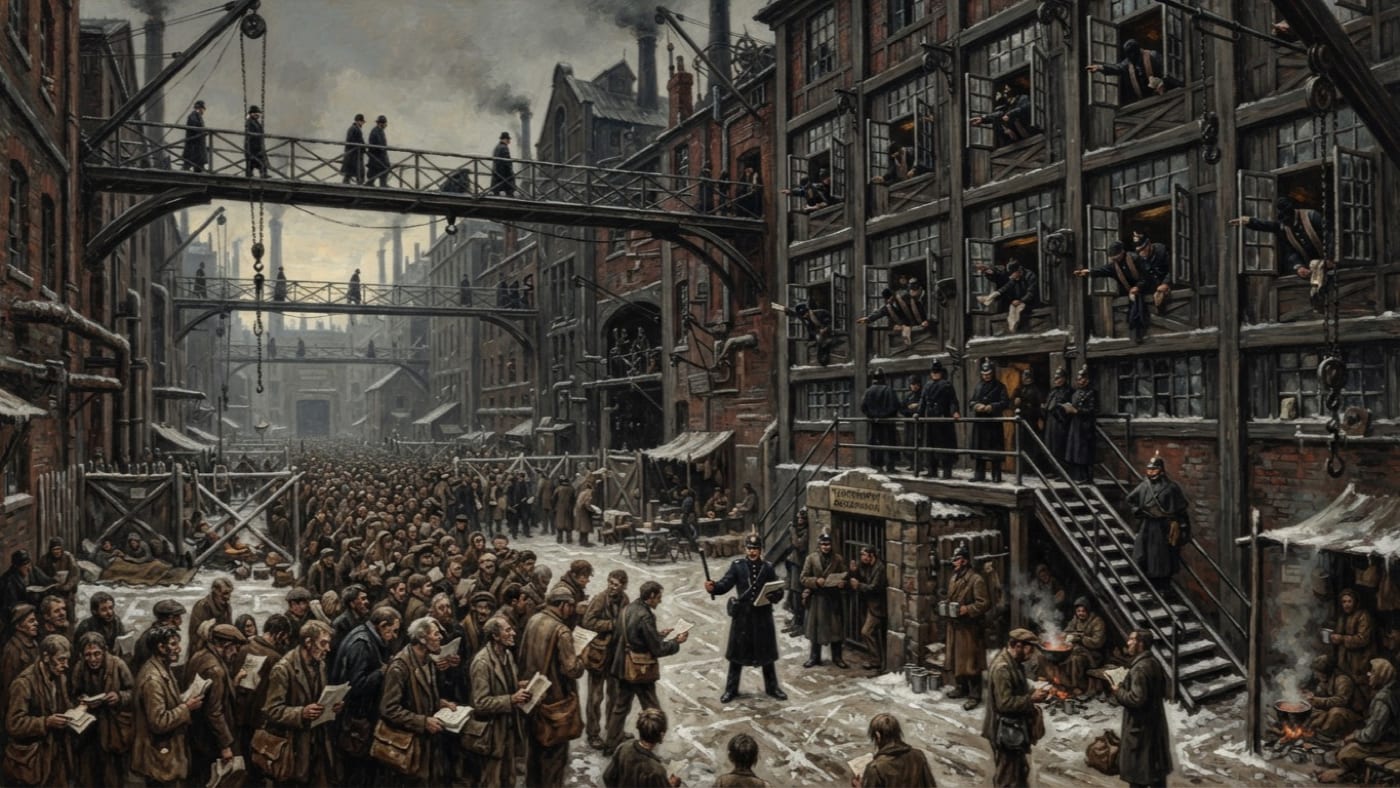
For a great many of the people who stand on it, the Queue Road ends in a trampled yard beside its ninth and largest court. The ground there is white with chalk. The air smells of people who have not been allowed to wash. The residents call the place Gate Nine Commons. The Synod Permit Directorate has no particular name for it, which is how the Directorate treats the places it depends on most.
The Commons is where the road hires. I give that description first because it is the one the Directorate would like you to keep. Day labourers gather at the dawn bell with their papers pressed flat against their chests. Recruiters work the edges of the crowd. Clerks lean out of windows cut into the timber-and-iron front of the court and call out names. Whoever is called steps forward. Whoever is not stays where he is, and the chalk under his boots goes a shade greyer by noon.
The chalk is everywhere because everything in the Commons must be counted. It marks lanes on the gravel, tallies on boards and numbers on fence-posts, and the residents swear it gets into the bread. Gate Nine is the reclassification hub of the whole road. A traveller can be a merchant, a pilgrim, a courier or a debtor when the Third Gate stamps his paper, and the ninth court can turn him into something else. The Commons is the yard where that something else waits to be collected.
#On Being Named for Work
Four kinds of labour pass through the Commons. The Directorate's cleverness lies in making sure that nobody standing in the yard can tell them apart.
The first is ordinary hire. A carter from the Salt and Grease Yards needs another pair of hands. A fence crew needs a body for the day. A copyshop on Clerk's Mile wants a steady wrist. Coin, ration chits or minute credits change hands on whatever terms the hirer names, and the hired man goes home at curfew. This is the version that appears in the Directorate's ledgers. It is real, and it is the bait.
The second is recruitment, and it wears the same coat. Notices for "employment drives" go up on the gate-timbers in the same six-inch letters as the road's commandments. The work they describe is honest and the wages are vague. Some drives are what they claim to be. Others are draft sweeps, and a man learns which kind he has joined when the fence closes behind him and a clerk hands him a Throughput Assignment in place of a wage.
The third is compulsory queue service. It is assigned by form, enforced by baton and described as a civic duty owed by those who use the road. Nobody in the line chose to use the road. It was the only one left after the Bureau of War removed the alternatives.
The fourth is conscription for minute debt. This one must be explained exactly, because the road's ruin depends on travellers confusing two things. A bell-mark records time spent waiting. Minutes waited become credit, which a traveller can hold or sell to a merchant who would prefer to wait less. Debt is something else. It accrues when a traveller misses a bell-mark, fails an audit, stands in the wrong lane or incurs a penalty that some clerk has priced. Credit is earned by the body. Debt is assigned to it. Debt also compounds, and when it goes unpaid, Gate Nine converts it into labour: hauling barricades, cleaning latrines, copying ledgers until the copyist's fingers bleed. When it is not converted into labour, it is converted into erasure.
No published table says how many minutes of debt equal a day of hauling, or when the hauling ends. I have asked for both. The requests are waiting in the queue.
The Commons is where the road hires.
The Commons is where the road hires, in the sense that a gibbet is where a parish provides employment for rope. The original wording stands in the Directorate's own summaries and is withdrawn from this one.
#On the Price of an Appeal
A man who has been reclassified can appeal. The Appeal Docket costs paper, wax and time. The wax comes from the Candlewick Palatinate, which charges more for it every year. The time is charged at the day's minute price, so the man arguing that he owes too many minutes must spend more of them to make the argument.
Before he reaches a judge, his account must be recognised, and recognition belongs to the Time Clerks' Collegium under Clerk-Prime Yoren. An entry the Collegium does not recognise does not exist. A clerk's error can add a day to an appellant's account and a clerk's favour can remove one. The difference between the two is usually a gratuity.
Then come the witnesses. The Witness Rental Houses keep to Stamp Court Row, and their stock walks up the road instead. Mother Venn and Garrik Two-Names run the largest ring. Their witnesses will swear that a man stood six hours in sleet when he stood two, or that he cut the line when he never did, depending on who paid first. An appellant who cannot afford a Witness Certificate is up against one his creditor could afford.
Mistress-Court Sera Nox presides in the Gate Nine Hearing Hall, perfumed and immovable. Her mercy rulings are famous because they so often cost more than the original offence. A debtor's conscription may be commuted to a confession, and the confession then becomes the next charge against him. Confessions at Gate Nine are timestamped, with every word indexed to its hour, so that anything a man says can later be set against something else he said.
The appellant who loses is collared. Bailiff Dorn and his colleagues carry the collar keys on their belts like a jeweller's chain. Some of the men they collar walk back into the Commons as labourers. Others leave by a different gate.
#On Those Who Remain
The Commons has residents, though the Bureau of Records would call them people who have not yet left. Labourers waiting for hire sleep against the fences rather than give up their places. Vendors keep thin broth simmering over tallow fires and sell it in cups that taste of metal. Families wait for a son to be named forward, or for news of where he went after he was. Copyists between postings sell their handwriting by the line.
Above them, Directorate officials cross the catwalks at walking pace. They are going somewhere else and they do not look down. The arrangement is deliberate. The stamp balconies and quiet gates were built so that the people who administer the Commons never have to stand in it.
Hatch Lyd's Runner Union sells another way through. For a fee or a future favour, a runner will take a labourer over the fence-lines by the catwalk routes or under them through the culverts. Some crossings deliver the man to a lane where the Commons cannot find him. Some deliver him to the Null Verge. The runners give no refunds.
The two places must not be confused. The Commons is registered ground, and its people hold bell-marks, names and debts. The Null Verge lies beyond the last fence-line, and its people hold blank tags. The road's registered population of forty-eight thousand counts the first group and leaves out the second. Some labour leaves the Commons through the Hearing Hall and some leaves on Custodian Reeve's carts, and the Bureau of Records counts the two departures differently. Neither group is paid.
#On the Closed Gate
"When Gate Nine yawns, the road starves."
The Commons cannot feed itself. Its whole economy depends on one court that decides both who may pass and who must work. When that court stops, the yard stops with it.
In the spring of A.S. 200, minute prices doubled. No decree was published. Director Othmar Vell sets the price bands, and the Directorate offered no other explanation. Debts that had been manageable became unmanageable before the next bell-mark. That autumn, Gate Nine closed for sanitation. There was no hiring, no hearing and no reclassification, and there was nowhere to take a payment. Within three days, bodies were piling up in the Barricade Maze faster than they could be carted away.
I have no separate death count for the Commons and I will not invent one. The arithmetic does not need invented figures. A district of people waiting for work spent three days in front of a court with its windows shut, while the debts against them kept compounding. The Directorate's sanitation, by all available evidence, was a success.
When the gate reopened, the Commons filled again at once. That should alarm the Bureau of War more than it does. A labour supply that walks back into the yard that nearly killed it is plainly not there by choice.
#On the Present Account
In A.S. 201 the Commons is crowded and poorer than before, and it is doing what it was designed to do. Auditors from Strasbourg now rotate through the road more often. Director Vell has not produced the master ledger for outside review, and Adjunct Ilse Quill has filed no explanation for its absence. The Runner Union is now a single organisation, so the black market at the edge of the yard has one price list and one proprietor. Wagons leave the gate loaded with Throughput Assignments for the staging depots that supply the Sagittal Line. Reports that some Commons conscripts end up in the camps behind Bastion-Brest remain reports. The Bureau of Shadows has declined to confirm or deny them.
There is one further matter. My earlier assessment of the road recorded that I had read three sealed reports describing an apparatus beneath the Hearing Hall, which is the hall where the Commons' appeals are lost. I repeat that claim here only as attribution. I have no evidence of any anomaly in the Commons itself. Its people grow old at the rate their papers record, which on this road can no longer be taken for granted.
[PARAGRAPH WITHDRAWN — BUREAU OF DOCTRINE REVIEW] [Subject: Relationship, if any, between Hearing Hall reclassification volume and the item described in the sealed reports] [Reason: "Inference unsupported by recognised ledger."]
The dawn bell rings and the clerks open their windows. Somebody is named.