
#On the Position
Gate Nineteen is a crossing of the Sagittal Line in the Irongate Southern Sector. It lies in the defended works below Bastion-Irongate, where the Danube shoulders through the Iron Gates gorge near Orșova and the old border of Romania and Serbia runs down the middle of the water. West of the wire is the defended rear. East of it a road runs out through the contested approaches toward the Charnel Lands.
That is all the Ledger holds on its geography. The gazetteers give coordinates for the bastion and none for the gate, and I will not lend the gate the bastion's numbers the way a poor parish borrows a richer one's relics.
The Codex indexes this entry to A.S. 73 because that is the year the gate entered the record by being used. That is a date of use. Nobody has filed when it was dug, who first manned it or why it was given its number. Nineteen implies a count of gates. The full count is in no register I have opened, and the number has no doctrinal meaning, whatever the cantors of Irongate say over their beer.
"The Synod had held the Sagittal Line for eight years." — as printed in this Codex's own account of the Cartographic Expedition of A.S. 73.
The formal Synod did not exist in A.S. 73. It was constituted at Strasbourg in A.S. 90. In A.S. 73 the Line, which had been defensible though unfinished since about A.S. 65–68, was held under the Church's provisional authority and the offices growing beneath it. The eight years belong to the trenches. The Synod may not backdate its claim to them.
#On the Wire
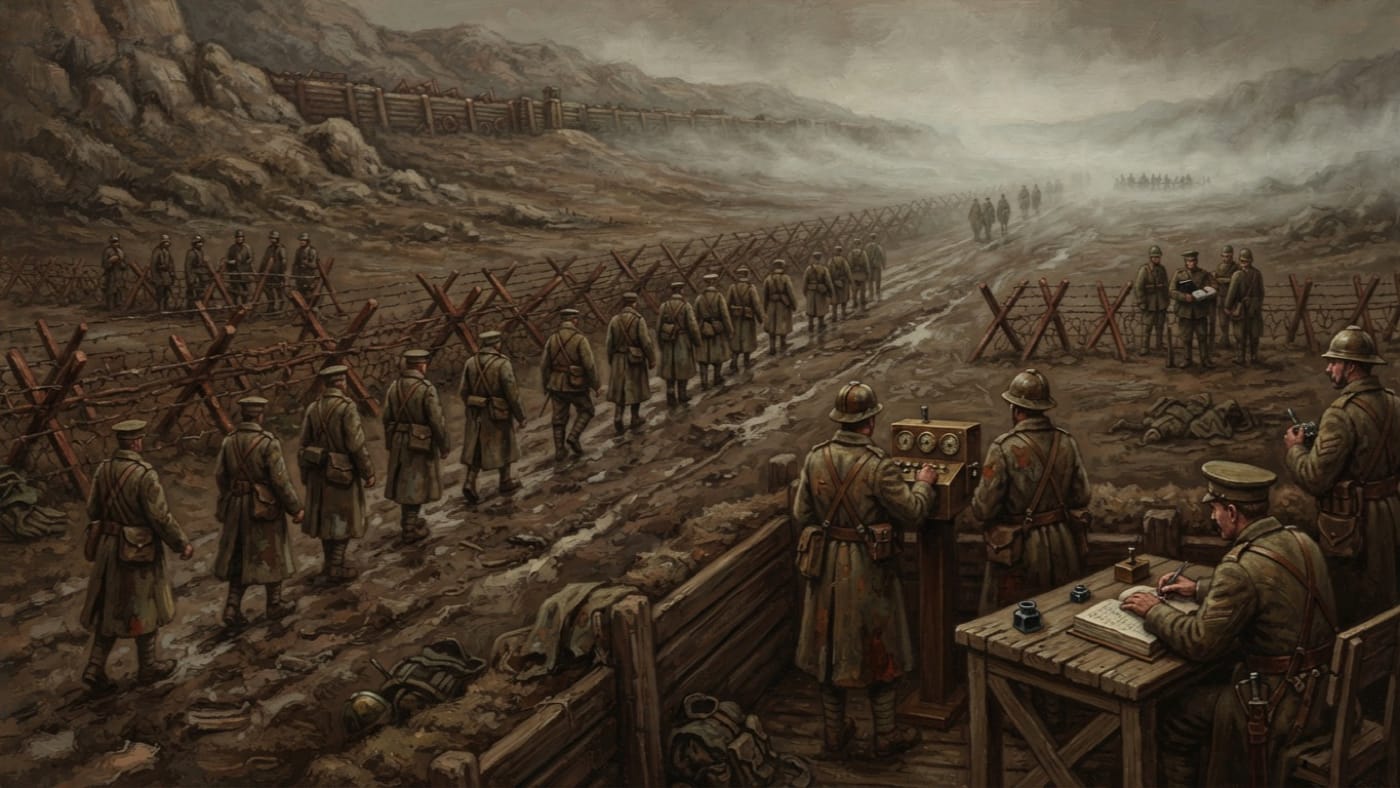
The record describes three positions at Gate Nineteen. The first is the fire-step, where an outbound column passes beneath the trench sentries. The second is the second wire. The third is the last defended position, after which the road leaves the Church's works. The first wire is six hundred yards from the third, and the record goes no further. Anyone who pictures a gatehouse, a winch or a carved lintel bearing the number has supplied it himself.
Rival claimants must be dismissed. Gate Nineteen is a separate place from Forward Staging Point Kessler, the trench-depot where Commission 73-C mustered. Kessler stood three miles behind the wire and south of the bastion. Those three miles measure Kessler's distance from the wire. Nobody recorded the distance from Kessler to the gate or from the gate to the bastion, and nobody wrote down the road connecting them. The gate also has nothing to do with the bastion's Intake Gateworks, its river chain-booms or any of the pressure locks that Irongate's engineers love so much.
The fire-step is in the fortified belt of Zone 4. Beyond the third wire the road enters the No-Man's-Land of Zone 5, and the demonic territory of Zone 6 lies further east, at a distance no surveyor has fixed. The gate faces the Charnel Lands. It does not touch them, and it marks no surveyed boundary of Zone 6.
#On the Outward Count
Every office title in the Commission's file needs one note. The file speaks of the Bureau of Records, of War, of Doctrine and of Medicine as though those bodies sat in A.S. 73 with their seals warm. They did not yet exist in that form. Records was remade in A.S. 78, Purity's Index work belongs to about A.S. 80, and War received its charter in A.S. 105. When this entry gives a Bureau's name for that year, it is a later clerk's courtesy. I extend it once, here, so I need not apologise for it in every paragraph.
Commission 73-C was issued on the 2nd of Februarius, A.S. 73. On the 14th of Martius, at the sixth bell, the expedition crossed at Gate Nineteen. The authorized complement was three hundred.
The fire-step sentries logged three hundred passing in columns of two. The sentries at the second wire logged two hundred and ninety-eight. The sentries at the third wire, the last defended position, logged two hundred and ninety-six.
Four men were lost in six hundred yards, in daylight, on a road the record says had been patrolled daily since A.S. 67. That year is a patrol attestation. It does not date the gate, and anyone who uses it to date the gate will find his citation returned to him with a stamp.
An investigation followed. It lasted three hours. It ruled that the original count had been "transcribed in error." That is the investigation's finding. The four men have not been found, and no clerk has been censured for the supposed error. A transcription error that removes four soldiers and leaves no guilty pen is a rare and gifted error.
A separate fault sits in the muster roll. It lists three hundred and four names against an authorized three hundred, and the four extra entries are anomalous. Do not add the two fours together. Several readers have, because four in and four out makes a tidy sum and tidy sums flatter the reader. The extra names are ink on a roll. The missing men are bodies counted at a fire-step. The Ledger keeps ink and bodies in different columns, and so will you.
#On the Returning Count
Fourteen came back through Gate Nineteen on the 2nd of Aprilis, A.S. 73, nineteen days after departure by the calendar kept on the defended side.
The sentries counted them three separate times. All three tallies came to fourteen.
All fourteen carried their instruments and their mapping folios. They wore the uniforms they had left in, and those uniforms were thread-worn, faded and chemically discoloured beyond anything nineteen days of weather could explain. That is everything the gate saw. It is a short list and an honest one, and I prefer it to most of what was filed afterward.
The rest of the processing must be kept apart from the gate. The fourteen's identities were confirmed by wax-seal, hymn-memory and bone-density comparison. The medical assessment estimated that each man had suffered three to seven years of physiological wear beyond the time he had been away. The file does not say where these procedures took place, and I will not drag them back to the fire-step for the sake of a better tableau. The estimate is Medicine's. It gives no man an exact age, and it names no cause. Those who want a mechanism may petition Doctrine, and Doctrine has no answer to give them.
#On the Sealed Record
Every recovered folio carried the same face. None of the fourteen remembered drawing it.
In A.S. 74 the doctrinal office judged the face consistent with earlier composite descriptions of Syrion and raised the Commission's classification from Amber to Obsidian. That judgement identifies a likeness on paper. It does not put Syrion at the fire-step, and it does not make Syrion the attacker or the master of the ground opposite Irongate. The registry assigns that ground to Morwen, whose quarrel with the bastion is long and envious, and it puts Syrion's fog at Shipka. The record does not name whatever met the Commission beyond the wire, and neither will I.
The maps were burned on the 9th of Aprilis, A.S. 73, in the courtyard of the Chapel of the Seventh Stair at Bastion-Irongate. The burning took place there and nowhere near the gate or Kessler. The expedition account records two hundred and eighty-six lost from the authorized three hundred. Colonel-Cartographer Oswin Reath is listed as missing. The fourteen were assigned to bell-mapping under an oath of silence. The office that received them was the Office of Bells, constituted in A.S. 52 and known to every later clerk as the Bureau of Bells.
This is how a crossing with clean tallies came to be bound up with sealed and contradictory testimony. The gate produced numbers. Every other office produced classifications, oaths and ash, and filed them in the same folder with the gate's numbers on the cover.
#On the Limits of the Entry
The Ledger can certify this much about Gate Nineteen. It is a crossing of the Line in the Irongate Southern Sector. It has three defended positions, with six hundred yards between the first and the last. On the 14th of Martius, A.S. 73, a column left through it, and its sentries counted the column down from three hundred to two hundred and ninety-six. On the 2nd of Aprilis, fourteen came back through it, and the sentries counted them three times.
The Ledger cannot certify who built the gate, when it was built or what it looks like today, and I make no inspection here that I have not made. The four men lost between the wires remain a three-hour ruling.
The gate counted correctly in both directions. Everything wrong in the file was written by someone who never stood at the fire-step.