
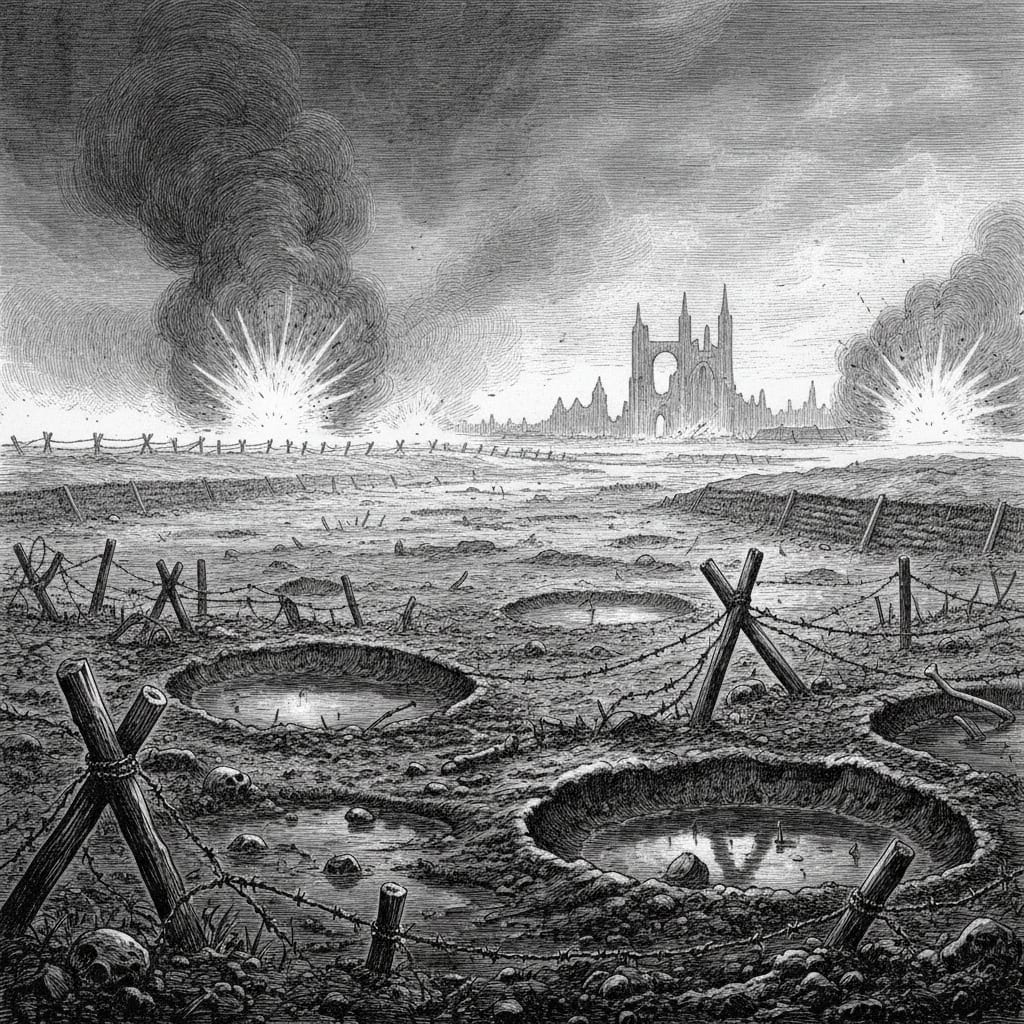
#The Wound
I am Valerius Drax, and I will tell you of the place that is not a place — the interval between the living and the damned, the ditch the Creator scraped across the body of Europa with a bayonet dipped in holy blood. The Synod calls it No Man's Land. The soldiers call it worse. The Bureau of Records calls it a taxable administrative zone, which tells you everything worth knowing about bureaucracy and nothing worth knowing about the zone.
From the Sagittal Line's Carpathian Gates to the salt-reek of the Aegean, it stretches — not a border, not a frontier, but a wound. Wounds heal. This one festers with intent. The soil remembers every shell, every hymn, every body pressed into its keeping. Centuries of assault and counter-assault have ground the earth into something that is not earth at all but a sediment of bone, iron, prayer, and the residue of sins the Bureau has not yet classified.
Do not imagine trenches as ditches. Imagine a cathedral toppled on its side, its nave packed with mud, its crypt brimming with the anonymous dead, its choir replaced by the ceaseless toll of Constantinople's bells. That is the trench. That is the world's spine.
#Named Sectors
The Land is not uniform. Each sector has cultivated its own particular species of misery, and each species has been duly catalogued, stamped, and filed by the appropriate bureau.
At the Knife-Mile, parapets have been gnawed down to bare stakes and bayonet-hedges. The mud eats boots, calves, and occasionally whole platoons. Every dawn the Wardens tally who has been swallowed. Every dusk the Inquisitors insist the numbers were lower.
Nominalist's Gate is more ferry-office than battlefield, a crossing where survival depends less on passwords and more on properly filed ledgers. A misplaced tithe-seal has slain more pilgrims here than bayonets ever managed. I myself once spent three nights detained in its archives while a clerk debated the orthography of my signature. Two companies perished in the interval. The clerk was promoted.
The Sister Trenches of the Aegean lie peculiar in their proximity to the tide. Twice daily the bones of the fallen wash back into the works, bleached and rattling, as if reluctant to depart the service. The soldiers joke that the tide is loyal — it always returns its tithe of marrow.
And there is the Quarter of Widow's Light, where lamps shatter without cause and the shards cut deep, yet the blood clots into letters — often forming names of men not yet dead. Doctrine declares them accidents. Records files them under premonitions. Both are correct.
Earlier editions of this Codex referred to the sector east of Lorraine as the "Gut-Wall."
The term is purged. Use Spine. The Bureau of Records has further noted that friction is fuel, which is not a metaphor but an accounting category.
#The Climate That Kills
The provincial fool supposes war is a matter of men, steel, and mud. Such a fool has never breathed the air of the Line. No Man's Land is not a stage upon which combat occurs. It is an organ of the Lie itself — hostile, animate, and malicious in ways the Bureau has spent two centuries attempting to tax.
Take the Gas That Sings. Mists rise not with the silence of rational fog but with a choir's perfection. Voices layer upon voices, harmonies of asphyxiation. A man who inhales does not choke as he ought — he sings, wordless hymns pressed from lungs until they burst. I have seen entire companies collapse in chorus, their final harmonies rising above the bombardment as though mocking the Bellways above.
Then there is the Prayer-Jam — bells that ring off-key, hymns that stumble, liturgies gagged mid-verse. To a layman this sounds unpleasant. To the soldier whose life is ruled by bell-peal and cadence, it is annihilation. When a muster-bell warbles false, regiments advance into each other's fire. When curfew tolls late, deserters vanish under providential cover. The Bureau of Orison blames sorcery. The Bureau of Engines & Furnaces mutters, off-record, that over-pealing may itself fracture the lattice of air.
Correlations between bell density and atmospheric malfunction are measurable. Probability of causal over-pealing: 72%. — Engines & Furnaces, leaked memorandum, A.S. 195. The word "measurable" has been replaced with "alleged" by order of Records, 4th Revision.
And the mud conspires with flesh. Flesh-Mud, the troops call it — a slurry seeded with the bone-reefs of centuries. Step upon it, and the ground remembers: it drags you down, wrapping your ankles in ligaments that were never yours. Entire battalions have been lost not in battle but in marches, not a shot fired, five hundred names struck through the ledger at dawn.
#Shadow Noon and the Stench of Contradiction
There is the phenomenon of Shadow Noon: hours when the sky grows brighter but shadows lengthen in the wrong direction, dragging equipment and men off balance. Veterans stay still, refusing to march until the shadows crawl back into obedience. Once, an entire division of Litany-Engineers ignored this practice, pressed forward, and were discovered calcified into statues of salt, their mouths wide open as if mid-hymn. The Bureau declared the incident edifying.
The Stench of Contradiction perfumes the Land: smoke, sanctified oil, burnt parchment, decomposing ration-paste, the faint sweetness of Lust's courts drifting downwind, the acrid tang of Wrath's forges. Inquisitors have sworn the stench itself distinguishes honest from heretic — curling sweet to the faithful, sour to the damned. Records wisely redacted this claim as inconclusive.
#The Land Devours
One truth binds all sectors, all climates, all contradictory accounts: No Man's Land devours without distinction. Friend and foe are swallowed alike. Rationalist prisoners march shackled into the trenches and vanish in the same mud as our levies. Demons have drowned in the slurry they conjured. Once, a Wrath-forged giant sank to his knees in the Knife-Mile, roaring curses, until the mire pulled him under. The Synod declared it a miracle. The soldiers called it Tuesday.
Veterans wear the grime of the Land upon their armor like chrism, swearing never to wash it away, for it is the closest thing to sanctity the battlefield affords. New recruits scrub their skin raw. Veterans boast of layered patinas of soil and marrow as a badge the Bureau cannot stamp but cannot revoke. Even the Abominations whisper of the place with something the Bureau insists is not dread — for dread implies respect, and the Enemy deserves no respect — but which sounds, to any honest ear, a great deal like it.
An earlier Hieromnemon described the Land as "a purgatory."
This is imprecise. Purgatory implies eventual release. No Man's Land implies no such thing. It implies only mud, and the mud implies only more mud, and the more mud implies a requisition form for shovels that the Bureau of Tithes has not yet approved.
#On Holding the Unholdable
To hold No Man's Land is not to hold ground. It is to hold rhythm. Every trench is a verse, every parapet a stanza, every bell a refrain. The Sagittal Line is not a fortification but a liturgy in earth, and like all liturgies it functions only as long as the congregation keeps time.
The Synod has learned to harness its horrors — gas clouds redirected with censers, Prayer-Jam countered by redundant peal-schedules, Flesh-Mud frozen by salt bombardments. But never eradicated. The Lie is the weather, and weather cannot be slain. It can only be endured, recorded, and taxed.
And that is the highest miracle of the Land: not that men survive, but that they continue to write, stamp, and tithe amid such storms. The Rationalists proclaimed that reason ruled the heavens. Let them look upon our trench atmospherics, where hymn, mud, and bone share equal sovereignty, and choke on their proclamations.
The Codex has spoken. The Land abides.