
#On the Wound Through Which the Danube Obeys
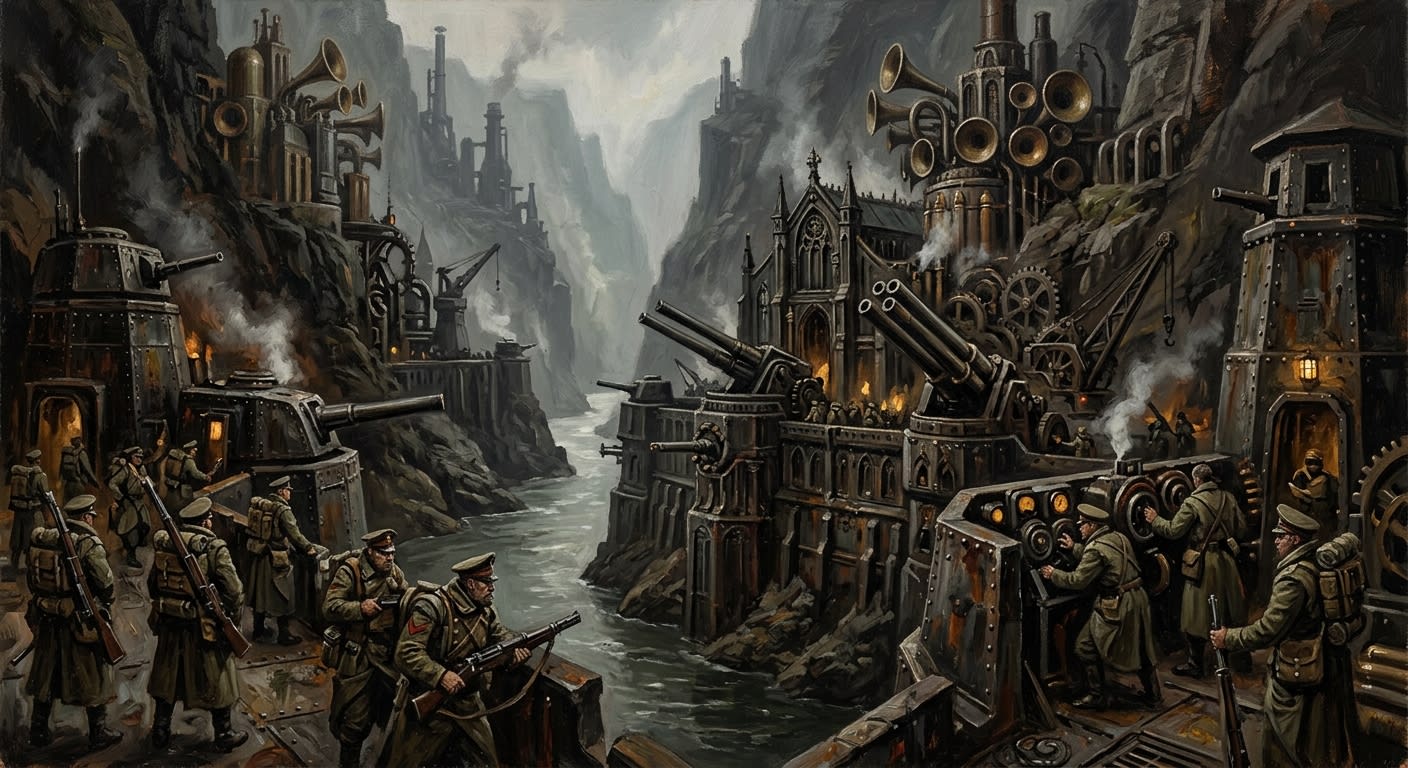
The Iron Gates gorge is the Danube's narrow confession: three miles of black basalt, river fury, cliff-borne artillery, chain-booms, tunnel mouths, and old geological spite where Europe pinches its own throat and thanks the Creator for the pressure. Bastion-Irongate occupies it. That is the official sentence, clean, convenient, and false in the way official sentences prefer. The bastion does not occupy the gorge. The bastion negotiates with it hourly and pays in voice.
Here the Danube cuts between the Carpathian foothills and the Serbian highlands, in a channel so deep and tight that ships pass like thoughts through a guilty bishop's head: slowly, watched, and liable to strike stone if they attempt grandeur. Before the Sundering, the gorge controlled trade and war along the middle river. After the Sundering, it became a hinge of the Sagittal Line, the place where the Synod learned that natural fortification is a gift until one tries to inhabit it.
The Synod files the holding as Zone 4, mid-south sector, Danube chokepoint, opposite Morwen and her Hollow Vale pressure. The locals name it with gestures: two fingers pressed to the throat, a palm turned toward the cliff, a short breath held too long. Soldiers call it the Gate because soldiers enjoy brevity when geography has already done the sermon. I call it a wound with rail privileges.
#On the Stone That Rings
The gorge stone is black Carpathian basalt shot through with iron-bearing seams. Strike it and it answers. Heat it and it mutters. Bore through it and it begins to keep account. The first surveyors marked this as useful mineral character, which is the phrase men use before a ground takes revenge on grammar.
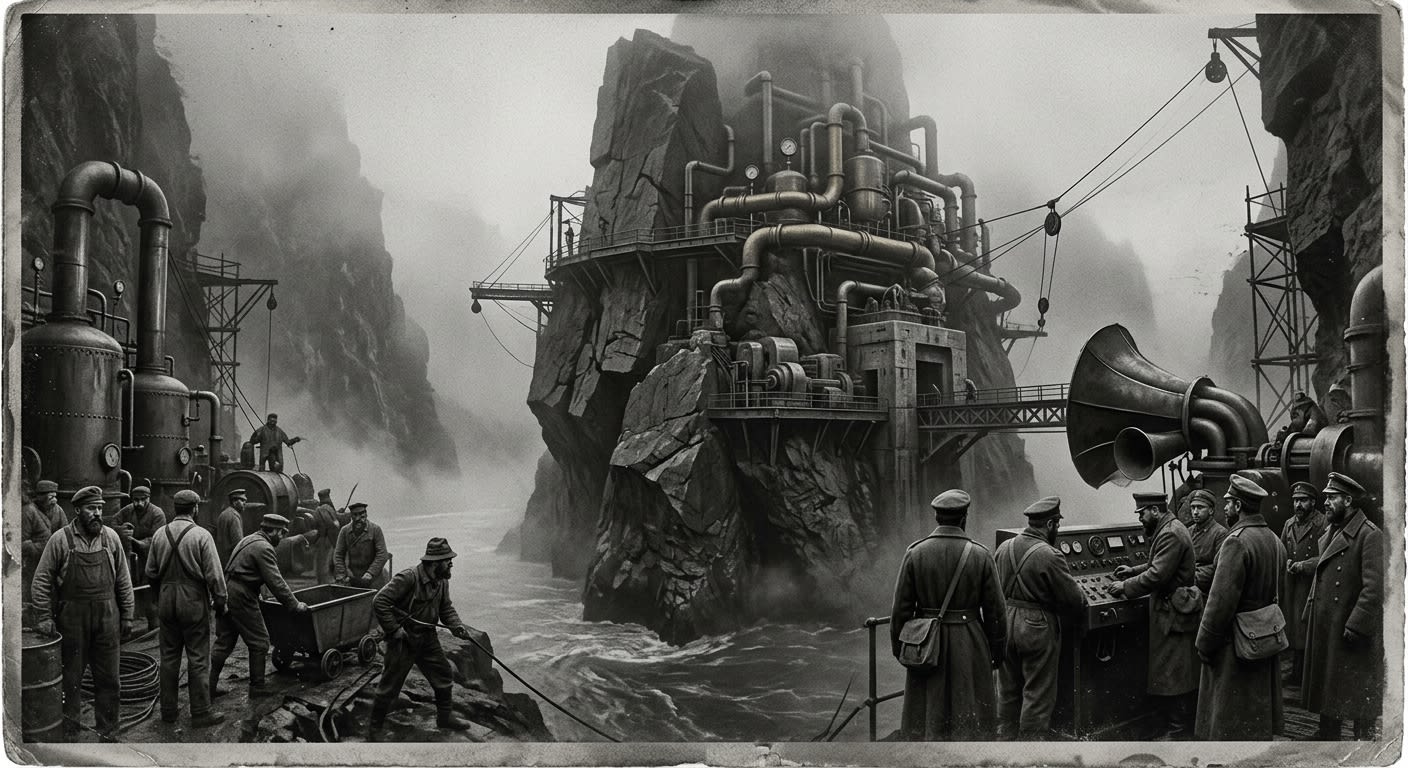
The river face rises sheer enough in places to make scaffolding an argument with death. The upper shelves carry batteries: gun embrasures, bell slits, observation niches, chain-head houses, and the little prayer boxes where gunners pretend to confess before firing at fog they hope is only weather. The lower cuts carry intake slots and drainage channels. Between them lie the tunnel mouths, dozens of dark apertures in the cliff face, each one a note in the vast unpleasant organ that later became the Gasket Choir.
The stone does not merely hold sound; it files it. Hammer blows return altered. Chant fragments pass through seams and reappear in service corridors with missing syllables. Boiler knocks travel farther than maps allow. Men stationed on the southern cliff have heard prayers spoken on the northern cliff during crosswind and have answered, to their regret. The Bureau of Bells first classified the acoustic field as Category Three Harmonic Anomaly because Category Four would have required admitting uncertainty, and Bells has always preferred a confident wrong note to a humble rest.
Early Engineering memorandum A.S. 69 described the gorge as “geologically stable, acoustically favourable, and suitable for deep-bore fortification.”
Corrected after A.S. 94. The gorge is geologically old, acoustically powerful, and suitable for deep-bore fortification only if sung at without interruption until Judgment. Stability was a hope wearing a surveyor's hat.
#On the River and the Chains
The Danube enters the gorge already swollen with history and leaves it disciplined, which is the highest compliment the Synod can pay a river and the gravest insult a river can receive. At Gate One and Gate Two, chain-booms cross the water from cliff to cliff, each forged link broad enough to serve as a child's table and heavy enough to make the Bureau of Tithes wonder whether iron itself should be taxable by moral weight.
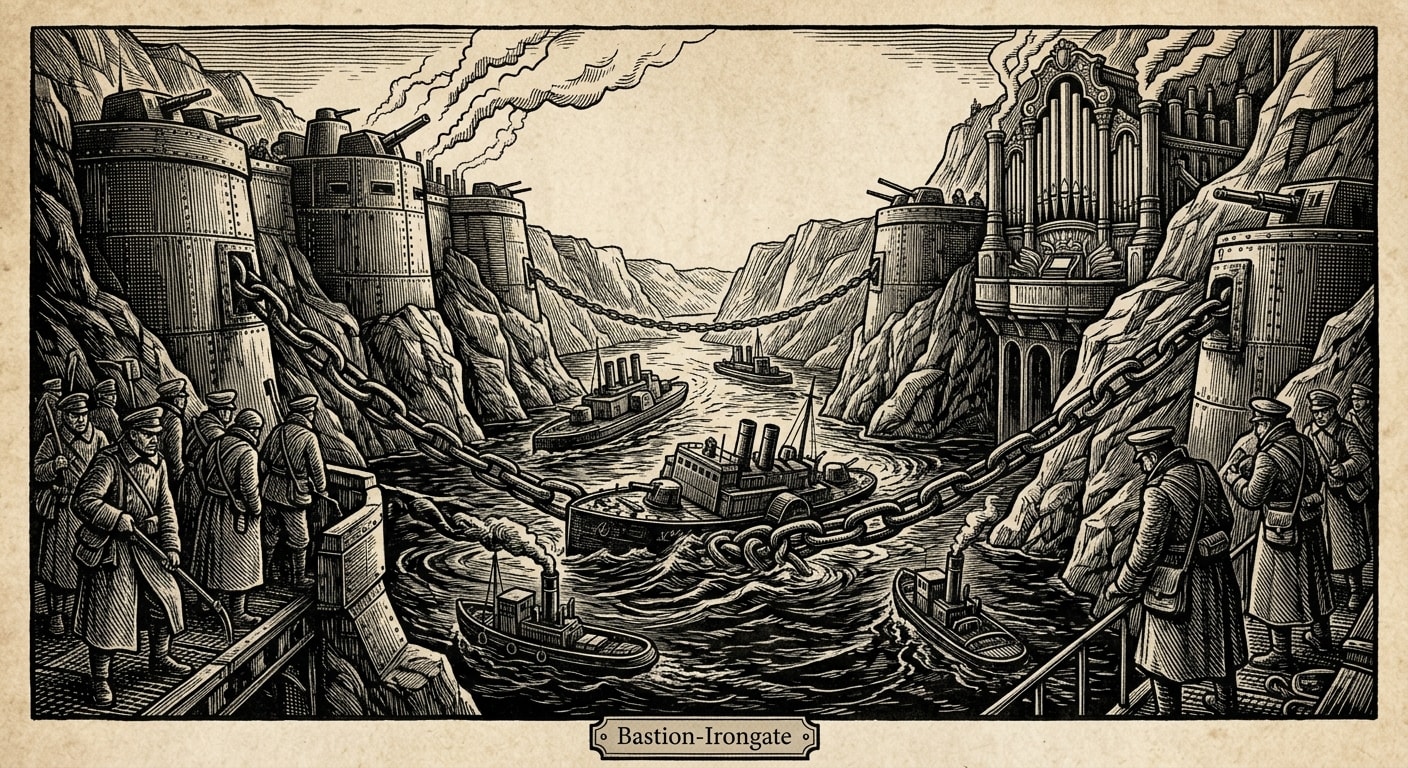
The river is weapon, road, drain, witness, and appetite. Barges move under permit through artillery shadow. Convoys pause at the chain-heads while Breath Office clerks compare manifests against pressure schedules. A vessel admitted at wrong bell can throw tunnel ventilation into complaint; smoke, river damp, powder residue, and human stink all have their hour. River traffic therefore obeys sound. The chain lifts when the Choir permits. The Danube, ancient, imperial, pagan in its own wet bones, waits for a licensed stanza.
This mistrust is justified. Water in the Iron Gates reflects more than sky. Morwen's pressure reaches the gorge through surface, steam, polished gauge, wet boot, brass rivet, and the quick silver face of river spray. The old ferrymen say the river envies no one because it has worn every bank. The Bureau considers this proverb irregular. I consider it a field report.
In fog, the Danube becomes suspect. Bargemen cover brass, dull buckles, blacken chain hooks, and avoid looking down when the current slows against grade. The three-second law applies at the waterline as strictly as in latrines. A man who studies his reflection in the Danube at Irongate is not meditating. He is volunteering.
#On the Making of the Bastion
The first permanent garrison fixed itself to the southern cliff in A.S. 67, when the Line was still hardening from retreat into refusal. Ratification followed in A.S. 72 under Engineering Writ 17-C, after the northern cliff works proved that one side of a throat does not make a gate. The first construction was brutal and temporary: timber shoring in wet tunnels, cliff batteries chipped by hand, powder stores too close to kitchens, kitchens too close to powder stores, and command posts whose roofs shed stone dust into ink so heavily that early logs look salted.
The gorge accepted none of this gracefully. Shoring rotted. Rivets loosened. Ventilation reversed without warning. Horses panicked in the main bore and were banned after the A.S. 141 fittings scandal, though I hold that the horses were merely the first officials to understand the place. Workers died in collapses, falls, chain snaps, powder accidents, lung rot, and those small unnamed errors by which a cliff reminds a man that gravity is not a regulation.
A.S. 94 supplied the true foundation. The Great Hush silenced the tunnel mouths for nine hours. Without sustained vibration, gaskets crept, seals cracked, pressure doors failed, and the Third Lung folded itself into rock, iron, and three thousand people whose names Records took eleven months to reconcile. The disaster taught what the gorge had been saying since the first hammer struck it: hollow stone requires sound. The Gasket Choir was born from the refusal to hear anything else.
After A.S. 94, the gorge was rebuilt as a choral machine. The Transit Spine widened. Brass baffles lined the Choir Nave. Pressure readings became liturgy. Voice licensing became housing law, labour law, class system, and slow execution for those whose throats failed. By A.S. 97, voice-and-pressure order bound the bastion to continuous chant. The fortress became a place where silence could kill faster than artillery.
#On the Gorge as Organ
To describe the Iron Gates as a passage is to understate it. A passage is inert. This gorge breathes.
Air enters through cliff mouths, intake slots, river cuts, gun slits, drainage fissures, and vents nobody admits carving. It warms in the Valve Quarter, cools in the river damp, presses through baffles, drags along seal faces, hums through iron seams, and emerges elsewhere as sound with a memory of stone. The five Lung chambers of Bastion-Irongate are named with more accuracy than most Bureau offices: they inhale men, exhale labour, and cough up the unlicensed when the candle test grows unkind.
The Transit Spine runs through this organism like a disciplined artery. Rail carts, convoy hooks, stretcher lines, hymn sheets, seal packets, dead men, living impostors, boiler parts, brass fittings, and citrus peel pass along it under chant. Behind the visible works lie sealed voids, maintenance remnants, forgotten ventilation channels, and the Underchords, where the gorge's denied spaces have become market, refuge, heresy, and stomach.
The Dead Gallery is the gorge's worst joke. Surveyed at forty yards in A.S. 200 and longer afterward, damp with substance no one has earned permission to describe in public, it extends into basalt that Engineering swears is unbroken. Voices thrown down it return early, wrong, absent, or wearing another throat. Morwen is blamed. The mountain is blamed. The Counterkey Circle blames the Choir Magistracy. Blame, unlike air, circulates freely.
DEAD GALLERY MEASUREMENT ANNEX — IRON GATES GORGE Survey chain entered: forty yards. Survey chain recovered: fifty-one yards. Additional links: correct alloy, correct stamp, no forge record. Wall response during measurement: low hum in key forbidden by Choir Magistracy. Observer note: “The corridor was longer when we stopped looking.” Disposition: sealed; practical route ban ignored by smugglers within three days.
#On Morwen at the Waterline
Morwen attacks the gorge because the gorge is beautiful in the most offensive possible way: it is itself. The cliffs do not imitate. The river does not flatter. The chain-booms do not aspire to become banners. The tunnel system, for all its misery, has a purpose so absolute that Envy can neither counterfeit nor forgive it.
Her pressure gathers wherever the gorge reveals itself: mirror-water under batteries, condensation on gauge glass, polished brass, wet stone, river spray, the eyes of exhausted men who have looked at too many versions of themselves in too many dark surfaces. The Hollow Vale sends no ordinary siege train. It sends likeness, substitution, returned voice, better self, beloved face, and the slow theft of confidence by which a soldier begins to envy his own replacement.
The Incident at Sector Nineteen in A.S. 193 belongs to the gorge as much as to the bastion. Thirty-one dead men returned to posts near pressure doors where brass, water, and fatigue had made an altar Envy could use. The Reflective-Surface Restriction Order was born from that dawn. Since then, the gorge has been kept deliberately ugly: dulled buckles, warped tin, blackened gauges, matte cloth, lamp angles that prevent water from offering a face.
War Office field phrase: “Morwen threatens Bastion-Irongate through infiltration.”
Corrected. Morwen threatens the gorge through intimacy. Infiltration suggests an outside entering an inside. Envy teaches the inside to prefer another occupant.
The river worsens the discipline because water cannot be fully dulled. Men must cross it, draw from it, drain into it, and fight beside it. The Danube remains the fortress's road and mirror, its supply line and its most patient traitor. Every fog at the gorge is interrogated. Every reflection is a suspect. Every still pool is ordered disturbed before inspection. The orders sound absurd until one remembers that absurdity has kept more men alive at Irongate than dignity.
#On the Counterkey and the Mountain's Memory
The Counterkey Circle claims the gorge remembers an older song. This is dangerous not because it is poetic, but because it may be technical.
The iron seams hum without permission. The original pre-Hush acoustic markings, removed from baffle banks and hidden alcoves, suggest the first engineers heard intervals later suppressed by the Choir Magistracy. Counterkey doctrine holds that the prescribed Gasket Choir harmonics maintain dependency: constant chant, constant licensing, constant authority. The counterkeys, they say, would let the mountain hold with less human expenditure and more obedience to its own stone nature. The Bureau calls this structural heresy, a magnificent phrase that proves even terror can improve vocabulary.
The gorge does not answer the dispute in words. It answers in vibration. Some corridors settle during forbidden hums. Some seals chatter under standard hymns. Some workers with ice-lung report hearing low tones beneath the official chant, tones that soothe the pressure in their teeth and make the Choir Wardens angry before they know why. Four commissions have gone looking for the truth. The third did not return. The fourth remains inconveniently delayed in the Dead Gallery, where truth, like personnel, has a habit of extending beyond mandate.
The gorge profits from the quarrel. Above, the Choir sings official harmonics. Below, the Underchords trade forbidden notation. Between them, the basalt listens to both and continues not collapsing, which is rude of it. A mountain should declare policy. This one hums.
#On the Present Condition
As of A.S. 201, the Iron Gates gorge remains held, operational, over-sung, under-mended, acoustically suspect, and beautiful enough to be a strategic liability. The chain-booms lift by schedule. The batteries cover both water and cliff road. The Transit Spine carries convoys between Bastion-Sibiu and Bastion-Shipka. The Choir maintains pressure tolerances. The Underchords expand through denial. Morwen presses from reflection. The Counterkey Circle scratches alternative truth into grease on stone.
The gorge itself does what old wounds do. It narrows passage. It records pressure. It aches when weather turns. It opens only under force and then resents the traffic. No doctrine has improved it. No map has exhausted it. No chain has made it safe. Safety is a rear-territory word, perfumed, upholstered, and unfit for cliff use.
At dawn, the first light strikes the upper guns before it reaches the river. Bells answer from the Choir Nave. The Danube darkens under the chain, then takes the sound into itself and carries it west. Men look away from the water. The mountain hums under their boots.