
#On the Western Entrance
"Say it clean. Walk it safe." — Inscription above the Gate of Clean Tongues, Peregrine Row
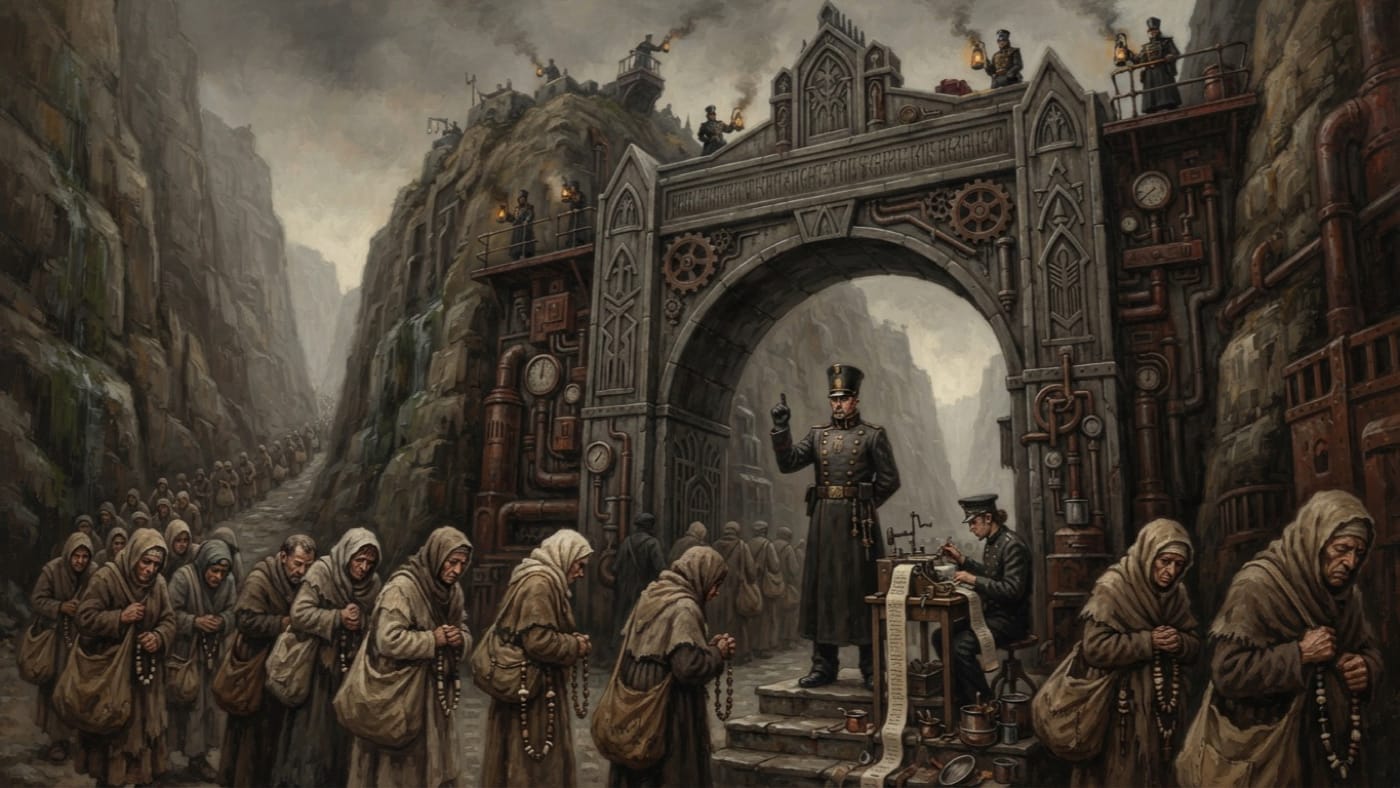
The proctor raises one finger, and the whole queue goes quiet.
That is the first lesson of the Gate of Clean Tongues, and the gate teaches it before anyone has spoken a word of the Creed. The pilgrim at the head of the line holds a card they no longer need to read. Behind them the line runs back down the canyon road, a column of dust-coloured cloth, mule bells and coughing. Limestone walls press it so tightly that there is no space for a second queue and no space to turn back. The inscription sits above the arch. Above the inscription is the ridge, where the lantern-keepers watch the line the way a clerk watches an ink-pot.
The gate faces west and admits arrivals from the Pilgrim Roads. It is the first of the Row's two arches and the only one that listens. Its eastern counterpart, at the far end of the market, handles departures: an escort contract verified, a water ration issued, a prayer supervised before the dangerous road. The eastern gate asks whether you are ready to leave. The western gate asks whether you deserved to arrive.
The published record says the artisan who cut the inscription was later investigated over their own pronunciation. It gives no name and no date, and I add neither.
#On the Authority to Hear
The gate's right to listen comes from the Road Chapter of Peregrine, chartered in A.S. 94 / 1804 CE. That was four years after the Concordat of Strasbourg established the formal Synod. The writ grants the Chapter "all matters of transit, devotion, and syllabic compliance along the designated pilgrim corridor." It says nothing about masonry. The Chapter's files do not record who built the arch or when, and I will not supply a year just because a reader would find one comforting. The cistern and shrine that first drew traffic through this canyon are older than all of it, and they are undated too.
The examination itself grew out of A.S. 101 / 1811 CE. Six hundred pilgrims entered the eastern approach that year, and two hundred and fourteen died in an attack from the ridge caves. The Bureau of Doctrine found that impure recitation among the pilgrims had weakened the road's protective virtue. That was a finding. No one ever demonstrated the cause, and the bandits were never named. A finding is sturdier than a cause, though, because a finding can be enforced. Creed-testing at the gates followed, and mandatory escorts came with it. Every arrival at the Gate of Clean Tongues re-enacts the finding of 101.
Authority at the arch is shared, as it is in all profitable things. The Chapter supplies the doctrine. Cantor-Auditor Selm Peregrin supplies the Chapter's legitimacy and its appetite for detentions. Broker-Matron Lysa Vane's contracts wait on the far side of the verdict, and Captain Odrik "Ridge-Hook" and his escorts wait beyond those. The proctor stands in front of all of them with one instruction: listen.
#On Examination and Clearance
The examination has three acts, always in the same order.
First comes the recitation. The pilgrim faces the proctor and speaks the Seventh Catechism aloud, at volume. The proctor listens for any vowel that deviates. At the proctor's elbow a scribe records each syllable as heard on a carbon-backed receipt. One copy goes to the Chapter and one to the pilgrim, and the pilgrim's copy is the fainter. I will not set the words down here. The Catechism belongs to the Creed and its custodians. A codex that printed it would invite every reader to rehearse it badly in private, and private rehearsal is how vowels go wrong.
Before reciting, the pilgrim should have checked the list of banned syllables, which the gate revises every day. Yesterday's clean prayer may hold today's offence. The list is posted. The reasons are not.
Second comes the bead count. The pilgrim's string carries bone for minor sins, wood for moderate ones and glass for grievous ones. It is counted against whatever confession receipts the pilgrim carries. At the gate this is only a first glance at the arithmetic. Full reconciliation belongs to the Bead Courts in the northern arcade. It has been mandatory there since A.S. 104 and audited daily since A.S. 110. The gate only notes whether the string and the papers appear to belong to the same soul. If they do not, the courts settle the matter later, for a fee.
Third comes the stamp. Wax is softened over tin pans, which leave the gate smelling of hot metal from first light, and pressed onto the pilgrim's left forearm. The impression means processed, and it must survive the length of the Row intact. If it cracks in the heat or smudges against a sleeve or a mule's flank, the pilgrim walks back west and starts again. They pay again and queue again.
The brokers care about the receipt. A standard escort voucher from the Choir-Broker Compact runs to four pages. It includes a syllable guarantee confirming that the pilgrim's score at the Gate of Clean Tongues meets the threshold for insured passage. A score below threshold voids the contract, and no refund is given. A companion canyon waiver releases the Compact from liability for acoustic distortion "indistinguishable from heretical mispronunciation." The broker never needs to hear the pilgrim. The broker reads the carbon.
#On the Second Voice
The canyon answers back.
This is the Echo Creed, and the Gate of Clean Tongues stands right in its path. A pilgrim recites, and a moment later the limestone returns the line with one vowel altered. Some accounts put the delay at two seconds and others at two breaths. The proctor has to decide which voice was the pilgrim's and which was the stone's. Training is supposed to make that decision. The published accounts agree that in practice the quarter's detention quota makes it, helped along by how well the proctor knows the pilgrim's broker.
The daily list moves the standard. The echo supplies the evidence. The proctor adjusts what he hears. A gate equipped this way never has to wait for a pilgrim to actually mispronounce anything. The Bureau of Doctrine firmly holds that the echo has no doctrinal authority, yet the gate uses it as evidence every day. Both positions are on file, and by order both are correct.
Altered echoes were reported before A.S. 143. They were filed under dust, wind and the accents of western peasants. After the Year of Ash Rain the disturbance worsened, and the Bureau of Alchemical Standards classified it as Category Two and placed it under review. The record does not settle when the alterations began, and neither do I.
Speaking cleanly does not keep your paper clean either. Contracts left overnight in the Hall have reportedly shifted by a vowel or a consonant by morning, usually to the holder's cost. An honest scribe does not make the gate's receipt any safer. The Bureau has not determined what alters it. Theologians who suggested intention have been reassigned to rooms with flatter walls.
"Echo Creed — Category Two Localized Acoustic-Doctrinal Disturbance (ongoing since A.S. 143)." — as printed in the administrative record of the Choir-Broker Hall.
CORRECTED. A.S. 143 marks the worsening of the disturbance and its formal classification. The altered echoes themselves were reported earlier, and their onset is still unsettled. "Since A.S. 143" refers to the review alone. Filed.
#On Failure and Its Remedies
A pilgrim who fails at the arch goes down. The Quiet Pens lie beneath the Tinmarket Arcade, reached by the Vowel-Stair. Pilgrims with deficient recitations and unreconciled beads wait there for correction. Entry carries a processing fee, every day of detention adds to the debt, and release carries a fee of its own. Those who cannot pay are converted into service assignments. They labour for the Bead Courts or the Escort Yards, or for distant bastions along the Line, where no one asks much about consent. The pilgrim who came to pray eventually leaves as an entry in someone else's supply ledger.
Licensed remedies exist, and they are for sale. Waxed ear-cords dull the canyon's reply. Silent hand-signs are permitted for licensed processions and for caravans that can afford the licence. Bead-buffer chants, recited before the Catechism, give the stone something harmless to spoil first. The Chapter approves a handful of them, and the street uses rather more. The Echo Creed account also records restricted waivers and premium access. None of these cures the canyon. Each reduces a pilgrim's exposure in proportion to the purse.
The other trade runs underneath the licensed one. Counterfeit syllable tokens are sold openly in the Tinmarket Arcade. In the cistern tunnels, quiet passes promise a route around the gate altogether, and water chits change hands where coin would be noticed. Somewhere below, an unnamed Syllable Forger teaches pilgrims, for a price, to make their tongues clean. The pilgrims call it survival. The Chapter calls it fraud, and when it catches the fraud, the fraud goes down the Vowel-Stair with the fees attached. The black market has one known limit: it cannot sell true absolution after a public creed failure. The gate keeps that for itself.
#On the Present Condition
As of A.S. 201 / 1911 CE, the gate operates under Peregrine Row's Amber status. That status was revised in A.S. 199, after a leaked Broker Compact ledger described "demonstration ambushes" in the eastern canyons. The Road Chapter's own investigation found no evidence of systematic coordination. The leak and the denial are both on file. Neither one attaches a finding to the proctors of the western arch, and I attach none. The gate worked through the whole scandal without a day's interruption, which is the most ecclesiastical thing I can say of any institution.
Every dawn the banned syllables are revised. Every morning the tin pans are lit, the wax softened and the carbon sheets interleaved. The proctor raises one finger and the queue goes quiet. The pilgrim speaks, the stone answers, and the scribe writes down one of the two.