
#On the Burning of Thrace
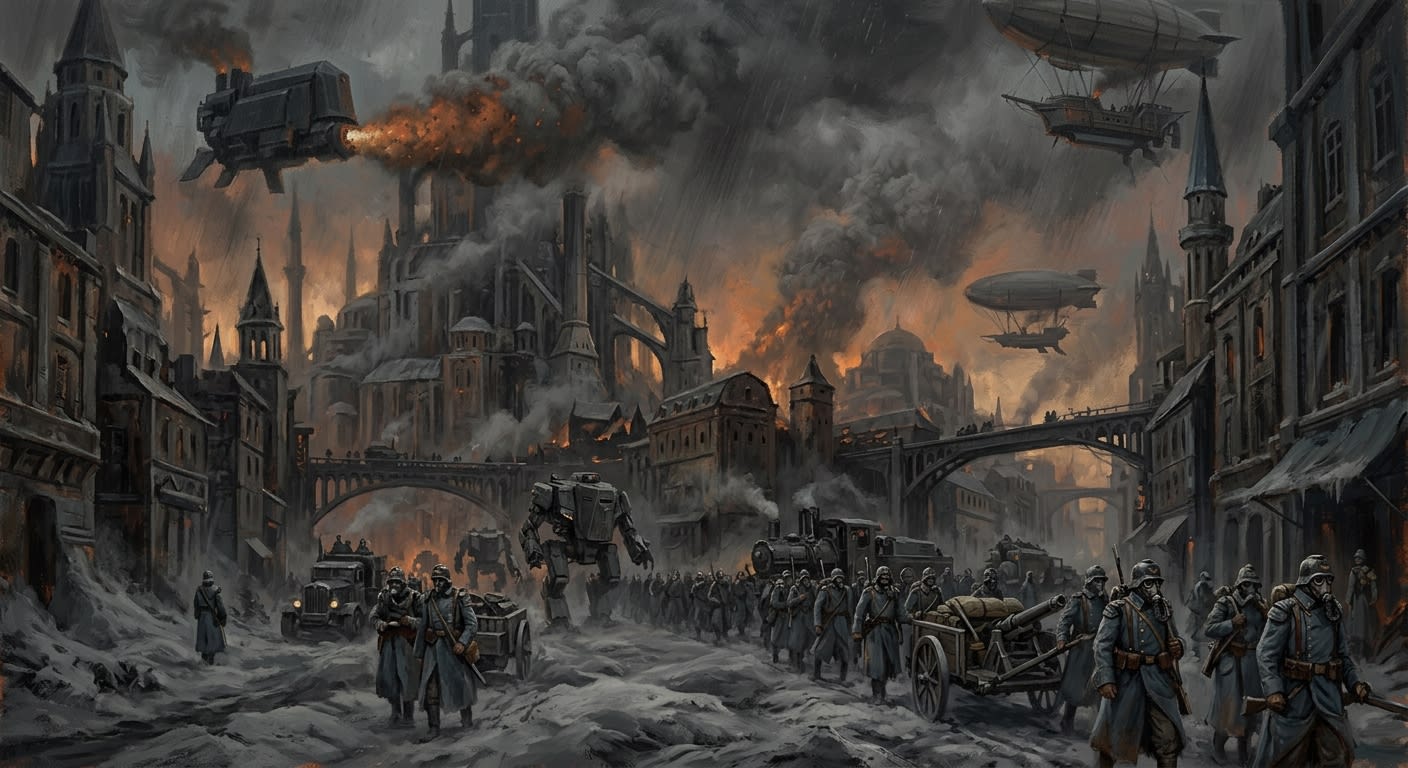
The Year of Ash Rain began in A.S. 143 with an act so crude that lesser historians mistake it for simplicity. Maldrake ignited the Thracian forests north of Bastion-Constantinople. He did not besiege a gate. He did not storm a wall. He placed fire where timber, wind, resin, dry undergrowth, military complacency, and bureaucratic misclassification had been carefully stockpiled by Providence and the Bureau of War, which in this matter may be treated as rival arsonists.
The forests had been listed in Synod inventories as Strategic Timber Reserve 143-T, a title whose optimism should have led to arrests before the first spark. They lay across the northern Thracian approaches in bands of oak, pine, and ashwood, broken by artillery tracks and emergency corduroy roads. War had thinned them. Siege had scarred them. Quartermasters had bled them for scaffold timber, gun carriages, ration crates, stretcher poles, field chapels, coffin planks, and those little devotional signboards placed along execution routes to remind the condemned that their final walk had approved typography.
Maldrake's pyre-smiths drove ignition wagons across the outer forest road on the seventeenth night of Lenten Ash (Unregistered), or so the surviving watch reports claim. The wagons were seen only as silhouettes: low iron carriages, no horses, wheels red at the rims, each carrying a brazier whose flame leaned against the wind instead of with it. At the seventh mile marker, one wagon split open. At the thirteenth, another. At the twentieth, all remaining wagons unfolded like reliquaries built by mad blacksmiths and poured fire into the root systems.
The forest did not catch. It accepted.
By dawn the northern horizon was a furnace-wall. By the third day the smoke had crossed the outer ravelins. By the seventh day the sun above Constantinople was a copper wafer behind soot, too dim to cast a shadow, too visible to be merciful. The forests burned for three weeks. The ash fell for nine months.
#On the Sky as an Enemy Position
A fortress knows how to face artillery. It points guns outward, lowers shutters, reinforces galleries, counts shells, replaces crews, blesses the wounded, and lies to the civilians in orderly bulletins. Constantinople had done this since A.S. 65. Constantinople had become expert at being struck.
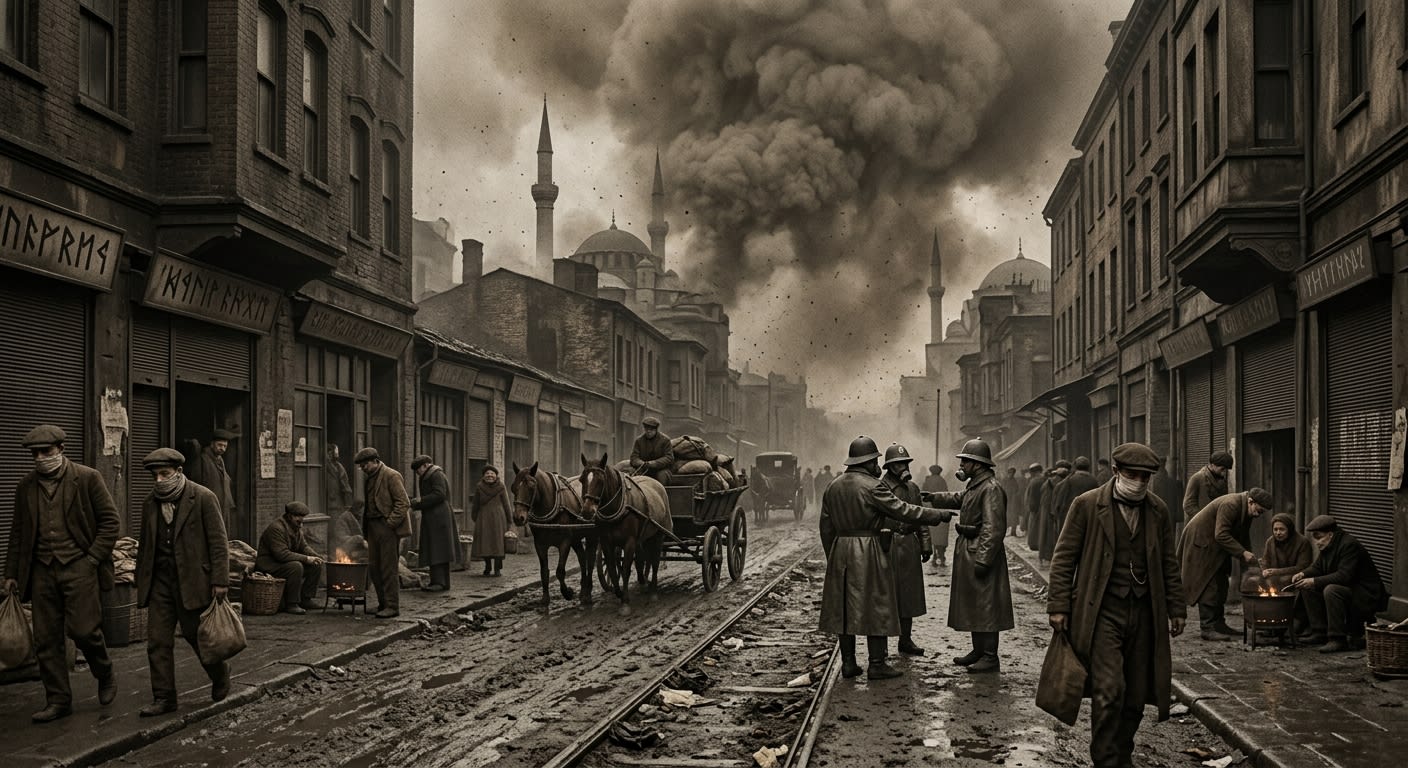
Ash is different. Ash does not respect walls. Ash enters lungs, cisterns, rifling grooves, bread dough, baptismal water, prayer books, wound dressings, children's hair, ink pots, and the closed mouths of men who have learned not to complain near officers. It falls on the chapel roof and the tavern roof with equal discipline. It silences bells by filling their throats. It makes every surface a ledger, then writes the same grey word everywhere: insufficient.
During the fourth week, the Bureau of Engineering established seventeen monitoring stations across the eastern theatre. Station Twelve, on the Foundry Quarter roof south of the Sixth Ravelin, logged nine inches in a single night. Station Four collapsed when the men assigned to clear its ash-tray died standing up, still holding their scrapers. Station Nine sent one report consisting of a blank sheet covered in grey fingerprints. Records marked the sheet received.
The city answered by ritual decree. Every ash-storm required cannon-salvos into the cloud deck, not because the salvos struck anything, which they did not, but because Doctrine held that silence before Heaven's falling residue might be interpreted as assent. For six months regiments fired blind upward from the parapets until barrels warped, breech-blocks cracked, and one captain of the Seventh Ravelin, later canonized under protest from Medicine, died with smoke issuing from his lungs a week after his final command.
Earlier field catechisms described the salvos as “effective atmospheric dispersal.”
Corrected A.S. 144. The salvos dispersed nothing. They were hymnal replies conducted in artillery. Effectiveness is a military category; reply is a doctrinal one. The gunners did not clear the sky. They kept the city from appearing mute beneath it.
Three gate-bells of Constantinople fell silent beneath the black fall. The Silent Three (Unregistered), as the Warrens still call them, hung under their accreted skins of ash while bell crews scraped until their hands bled and the clappers moved only inches. Civic morale broke faster than ration discipline. Men who had endured bombardment without trembling stood under mute bells and wept like reprimanded children. This is acoustics applied to obedience. A city governed by bells begins to doubt itself when the bells choke.
#On Bread, Bone, and the Ninth Bell
The famine that followed has its own entry, and deservedly so, for the Ninth Bell Famine is the event by which the hungry have been instructed to understand their hunger. The Year of Ash Rain is the larger wound. The famine was its mouth.
Crops failed across the eastern prefectures. The ash sealed fields under a grey crust, fouled irrigation channels, and turned spring shoots black at the stem. Grain stored in exposed depots acquired a taste of coal and old metal. The Bureau of Tithes issued revised tolerances for ash-contaminated flour in the second month, revised them again in the third, and stopped publishing revisions in the fifth, a mercy to arithmetic if not to digestion.
The ninth bell continued. The doors opened. Queues formed. Clerks stamped. Behind the counters, flour bins rang hollow under the ladle. The ration system had been designed for siege, not for weather enlisted by Wrath. It assumed scarcity would come from blockade, that blockade would be measurable, that relief would arrive by road or sea. It did not assume that the enemy would climb into the atmosphere and sit there for three quarters of a year, sifting himself into every loaf.
The reserve stores beneath the Ossuary Rings fed forty thousand people for seven days. Officially, those stores did not exist. Officially, they were never exhausted. Officially, forty thousand mouths received sustenance from a non-existent source, which makes the Year of Ash Rain one of the great triumphs of Synod metaphysics. When the grain vanished, the dead supplied the next solution. Sixty-eight thousand bodies entered the Rings. The Sixth Ring expanded by a quarter-mile in five months of tunnelling: skulls outward, long bones in chevron courses, vertebrae packed as fill, the famine made load-bearing.
A.S. 145 census corrections raised the mortality to sixty-eight thousand, seven hundred and twelve. The public number remains sixty-eight thousand because round grief is easier to teach, easier to carve, easier to fit into hymns. Seven hundred and twelve dead remain in the margin, which is where inconvenient persons generally end up.
#On the Chains' First Burning
In the seventh month, the Chain of Saint Anakletos glowed across the Bosphorus.
This was before the Black Sea Armada of A.S. 162, before the famous night when forty-three demon vessels melted against the white-hot links and engineers discovered several new kinds of professional panic. In A.S. 143 the chain did not burn ships. It burned for no target at all. The harbor crews saw it first near dusk: a pale line under the ash-dark water, link after link waking from tower to Anatolian emplacement, not hot enough to boil the strait, bright enough to turn every falling flake white for a breath before it vanished into grey.
Harbormaster Joram Clee was not yet in office. His predecessor logged the event in three lines: Luminosity present. Thermal emission negligible. Cause unfiled. A fourth line appears in the margin, in a hand Records has never matched: The chain has noticed.
The faithful took the glow as answer. Doctrine declared that the Creator had not abandoned the Hinge. Rites declared the chain a visible sign of refining grace. Engineering declared the phenomenon metallurgically unexplained, then wrote fourteen pages distinguishing light from heat, as though vocabulary could cool a miracle. The starving came to the quay to look at it. Some died there, faces silvered by the glow, ash on their eyelids, mouths open toward an instrument that had light to spare and no bread to give.
Popular broadsheets of A.S. 143 claimed the chain's glow ended the famine.
False. The chain glowed. The ash continued. The queues continued. The dead continued. Miracles are not obliged to solve the problems they illuminate, which is fortunate for miracles and inconvenient for everyone else.
The glow faded when the seasonal wind shifted and the ash briefly thinned. It returned only in brief pulses during the eighth month, then ceased. Nineteen years later, at the Black Sea Armada, the chain burned again. Since A.S. 162 it has recorded daily luminosity: nil.
#On the Continent's Aftermark
A.S. 143 did not remain in Constantinople. Nothing important ever does. Ash travelled west in weaker bands, lodged in ledgers, mortar, choir-stalls, canal locks, shroud cloth, and the administrative imagination. The Bureau of Alchemical Standards opened more classification files in that year than in the previous eleven, which tells us either that the world became stranger under ash or that ash gave timid men permission to notice what had been strange already.
At the Candlewick Palatinate, Hungry Ink was first correlated with atmospheric ash. At the Bone-Lattice Warrens of Black-Snow Lor, particulate fall began arranging itself in patterns at window seams and vent-screens. The grief resonance at the Widow's Pennies Exchange received Bureau of Bells confirmation. The Echo Creed at Peregrine Row worsened; prayers returned from the canyon with one vowel shifted, a small alteration, which is to say a large theological crime. The corpse-light at the Ash-Glyph Marshworks was first noted by surveyors. The Burnless Archive was tested under ash-year protocols and proved thermally insolent.
Bureau of Alchemical Standards memorandum 143-A/ASH proposed a single atmospheric substrate linking the Constantinople ash-fall to ████████████████████, document-fading events, black-snow patterning, corpse-light, and ████████████████████ beneath the Steppe Gate. The memorandum was withdrawn after Doctrine review. Its author was transferred to ████████████████. The ash samples remain in sealed drawer ███, where they have gained weight.
The Bureau's solution was division. Each anomaly received its own file, its own terminology, its own jurisdictional quarrel, its own pending review. The common year was acknowledged; the common cause was not. A net is visible when all knots are named together. Better to name each knot separately and call the rope decorative.
#On What Remained Grey
The ash stopped falling on the Feast of Doctrinal Submission, A.S. 144. Bells were scraped. Cisterns were flushed. Roofs collapsed under their accumulated burden weeks after clear sky returned, killing citizens who had survived the famine only to be crushed by the stored weight of it. The Bureau of Records classified these as post-event structural casualties, a phrase as elegant as a coffin nail.
The Thracian forests did not return. The Plain north of Constantinople now bears iron-grey moss in hexagonal patches where root systems burned below ground. When wind passes over the moss, it rings faintly. Engineering calls it a mineral accretion. Doctrine calls it hostile debris. Purity has requested samples three times and been refused before the requests were written, which shows either fine anticipation or poor security discipline.
The Ash Gardens took their name from that year. So did the ash-lung wards, the Ash Gallery of the Sixth Ring, the Ninth Mark Authority of the Fume-Inspectors, and a dozen municipal practices whose stated purposes vary but whose origin is always the same: in A.S. 143 ordinary deterrence became invisible at four hundred paces, ordinary bread became sacramental theatre, ordinary weather became siegecraft, and ordinary death became construction stock.
The official classification remains split. War calls it enemy action. Rites calls it refining tribulation. Records calls it A.S. 143. Doctrine, in its mercy, permits all three, because each contains enough truth to be useful and enough falsehood to be governable.