
#On the Roads That Made Walking Obedient
The Pilgrim Roads are the Synod’s low earth doctrine: mud, stone, ration-marker, toll arch, gate bell, shrine-post, rope lane, confession stall, and every official lie by which a bleeding foot becomes evidence of faith. They run through Zone 1 and Zone 2 heartlands, climb toward Zone 3 staging towns, narrow near river crossings, bruise themselves against the Queue Road, and feed the eastern appetite of the Sagittal Line with pilgrims, prisoners, merchants, soldiers under penitential cover, relic carts, widows, counterfeit saints, and children whose names have been corrected more often than their shoes.
A road, in heathen simplicity, allows passage. The Pilgrim Road improves upon this vulgar function by requiring permission, recording delay, assessing grief, pricing safety, synchronising cadence, measuring guilt, and occasionally delivering the traveller to his destination. Arrival is among its lesser products.
The oldest catechism divided lawful motion vertically. Above were the Bellways of tower, horn, Ark, and sermon. Beneath were crypt routes, sluices, ossuary tunnels, and those marrow-scented passages used by smugglers, Bureau detachments, and the practical dead. Between them lay the Pilgrim Roads, the low earth where ration-stones bear saint names and every mile asks for both prayer and receipt. The division was elegant enough for schoolroom charts. It was also a children’s map drawn over an adult crime.
The Pilgrim Roads are a distributed tribunal. Every shrine-post can witness. Every tithe-gate can refuse. Every toll arch can remember grief. Every route token can answer a bell. Every procession can become a column, every column a chain, every chain a quota. Call that pilgrimage after the Synod taught it to keep accounts.
#On Origin, Concordat, and Sainted Mileage
The roads existed before the Synod, because men have always walked toward bones, miracles, markets, and excuses. Pre-Synodal routes joined old abbeys, Roman stones, river ferries, market towns, plague shrines, and battle graves. They were untidy, local, argumentative, and insufficiently profitable. The Concordat of Strasbourg in A.S. 90 did not create them. It disciplined them.
After the Concordat, movement became a problem too valuable to leave to feet. The Bureau of Pilgrimage began licensing route chapters. Records required stations. Tithes required receipts. Bells required cadence. Doctrine required slogans. War required that devotional traffic not interfere with convoys unless devotional traffic could be reclassified as useful cover for convoys. The result, by A.S. 94, was a network of sanctioned road chapters whose first public virtue was safety and whose first private virtue was extraction.
The early A.S. 94 charters gave us the pattern. Peregrine Row became a waystation-market in a canyon throat, where syllables could be tested and protection sold. Griefgate became a choke-town beneath three black arches, where loss acquired weight and weight acquired toll. The Cloister of Miscounted Beads accreted near Strasbourg to reconcile the strings, names, and lies produced by the roads before they reached the city proper. Each claimed to serve pilgrims. Each proved pilgrims could serve the apparatus.
By A.S. 112, Saint Cadrin the Measured had been canonised to bless counted motion, stamped routes, bell-hour reckoning, and the trade of Route-Stampers and Indulgence-Token Smiths. He walked a siege-ring in approved antiquity and produced a number before dawn. From this thin miracle came a fat jurisdiction. The saint’s fork entered every stamp-chapel, and the road became holier precisely where it became harder to cross.
Pilgrimage catechisms describe the road network as “ancient sanctified fellowship preserved by Synodal care.”
Corrected. The routes are ancient in mud, recent in law, and profitable in every age where grief, fear, hunger, or obedience can be made to stand in line.
#On the Anatomy of a Pilgrim Road
A proper Pilgrim Road begins with a recognised path and ends with someone denying that the path has owners. Its visible elements are simple enough for a peasant to love: ration-stones, shrine niches, well chapels, way crosses, route bells, saint markers, inns, ferry ropes, confession sheds, and the slow mercy of a mile counted after pain. The hidden elements do the governing: passage ledgers, station slates, route-token calibration, tithe-rate tables, grief assessments, escort contracts, detention quotas, broker compacts, silence orders, and sealed exceptions written before the exception occurs.
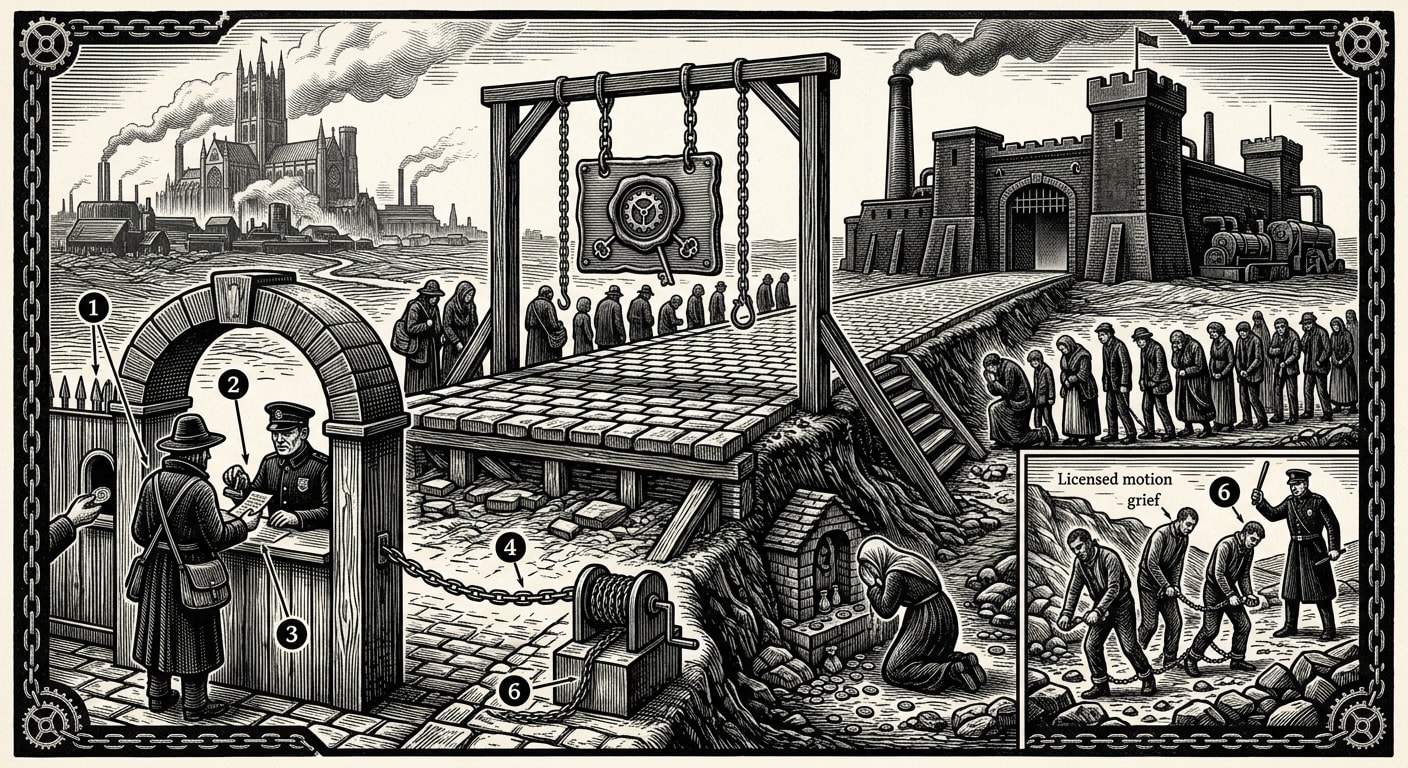
Ration-stones mark distance in devotional arithmetic. “One meal to Saint Edras.” “Three fasts to Theophania.” “Nine blisters to Varric.” Soldiers curse them as mile-markers; peasants kiss them bloody; children sit on them until their mothers slap them for irreverence. A ration-stone is a marker with teeth. It tells the traveller how much body remains due.
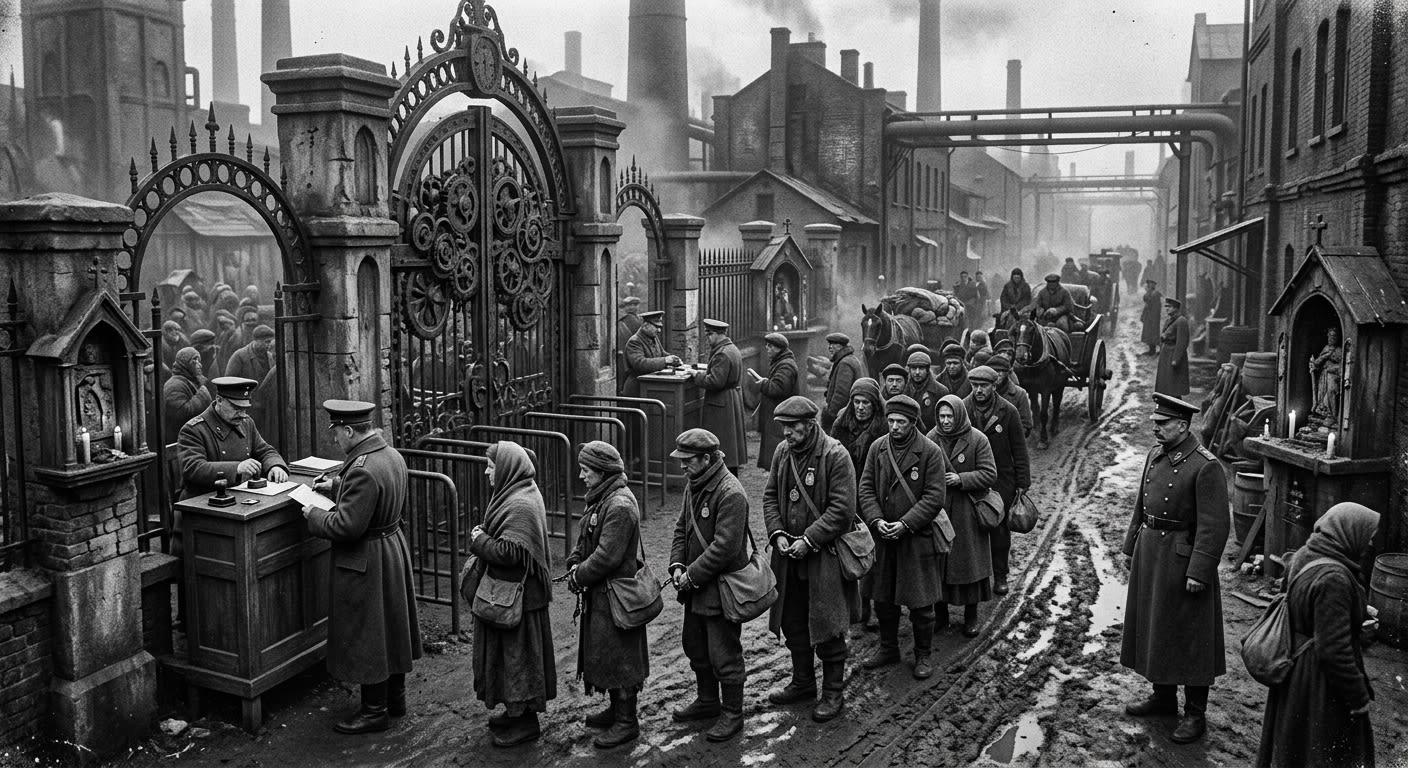
Tithe-gates punctuate the roads. One pays in coin and Creed. No oath, no passage. No clean token, no lane. No witness, no classification. At larger gates, the process expands into theatre: creed recitation, bead verification, confession comparison, toll assessment, route stamp, token chime, lane assignment, appeal notice, and a little sermon about obedience delivered by a man whose own boots arrived by cart.
The Bellway sheath holds the road where sound has been properly licensed. Shrine-posts answer tower tones. Tokens carried by travellers answer softly in brass and wax. A person bearing permission becomes audible to the road, which is comfort if one fears ditch-mouths and tyranny if one fears offices. The bargain is reasonable. The best tyrannies usually are.
#On Waystations, Gate-Towns, and the Trade in Delay
The Pilgrim Roads breed settlements the way wounds breed heat. Wherever geography narrows, where water is scarce, where a canyon echoes, where a bridge admits only one cart at a time, where grief gathers under an arch, a waystation-market rises and discovers that holiness has excellent margins.
At Peregrine Row the canyon returns prayers with one vowel wrong. The Bureau of Alchemical Standards classifies the Echo Creed as Category Two Localized Acoustic-Doctrinal Disturbance, which is the Bureau’s way of admitting that stone talks back and nobody knows whether it is mocking Doctrine or assisting quarterly revenue. Gate proctors listen. Brokers sell protection. Escort captains rent certainty by the bell-window. Quiet Pens fill with pilgrims whose syllables failed to please the rock, the proctor, or the detention quota.
At Griefgate the road enters a black-stone throat. Three arches divide Coin, Confession, and Cargo. The Widow’s Pennies Exchange converts sorrow into assessed burden. A death in the family, a debt unpaid to the Church, a sin unfiled, a blood obligation poorly phrased: each becomes weight; weight becomes toll; toll becomes stamped indulgence slip; slip becomes portable clean. The arch hums when grief crowds beneath it. Wax smears. Coins tarnish. People forget names mid-sentence. The Exchange keeps excellent books.
The smaller roadhouses imitate the larger monsters with touching ambition. A two-room toll chapel near a reed marsh will call itself a Gate Chapter if it possesses one stamp and a nephew with handwriting. A ferry hut will develop lane priority by the second flood season. A shrine keeper with a cracked bell will begin charging for “sound assurance” after one traveller vanishes in fog. Bureaucracy is contagious because power, once tasted, leaves a liturgical aftertaste.
#On Chain, Token, and Licensed Suffering
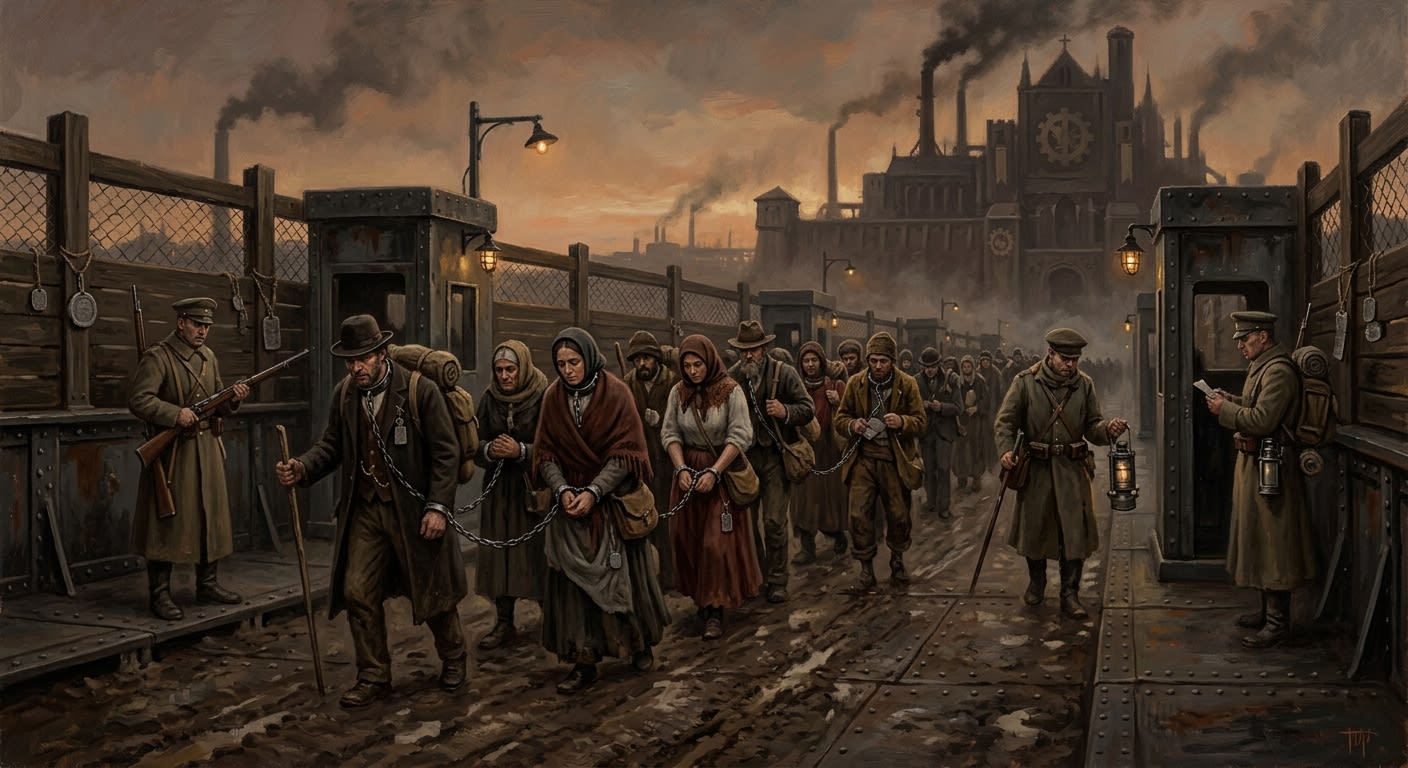
The Pilgrim Roads do not move only volunteers. Jubilee years and emergency orders transform penitential tradition into forced motion. The Pilgrim-Chain Handler drags condemned bodies along sanctified routes to relic-sites, bell-towers, wound-markers, and public squares where suffering can be watched becoming doctrine. Iron keeps the feet honest. That is the official phrase. Iron also keeps the crowd from discovering that sanctity looks very much like transport custody when viewed from the ditch.
A chained column is treated as pilgrimage if the writ says pilgrimage. Names are tagged. Offence classes noted. Mercy units counted: water, rest, cloth, bandage, permission to stop vomiting. Each mercy enters the handler’s ring. Each casualty enters a slate. Each shrine checkpoint reconciles headcount against route tokens. A missing segment becomes riot, escape wave, heretic recruitment, or audit, depending upon who writes first.
Jubilee pamphlets state that chains are “symbolic reminders of sin’s bondage.”
Clarified. The chains are iron, lock-bearing, wrist-cutting, weight-true implements of bodily custody. Their symbolic value remains available to readers whose wrists are not inside them.
Route tokens and indulgence tokens provide the softer chain. A token says the road may notice me, and I consent to being noticed in exchange for not being eaten, detained, or mislaid without documentation. The Route-Stamper seats the bell-hour core. The Indulgence-Token Smith seals the wax. Saint Cadrin watches from his icon with ledger and fork. The traveller pays, carries, answers, and becomes a note in the low Bellway.
Counterfeits kill. The Great Counterfeit Winter of A.S. 160 taught every serious road office that almost-correct tokens are worse than open fraud. A bell-hour core drifting by fractions sends a family outside the sheath by three hundred yards, enough for hunger lights, ditch-mouths, or the smaller roadside intelligences that wait where protection thins. The Bureau never forgave the mathematics. It did, naturally, preserve the revenue model.
#On Anomalies of Road and Crowd
Roads remember. Public schoolrooms receive gentler lies involving obedience and scenery. Field truth is less decorative. Peregrine Row’s canyon echoes wrong. Griefgate’s stone stores grief until seals smear. The Queue Road’s Minute Drift extracts waiting into ledgers and sends the surplus interval below Gate Nine, where an apparatus turns in a chamber no honest map admits. The Cloister’s bead strings warm and count back. The Bellway boundary moves under weather, fog, river water, demon pressure, and human bribery.
COMPOSITE PILGRIM ROAD ANOMALY NOTE — INTERNAL Correlation proposed between grief resonance, Echo Creed vowel shifts, bead drift, and minute extraction. Common factors: dense crowds, licensed delay, repeated recitation, portable tokens, suppressed names, and roadbed sites predating Synodal charter. Recommendation: █████████████████████████████. Doctrine response: do not draft systems from coincidences that collect fees.
The public calls these local peculiarities. The Bureaus classify them separately, which prevents panic, budget consolidation, and thought. Bells measures resonance. Rites misnames time. Records files bead irregularities as handling error. Pilgrimage calls crowd dread devotional pressure. Alchemical Standards assigns Category Two and waits for the phenomenon to become someone else’s mandate. Doctrine reads the reports and, when necessary, improves their endings.
Countermeasures repeat with variations: steady chants, witness pairing, vinegar washing, silence hours, token testing, segregated mourners, salt basins, shrine-post recalibration, gate lockdowns, incense fans, and the oldest countermeasure in the Synod’s cabinet — making the poor wait somewhere else.
#On the Present Congestion
As of A.S. 201 the Pilgrim Roads function, which is to say they wound the continent in an orderly direction. Mandatory penitential travel, refugee disguises, eastern labour demands, Jubilee surges, road-token audits, and Line supply pressure have swollen every major route. The Queue Road is tighter than it has ever been after A.S. 200 minute-pricing changes and Gate Nine closures. Griefgate operates at capacity and beyond it. Peregrine Row remains Amber since the A.S. 199 broker-audit leak. Strasbourg’s Cloister receives the road’s arithmetic failures by the thousand.
The official reports say throughput remains adequate. Adequate is one of those Bureau words that can survive any number of corpses if the handwriting is steady. Pilgrims sleep against ration-stones so they do not lose place. Merchants buy escort windows twice because the first window vanished into audit. Widows trade indulgence slips in culverts. Chain Handlers ration water by notch. Route-Stampers hear tokens answer after midnight. Queue Marshals cut ropes before crush panic and call the cut merciful. The roads move.
Do not mistake my tone for condemnation. Condemnation is cheap and usually performed by men who still believe systems are designed by accident. The Pilgrim Roads are magnificent. They convert terror into motion, motion into record, record into tax, tax into Doctrine, Doctrine into another road. They keep the faithful moving east, the doubtful moving slowly, the guilty moving under price, and the unclassifiable moving beneath the surface where the culverts, crypt routes, and unlicensed guides conduct their quieter liturgies.
A pilgrim stepping onto the road believes he has begun a holy passage. He has entered a machine with saints painted on its teeth. The ration-stone names his hunger. The gate names his guilt. The token names his permission. The bell names his hour. The clerk names his delay. If he reaches Strasbourg, the Cloister counts his beads. If he reaches the Line, the bastion counts his body. If he fails, the road keeps what can be filed.