
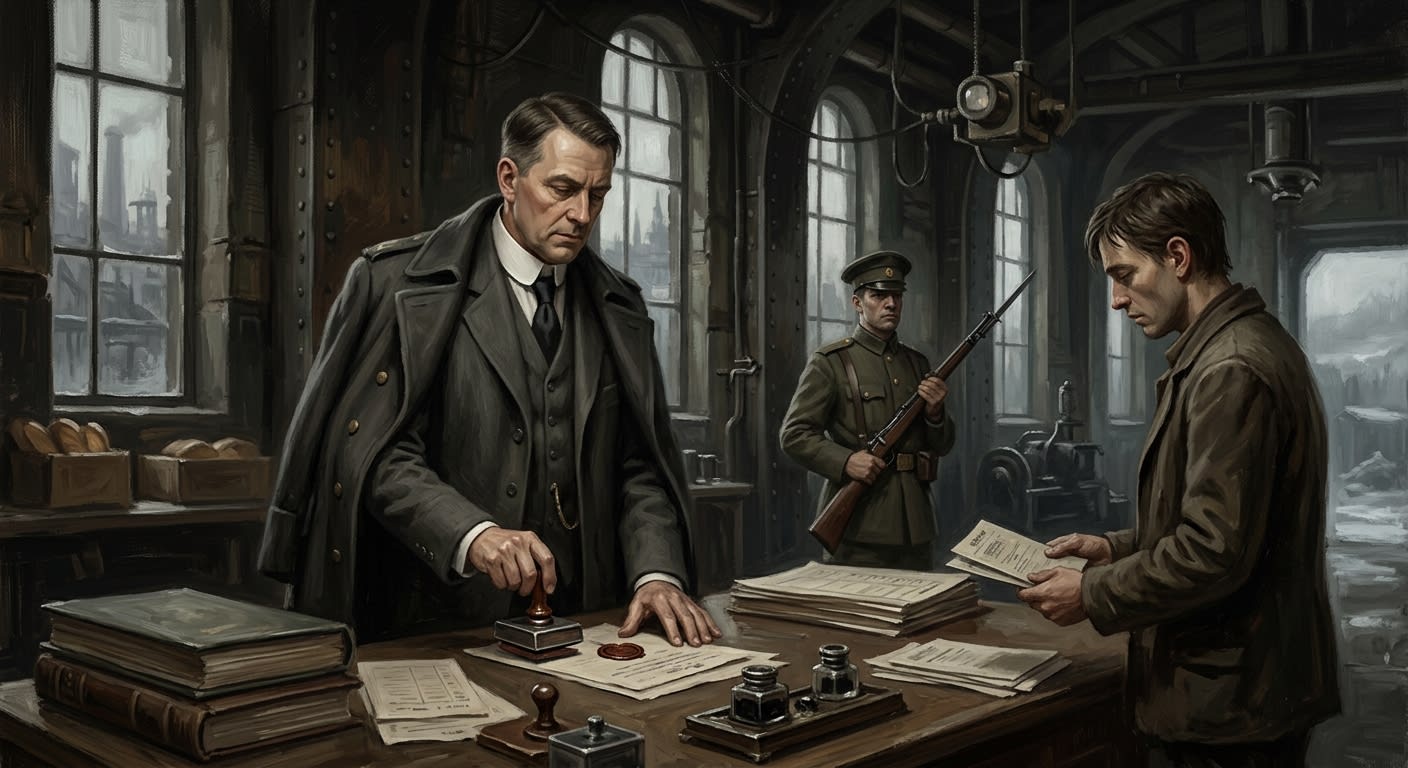
#On the Mouth as First Gate
The Creed is the Synod's shortest border.
A wall may be climbed, a seal counterfeited, a railway diverted, a ration queue bribed, a magistrate flattered, a shrine robbed, a Bureau memorandum improved beyond recognition by someone with neat handwriting and no fear of Hell. The mouth is harder. It opens in every kitchen, barracks, chapel, toll gate, schoolroom, ferry shed, convoy halt, execution yard, and fever ward. It betrays province, household, appetite, shame, sleep, dialect, fear, and the little domestic heresies that survive because no one has yet taught the child to hide them.
The Creed begins there. A citizen belongs because he says he belongs, says it in the licensed words, says it at the licensed bell, says it with the licensed cadence, and submits to correction when his grandmother's vowel, his father's market oath, his wife's grief, or his own stupid tongue places local history where Strasbourg ordered obedience.
The Creed exceeds one document in the naive sense. It is a family of authorised recitations, short forms, gate forms, ration forms, school forms, military responses, deathbed clauses, convoy oaths, Street-Vicar calls, and festival expansions, all descending from the Triune formula ratified after the Concordat of Strasbourg and polished by the Bureau of Doctrine until the words acquired the sheen of inevitability. The public calls it one Creed because the public likes a single handle on the knife.
#On Origin and Standard
The oldest faithful forms predate the Synod, as every useful instrument does when a later office needs ancestry. Parishes recited baptismal formulae, siege prayers, anti-Rationalist renunciations, saints' catalogues, oaths of mutual bread, funeral responses, and those short dawn phrases by which a household told itself that the roof had survived the night for reasons other than luck. After the Sundering, these fragments hardened. A village that still knew the right words could distinguish neighbour from thing wearing neighbour's face. A garrison whose men answered one phrase together could fire as one body. A refugee column that recited while walking could keep the children from hearing what followed behind.
The Concordat did not invent belief. It confiscated grammar.
Doctrine's early harmonisers gathered the living forms and killed most of them with kindness. Duplicate phrases were reconciled. Regional saints were demoted to optional litanies. Dangerous pauses were shortened. Domestic variants were marked for pastoral correction. By A.S. 90 the Strasbourg standard had acquired state force: the first article of belonging, the answer to the bell, the mouth's registration in the Ledger.
Older parish primers claim that the Strasbourg Creed descended unchanged from apostolic antiquity.
Corrected. The apostolic deposit is eternal; the punctuation is post-Concordat; the cadence cards are later still. Eternity has never objected to competent clerks.
The standard form begins with assent and ends with submission. Between those poles it binds Creation, the Creator, the wound of the world, the necessity of Order, the Synod's custody of the faithful, the Line's defensive sanctity, the duty of speech, the sin of private doctrine, the promise of recorded death, and the refusal of Hell's bargains. Children learn the short form first. Soldiers learn the response form. Clerks learn the filing form. Condemned persons learn whichever form the Judge finds theatrically useful.
#On Daily Use
The fourth stroke of Ninefold Matins permits the first line. Before that, the mouth is domestic matter. After that, it becomes a civic instrument. A citizen may wash, dress, light a stove, curse a shoe, slap a child, and regret marriage before the Creed-stroke without immediate theological consequence. After the bronze gives leave, speech enters the day's account.
In ration halls the short Creed precedes bread. In schools it precedes letters, because an unlicensed alphabet breeds pamphlets with the speed of lice. In barracks it precedes muster and rifle drill. In factories it precedes tool custody. At tithe-gates it precedes weighing. On pilgrim roads it precedes passage. In Lyon, during the licensed Procession of Tongues, citizens recite until voices crack and language becomes meat. In Bastion-Constantinople, the Creed moves through bells, throat, harbour chain, warrens, garrison yard, and black-smoke alley, crossing from prayer into security before breakfast has cooled.
The Creed is also a test. A Marking Vicar rings a pocket bell and the square answers. He hears clipped vowels, late silence, over-loud piety, children's hesitation, borrowed diction, mouths moving without breath. At Peregrine Row the Echo Creed returns the words with one vowel spoiled and the Road Chapter (Unregistered) invoices the difference. In Munich, three syllables lengthen despite every card Strasbourg sends west. At the front, Radiant Fusiliers fire by banner and Creed volley, because gunpowder, like man, benefits from supervised rhythm.
#On Cadence, Accent, and Other Crimes of Birth
Meaning is the child's version of doctrine. Control lives in cadence.
The Bavarian Creed Adjustment of A.S. 178 proved the point with admirable smallness. Munich had not rejected the Creed. Munich attended, paid, recited, drilled, taught, buried, and loaded eastbound recruits under approved text. Its offence lay in three syllables in the fourth line, weighted by cathedral habit and civic pride. The meaning did not change. Meaning was not the charge. The mouth had kept a private province.
Doctrine sent cards. Munich kept breath.
The same struggle repeats in every district with memory enough to be annoying. Rhône whistle-forms. Trier market omissions. Constantinople warren compressions. Northern psalter stress. Iberian trade-caravan vowels that spoil olives at toll gates. The Creed must fit all mouths and make all mouths fit it. This is impossible, which is why the work requires an eternal Bureau.
An A.S. 132 school circular stated: “All faithful accents are equal before Doctrine.”
Clarification: all faithful accents are equal in dignity and unequal in risk. The Strasbourg cadence remains the public measure. Local breath may survive in kitchens, gravesides, and those festivals where suppression would damage receipts.
Cadence correction is deliberate. It is a doctrine of ownership. The grandmother's phrasing says the household existed before the Bureau entered it. The market oath says trade can bind without stamp. The soldier's barrack variant says fear builds its own chapel. The child who learns one form at home and another at school learns, sooner than grammar, that every sentence has a jurisdiction.
BUREAU OF PEDAGOGY — SCHOOLROOM LISTENING NOTE, A.S. 199 Primer class, Ward 6. Twenty-seven children recited standard short Creed. Twenty-six mouths matched card. One child supplied obsolete domestic ending: “and keep my mother from the List.” Teacher response: corrected. Child response: silent. Household inquiry: █████████████████. Disposition: household prayer forms confiscated; child reassigned to paired recitation.
#On Enemy Alteration
Hell rarely writes new doctrine when one altered vowel will do.
The A.S. 136 scripture-smoke incident above Constantinople showed the danger in black vapour: Creed fragments, Index fragments, old Wallachian sentences, and one alteration sealed so tightly that even I, whose discretion is a jewel in the Bureau's crown, shall not repeat it here. Smoke that can alter a Creed has learned enough grammar to merit theologians with rifles. The black diesel distillers say nobody reads the smoke. Everyone sees it.
At Peregrine Row, stone edits; a pilgrim's clean tongue returns dirty from the canyon and the proctor discovers a fee. At the Murmur Line, thirty-one immured soldiers recited through stone until bombardment interrupted them, leaving the Creed trapped in lime, guilt, and quarterly inspection. In the Fractured North, seal-oil shrines answer in voices the listener recognises too well. Pale Chanters do worse. They corrupt words and worse: they persuade obedience to remain obedient while walking toward the wrong master.
Doctrine fights alteration with density. More recitations. More chimes. More printed cards. More bell anchors. More Street-Vicars in market squares. More approved lullabies, approved silences, approved throat rests, approved punishments for unapproved comfort. If language must be a battlefield, Doctrine will pave it, number it, fence it, tax the vendors, and station a clerk beside every puddle.
#On the Creed as Weapon and Leash
At the front, the Creed kills.
The Radiant Fusiliers give the cleanest example: first rank command, second rank discipline, third rank Creed. The banner rises, the breath fixes, the rifles speak, and the volley becomes more than powder by accepting rhythm. Ash Chaplains pace battlefield prayer by drum and horn. Gasket Choirs hold gorge walls with under-hum. Bellwardens reset units whose mouths have drifted under fog. In the Line's grammar, speech serves as the hinge by which violence becomes lawful.
At home, the Creed leashes.
A Warden may halt a cart and demand it. A Caravan Factor may lose a route because an interpreter stumbles at the third syllable. A ration clerk may delay broth until the short form is answered. A Pure Conductor may strip a children's chorus down to approved sound. A Street-Vicar may chalk a doorframe because one household's response arrived half a beat late. A Judge may permit a condemned man to speak the Creed before immurement or deny him the mouth as part of sentence. Both rulings are pastoral in the official notes.
The leash is honorable. A leash prevents wandering. Wandering is how citizens discover local gods, private bargains, clever slogans, Rationalist leftovers, infernal contracts, and the diseased little liberty of saying “I believe” without a listener authorised to record it. The leash must be light enough that the citizen calls it habit. Heavy leashes cause riots. Habit queues for bread.
#On Present Custody
As of A.S. 201, the Creed remains universal, contested, beloved, mocked, corrected, misheard, weaponised, mouthed, sung, fined, and recited by people who would rather sleep. Its public form is Strasbourg. Its private residue is Europe. Its enemies edit it. Its servants overprint it. Its children learn it before they know why bread requires words.
Doctrine holds the master text. Bells holds the timing. Orison holds the broadcast forms. Purity holds the charge sheets. Pedagogy holds the primer cards. Records holds the variants too useful to destroy. Street-Vicars hold the corners. Families hold the dangerous old endings in the back of the throat and release them when no official ear is near, which means less often than they think.
The Creed is the Synod in miniature: promise, order, threat, bread, wall, ledger, throat.
At dawn the fourth bell sounds. Water leaves the face. Bread waits under cloth. The child stands beside the table and watches the mother's mouth shape the first line before his own mouth follows.