
#On the Nature of the Place
"Say it clean. Walk it safe." — Inscription above the Gate of Clean Tongues, carved in limestone by an artisan whose own pronunciation was subsequently investigated.
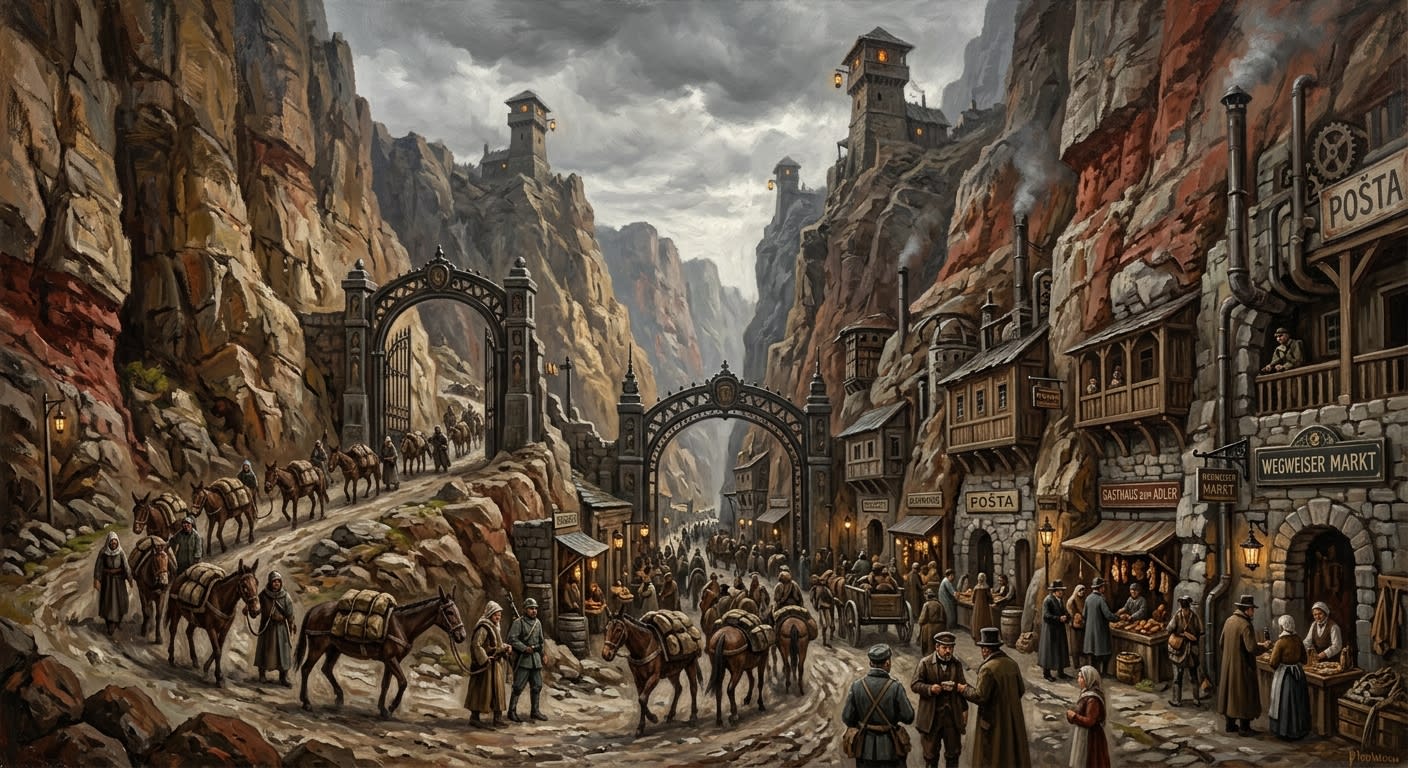
One approaches Peregrine Row from the west, by mule-road, through two miles of canyon so narrow that a man standing with both arms outstretched may touch the walls. The dust is red. The acoustics are catastrophic. Every syllable spoken in that defile returns from the stone amplified and subtly wrong, which is — as the Bureau of Doctrine has determined — the canyon's fault, and never the speaker's, unless the speaker is under audit, in which case it is always the speaker's.
Peregrine Row sits at the throat of this geological indignity: a waystation-market built into the switchback where the Pilgrim Roads fork toward three sanctuary cities, two trench-supply spurs, and a dry ravine the Bureau of Records classifies as "former settlement, currently geological." Eighteen thousand souls live here, give or take the seasonal tides of pilgrims who swell the population to forty thousand in high season and contract it to twelve in winter, when the canyons freeze and the only traffic is military.
It is, in the official filing of the Bureau of Pilgrimage, a "Waystation of First Classification, Operating Under Joint Charter of the Synod Road Chapter (Unregistered) and the Licensed Broker Compact Council of Peregrine Row." The pilgrims call it Bead-Row. The soldiers call it Vowel-Tax. The brokers call it revenue.
#On the Founding
The original settlement was a cistern, a shrine, and three families who taxed passing mule-trains with the cheerful impunity of people who controlled the only water source in a twelve-mile canyon. This predated the Synod by a comfortable margin. The Sundering altered nothing about the geography and everything about the traffic: where a hundred mules had passed in a season, ten thousand refugees now stumbled through, fleeing the horrors of the east. The three families tripled their prices, built walls, and called themselves a government.
The Synod, upon its formation, took a characteristically bureaucratic view of this arrangement. A writ dated A.S. 94 — four years after the Concordat — establishes the Road Chapter of Peregrine and grants it authority over "all matters of transit, devotion, and syllabic compliance along the designated pilgrim corridor." The three founding families were absorbed into the Broker Compact, which is to say they were given titles, stripped of independence, and permitted to continue extracting money under the supervision of a Cantor-Auditor dispatched from Strasbourg.
The first catastrophe arrived in A.S. 101, seven years after the charter. A pilgrim convoy of six hundred was ambushed in the eastern canyon by bandits operating from the ridge caves. Two hundred and fourteen died. The Bureau of Doctrine's investigation concluded that the massacre resulted from "impure recitation among the pilgrim body, which weakened the protective virtue of the road." The surviving pilgrims were fined for doctrinal negligence. The bandits were never identified.
The Road Chapter's response was efficient and transformative. Creed-testing was introduced at the gates. Escort contracts became mandatory. Bead-count reconciliation — the system by which each pilgrim's sins are tallied, priced, and subtracted from their passage credit — was formalized into a daily audit. The detention system, initially a holding pen for the actively heretical, expanded to accommodate anyone whose pronunciation failed to satisfy the gate proctors, whose standards tightened with each passing year and each new premium schedule.
By A.S. 110, the year of the First Continental Levy, Peregrine Row had become the model for every waystation on the Pilgrim Roads: a place where safety was sold, salvation was priced, and the distinction between insurance and extortion was a matter of which side of the broker's desk you sat on.
#On the Fortifications and Geography
The Row has no walls in the conventional sense. The canyon is the wall. Two hundred yards of switchback road compressed between limestone cliffs, funnelled through the gate-arches at east and west, overlooked by seven ridge lantern towers whose operators can see — and signal — everything that moves for three miles in either direction. A military engineer would call it defensible. A broker would call it controllable, which is a more honest word for the same condition.
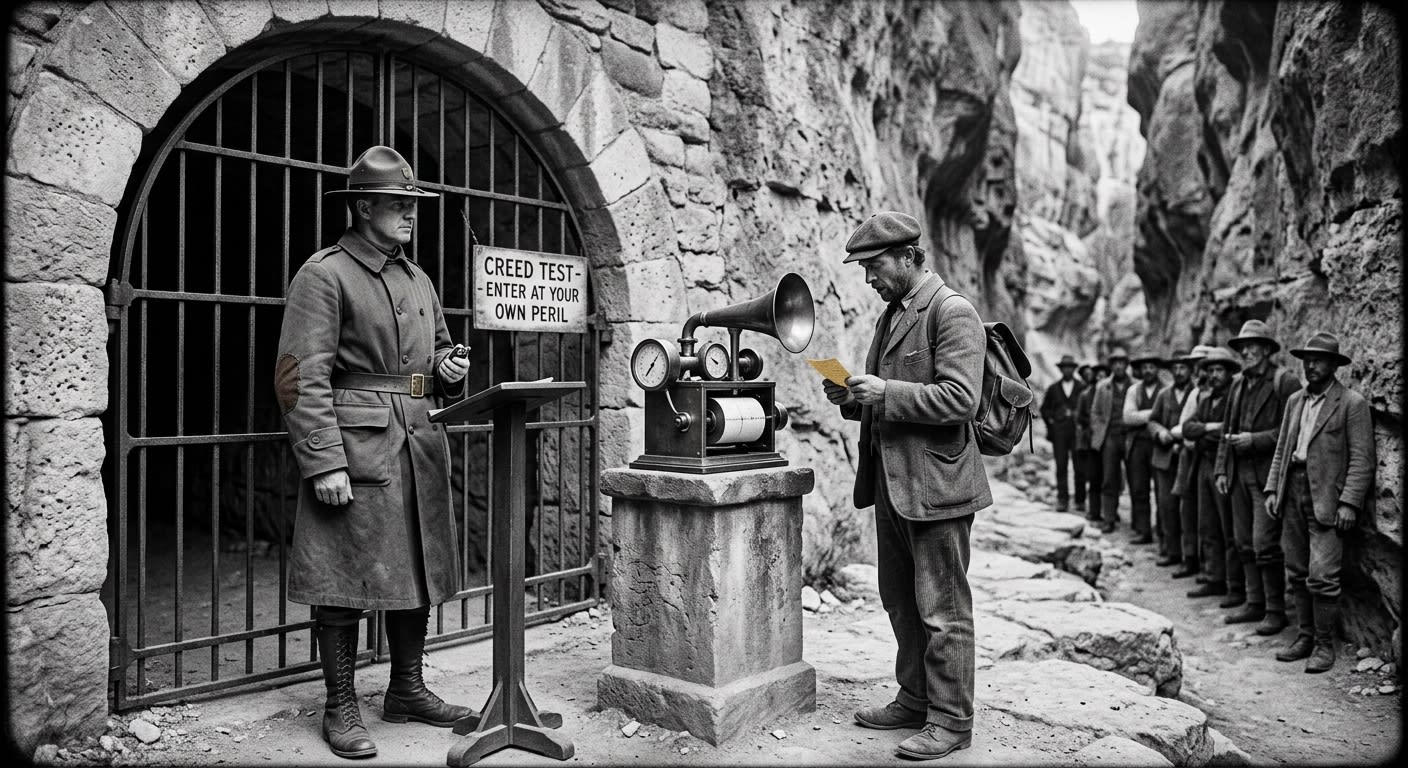
The Gate of Clean Tongues, facing west, admits arriving pilgrims through a sequence of checkpoints that would embarrass a bastion. Creed recitation — spoken aloud, at volume, with a gate proctor listening for vowel deviation and a scribe recording each syllable on a carbon-backed receipt. Bead-count verification — the pilgrim's personal tally of sins, carried on a bone-and-glass string, cross-referenced against whatever confession receipts they possess. Identity stamp — the wax impression on the left forearm that marks you as "processed" and which, if it cracks or smudges before you reach the eastern gate, requires a full re-entry procedure at the pilgrim's expense.
The eastern gate, facing the dangerous road toward the trench-supply spurs, is simpler. An escort contract, verified. A water ration, issued. A prayer, recited under the supervision of a military chaplain whose primary qualification is the ability to distinguish between genuine faith and the particular brand of desperate gabbling that precedes an ambush.
Between the gates, the Row arranges itself in a linear compression of commerce and control: the Choir-Broker Hall at the centre, flanked by the Bead Courts to the north and the Escort Yards to the south, with the Cistern Chapel occupying the only natural hollow and the Tinmarket Arcade (Unregistered) filling every available gap between them. Below it all, carved into the canyon floor in an era no one has bothered to date, run the cistern tunnels — the black market's highway, the smuggler's chapel, the only space in Peregrine Row where the ridge lanterns cannot see.
#On the Choir-Broker Hall
The Hall itself is the economic engine of the Row, and I use the word engine with the precision of a man who has watched its machinery strip a pilgrim of his savings in the time it takes to recite a psalm.
The Choir-Broker Compact operates from a raised dais at the Hall's centre — seven desks, seven brokers, seven scales for weighing the particular kind of nothing that passes for commerce here. What they sell is protection. A contract guaranteeing safe passage through the eastern canyons, priced according to a formula that accounts for the season, the threat level, the pilgrim's declared sin-count, and a variable the brokers call the "Canyon Premium" and the pilgrims call theft.
The contracts are elaborate documents. A standard escort voucher runs to four pages of dense notarial script and includes, among its provisions: a grief clause pre-pricing the compensation due in the event of the pilgrim's death (payable to the broker, who will forward a percentage to the bereaved, minus administrative fees); a syllable guarantee confirming that the pilgrim's creed-test score at the Gate of Clean Tongues meets the minimum threshold for insured passage (scores below threshold void the contract, refund excluded); and a canyon waiver acknowledging that the echoing properties of the local geology may produce "syllabic distortion indistinguishable from heretical mispronunciation," for which the Compact accepts no liability.
The escort captains operate from the Yards, hiring out companies of between twelve and forty armed men — licensed by the Road Chapter, bonded by the Broker Compact, and equipped with the particular combination of cynicism and competence that characterizes men who sell certainty for a living. Captain Odrik, called "Ridge-Hook" for reasons the local constabulary has investigated twice without resolution, commands the largest company. His men know every canyon echo, every ambush lane, every rockfall that can be arranged to look geological. They are, by all accounts, very good at their work. The question of which work occupies the Bureau of Purity when it can spare the manpower, which is seldom.
#On the Bead Courts
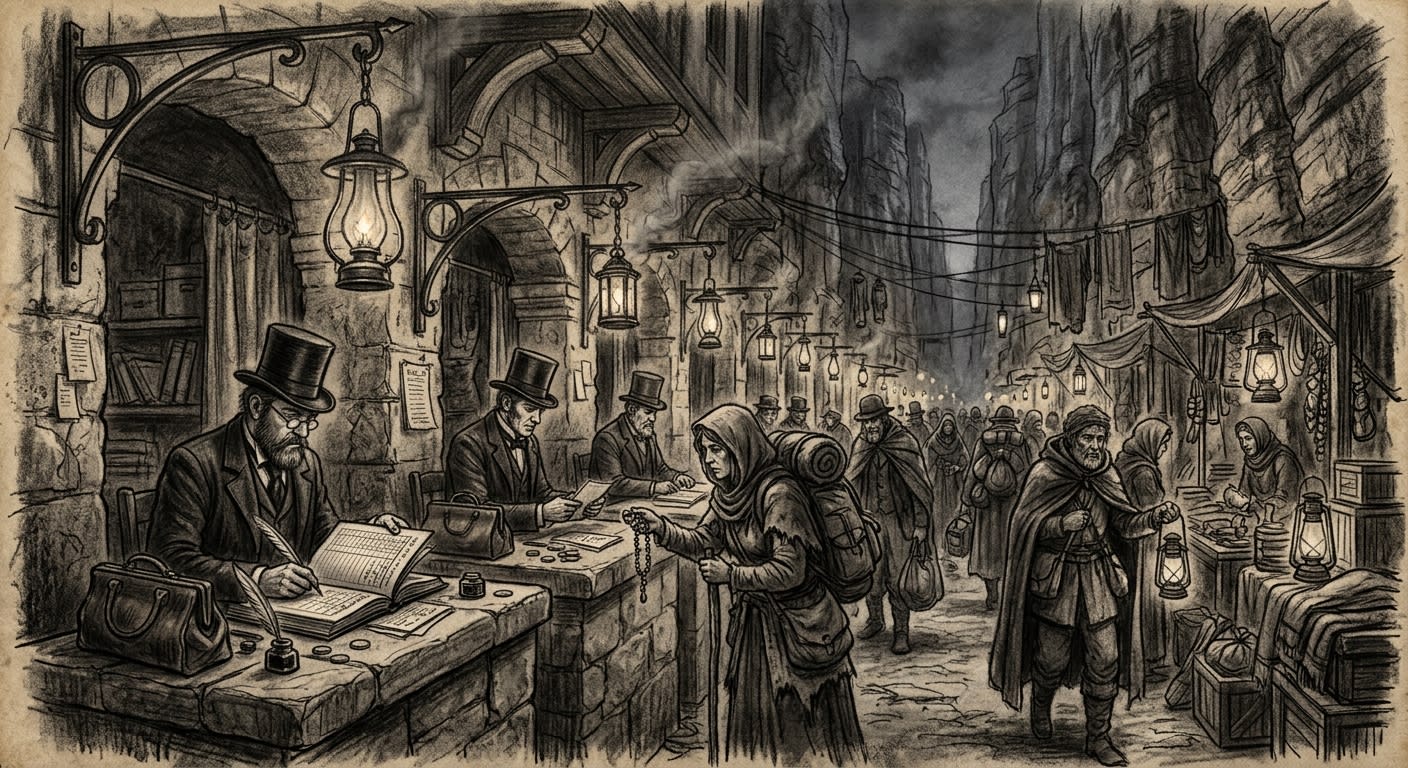
The Bead Courts occupy the northern arcade: twelve reconciliation tables staffed by clerks whose mathematical skill is exceeded only by their willingness to deploy it as punishment.
Every pilgrim carries a bead string. The beads are denomination-coded — bone for minor sins, wood for moderate, glass for grievous — and the string's total must reconcile with the pilgrim's confession receipts, passage stamps, and whatever tithe credits the Bureau of Records has seen fit to assign. The reconciliation is performed at the tables, in chalk, on slate boards that are wiped clean after each session. No record is kept of the calculation. Only the result is filed: "reconciled" or "unreconciled." Unreconciled pilgrims are remanded to the Quiet Pens (Unregistered) until the discrepancy is resolved, which requires either payment or a supplementary confession, which generates a supplementary receipt, which must itself be reconciled at the tables, which generates a processing fee.
Previous editions of this entry stated that bead-count reconciliation was "voluntary." The Road Chapter has clarified that reconciliation has been mandatory since A.S. 104 and that voluntary participation was never offered, discussed, or theologically plausible.
CORRECTED by order of the Cantor-Auditor's office, Peregrine Row, A.S. 200. Filed.
The Reconciliers' Union (Unregistered) controls who counts, how the counting is done, and — with a subtlety that would shame a Bureau of Records clerk — who becomes "unsound." An error of one bead in a string of sixty is a miscount. An error of two is suspicious. An error of three is heresy, and heresy has a processing fee attached, and the processing fee generates a new bead, and the new bead must be reconciled. The system, like all the Synod's finest instruments, feeds on itself with the quiet efficiency of a prayer wheel that grinds grain instead of sin.
#On the Quiet Pens and the Detention Economy
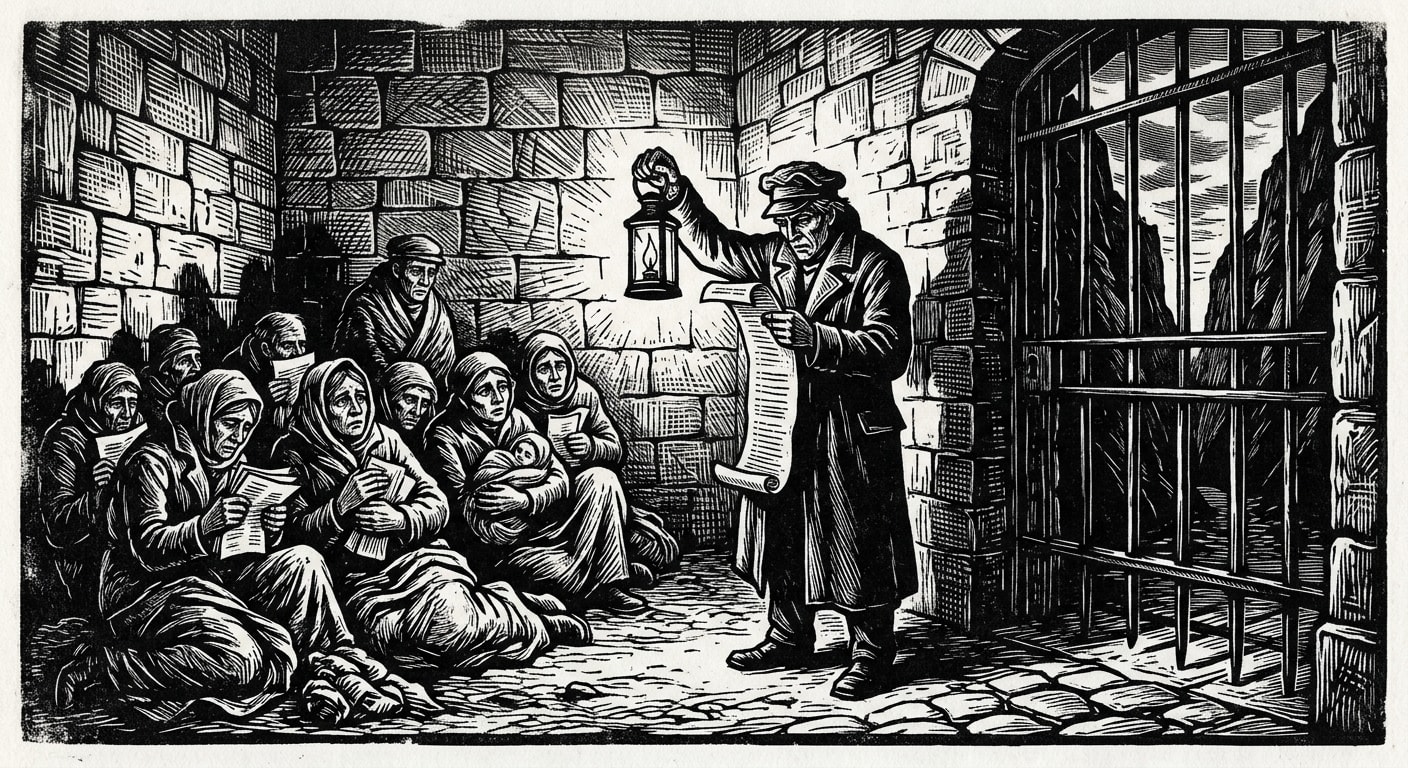
Beneath the Tinmarket Arcade, accessed through a staircase the locals call the Vowel-Stair (Unregistered), lie the Quiet Pens.
I will describe them briefly, because they deserve brevity. They are stone rooms. They smell of lye and the particular human scent that accumulates where fear is sustained at low intensity over extended periods. They hold, at any given time, between forty and three hundred souls — pilgrims whose creed recitation was judged deficient, whose bead-counts failed reconciliation, whose escort contracts lapsed mid-passage, or whose faces simply displeased a gate proctor on a bad morning.
The Quiet Pen Wardens (Unregistered) operate under the Road Chapter's authority and the Broker Compact's budget. Detention is monetized. A "processing fee" is levied upon entry — the amount varies by the detainee's assessed sin-count, passage status, and ability to pay. Release requires either full payment of accumulated fees or a "service assignment" — labor contracted to the Bead Courts, the Escort Yards, or, in cases of extended detention, to distant bastions whose supply needs are less particular about the voluntary nature of the labour.
The detention quotas are the Row's ugliest secret and its most reliable revenue stream. Each quarter, the Road Chapter sets a target: a number of detentions to be processed, a volume of labour to be extracted, a sum of fees to be collected. The quotas are achievable because the creed tests are calibrated to produce them. A gate proctor who needs twelve more detentions to meet his numbers can tighten the vowel standards, and the canyon's echoing acoustics will provide the evidence. The Bureau of Doctrine has been informed of this arrangement. The Bureau's response, filed under Internal Memorandum 7R-201, reads in its entirety: "Standards are standards."
#On the Canyon and Its Anomaly
The Echo Creed.
The Bureau of Alchemical Standards classifies it as a "Category Two Localized Acoustic-Doctrinal Disturbance" — which is the Bureau's way of admitting that the canyon repeats your prayers wrong and they do not know why.
A pilgrim recites the Seventh Catechism at the Gate of Clean Tongues. The canyon wall returns the syllables two seconds later, shifted by one vowel. The gate proctor hears both recitations — the correct one and the echo — and must determine which is the pilgrim's and which is the stone's. In theory, this determination is made by training and discernment. In practice, it is made by the quarterly detention quota and the proctor's personal relationship with the pilgrim's broker.
The disturbance worsened after A.S. 143 — the Year of Ash Rain, when Maldrake's fires blackened the Thracian forests and ash fell across the continent for eleven days. Whether the ash altered the canyon's acoustics or whether the canyon had always been this way and the ash merely gave the Bureau an excuse to classify what it had been ignoring, the records do not clarify. The records, in fact, contradict each other on three separate points regarding the Echo Creed's onset, its severity, and its theological implications. The Bureau of Doctrine has resolved these contradictions by classifying all three versions as simultaneously correct.
More disturbing: the letters on contracts left overnight in the Choir-Broker Hall shift. A vowel here. A consonant there. A grief clause that read "compensable at standard rate" in the evening reads "compensable at stated rate" in the morning, and the stated rate is lower. The scribes blame the ink. The brokers blame the scribes. The Bureau of Alchemical Standards blames atmospheric conditions. The canyon, asked for comment, repeats the question back with one word changed, and the changed word is always whose.
#On the Present Condition
Peregrine Row, as of A.S. 201, operates under Amber status — a designation the Road Chapter has maintained since A.S. 199, when a leaked ledger from the Broker Compact's internal audit revealed that certain "demonstration ambushes" in the eastern canyons had been contracted and paid for by the brokers themselves. The purpose was commercial: a well-timed attack validates the insurance model. Dead pilgrims are a line item. Living ones pay their premiums.
The leak has not been formally acknowledged. The Road Chapter conducted its own investigation, found "no evidence of systematic coordination between licensed brokers and unlicensed hostile elements," and fined the leaking clerk for "administrative indiscretion." The clerk was remanded to the Quiet Pens. His current status is filed as "processing."
Cantor-Auditor Selm Peregrin — direct descendant of the founding family, whose name the Row bears like a brand — maintains order with the particular authority of a man whose voice can condemn you to detention or approve your passage with the same inflection. He hears profit in mispronunciation. He has done so for eleven years, and in those eleven years the detention revenue has tripled, the escort premiums have doubled, and the pilgrim throughput has decreased by nine percent, which the Road Chapter attributes to "seasonal variation" and which the Queue Road merchants attribute to pilgrims choosing longer, more expensive, less efficient, but less terrifying alternative routes.
Earlier reports from this office described the Choir-Broker Compact as "a model of Synod-private cooperation." The Bureau of Doctrine, following review of the A.S. 199 audit documents, has amended this assessment.
REVISED designation: "A model of Synod-private cooperation, operating within parameters that are currently under review." The distinction is important and should be noted by anyone whose passage contract is still active.
Broker-Matron Lysa Vane sells comfort with a trembling smile and keeps a ledger of bodies — every pilgrim lost on a contracted escort, every grief clause paid, every refund denied. The ledger is her insurance against the Compact, which is her insurance against the Road Chapter, which is her insurance against the Bureau. The chain of mutual blackmail extends to Strasbourg and back, and at each link the price of passage increases by a fraction that compounds across the season into a sum the Bureau of Tithes finds theologically satisfying.
Captain Odrik "Ridge-Hook" commands forty-three escorts, controls the ridge lantern signals from Towers Four through Nine, and has survived two formal investigations into his relationship with the Canyon Saints — the bandit coalition that taxes the eastern approach with ambush, hostage creed-games, and the occasional theatrical massacre. Odrik's defence, both times, was simple: he cannot control what happens outside his contracted safe-window. His contracted safe-window, by coincidence, never overlaps with the Canyon Saints' operating hours.
The cistern holds. The water flows. The bead-courts click and tally and condemn. The Quiet Pens fill and empty and fill again. The canyon echoes. The contracts shift overnight, and in the morning the scribes find new terms they did not write, in ink they did not use, binding parties to clauses the stone itself appears to have authored.
And somewhere in the cistern tunnels, where the ridge lanterns cannot see, a syllable forger (Unregistered) trades clean tongues for a price — teaching pilgrims to swallow the third syllable, to breathe through the vowel, to pass the gate proctors with a recitation so perfect it could only have been manufactured. His customers pay in water chits and silence. His product is survival. His name, if the canyon knows it, the canyon has not yet repeated.