
#On the Glass Rain
The Glass Rain is Bastion-Przemyśl's name for forty minutes in A.S. 194 during which the garrison of Orchard Ring could not agree who commanded it. The longer records call it the Glass Rain over Orchard Ring. It is the same disaster with a fuller postal address. It took place inside the Wire Orchard of Bastion-Przemyśl, in the western Carpathian sector of the Sagittal Line, one year before the Spire-Crusher came out of the eastern fog to make the same walls feel small.
The Spire-Crusher entry lists the Glass Rain among the insults the bastion's inner stone had already survived. That is generous to the stone, which was never in danger in 194. The thing broken at Orchard Ring was the chain of command, and the Orchard leans on that chain harder than on any wall.
The record does not give the month, the day, the hour of the opening strike, the number of dead or a full inventory of the damage. I have supplied none of them. An archivist who invents a casualty figure is just a forger with better handwriting.
#On the Orchard's Instruments
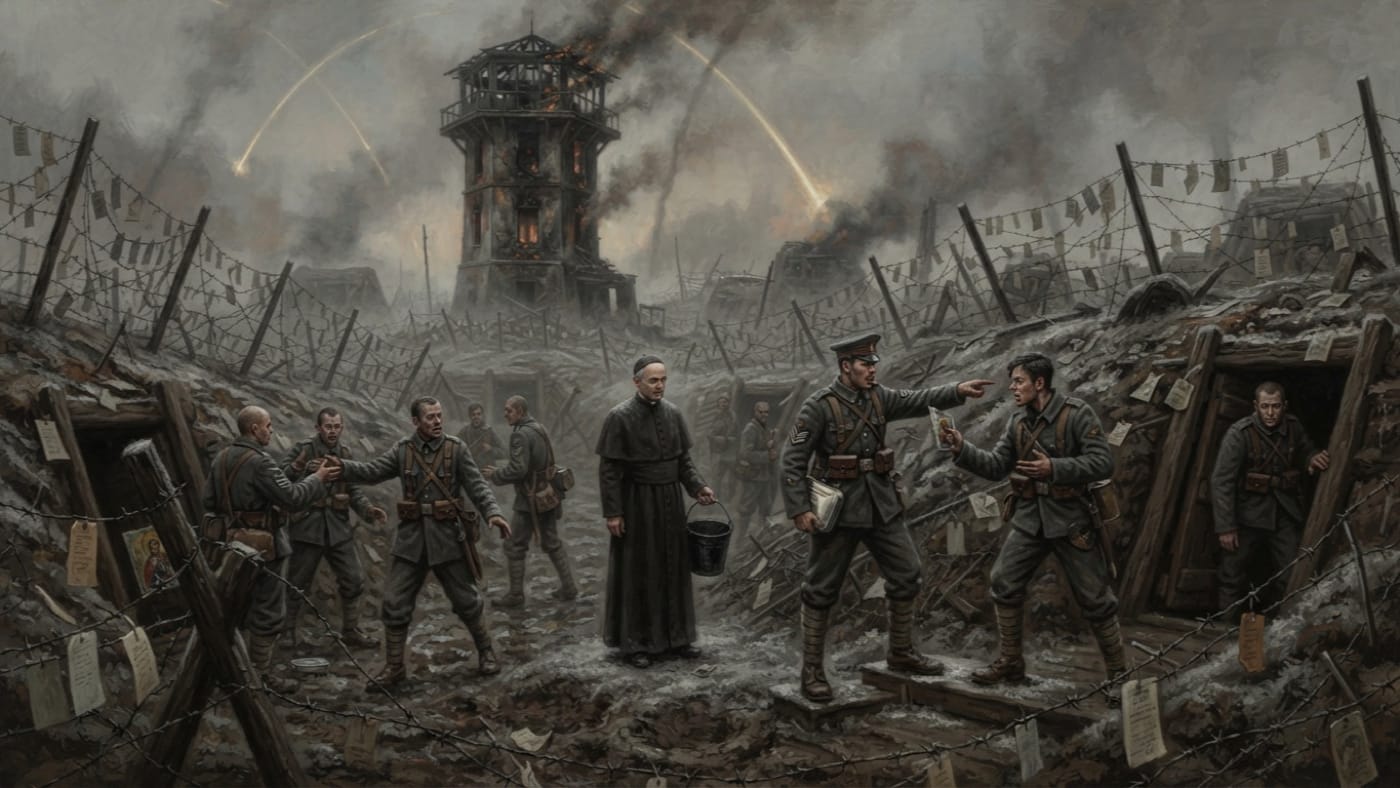
Orchard Ring is a district of wire groves and gallows posts. It smells of rust, wet rope and lamp oil, and of ozone when the strands are live. The wire carries more than current. Ration tags, transit chits and confession receipts hang from the barbs, so every grove doubles as a filing cabinet with a lethal handle. In the Ring a soldier is what his tag says he is, and his corporal is whoever the roll names. Above them stands Tower Nine, the Orchard Eye: an overwatch post of cold wind, oil lamps and observation glass.
The whole arrangement runs on counted identity. Bread goes to the tag. Orders come down through rank. Relief goes to whoever the roll says is due it. A soldier who cannot say who stands above him and who stands beside him cannot be fed, posted, relieved or hanged in the correct sequence, and Przemyśl takes correct sequence very seriously.
Glass is part of that system too. The Orchard Eye watches through lenses. Clerks read tags through spectacles. Lamps burn inside glass chimneys. Empty ration tins come back from the line polished by thumbs. These are humble objects, and they are everywhere a man might glance while waiting for an order.
Atheron, Sin-General of Pride, attacks the place where those glances land. The Bureau of Doctrine teaches that Pride lets a soul understand any relation only as above or below, so that it loses the level gaze between equals. A garrison is assembled from level gazes: the man beside you on the firestep, the runner you trust to carry a message honestly, the sergeant whose order you obey because the roll and your own eyes agree on who he is. Take that agreement away and the wire still hums, but nobody can say who it answers to.
#On the Forty Minutes
The incident opened with a Sun-Spear burst against Tower Nine. The Sun-Spear Legion is Atheron's ranged arm, and its spears of light are made to blind. The record says the strike came first and the outbreak followed. It does not say how one produced the other, and I will not supply a mechanism for the convenience of a paragraph.
What followed was this. Within a reported quarter-mile, any surface able to hold a face started returning ranks. Fragments of observation glass, spectacle lenses, lamp-chimney glass and polished ration tins all did it. A soldier who looked into one saw a station, rarely the one he held. The neighbour looking into the next shard saw a different one, and the two could not both be true. No two reflections fitted the same table of organisation.
Corporal Jarek Muth saw himself as Marshal of the Outer Wire. He held that office by appointment of a piece of glass, and he used it at once to order a retreat.
Private Elya Sorn claimed spiritual authority over Muth and countermanded the retreat.
So there were two orders, given by two men who each believed himself the only legitimate source of orders, to soldiers who had looked into their own tins and lenses and found their own commissions there. An order works only if the man receiving it believes the man giving it outranks him. In Orchard Ring that belief had splintered into as many versions as there were reflective objects. Runners could not tell which way to carry a message. A sergeant could not tell whether the private in front of him was a private. Each new claim of command drew fresh claims against it.
For the whole forty minutes the roll listed Muth as a corporal and Sorn as a private. The roll was correct. Nobody in the Ring could read it.
No Mirror-Lord is recorded at Orchard Ring. Doctrine's account of the Mirror-Lords describes injuries of this kind, and anyone who has read it will find the resemblance close. Resemblance is not attribution, though. The surviving account names a Sun-Spear strike and reflective rank distortion. It names no demon, reports no sighting and says nothing about how the effect spread. The Ledger records what the Ledger holds.
Recognition cards of A.S. 186 identified a Mirror-Lord by its fixed reflective head and silver robes.
Withdrawn. The cards trained observers to look for one costume and to feel safe whenever they did not see it. That was earlier recognition doctrine, not a finding from the Glass Rain, and nothing in the Orchard Ring record mentions silver robes. The garrison's own tins and lenses did the work. A sentry with a card would have spent the forty minutes waiting for the wrong thing to arrive.
#On Ash and Authority
The forty minutes ended in the Chapel's favour. Archivist-Prelate Odran Kelle of the Chapel of Counting emptied a bucket of ash over Muth and Sorn together.
That is the intervention as recorded. Kelle's report on the incident is said to contain no adjectives. I have not seen the full text, and the published accounts do not reproduce it. Everyone who mentions the report mentions the missing adjectives, though, so I assume they were missed.
Ash dulls whatever it lands on. Grey grit on a lens, a cheek or a tin leaves nothing for a reflection to grip. Whatever Kelle believed about the theology of the moment, he understood its material side, which is more than can be said for several Bureaus with larger budgets. The record does not claim the ash cured anyone. The ash and the end of the forty minutes appear in the same report, and the report leaves the arithmetic to its reader.
Nobody should mistake this for kindness. Kelle's authority at Przemyśl rests on the confession vaults, the counted slips, the indexed sins and the order in which they are filed. The Chapel of Counting exists to know where each soul stands in relation to every other soul. Atheron had thrown that order into disarray, and the custodian of the order put it back with the nearest dirty bucket. A man who keeps the inventory is not neutral about whether the inventory can be read.
#On the Subsequent Instructions
These measures need to be kept in order, because the Bureaus prefer to remember them as one wise act of foresight.
The Chapel Glass Incident came in A.S. 188. Switchbox Nine followed in A.S. 192, and Circular 192-M followed Switchbox Nine. The Chapel of Counting took custody of the paired witnessing procedures. When the Sun-Spear struck Tower Nine in 194, then, reflective-surface precautions already existed at Przemyśl on paper. The record does not say how far they had reached the lenses, lamp chimneys and ration tins of Orchard Ring. I will not assume they had.
The measures now taught as standard field doctrine against the Mirror-Lords belong to the engagement of A.S. 199, five years after the Glass Rain. They include supervised use of essential reflective surfaces, so that a lens is never consulted alone. They include paired witnessing, so that no soldier's own sight is the final word on his station. They include inventory speech, under which a man under suspicion recites what he carries and what he is instead of what he believes himself to be. Ash dispersal appears among them as well. Whether Kelle's bucket wrote that clause, nobody can now prove, and the Chapel has not tried very hard to deny it.
None of this was available to Corporal Muth. Applying the doctrine of 199 to the Ring of 194 flatters the garrison and the Bureaus equally.
A year after the glass, Przemyśl met a different assault. The Glass Rain had attacked rank, setting every soldier above or below the man beside him. The Spire-Crusher of 195 attacked scale, setting the whole bastion below something taller. The Ring had learned to distrust a lens. It had not yet learned to distrust the sky.
#The Ratification
The Glass Rain over Orchard Ring is ratified as a Sun-Spear strike against Tower Nine in A.S. 194, followed by reflective rank distortion across a reported quarter-mile and forty minutes of competing commands. It ended in ash. The dead, the date, the transmitting agency and the full text of Kelle's report are not in the record, and they are not in this entry either.
Corporal Muth remained a corporal and Private Sorn remained a private. The Wire Orchard went on hanging its tags.