
#On Their Place Beneath the Banners
The Sun Spear Legion is Atheron the Exalted's ranged arm, which is to say it exists for the moment after the Crownguard Titans have taught the body to kneel and before the Mirror-Lords teach the mind to call kneeling insight. Pride, being a sin of ceremony, kills in order.
The Legion advances in phalanxes of bright helms and levelled lances, ranked behind the Titans opposite Bastion-Przemyśl and along the eastern Carpathian salient. Their task is clean enough for War to draw arrows around it and filthy enough for Doctrine to seal the annex: they throw light until a battalion can no longer see itself except from Atheron's height.
They are called Legion because Atheron cannot imagine a troop without antique dignity. They are called Sun Spear because the lances they hurl burn with a white-gold radiance like noon trapped in a crown, a chapel plate, or the spoon of a bishop who has mistaken silverware for theology. They are not solar in any orthodox astronomical sense. The sun, whatever its failings since the Year Without Dawn, has not sworn fealty to Pride.
The earliest Przemyśl field cards placed the Legion among “blinding artillery equivalents.” This description has been retained for junior officers, invalided men, and other persons whom the Bureau believes benefit from lies delivered simply. The spears blind. They also pass sentence.
#On Their Form and Drill
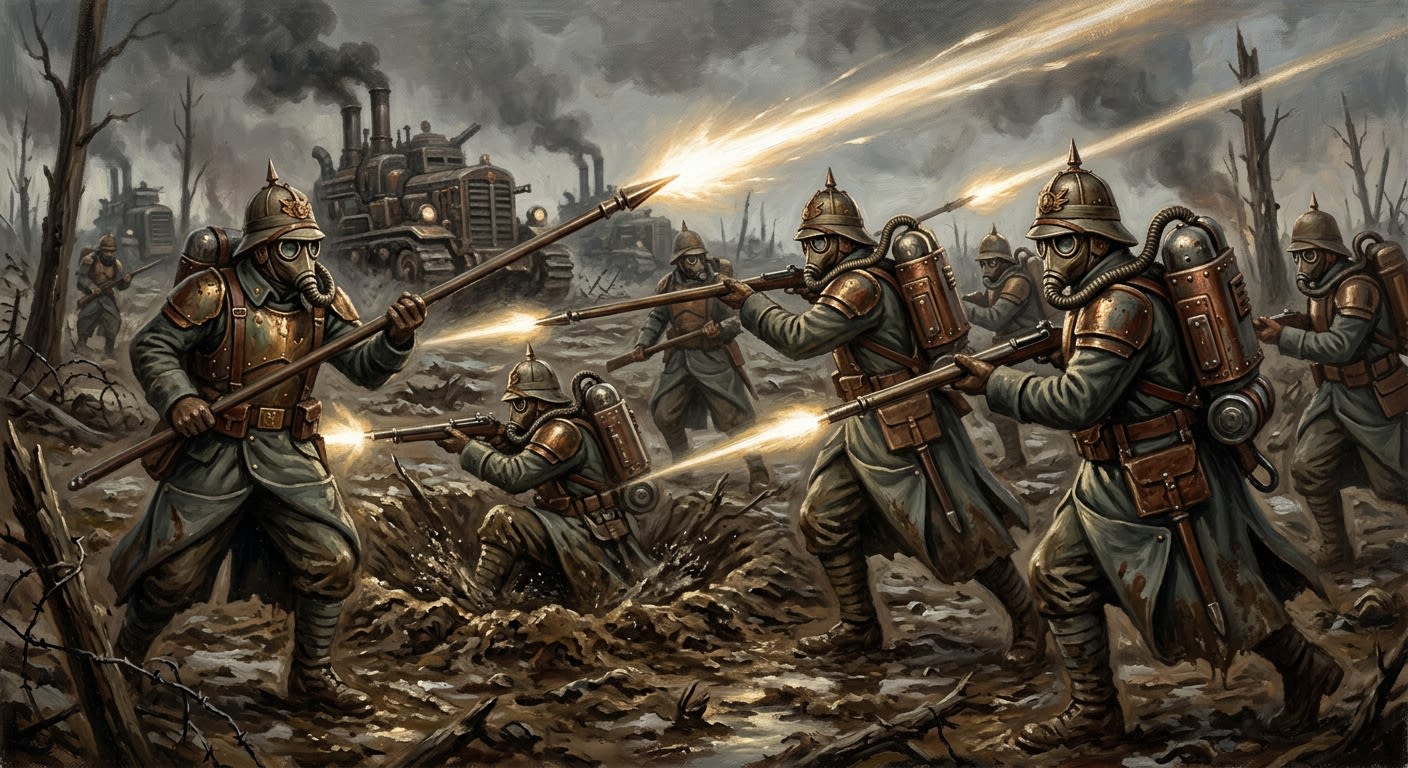
A Sun Spear legionnaire stands taller than a man and shorter than a Titan, which is precisely the grievance from which Atheron's middle ranks appear to be made. They are narrow, upright, and plated in pale armour whose edges catch light under rain, soot, and the dispiriting grey of dawn watch. Their helmets carry small crown-spikes: too small to challenge the Crownguard, large enough to insult every breathing defender beneath them. No confirmed face has been seen behind a visor. Witnesses report brightness where a mouth should be.
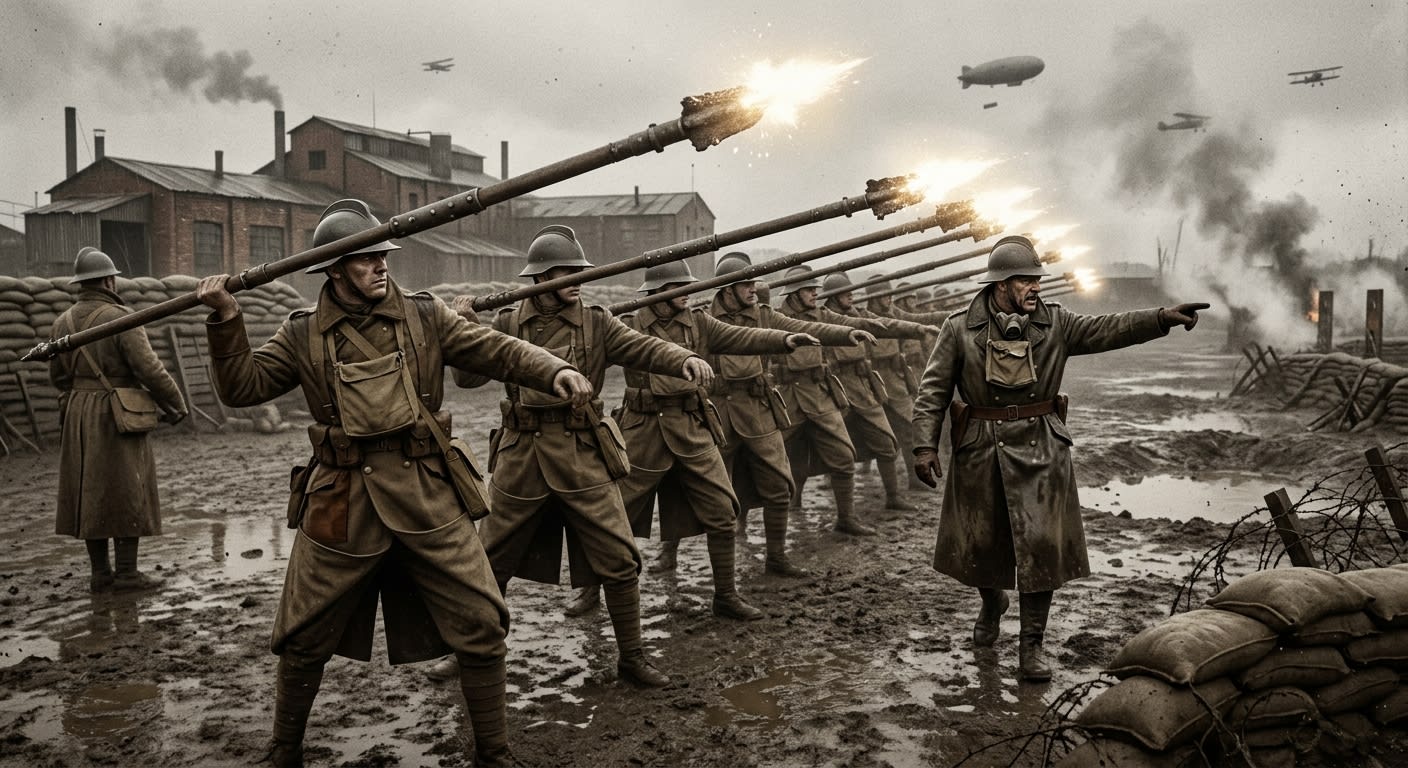
They march in files of twelve, then wheel into ranks of six by six, with an elegance that has caused two Synod drillmasters to compliment them in reports and one to receive corrective fasting. The left foot lands on the fourth beat of the Crownguard step. The lance lowers on the seventh. The throw comes after a pause long enough to make the target understand that selection has occurred.
Their spears are not carried in racks. Each lance forms in the gauntlet: first a line across the palm, then a shaft, then a spearhead too bright to inspect. The legionnaire draws the arm back with courtly restraint. No haste. No strain. The throw makes no sound at release. Sound arrives after impact: a bell-crack in the skull, a choir inhaling through teeth, wet linen torn in a sacristy where no cloth hangs.
The spear travels straight unless the target looks at it. A watched Sun Spear seems to lengthen toward the eye. Men who stare at incoming fire report that the shaft fills the whole field of sight, then becomes a corridor, then a throne room, then nothing useful ever again. Gunners are trained to fire by shouted range-table while looking at the mud lip of the parapet. This is difficult. Men want to see what kills them. Pride profits from courtesy.
Earlier Przemyśl guidance instructed troops to “observe the projectile path and report curvature.”
Withdrawn. The observers went blind, filed reports of unbearable beauty, and in four cases attempted to thank the enemy for the correction. Projectile curvature is now inferred from survivors facing the wrong direction, which has improved both data quality and morale.
#On the Light-Burn
A Sun Spear wound is seldom tidy. A man struck through the chest may die at once, which the Bureau classifies as merciful and the quartermaster classifies as easy to count. The more instructive victims live.
The light enters through eye, skin, glass, fog, rain, or the polished rim of a badly maintained mess tin. It burns white at the point of contact and violet at the edge. Flesh does not char. It whitens, tightens, and receives impressions from nearby marks: rank pins, rosary beads, ammunition stamps, buttons, coins, the seal on a ration chit. Medics at Przemyśl have peeled a corporal's sleeve away to find the shape of his lieutenant's insignia burned into the forearm, though the lieutenant stood twenty yards away. Atheron's light is socially ambitious. It climbs.
The first symptom is not pain. It is comparison. The trench seems low. The parapet seems childish. The gun seems crude. The hands seem animal. Every object is measured against an unseen height and found wanting. Sight fails from the centre outward, as if the world has been punched through with a white seal.
Those left alive after direct exposure enter the Radiant After-Period, a span of minutes or hours during which they describe seeing themselves as Atheron sees them. Their words recur with nauseating precision: small, dim, smudge, animal, low thing, crawling light, unworthy spark. Some recover ordinary speech. Some return to duty with smoked lenses and an intolerance for polished surfaces. Others spend the rest of their lives facing walls, because horizons have become accusations.
The worst cases praise the spear. They speak of the beauty of rank, the relief of knowing one's place, the mercy of being shown littleness by a higher light. These cases are removed by Purity. The official phrase is pastoral isolation. The unofficial phrase is quicker and involves locks.
MEDICAL ANNEX — PRZEMYŚL, A.S. 197 Patient: ███████ █████, Battery Nine. Exposure: indirect Sun Spear reflection from cracked range glass. Statement repeated for eleven hours: “I was wrong to stand.” At hour twelve patient rose without sight, saluted east, and named ███████████ as “proper altitude.” Range glass melted after storage in lead drawer. Drawer now warm.
#On Incidents at the Wire Orchard
The Legion's first well-filed appearance at the Wire Orchard dates to A.S. 184, though Atheron's ranged formations had been reported in broken language for decades before that. The A.S. 184 sighting came from Orchard Ring North, where a fog bank turned gold at dawn and twelve lances crossed three hundred yards of wire without disturbing the fog. They struck observation slits, periscope mirrors, and the brass numerals on Battery Saint Ulrich's elevation wheel. No soldier standing in the open was hit. Forty-one men inside protected works lost partial sight. War concluded that the Legion preferred instruments to bodies. Doctrine concluded that Pride prefers mediation. Engineering concluded that brass numerals should be blackened. Engineering was the most useful that day, a sentence I write under protest.
The A.S. 190 White Noon (Unregistered) produced the current smoke doctrine. A Crownguard file halted short of artillery range and the Sun Spear phalanx stepped between its banners. The sky above the salient brightened without heat. Shadows fled under boots. Every polished surface in the forward works cast light upward, so the defenders appeared to stand inside a bowl of white fire. The garrison fired smoke charges by touch. The first volley rose too thin. The second, mixed with ash from chapel braziers and kitchen soot, dulled the spears mid-flight. Three lances fell as brittle rods and shattered on the wire.
The A.S. 195 Nine-Hour Rubric, better known for the destruction of the Spire-Crusher, also gave the Legion its ugliest success. During the fifth hour, as batteries concentrated on the growing tower, a Sun Spear detachment targeted the counter-bell crews beneath Platform Casimir (Unregistered). The spears entered through ventilation slits, struck the underside of bronze plates, and burst into reflected shards. The bell-men were found blind beneath their instruments, still striking the Humility Sequence from memory. They saved the platform. They never saw their medals.
The A.S. 197 Bell-Plate Countermeasure errata followed a smaller embarrassment. A polished ceremonial hammer used by a visiting inspection team reflected a spear into the inspection trench, where five officers were struck while admiring the neatness of their own equipment. The garrison song composed afterward is not approved for chapel use. It is excellent.
#On Countermeasures Against Radiance
The first rule is do not look. This sounds simple until the horizon becomes a weapon, the fog shines like a reliquary, and some undertrained lieutenant begins shouting for visual confirmation because he has confused eyesight with command. The best Sun Spear crews at Przemyśl fight as if ashamed: heads down, lenses smoked, brass blackened, range calls memorised, hands moving by drill.
Smoke works when it is dirty. Pure white smoke can become a screen for the enemy's splendour; ash smoke insults the light. Soot, lampblack, burnt ration flour, coal dust, chapel ash, and the powdered remains of failed requisition forms have all been approved in emergency mixtures. The last ingredient pleased Records until it learned the forms were being burned before completion.
Blackened goggles reduce direct burn and worsen peripheral terror. Soldiers hate them. They report feeling entombed, blinkered, rendered into draft animals. This is unfortunate. Draft animals survive many battles by lacking the conceit of panoramic vision.
The second rule is ugliness. Pride's radiance catches edges, polish, symmetry, ceremonial order. Rag screens reduce reflections. Mud on buckles saves eyes. Crooked parapet hangings work better than neat canvas. The Sun Spear seeks a worthy surface and sulks when offered filth.
The Bureau of Heraldry objected to the Przemyśl directive requiring all forward banners to be deliberately stained during Sun Spear alerts.
Objection overruled. A clean banner under Atheron contact is a mirror asking to become a sermon. Heraldry may launder its feelings after the shelling.
The third rule is collective profanity. This was discovered by accident and preserved against strenuous clerical objection. A squad chanting titles, prayers, or patriotic slogans lifts its attention toward grandeur. A squad singing obscene insults about Atheron's crown, Atheron's posture, Atheron's probable loneliness, and the regrettable narrowness of Atheron's ancestral imagination keeps the mind low and shared. The Legion's light feeds on vertical thought. Filth keeps men horizontal in the useful sense.
#On the Proper Contempt
The Sun Spear Legion is beautiful. This must be written with care, because the word is a hook and Pride keeps account of hooks. Their lines are clean. Their throws are graceful. Their armour catches dawn with the insolent competence of a court painter flattering a king. The lances cross the field like verdicts from a tribunal that has never heard a defence and considers that omission efficient.
Beauty is not authority. Radiance is not truth. Height is not worth. The Synod, which understands all three errors from professional experience, is qualified to condemn them in others.
A Sun Spear kills by making the low thing ashamed of standing. Its counter is a lower loyalty: boot, mud, ration, wire, cartridge, number, name, breath; the ugly inventory that saved men from the Crownguard and now saves them from the lance. A soldier who can name the mud beneath him has not surrendered the field to the sky.
At Przemyśl, the Legion still forms behind the Titans when the eastern fog burns gold. The bells strike downward. The ash pots open. The men lower their heads, curse with admirable sincerity, and fire by table into light they refuse to admire.