
#On the Ninth Tower and the Error That Became a System
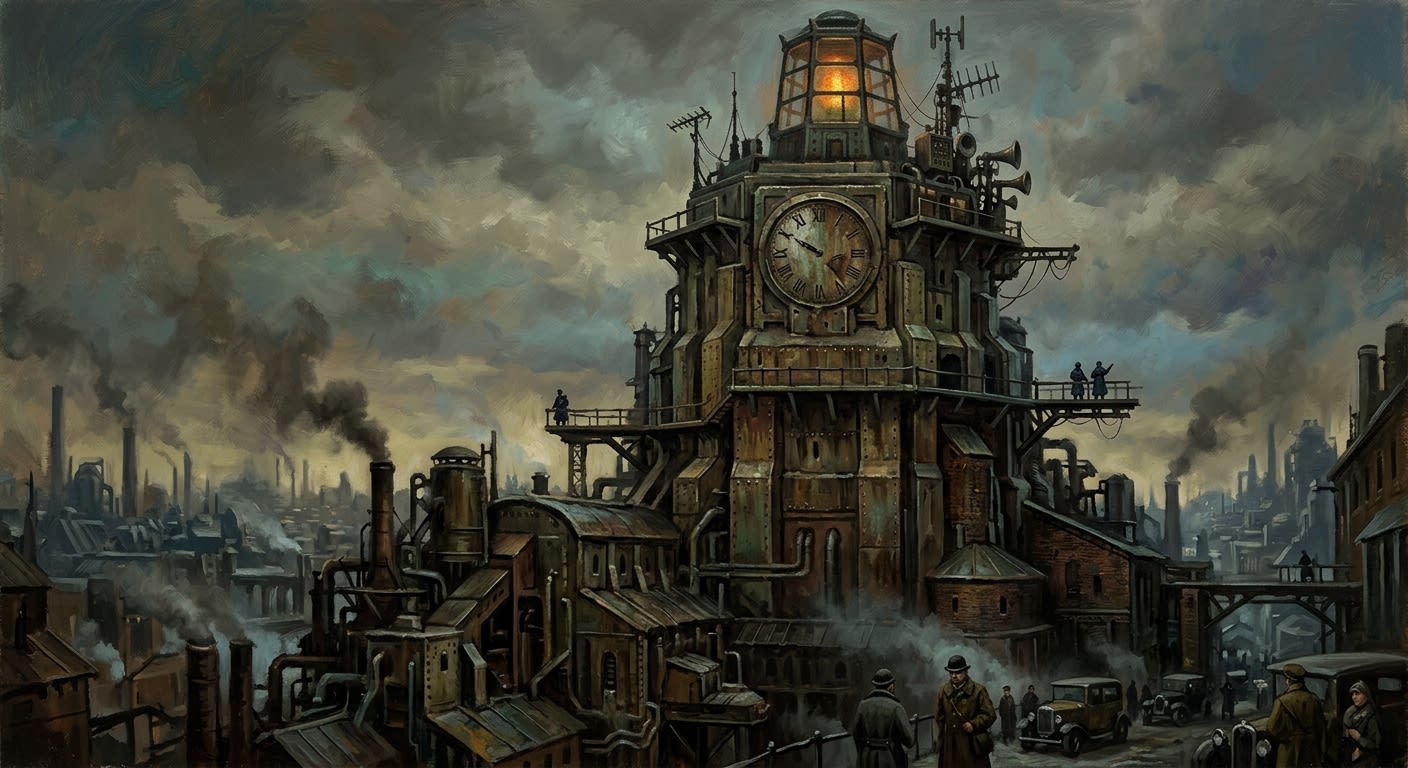
Tower Nine is a name the Bureau would prefer to singularise. It cannot. There is a Tower Nine at the Palatine Switchyard of Lorn, where lamps blink in codes no Signal Manual admits and a sealed clock tower lies bricked into the foundation. There is a Tower Nine at Bastion-Przemyśl, called the Orchard Eye, where the Wire Orchard is watched, harvested, and lied about with official tenderness. There are minor ridge lanterns, ribwatch posts, and forgotten military towers also numbered Nine because the Synod builds by template, files by district, and then feigns surprise when identical labels breed like rats in warm paper.
This entry concerns the dangerous one by current inquiry: Switch-Tower Nine of Lorn. Yet the Przemyśl tower must be named, because errors of nomenclature are rarely innocent in a state where names authorise movement, ration, arrest, burial, and the exciting variety of disappearance called transfer. The two towers have begun appearing in the same files. Their lamp codes are compared. Their missing logs are cited together. Their watchers use similar oaths. Their silences smell different, which is how one knows the matter has passed from clerical nuisance into Doctrine.
At Lorn, Tower Nine stands above the Palatine Yard as an iron-and-glass routing cage: wet rope, ozone, coal haze, signal lamps, bell horns, falling hazards, and the private terror of men who know that a blink may send three hundred tons of grain toward a bastion or into a siding that last existed before their fathers were born. It rises from the yard floor near the old cellar alignment of the vanished market town requisitioned in A.S. 104. Its foundation contains a pre-Synod clock tower sealed under slag, brick, prayer, and that most pious mortar, refusal.
The tower is operational. The tower is watched. The tower is denied whenever denial would cost less than repair. It routes trains, answers hymns late, leaks lamp-talk into the Hush Tunnels, attracts Inquisitor-Regent Veyl Hark from Strasbourg, and has made the A.S. 201 Payroll Spur scandal smell less like theft than summoning by timetable.
#On the Foundation Under the Cage
Lorn was built in haste because war logistics do not wait for beauty, mercy, or the objections of a town whose name is about to be deleted. In A.S. 104, the Bureau of War requisitioned an old market settlement at the convergence of three supply corridors and made it into the continent's iron throat. The chapel became a dispatch office. Cellars became fill. Streets became sidings. Graves became inconvenient subgrade features. The town vanished from the Ledger. Lorn appeared, meaning “surrendered to divine purpose,” which is the kind of phrase an office writes after stealing a place so thoroughly that even theft grows bored.
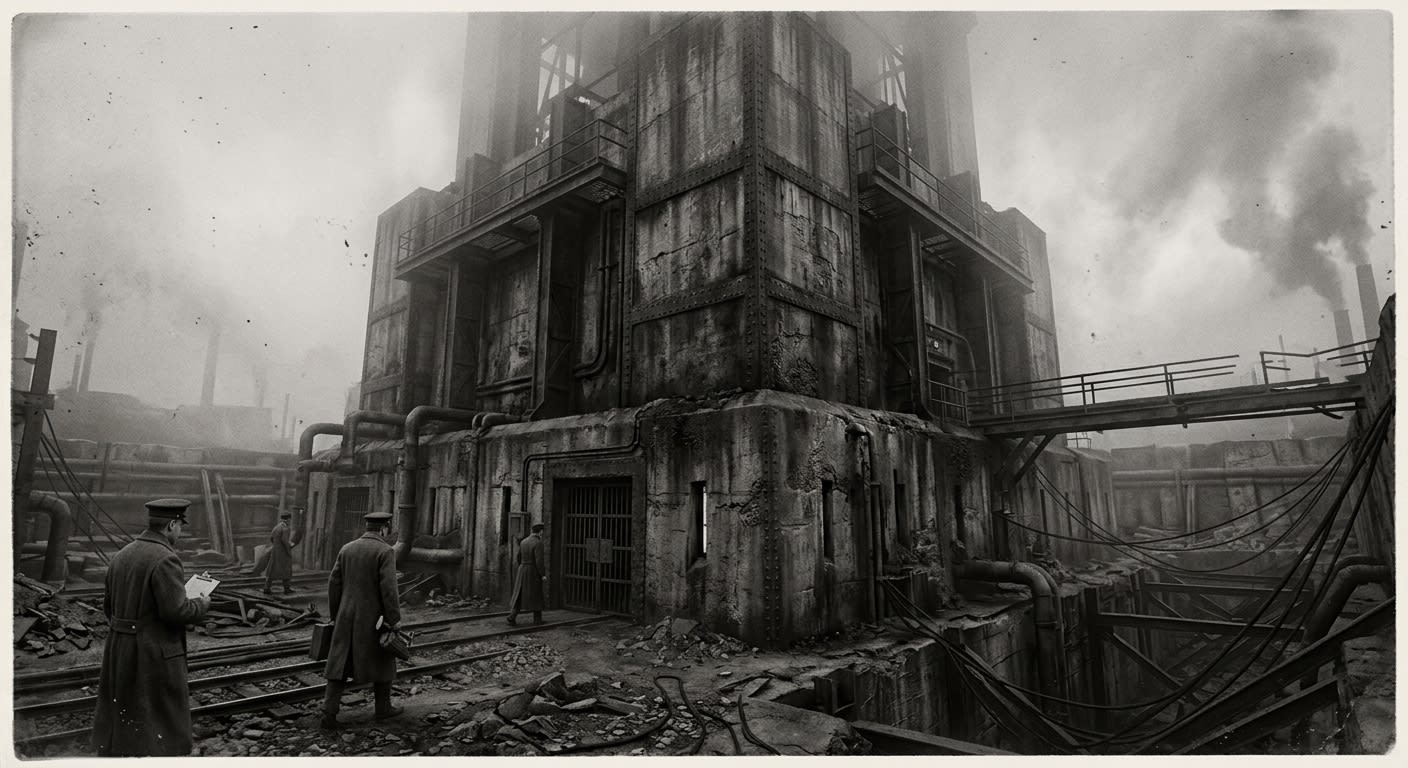
The old clock tower should have been demolished. It was not. No surviving public file says why. The engineering appendix notes foundation instability. The Records appendix says relocation of civic timepieces remained pending. The Bells appendix calls the bell-metal “unrecovered.” The War appendix orders schedule continuity. Four explanations entered the file. None explains the bricks.
What happened is visible in the foundation if one is permitted below, and I have been permitted below more often than local officials enjoy remembering. The tower was not dismantled. It was encased. Its lower courses remain inside the footing beneath Switch-Tower Nine, locked behind slag-fill buttresses and sound-deadening masonry. The clock face is gone from public view, but not gone. Its hands, according to one prohibited survey sketch, remain fixed at an hour no Lorn schedule uses.
By A.S. 110, during the swelling of the First Continental Levy, the Palatine Yard processed enough departures to make the old town groan under its replacement. Under-yard traffic already existed: drain runs, cellar lanes, coal conduits, brick throats, salvage cuts. By A.S. 112, after the Silent Derailment killed forty-one men on a siding the manifests denied, the first Tower Nine marks entered provost reports. Chalk arrows beneath the cage. Wax scratches near the sealed clock masonry. Rope knots arranged in patterns used by no approved maintenance crew. A child's black handprint where no child should have reached.
The Cantor Corps took the public lesson: all movements must be sung. The tunnels took the private lesson: silence moves what song condemns. Tower Nine learned both.
Initial Yard histories described Tower Nine as “constructed entirely within the A.S. 104 Palatine Yard works.”
Corrected. The visible cage belongs to the Yard. The foundation contains a sealed civic clock tower from the swallowed market town. A structure may have two births when one of them was buried for administrative convenience.
#On the Cage Above
The visible tower is practical enough to pass inspection: iron uprights bolted into a square base, glass panels streaked with coal grease, lamp housings in three tiers, bell horns aimed toward the Needle, the Tri-Span Bridge (Unregistered), and the western receiving throat, a routing desk with slate insets, rope drops, lever locks, and a narrow stair that induces piety in men afraid of heights. It smells of wet rope, lamp oil, ozone after lightning, old wool, burnt dust, and the sour breath of callers who drink tea strong enough to qualify as medicine.
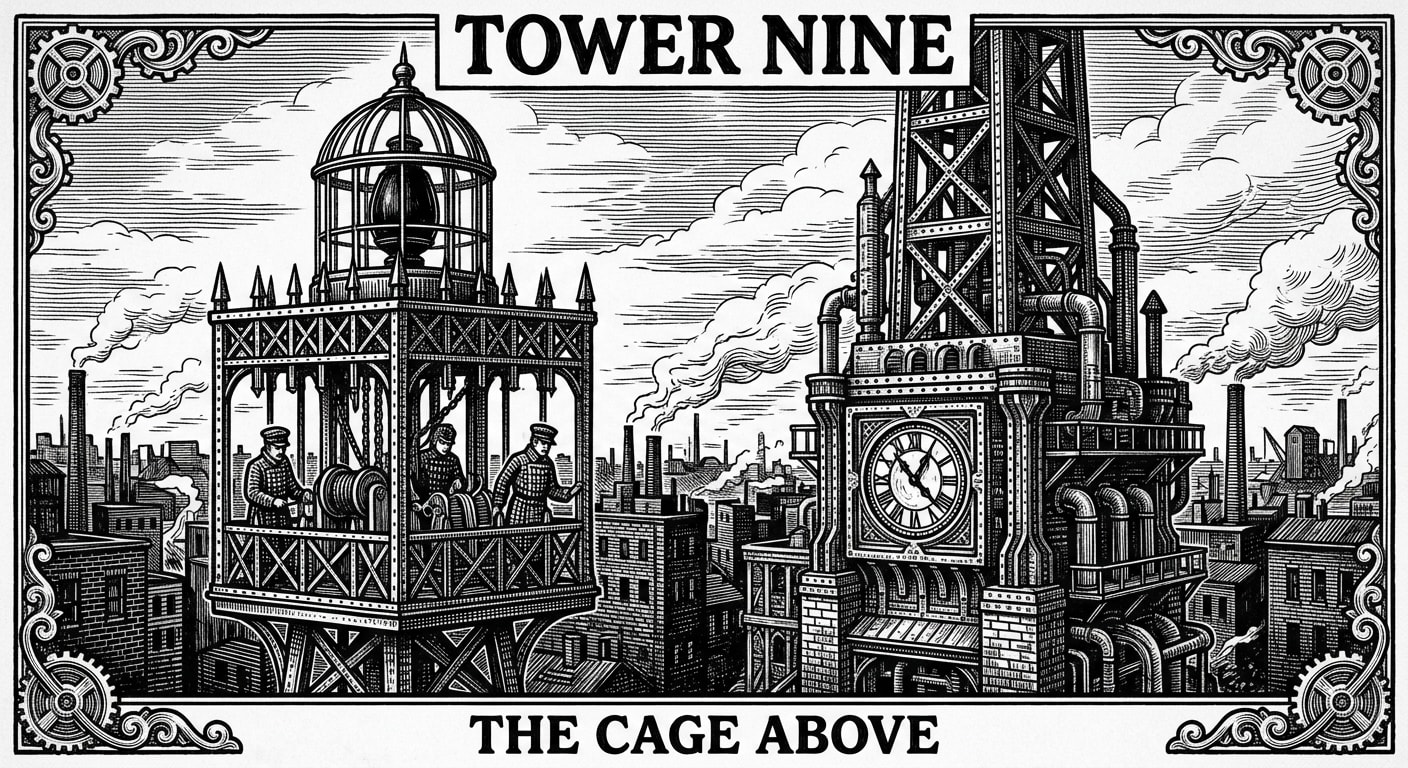
Tower callers work in pairs under Bell Marshal certification and Yard Palatine warrant. One reads the lamp sequence. One confirms the sung measure. Both mark the throw. Neither is supposed to improvise, interpret, delay, double-blink, answer a tower that has not called first, or accept chalked corrections passed up from under-yard grates by hands too small or too quick to arrest. These prohibitions are posted in black enamel beside the routing desk. The enamel is chipped where callers have struck it with mugs.
The tower commands no single switch. It commands relation. That is worse. From Tower Nine, the caller sees the Needle's eastern pinch, Payroll Spur sidings, three secondary yard ladders, the edge of Cinderrow steam, and the lamp-line toward Cantor Walk. A wrong signal here does more than misroute a car. It teaches adjacent towers the wrong confidence. It makes the yard briefly agree with an error.
Lightning favours Tower Nine. This is attributed to height, metal, exposed glass, and the Bureau of Rites' preferred explanation, divine attention. The strikes blacken the upper cage and leave blue halos inside lamp glass. Workers say the tower sees better after storms. Bell officials call this superstition. Hush lamp-readers pay double for post-storm codes, which is the form superstition takes when it becomes market data.
Falls are common. The stair is narrow. The catwalk sweats in fog. Ropes freeze. Men lean too far over glass to see whether a point has truly thrown or whether the yard has only pretended obedience. The Yard Tribunal classifies most falls as worker lapse. The Switchmen's Union keeps a separate count in the Crushed Book and marks Tower Nine deaths with a crooked chalk band, because a fall from a routing cage is never merely descent. It is testimony interrupted by gravity.
The last rule is the only honest one.
#On Lamp-Talk and the Late Blink
Tower Nine's lamps are the most valuable stolen language in Lorn. The Hush Tunnel Runners call it lamp-talk: blink, pause, double-pause, false clear, warning red, white hold, gutter flicker, low blue after storm, and the delayed answer known locally as Nine-late. A route-mother below ground can read enough through a drainage grate to move men beneath an inspection sweep. A Union watchman can see a false clear before a cantor finishes the measure. A child in Cinderrow can tell whether the Needle is hungry by counting how long the tower keeps amber alive.
The Signal Manual records none of this. The Signal Manual is an authorised lie with diagrams.
Official codes exist, naturally: proceed, hold, reverse, seal check, obstruction, medical train, relic-priority, armed escort, brake failure, purge corridor, bell quarantine. The unauthorised codes live between them. A half-beat too long. A blink answered from the wrong side. A lamp returning after the caller has logged it dark. Tower Nine's vice is reply. Other towers signal. Nine answers.
The late blink first appears in provost notes after A.S. 112, though the notes avoid the phrase. A caller sends a signal to Tower Six (Unregistered). Tower Six does not answer. Tower Nine blinks once, late, in the colour expected from Six. A switchman throws according to the answer and saves a train from frost-locked points. The caller is commended, then reprimanded, then transferred. The event is filed as correct procedure following visual confirmation, which is the bureaucratic term for sin with good results.
Later cases are harder to bless. A Payroll Spur lamp goes white after being logged dark. A Hush route opens beneath Cantor Walk before the sweep begins. A westbound munitions train receives a hold code that prevents it entering the Tri-Span during a wind shear. A funeral car marked empty is sent to a siding where seventeen paper-dead persons board under cover of fog. The tower's defenders call these coincidences. Its enemies call them Runner manipulation. Veyl Hark, sensibly, will call for copies of all codes and then remove the callers from the room.
Bureau of Bells Circular 201-L described the late blink as “local glare variance in aged lamp glass.”
Withdrawn in practice, though not in print. Glare does not select Payroll Spur routes, pre-empt Hush sweeps, or answer in decommissioned colours. Glare, like most innocent phenomena, lacks ambition.
The shibboleth below ground is simple. “Which tower answers?” Proper reply: “Nine — late.” An outsider says “Nine” and dies informed. An official says “all towers answer to Palatine authority” and dies deserved, though I cannot endorse the execution in formal prose until someone provides a receipt.
#On the Silent Derailment and the Siding That Denied Itself
The Silent Derailment of A.S. 112 is Lorn's original bruise. Forty-one men were routed onto a siding the manifest denied existed. The train entered under correct measure. The switch threw clean. The signal logged clear. No crash bell sounded. No collision alarm rang. At dawn the crew were found dead along a slag wall, bodies laid parallel to rails that had no authorised installation number, their mouths open as if singing had been removed after use.
The official lesson made song mandatory. No switch, signal, or departure without voiced hymnal measure. This gave the Bureau of Bells a city, Sister-Calder (Unregistered) a future office, and every worker in Lorn a new way to be blamed. The unofficial lesson belonged to the men beside the levers: if procedure could kill forty-one men and deny the track, then procedure required witnesses who were not clerks.
Tower Nine appears in the annex as “adjacent control station.” That phrase is doing penance for a larger fact. Lamp timing from the night of the Derailment shows Tower Nine answered a signal never sent from Tower Three (Unregistered). The answer was late by one measure. The throw was made. The siding appeared where no siding should have accepted traffic. By the time investigators climbed the cage, the routing slate had sweated through its chalk and the lower lamp held a hairline crack in the shape of a clock hand.
SILENT DERAILMENT ANNEX — TOWER NINE ROUTING SLATE Recovered mark: ███████ Clock-hand fracture orientation: ███ degrees. Surviving caller testimony: “We waited for Three. Nine answered. It sounded under the lamp.” Disposition: caller transferred; slate sealed; phrase “sounded under the lamp” removed from public copy.
The Unmeasured (Unregistered) were blamed first because dead or condemned sectarians are excellent sponges for institutional wetness. They were executed. The Bureau later corrected the attribution to accumulated procedural drift in an unsanctioned tonal environment, a phrase that should itself be bricked into a foundation and left without air. The correction did not resurrect the Unmeasured. Corrections seldom do anything useful for the dead.
The Silent Derailment birthed the Cantor regime, the Union's modern oath funds, stricter tower posting rules, and the first deep market for lamp-talk. It also taught Tower Nine that being wrong in the right rhythm can change a map.
#On the Hush Below
Beneath Tower Nine, the Hush Tunnels thicken.
Smell-guides mark the approaches by iron rain, cold wax, and the old clock's dry breath. Key-brokers keep bolt-cut copies of siding locks wrapped in cloth soaked with rancid tallow. Lamp-readers gather below grates with mirrors blackened by soot so they can watch the tower without letting the tower watch them cleanly. Mouthless carriers pause under the foundation and press two fingers to the wall before entering Payroll Spur routes. Route-mothers teach children never to whistle there. Whistling is for fools, cantors, and men who enjoy being counted by things with no mouths.
The Runners insist they do not control Tower Nine. This may be true in the same way a fisherman does not control weather. He still knows when to cast. The tower's late blinks have fed under-schedule movement for decades: fugitives moved during false holds, blank manifests passed under purge lamps, paper-dead persons guided toward Vire-bound freight, relic consignments delayed long enough for crates to become lighter than their seals expected.
The Payroll Spur scandal of A.S. 199–201 sharpened everything. Sealed crates of relic-payroll consigned toward Bastion-Przemyśl passed through the Needle with valid stamps, correct measures, and intact wax. They arrived empty. The street-truth says the Runners stole them. The buried truth stinks of older routes. Codes cut beneath Tower Nine directed the first movement. The payment included salt nobody mined and wax nobody poured. One Runner retired rich and refuses coin. One joined a silent religious order whose register has no vowels. One was found stamped DEAD with a live heartbeat.
The Payroll Spur lies east of Tower Nine's strongest lamp field. A caller can hold the siding in amber long enough to freeze inspection without declaring obstruction. A lower-yard hand can read that amber through a pipe crack. A tunnel crew can move while official time waits politely above. This is not proof. Proof is what courts require after events have become safe. This is anatomy. A vein does not need to confess that blood moved through it.
#On the Orchard Eye at Przemyśl
At Bastion-Przemyśl, Tower Nine means something else and too much the same.
The Orchard Eye rises on the inner edge of the Wire Orchard: overwatch, cold wind, oil lamps, sniper lanes, patrol boards, harvest alarms, and a stairwell bearing the graffito, “Every strand is a sentence. The question is whose.” It watches electrified steel grown across the approaches in tangles the soldiers call fruit-clusters, where ration tags and transit chits snag like pale apples. Its searchlight sweeps the eastern ditch. Its watchers, the Nine-Eyes, know when the Underwire (Unregistered) breathes and when Atheron's silhouettes climb the high morning.
A missing patrol logbook was reported from the Orchard Eye in A.S. 199. Records denies the logbook existed. This confirms it with admirable economy.
The tower has seen more honest war than Lorn's cage and less honest paperwork than Taghouse Row (Unregistered), which is an achievement in Przemyśl. The A.S. 194 Glass Rain over Orchard Ring followed a Sun-Spear burst against Tower Nine. Every shard of observation glass, spectacle lens, lamp chimney, and polished ration tin in a quarter-mile radius reflected different ranks for every man who looked down. The garrison fought a battle of promotions for forty minutes. Archivist-Prelate Kelle (Unregistered) arrived with ash and no adjectives. The report remains a model of restraint and should be forced upon young writers until they stop using fog as an excuse for vagueness.
In A.S. 195 the Spire-Crusher was first confirmed from Orchard Tower Nine at dawn, when Corporal Tamen Voss saw a dark line above the ridge like a chapel steeple walking behind a curtain. His superior charged him with poetic excess, then looked through the glass and rang alarm until the clapper cracked. The tower survived the Nine-Hour Rubric, the sky-fixation that followed, and the peculiar shame of watching a nine-hundred-foot siege colossus collapse into forty feet of rubble with better discretion than most officials manage while sitting down.
The two Tower Nines share no masonry. They are linked by function, file, and bad luck. Each stands where a system must see: Lorn over movement, Przemyśl over wire. Each leaks: lamp-talk in one, missing patrol truth in the other. Each is watched by people whose names enter ledgers only when something has gone wrong. Each makes officials nervous because observation posts acquire opinions when neglected long enough.
The comparison has already produced clerical casualties of the harmless kind, which is to say careers. A Records aide attached to the Joint Investigatory Cloister cross-filed Orchard Tower Nine under Lorn because both entries included “late signal” and “missing log.” His superior corrected the index, then discovered the correction had created a third reference: Tower Nine, Unassigned. That reference now appears in a sealed routing table associated with neither city and both. Records calls this an indexing artefact. Bells calls it acoustic bleed. Purity calls it suspicious. Doctrine calls it mine, since I have the misfortune of making other offices sound coherent after they panic.
The practical result is a new hand-copy rule for Ninth Tower references. No stencil. No duplicated strip. No carbon sheet. A clerk writes the site name in full, reads it aloud to a witness, and receives correction if his hand begins to abbreviate. This is ridiculous, costly, slow, and wise. Machines love repeated labels. So do demons, frauds, auditors, and railway systems. A hand, being frightened and vain, hesitates before making the same mistake twice.
Veyl Hark's commission includes Lorn Tower Nine and references Przemyśl because the empty crates were destined there, because Przemyśl's Orchard Eye has its own missing log, and because someone in Strasbourg has noticed the inconvenience of two Ninth Towers blinking at separate scandals in the same decade. I congratulate that clerk. Slowly. Without enthusiasm.
#On Veyl Hark's Pending Question
Inquisitor-Regent Veyl Hark has not yet reached Lorn. That delay is now part of Tower Nine's architecture. Men look at the cage and imagine her inside it, separating voice from record, record from route, route from profit, profit from alibi. Kessel adjusts his gloves before speaking of it. Wry rebinding archives calls itself routine. Sister-Calder tunes the Missed Measures as if leather can repent. The Union slows by one heartbeat whenever Hark's name enters a canteen.
Her commission names Tower Nine bell codes, Payroll Spur ledgers, corrected manifests, freight priority windows, and sealed Hymn-Phase reports. A lesser inquisitor would ask who stole the crates. Hark will ask who taught the route to be available. The distinction is why sensible criminals fear her and administrators fear her more.
Lorn notices describe the coming inspection of Tower Nine as “supportive audit presence.”
Corrected. A supportive audit asks whether paperwork matches conduct. Hark asks what conduct trained the paperwork to lie so beautifully.
The tower's current staff have been rotated three times since the A.S. 199 escalation. Rotation solves nothing. It changes the hands touching the levers while leaving the cage, foundation, late blink, and sealed clock below. One cannot cure a haunted desk by replacing the clerk, though it often improves morale in the corridor.
Hark will copy the codes by hand under oath. She will make unrelated cantors sing them outside the yard. She will reconstruct lamp sequences without tower men present. She will separate Bell records from Yard records, Union complaints from provost notices, Hush rumours from paid testimony, and Przemyśl correspondence from Lorn's local excuses. Then she will name the sealed clock in writing. That will be the first excavation.
If Tower Nine answers before she speaks, the yard will hear it. If it does not answer, the silence will be worse. Lorn has built an economy on movement, and every movement has passed within sight of the cage. Seven hundred departures per day. Two hundred and ten thousand registered souls. Twelve lines. One schedule. An old clock under new iron, holding an hour no bell will claim.
#On the Present Condition
As of A.S. 201, Tower Nine remains active. It continues to route, blink, hold, answer, deny, and attract files. Its callers work in pairs and pretend not to listen downward. Its lamps are cleaned under supervision. Its lower masonry is sealed, patched, resealed, chalked over, scratched clean, and watched by people pretending to inspect drainage. The Hush approaches are colder than they should be. The Payroll Spur remains under investigation. The Signal Manual remains insufficient. The late blink remains unratified, which is not the same as absent.
At Przemyśl, the Orchard Eye remains on the Wire Orchard, searchlight sweeping the eastern ditch, missing logbook denied, Nine-Eyes looking toward Atheron's heights through smoked glass and ash discipline. Its existence contaminates Lorn's file by name and by echo. Strasbourg may separate them later. Strasbourg may also discover that separation is the wrong verb.
JOINT NOTE — RECORDS / BELLS / PURITY — A.S. 201 Subject: Ninth tower designation recurrence. Sites compared: Lorn Switch-Tower Nine; Przemyśl Orchard Tower Nine; ████████████. Shared features: late signal, missing log, sealed substructure or sealed archive, under-route proximity, witness discomfort. Recommendation: do not circulate numbering pattern pending Hark review. Marginal hand: “Which tower answers?” Second hand: “The one we built over.”
The Bureau's official position is narrow. Tower Nine at Lorn is a routing structure under audit. Tower Nine at Przemyśl is an overwatch tower with a separate log anomaly. No doctrinal unity has been established. No structural kinship has been certified. No tower is to be addressed, answered, named in lower-yard song, or asked what hour it keeps.
Good. Let the official position stand where it is, neatly dressed and facing the wrong door. Tower Nine blinks above the yard. The sealed clock keeps its useless hour. Under the cage, a child carrying payroll wax once returned alone. At the Orchard, a logbook that did not exist went missing. Veyl Hark travels eastward with an audit press and cold patience.