
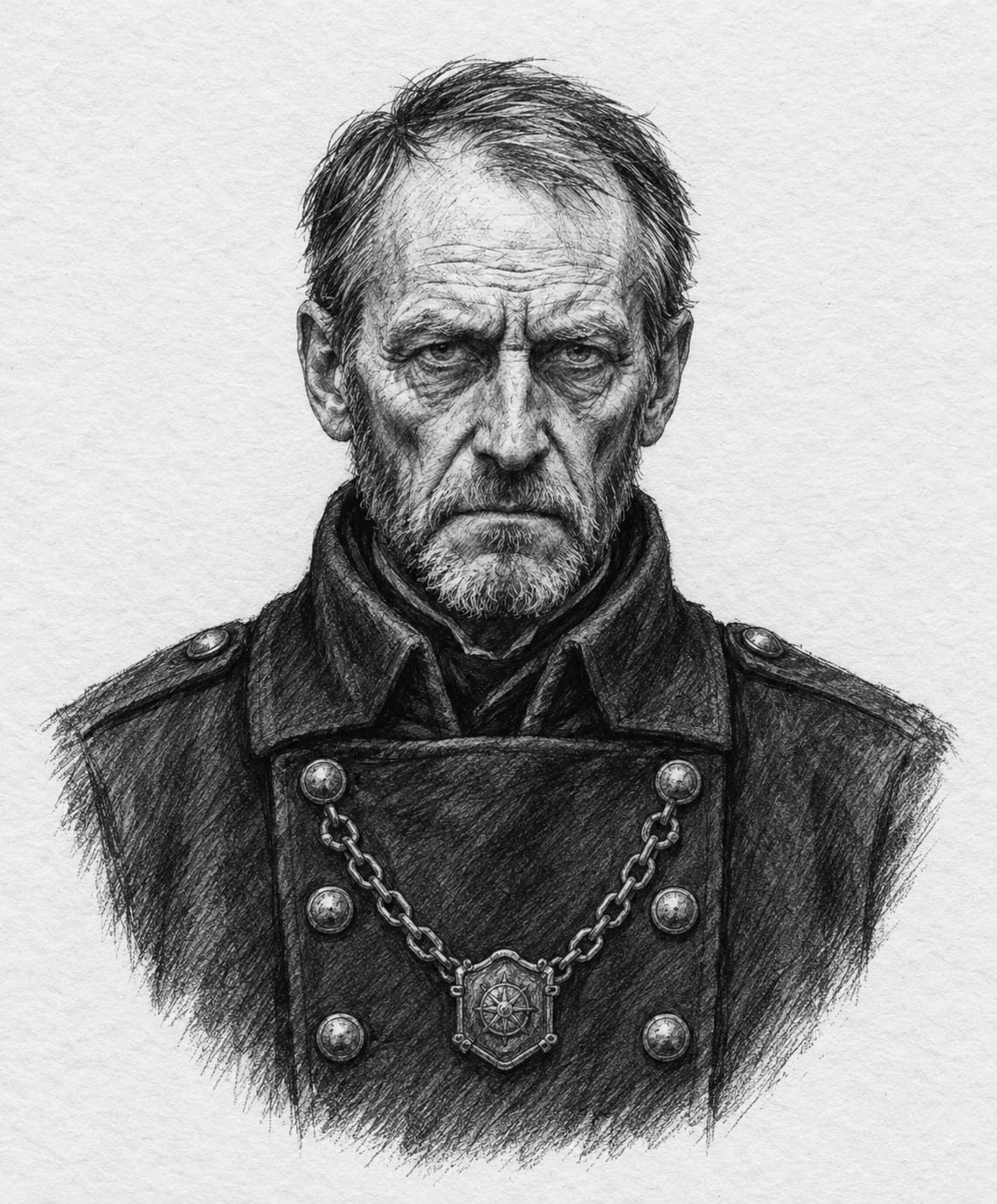
#On His Station
"Paper lies. Mortar tells." — Proverb of the Causeyworks, carved nowhere, repeated everywhere
I first entered the Archivolt Causeyworks in A.S. 197, by barge, through the Mouth-Sluice, where the canal squeezes between the sluice teeth and the air smells of brine and tar. A toll warden asked me three things: my registered name, my destination, and the weight of my ink. I came back in A.S. 201 by the same sluice. The same warden asked me the same three things in the same order. Both times he took my answers without raising his eyes from his papers.
His name is Goss. I know it because the city carved it into the lintel above his station. Beyond that, the record gives no given name, age, parish of birth, ordination or earlier office. Everything the Ledger knows about Warden Goss would fit on a lintel, and it does.
He should not be mistaken for a magnate of the waterways. In the Causeyworks, toll wardens check passes at the gates. The bridge-scribes of Archivolt Row verify names. The masons of the Stone-Ledger Yards carve whatever is to be made permanent. Above them stand the three people who run the city: Canon-Toller Edris Vane, who controls crossing access; Chief Scribe Mael Arct, who controls names; and Master Mason Lysa Korr, who controls the stone. Goss has a post at the water's edge and three questions. The file gives him no tribunal seat, no provosts, and no seal. Wardens of the city wear the chain badge of their office. It marks a man who inspects. It does not mark a man who judges.
#On the Candle Account
Below his name is a sum. It is the amount of a debt incurred in A.S. 189 for an overweight shipment of devotional candles.
I will not repeat the figure. The Bureau does not publish a man's arrears a second time when the first publication is in granite. The shipment's owner and origin are also absent from the record. The Candlewick Palatinate sends its wax upriver through the Causeyworks in quantity, but the lintel does not say these candles came from the Palatinate, and I will not say it for the lintel. The tribunal that set the debt, any interest on it, and any terms of repayment appear nowhere I can cite. What can be cited is the carving: a name, a sum, a year, and a cargo that weighed more than it should have.
The Causeyworks collects debts with the patience of a city that never has to dry anything properly. It refuses a debtor passage. It flags his name in the registry. It also commissions the most feared instrument in the River-belt, the stone entry, carved where the debtor's daily route has to pass, so that his neighbours, his creditors, and the provosts on the causeways can read it every morning before he can. The locals call this being "stone-entered." The Toll Chapter calls it "stone reconciliation," the same way a surgeon might call a leg a "reconciled limb."
Arrears can also be paid in labour. Toll arrears bind debtors to the city's work, and name-clearing fees can be settled in hours where coin is lacking. The debt is a matter of record and so is the man under it. The instrument that ties this particular debt to this particular post is not on the file. I note the gap and do not fill it. The Ledger has no use for a clerk who supplies what he cannot cite.
A settled stone debt is never erased. By decree of the Bureau of Doctrine, erasing stone is a theological impossibility. A settlement would be carved beside the original by Master Mason Korr's lodge, and both entries would stay there indefinitely, contradicting each other in granite. My earlier record of the lintel notes Goss's name, the sum, and the year. It records nothing carved beside them.
#On the Examination of Others
The three questions are not small talk. Each one is a gate in its own right.
The first is the registered name. The Causeyworks is governed by a slogan, Names belong to the Synod, and the warden at the Mouth-Sluice is the first official to collect what belongs to the Synod from each traveller. He does not decide whether a name is true. He takes it down, and the bridge-scribes along Archivolt Row, ink-cuffed and slate-tagged, test it later against the registry under Chief Scribe Arct's authority. The warden is the funnel. The Collegium is the bottle.
The second is the destination. Destination determines which locks a barge will need, which bell schedule it must wait for, and which part of the city's eight districts it is asking to burden. A barge without a declared destination is a barge without a queue, and a barge without a queue is a smuggler.
The third is the weight of one's ink. Unsealed ink is among the cargoes the Causeyworks forbids outright, along with blank permits, unregistered bodies, and relics that lack stone witness marks. A city that writes its laws on bridges takes great interest in anyone who arrives able to write. I carry the ink of the Warden of the Sacred Ledger, consecrated, sealed, and accounted for to the dram. I declared its weight. He wrote the figure down. On the subject of weight, I observe only that the man asking the question sits beneath a carving that records what happened when a cargo was declared wrongly.
Paper at the Mouth-Sluice does not last. The Bridge-Scribe Collegium was founded in A.S. 92 because toll records rotted in the canal damp, and it moved the city's permanent accounts into stone. The paper did not get any drier as a result. Permits arrive soft. Declarations wrinkle in the hand. The locals have a word, dry-safe, for papers that are still legible, and they treat dry-safe papers as wealth. A warden writing in that climate keeps a record that starts rotting as soon as it is made, under an inscription that will not rot at all. The paper record covers the traveller. The stone record covers the warden.
#On Names Kept in Stone
Every barge that comes up to the Mouth-Sluice reads the warden before the warden reads it. The inscriptions of the Causeyworks are legible from the water, and they were designed to be. A boatman on the approach knows the warden's name, the warden's debt, and the year of the warden's mistake before he hands over his own name to be written down. Goss asks for a name while displaying one. He asks about weight under a carved penalty for weight. The office of identification is housed beneath the identified.
The rest of the city brings a further complication. The Causeyworks suffers from the phenomenon the Bureau of Alchemical Standards calls Name-Resonance Architecture. Certain arches respond physically to spoken names: water levels shift, inscriptions sweat lime, and candles gutter in pulses. The Saintspan is the worst of these. The Stitchbridge has been worse since A.S. 199. No inquiry has asked whether the lintel at the Mouth-Sluice belongs among them, and nothing in the record suggests that Goss's name produces any effect at all. The same ledger-drizzle that crusts every inscription in the city crusts his.
Inspector Corris of the Bureau of Alchemical Standards (A.S. 194) attributed the Name-Resonance phenomenon to "mineral moisture interacting with vocal vibrations in enclosed stone environments."
Municipal correction: the phenomenon was reclassified Category Three: Pending. Inspector Corris was reassigned. The reclassification stands.
The Mortar Saints, who carve forbidden names into public stone, have taught the Bureau of Purity to look at every inscription in the Causeyworks with suspicion. Goss's inscription is a debt entry, carved for revenue in the ordinary course of business. The Index Damnatus handles names that have been struck out. The Toll Chapter handles names that are kept on record. His name belongs to the second category, and the second category is by far the larger in this city.
#On His Recorded Condition
After a banned name was found inside a keystone of the Stitchbridge in A.S. 199, the Causeyworks imposed emergency crossing inspections. Inspections grew longer, tolls rose, and the Lock Authority took up "safety closures" with real enthusiasm. When I came through the Mouth-Sluice in A.S. 201, the barge queue had been lengthened by statute. The warden's questions had not changed. There were still three, in the same order.
Canon-Inquisitor Silex Marrow has since been sent to the city with authority to unseal keystones in the Saintspan Quarter. The Toll Chapter petitioned against the assignment. The Bureau of Records raised jurisdictional objections. The Bureau of Purity overruled both. The audit has not yet produced an outcome. What it will mean for a toll warden at the far end of the canal is not on file, and neither is anything about Goss after my second crossing. I have no record of a release, a promotion, a punishment, or a death. I have a lintel and two inspections.
Goss did not look up. At the time I wrote that he had not looked up in twelve years. That is the interval between the year carved on the lintel and my second crossing. I let the arithmetic stand.