
Research done; writing the Archivolt Row article now.
#On the Row Where Names Are Weighed
"A clean name is a paid name." — Causeyworks proverb, chalked by some clerk's private wit above a fee schedule and scrubbed off weekly by his superiors.
Archivolt Row runs down the central spine of the Archivolt Causeyworks. It is the only district of that city whose chief product weighs nothing. The Triple Lock moves water. The Stone-Ledger Yards move lime. The Row moves names, and only one way: out of a petitioner's mouth, onto damp paper, across a correction slate, and into a parapet, where they stop moving forever.
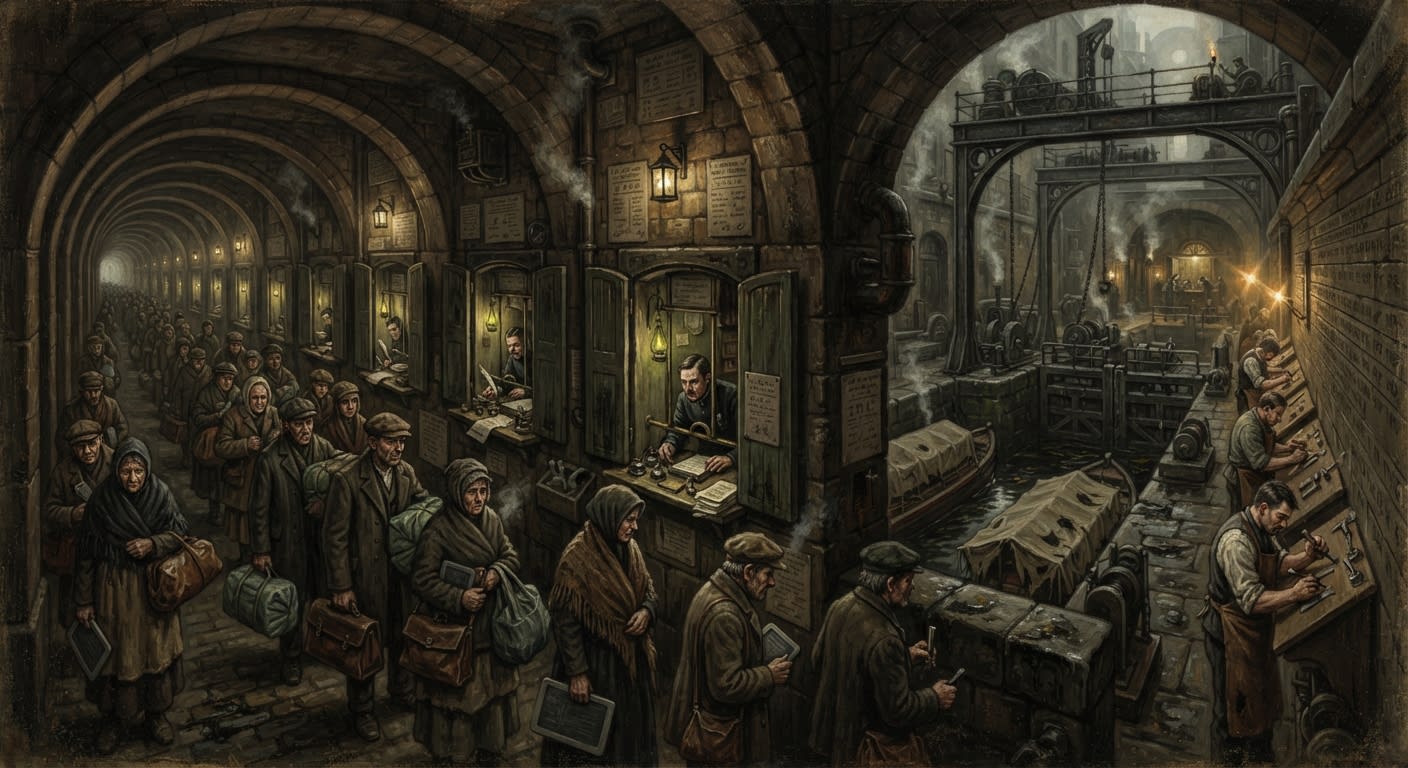
The street is a causeway, roofed at intervals by its own arches. Down both flanks stand the registry windows of the Bridge-Scribe Collegium. Each is a stone mouth with an oak shutter, an iron sill worn bright by generations of elbows, and an oilcloth awning that keeps off the rain badly. Behind the windows sit the bridge-scribes in ink cuffs and slate tags. Behind the scribes stands the Archivolt Registry Hall. Under all of it, in the ribs of the span, the masons tap.
The Row smells of wet parchment and chisel dust. The sound is of quills, and beneath the quills there is always the small patient knock of a chisel making somebody's entry permanent. I have heard monasteries at Compline that were less orderly and slaughterhouses that were less honest.
The Collegium was constituted in A.S. 92, when the Synod concluded that paper toll records rotted too quickly in the canal damp and that stone should take up the burden of memory. The scribes settled on the central spine because every other site required a boat. No separate founding of the Row appears in any register I have consulted. The windows accumulated one at a time, as debts do, until the street became a district and the district became a verb. In the River-belt, "to be Rowed" is to have one's name examined and returned in a condition one did not order.
#On the Windows of Verification
The lock bells ring at dawn and the shutters go up in a single clatter that runs the length of the spine like a volley. The queue is already there. It is always already there.
It holds bargemen with cargo declarations wrapped in oilcloth, debtors with name-dispute petitions, pilgrims bound for the Saintspan with candle stubs in their fists, widows carrying the name-settling slates that the Causeyworks demands before it will admit a man is dead, and lock-labor draftees who have been told to present themselves for "confirmation" and who have correctly guessed what that means. Barges up from the Seal Locks send one man ahead to stand in line while the crew waits at the Mouth-Sluice paying mooring by the hour.
The rule of the window is simple. Every crossing in the Causeyworks requires a spoken registered name. The petitioner speaks it. The scribe listens to the voice, to the paper and to the arch overhead, which in certain stretches of the Row returns the last syllable a half-beat late. Then the scribe compares all three. A scribe performing this office is called an archlist, and a good one can tell a forged surname by the way its owner breathes before saying it.
Papers must be presented dry and flat. A permit whose ink has bled is refused. So is one that has curled, or one that smells of the Undervaults. Dry paper is the scarcest commodity on the Row and the plainest mark of rank. A petitioner who has walked from the Barge-Lip in drizzle with his permit inside his shirt is presenting the Collegium with his own sweat, and the Collegium notes it.
A satisfied window issues a crossing receipt, a lock-priority slip, or a toll chit sealed publicly in wax, which the locals call the Seal-Wax Anointing. An unsatisfied window issues a referral. The referral is a narrow grey card, and it sends the bearer three arches down to the correction desks.
Any ordinary provincial Records scribe would recognize the method. He would not recognize its consequences. In a provincial office an error in the register is an error. On the Row it is an address.
#On Correction
Chief Scribe Mael Arct presides over correction from a desk at the Registry Hall end of the spine. The desk is raised a hand's breadth above the others, so that petitioners approach it slightly uphill. His fingertips are stained to the second knuckle, and he no longer troubles to wash them, since ink is the only thing on the Row he is never asked to account for.
His powers are three, and the whole city can recite them. He can forget a name for a price. He can remember one for a higher price. He cannot un-carve a stone entry, because nobody can, and the Bureau of Doctrine has confirmed that erasure of stone is a theological impossibility as well as a civil offence.
Correction therefore adds and never subtracts. Arct issues a correction writ. The revised name is chalked onto a correction slate, and the slate goes by runner to the Stone-Ledger Yards, where Master Mason Lysa Korr's people "reconcile" it: they cut the new entry beside the old one. Neither is struck out, and both persist. A corrected citizen crosses both of his names every morning on the way to work, the old above the new, and his neighbors can read the sequence as plainly as a baptismal register.
Paper begins the claim and stone completes it. The slate stands between the two, and it is the most honest object on the Row, because it is the only one that records when a name changed and who asked.
Bridge-Scribe Collegium correction is a minor administrative clarification of registry orthography, having no bearing on the identity, lineage or legal person of the petitioner.
Correction is identity revision. The previous identity is retained in stone. The petitioner's lineage is recorded on the slate. The Bureau of Records regrets the earlier circular and has reassigned its author to the Namewash Cloisters, where he may observe clarification at closer range.
Petitioners who want their names cleansed instead of corrected are sent across the canal to the Namewash Cloisters. The Cloisters send them back with a confession etched into floor slate and a new referral card. The route between the two institutions is worn smooth enough that children skate it in winter.
#On the Quiet Trade in Names
Every window on the Row has a side-ledger. This is not corruption, or at least not only corruption. It is the natural consequence of a system in which the official ledger is permanent and the petitioner is not.
The trade is conducted in a register everyone overhears and nobody records. A scribe who "recognizes" a regular client costs a candle-tax, paid in wax, which is the Row's preferred bribe because it can be passed off as sealing stock. A number-pass lets the bearer cross by registry number instead of speaking his name. It is legal, expensive and dangerous. The forged kind comes up the landward stairs from the Undervaults in the pockets of Mudkeys, works exactly once, and afterward marks the bearer for a name-hygiene action. The Mudkeys know this. Their customers learn it. Keystone couriers pass the Row at a walk, carrying slivers of cut stone no larger than a thumbnail with letters on the inner face, and the archlists do not look up.
Behind a false wall in the Registry Hall there is an unofficial registry. Everyone on the Row knows of it, and no one on the Row has seen it. It is said to hold the names Arct has forgotten, filed in the order in which he was paid to forget them.
At the far end of the correction desks stands one desk that takes no petitions. Its clerk wears no slate tag. When certain names are spoken at certain windows, a runner carries a folded packet to this desk, the clerk copies the name in a different hand, and the packet leaves the Row under a Bureau of Purity seal. I asked the clerk what principle governs the selection. He said the list was compared against the Index Damnatus. I asked why, in that case, the copied names included living children with no entry in the Index. He said the Index was not the only list.
#On the Present Audit
The Row's troubles in A.S. 201 have a single name, and it is one the archlists will not say aloud at their windows.
Canon-Inquisitor Silex Marrow holds a warrant, issued under Purity seal, to unseal the Saintspan's rib cavities. Its schedule also reaches Stitchbridge comparison cuts, tool marks in the Stone-Ledger Yards, and Bridge-Scribe Collegium correction slates. The last item is the one that has closed the Row's shutters an hour early three times this season.
The reason is not hard to find. The banned name recovered from the Stitchbridge keystone cavity in A.S. 199 was carved by a mason. The mason worked from a slate. Every slate that has crossed from Archivolt Row to the Yards carries a date, a scribe's mark and a requesting hand. If the Mortar Saints ever routed a forbidden syllable through the ordinary machinery of correction, the proof lies in a stack of chalked slate in the Collegium's damp stores. So does the proof of which officials passed it along, and which window was paid to look elsewhere.
Chief Scribe Arct has objected on the grounds that names are the Collegium's property until carved. Canon-Toller Edris Vane has objected on the grounds that an audit of the Row halts every crossing in the city. The Bureau of Records has raised its customary jurisdictional objection and appealed. The appeal is pending. The warrant has not been stayed. Marrow has not yet entered the slate stores. He has been seen at the windows, standing in the queue like a bargeman and listening.
[EXCISED — BUREAU OF PURITY SEAL, CUSTODY OF CORRECTION SLATES] Slates requisitioned under the Saintspan warrant are to be held by Purity and not returned to Collegium stores. ████████████████████████████████████ ███████████ cross-referenced against the side-desk packets by surname, by parish of origin and by ██████████████. The purpose of the cross-reference is not to be entered on any slate.
In the Causeyworks, a guest must never ask a host what name was there before. The rule is older than the Collegium, and it keeps the city polite. Marrow intends to put that question to the whole of Archivolt Row at once, in writing, under seal.