

#On His Station
Gruss is a Caravan Factor, which means the Synod has granted him lawful authority to do three unlawful things in rapid sequence and then explain them in handwriting sufficiently pious to survive audit. His full baptismal name has not been recovered. The road calls him Gruss. The Bureau of Tithes calls him Licensed Transit Factor 19-C/Carpathian Corridor. The Turda (Unregistered) gate-sergeants call him “that belt bastard,” a title which, though unbeautiful, has the virtue of field accuracy.
I observed him at the Carpathian ridge-gate of Turda during a wet dawn when every mule in the convoy had reached the private philosophical position that eastern logistics were a sin against hooves. He carried thirty-seven separate documents, four bribe units — two grain, one wax, one favour to be named — and a knotted route-cord (Unregistered) so long he wore it as a belt. He had not slept in three days. He smelled of mule, diesel, damp wool, candle-wax, and whatever rancid courage leaks from men who have already used up their fear and continue moving from habit.
The convoy numbered eleven wagons. Eleven is a number logistics clerks distrust, since ten can be divided and twelve can be sanctified by lazy numerologists, while eleven merely stands there like a witness refusing correction. The cargo was grain, lamp-oil, reliquary rivets, psalter-straw, and two crates whose seals bore the grey overmark that means “do not ask unless you prefer the answer.” Gruss asked no questions. This was his genius. He counted.
#On the Thirty-Seven Documents
A lesser man would have carried fewer papers and died cleanly. Gruss carried thirty-seven because Turda required thirty-four by posted rule, thirty-five by current practice, thirty-six if the Palatinate Inspector happened to be awake, and thirty-seven if the inspector's nephew was present in borrowed uniform pretending to understand seal order. He was present. His borrowed boots squeaked.
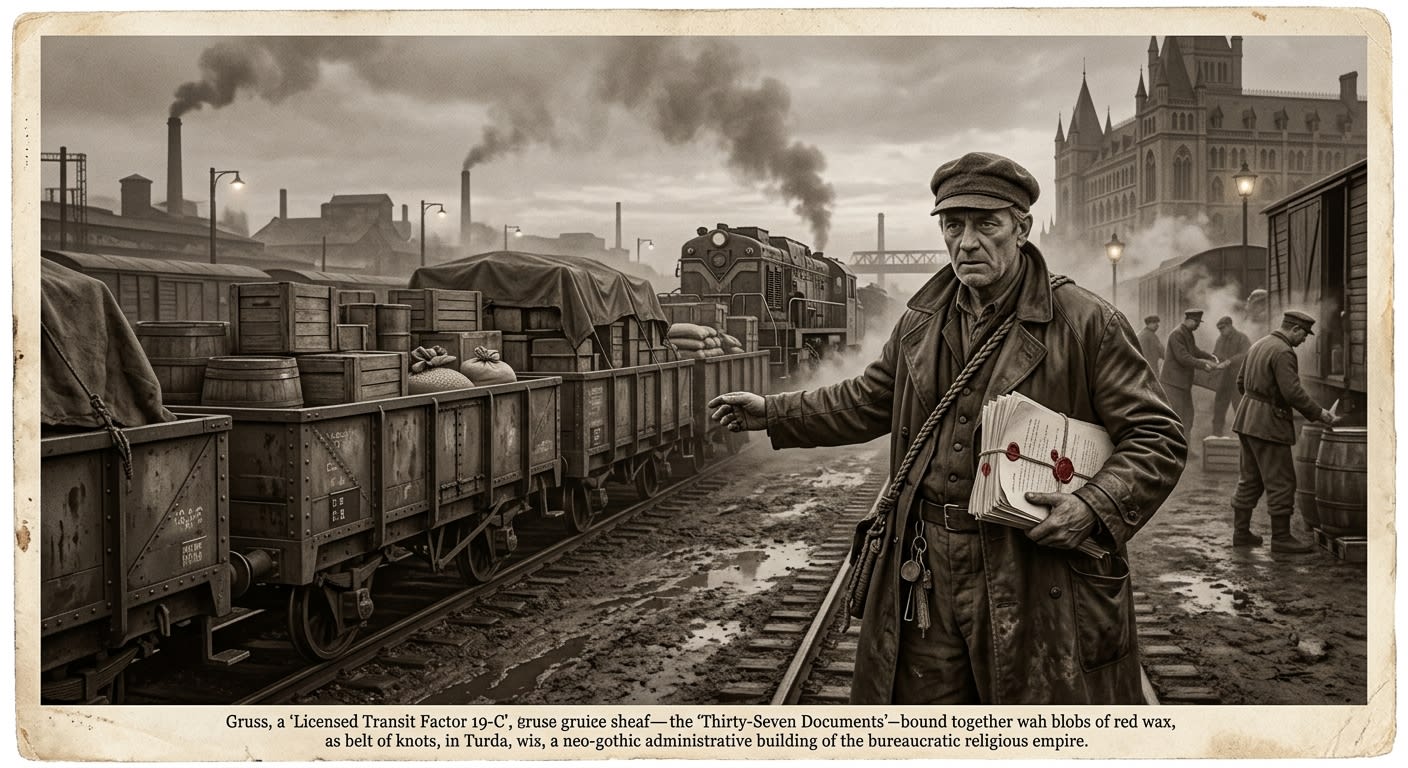
The first bundle was honest: route permit, weight tally, seal folio, wagon order, bell-credit assignment, ration chit, animal count. The second bundle was tolerable: substitute road clearance, rain delay attestation, wax spoilage exception, chapel detour notation, bribe record under the approved heading “Operational Facilitation.” The third bundle was for men whose authority exceeded their literacy. It contained one obsolete pass, two duplicate stamps, a blank prayer-slip, and a folded note addressed to a sergeant's wife.
The thirty-seventh paper was the masterpiece: a supplementary manifest whose weight totals contradicted the primary manifest by precisely half a sack. Not a full sack. A full sack is theft. Half a sack is weather, spillage, mule-mouth, clerkly rounding, spiritual evaporation, or any of the small lies by which civilisation crawls from checkpoint to checkpoint. Gruss placed it on top only after the inspector's nephew had begun to sweat.
The nephew saw the discrepancy and smiled like a novice finding sin in another man's laundry. Gruss smiled back and produced the wax unit. Not the grain. Not the favour. Wax. Wax flatters gatehouses because every gatehouse believes itself under-candled. The nephew accepted the wax and stamped the half-sack into orthodoxy.
Earlier corridor gossip claims Gruss bribed the Turda gate with grain alone.
False. Grain opens hungry gates. Turda was not hungry that morning. Turda was vain, damp, under-candled, and afflicted with a nephew. Wax was correct.
#On the Belt of Knots
The route-cord deserves its own entry, though the Bureau of Heraldry would rather license an emblem for a rat than admire a Factor's belt. Gruss's cord circled his waist twice and hung to the knee, dark with thumb-grease, rain, seal-dust, and the little clots of candle-smoke that collect on men who sleep in wayhouse lofts above bad lamps. Each knot marked a gate, a bribe, a cache, a warning, a dead mile, a sergeant's weakness, a mule team that could be trusted, a mule team that had once bitten a deacon, and one place where children vanished in fog and nobody joked afterward.
He read it by touch while arguing. This is worth recording. Many Factors can read knots. Fewer can read knots while a gate-sergeant threatens confiscation, a mule sits down, a bell-credit narrows, rain softens the ink on the outer sheet, and a pilgrim woman in the rear wagon begins to cough in the rhythm Purity inspectors associate with concealment. Gruss's thumb moved along the cord beneath his cloak. His mouth discussed toll precedent. His eyes watched the nephew. His left boot pinned the edge of a document before the mud could take it.
The belt also concealed the favour unit. This is observed record. I saw the knot. A favour to be named is the most dangerous coin in the Synod, because unlike grain and wax it does not diminish after payment. It grows teeth. The knot was tied in the old ridge style: doubled, bitten, and turned inward, indicating a debt owed to a named clerk whose name had been removed from the cord by knife. Gruss touched it once when the queue behind him began to mutter.
He did not spend it.
#On the Turda Passage
The Turda ridge-gate is less a gate than a stone argument with hinges. It sits where the Carpathian road narrows between a shoulder of black pine and a drop that makes even soldiers speak respectfully to gravity. The gate chapel leans west. The audit room leaks. The mule trough is too short by four feet, which has caused more heresy than several printed pamphlets I have been required to condemn.
That morning the queue had already begun to rot in place. A pilgrim cart blocked the lower turn. Two military wagons waited with priority tags. A bell runner from Bastion-Sibiu had arrived breathless, demanding passage for a sealed pouch. The gate-sergeant wanted grain. The nephew wanted importance. The weather wanted everything.
Gruss cut the knot.
Not the favour knot. A lesser reader will assume drama where technique suffices. He cut a plain mile-knot from the tail of his cord and tied it around the lead mule's bridle, marking the animal as officially reassigned to gate service under emergency traction custom. The gate-sergeant objected. Gruss produced paper twenty-two. The nephew objected. Gruss produced paper seventeen. The bell runner objected. Gruss handed him the blank prayer-slip and told him to write the name of the man whose death would be caused by further delay. The runner stopped objecting.
TURDA GATE ORAL ADDENDUM — UNFILED The pilgrim woman in the rear wagon was not listed as passenger, hand, cargo, escort, attendant, or tolerated encumbrance. She carried no papers. Her cough ceased after the gate opened. Gruss's manifest records one sack of psalter-straw transferred to wagon nine at the upper turn. Wagon nine had no psalter-straw when it arrived.
By the time Sext struck from the ridge chapel, the eleven wagons were moving. The military wagons had been moved aside under traction priority. The pilgrim cart was pulled clear. The nephew had a wax unit, the sergeant had two grain units pledged after delivery, the bell runner had a sealed pouch and a moral injury, and Gruss had lost one mile-knot, one blank prayer-slip, and no sacks.
#On His Character
Gruss is often described as cold. This is unjust. Cold men are simple. Gruss was heated throughout by impatience, contempt, fatigue, calculation, and a private tenderness he kept hidden under enough grime to avoid prosecution. He did not comfort the frightened. He moved them. He did not reassure the convoy. He counted it. He did not pray aloud to Saint Kelm the Measurer, though his thumb passed three times over a broken-wheel bead tied near the cord's buckle.
His cruelty was selective, which is the beginning of mercy in a profession that measures grief by the sack. He cursed a child for dropping a seal case, then stood between the child and the inspector's nephew before the nephew could notice the dropped case had opened. He slapped a mule hard enough to draw blood from his own hand, then fed it the last apple from his coat. He told the pilgrim woman in wagon nine that coughs should be saved for confession, and when Purity riders appeared on the lower road, he put her beneath psalter-straw and wrote her into the manifest as “settlement fibre, dry.”
A later Purity memorandum identifies Gruss as “suspected passenger launderer.”
Corrected for Doctrine circulation: Gruss was a Factor. The distinction is not innocence. It is grammar.
He knew the Bureau's language better than many Bureau men. A bribe became facilitation. A missing person became labour adjustment. A falsified half-sack became moisture correction. A terrified woman became settlement fibre. Sin, in his hands, acquired acceptable nouns and moved east.
#On His Legacy in the Corridor
The Turda passage entered Factor talk within a month and official silence within two. Corridor apprentices learn it badly, as apprentices learn everything worth knowing: eleven wagons, thirty-seven documents, four bribe units, no loss. They forget the rain, the nephew, the cough, the half-sack, the mile-knot cut from the cord. They turn Gruss into a charm against delay, which would have disgusted him, since charms are paperwork done by cowards who dislike ink.
No grave is recorded. No retirement allotment appears in Tithes registers under his name. One cord resembling his belt was later seen at a wayhouse above the Budapest road, cut into short teaching lengths and sold to Tally Runners at a scandalous price. This may be fraud. It may be relic commerce. It may be both, which places it safely within Synod tradition.
The formal entry remains small: Gruss, Transit Factor, Turda ridge-gate, eleven wagons delivered within bell-credit window. A line fit for Records, and Records is welcome to it. I prefer the smell of mule and diesel, the thumb on the knot, the nephew's squeaking boots, the wax changing hands, the gate opening because one filthy man understood the exact weight of everyone else's vanity.