
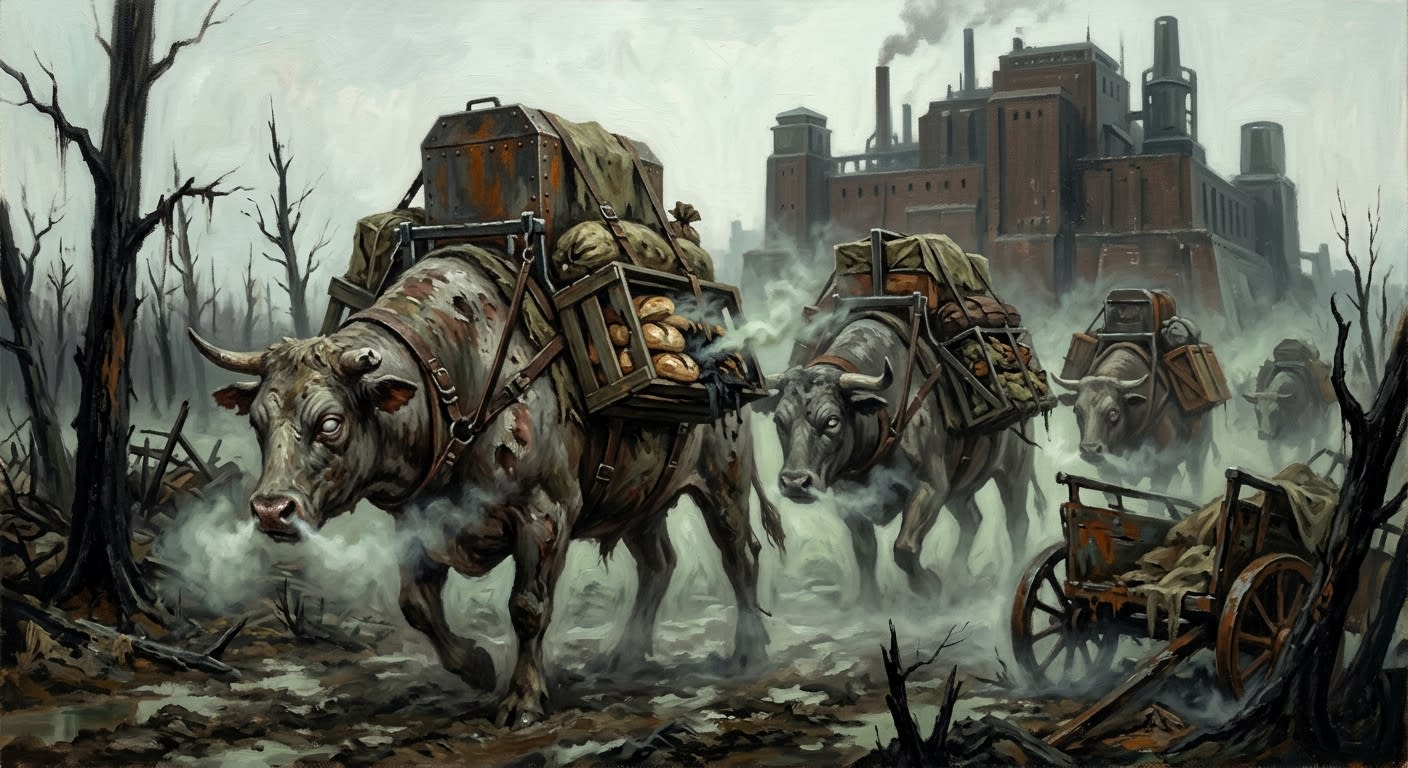
#On Their Nature
The Rot-Ox is the enemy's answer to the mule, which is to say Hell has improved upon mulekind only by making it more dead, less stubborn, and worse-smelling. It is a supply beast of the Shadow Court, a hulking carcass reanimated by gluttonous hymn-work, its hide stretched taut by gas, corpse-fluid, and whatever passing theological disgrace permits a dead animal to continue obeying orders after anatomy has withdrawn its consent.
A Rot-Ox does not graze. It does not rest. It does not turn its head toward the driver because there is rarely a driver, and where a driver exists he is usually stitched into the yoke or nailed beneath the horn. The beast lurches. That is its gait, its liturgy, its legal category. It lurches across enemy supply corridors dragging bone-carriages chained to its spine, each carriage packed with carrion rations, rusted arms, plague-cloth, corpse-candles, worm-jars, and those little sealed black boxes the Bureau of Purity insists do not whisper until one is opened in an office.
The Bureau classifies the creature as Category D/9: Olfactory Corruption of Supply. One admires the calm of it. A thing the size of a chapel-bell moves through a village, drains the breath from the cattle, blackens the bread in the sacks, makes iron weep rust from nail-heads, and leaves every inhabitant shrivelled with a tongue like burned leather. Olfactory. Supply.
#On the Train
A single Rot-Ox is a battlefield hazard. A train of them is an argument against optimism. The enemy binds them in processions of three, seven, nine, or thirteen, depending on the cargo weight and the appetite of the hymn-master who woke them. Their chains are made of bone reinforced with black iron. Their hooves leave prints that fill with grey fluid and continue bubbling after the beast has passed. Their horns are often capped with reliquary metal stolen from eastern shrines, which explains why some bullets turn aside from them with the offended dignity of a bishop refused precedence.
The carriages behind them resemble funeral carts because the Shadow Court has a consistent visual policy and a vulgar imagination. Wheels made from femurs. Axles wrapped in tendon. Lanterns burning fat that belonged to named citizens. Cargo nets braided from hair. Along the sides hang bell-clappers taken from dead parishes, rung by the motion of the march into a dull knock that Factors along the ridge call “the cupboard sound,” because it resembles someone trapped inside a pantry beating politely to be let out before becoming provisions.
The train's fog is the true cargo. It rolls low, green-grey, neither mist nor smoke, though both words appear in early field reports written by men attempting to remain sane enough for promotion. The fog drinks damp from the tongue and colour from the hand. Crops yellow, then collapse inward. Horses cough black foam. Bread darkens in the sack as if baked a second time in a hateful oven. Iron buckles, nails, rifle springs, cart-rims, bayonets, shrine hinges — all begin to sweat rust.
#On the Black Convoy of Galicia (Unregistered)
The Black Convoy of Galicia remains the approved instructional catastrophe because it contains every error a commander can make while still providing the Bureau a martyr roll. A Rot-Ox train was being pursued from the east toward a trench crossing. The local regiment had orders to hold the crossing until the supply cut could be sealed. The timing was wrong by minutes. Minutes, in war, are where incompetence hides its knives.
The Rot-Oxen reached the trench first.
The fog poured down the dugouts like grave-wash. Lamps guttered blue. Men tied wet cloth over their mouths, then found the cloth dry and stiff within breaths. Rifle bolts fused with rust in their hands. Loaves issued that morning turned dark in haversacks and split along the crust as though something inside wished to hatch. The regiment did not flee. The Bureau is correct there. They fought as trained, fired when the guns still moved, bayoneted when the guns failed, recited the short catechism when speech still had moisture enough for consonants.
GALICIA RECOVERY NOTE — SUPPLEMENTAL Bodies found seated in firing posture. Rifles across knees. Mouths closed. Tongues black. Uniforms intact. Skin dry, waxen, reduced. One corporal's left hand continued moving in tally-count after removal from trench wall. Hand burned separately. Ash placed under seal.
When reinforcements broke through, the trench was lined with hundreds of figures seated in perfect order. Wax saints, the troops called them. The Bureau declared them martyrs, assigned a feast, revised the casualty phrasing from “mummified by hostile vapour” to “preserved in testimonial posture,” and circulated a woodcut that made the dead look serene. The woodcut omitted the bread bursting in their packs.
Earlier field instruction stated that Rot-Ox fog causes “temporary dehydration and morale pressure.”
Amended after Galicia. Rot-Ox fog causes lethal desiccation, supply corruption, metal failure, crop death, and the kind of morale pressure usually associated with watching one's tongue die before one's lungs.
#On Countermeasures
The protocols are simple because complicated protocols die first. Salt the track-bed. Burn the track-bed. If the beast still stands, blind it with lime. If the fog thickens, cast reliquary grit into the vapour until the air hisses. When the hide dulls and begins to crack, apply fire. Continue fire after collapse. Burn the chains. Burn the carriage axles. Burn the nearest grass. Burn the boots of the men who stood closest. Record the losses after the smoke clears and before anyone drinks.
Blades dull on the hide. Bullets enter and vanish with the wet indifference of coins dropped into soup. Artillery works only when the shell bursts beneath the belly and tears open the gas-sacs. This is satisfying to observe from a distance and fatal to observe from below. The preferred mixture remains reliquary grit with lime and ash, blessed under short rite, thrown or blown into the fog by hand-pumps. Doctrine calls its success the miraculous intercession of blessed lime. Engineers have, in older memoranda, used a shorter word.
Engineering memorandum 14-D described the lime reaction as “chemistry.”
Corrected. The approved phrase is “miraculous intercession of blessed lime.” Engineers may continue producing the miracle in standard sacks of forty pounds.
The ground after passage must be treated as enemy material. Even a dead Rot-Ox poisons soil through shadow contact, which sounds poetic until a man plants onions where one stood and harvests black knots that bleed when cut. Track-beds are salted and burned regardless of whether the train is destroyed. Villages touched by the fog are quarantined, inventoried, and usually abandoned. Wells are filled. Bread is buried. Iron is melted if it can still bear heat.
#On Their Present Use
The Rot-Oxen matter because Hell must also move goods. The devout recruit imagines the enemy as a shrieking mass crossing the horizon beneath banners of blasphemy. The older soldier knows better. Behind every shrieking mass is a line of transport. Behind every sin-general's theatre stands a clerk, a butcher, a corpse-cart, a tally. Even Kargath has supply. Even Maldrake has scheduling. Even Velmora, who would charge rent to a plague, must move cargo from mine to altar, from pit to trench, from hunger to use.
Rot-Oxen are common along the eastern corridors beyond Bastion-Sibiu and the Galicia approaches toward Bastion-Przemyśl. Caravan Factors know the signs before soldiers do: iron sweating at the rivets, bread souring without damp, mules refusing a ridge that yesterday they climbed with only the usual vulgar complaints. A Factor who smells a Rot-Ox train and lives will abandon cargo faster than doctrine prefers and slower than wisdom demands, because every sack left behind must later be explained to an auditor who has never inhaled the fog.
The holding is grim and plain. Rot-Oxen do not conquer territory. They prepare territory for conquest by teaching it to rot before the army arrives. They are the enemy's logistics given corpse, horn, chain, stink, and obedience. Shoot them if you must. Burn them if you can. Count the bread afterward.