

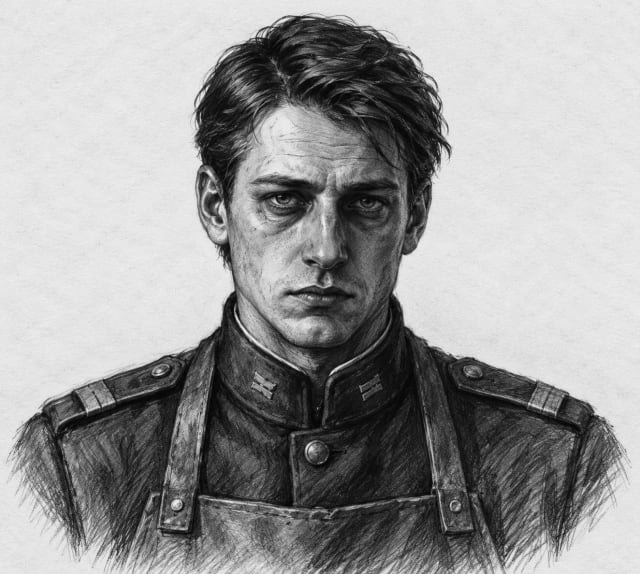
#On the Clerk's Station
The surviving record names him by office first and by surname second: Night Clerk Harro Pell. That is the right order, and the Bureau approves of it. A clerk's name gets entered in a ledger. His office is what writes in it. Pell held the second-bell post at Booth 77, in the north Confessional Lane of Bastion-Brest, third pylon from the west. On the night the booth first inverted, he had at his station a candle, a stack of receipts and a tray of stamped tokens.
That inventory is the most dependable thing in his file. I trust a candle more than a man's memory, and a token tray more than both.
This dossier is a documentary survey made in A.S. 201. It isn't a biography, and the dateline belongs to the survey. A.S. 201 is not the year of Pell's birth, his appointment or his ordeal. The incident it examines took place in A.S. 199, eleven days after the Confession Echo began. The Synodal reckoning puts that year at 1909 by the old count. Neither the published account of the booth nor the timeline gives a day or a month. Second bell and the dawn that followed are the only clocks the case provides, and I will not wind them further.
The record doesn't give his age. My own earlier account called him "young enough to believe protocol would save him and trained enough to follow it after belief had abandoned the room." I stand by that sentence as prose. As evidence it is worth less. It is the narrator's verdict on a stranger's interior, written by a man who has never sat the second-bell shift in that booth and does not intend to. Nothing in the file establishes where he trained, how long he served, what he looks like, or whether he believed anything at all.
#On the Voice at Second Bell
According to the Booth 77 account, a woman's voice reached Pell through the grille at second bell. No footstep came before it. The lane board did not creak and the queue marker did not move. In the north Confessional Lane, where every arrival is supposed to announce itself in boot-leather and floor timber, that silence was the first irregularity. Everything after it followed in order.
The voice confessed to concealing a child beneath a flour cart and to using a forged widower's stamp to cross the west gate.
Pell opened the shutter and found the lane empty.
In the account's words, he should have called the Watch, and he wrote the confession down instead. He logged the voice. He marked the booth number. He noted that no penitent could be seen. Then he put the page in the black variance folder, because the red folder was reserved for sins already attached to bodies. The account presents this as training rather than courage, and I wrote that judgement myself, so I am in no position to dispute it.
The file is precise about what the clerk recorded and silent about how he felt doing it. That silence deserves respect. Its absence of expression may be the most honest part of the record. A trembling hand leaves no mark on a variance page unless the ink pools, and nobody has reported pooled ink.
Who the voice belonged to, the case does not settle. The account reports that it was a woman's voice. It does not prove whose throat produced it, or whether a throat was involved at all. In Brest, theories about the Echo, the Nameless Tide and the booth's workings change hands faster than forged tokens under the Ribwalk. None of them is entered in Pell's file, and I will not attach one to him.
#On the Dawn Comparison
At dawn Marta Senn arrived with a flour cart. A child lay under its sacks, and her widower's stamp was forged. When she was halted, she confessed in the same words that stood in Pell's record.
The account adds two facts that turn a coincidence into a case. Senn had never entered the booth before. She also knew nothing of the black folder, which by then lay under the seal of the Bridge Tribunal.
Then the comparison was made, and Pell fainted after it.
The record gives that much, and I have checked it twice for anything more. It does not say who halted Senn, and it does not say Pell did. It names no room where the pages were laid side by side and no officer who read them aloud. It does not record what the clerk said before he fell, or whether he said anything. His medical outcome is not entered either: no physician's note, no recovery chit, no bed-ward receipt. A man fainted, and the file moves on. Brest has a lot to file.
Nothing in the case says Pell fainted from fear. The account places his fall after the comparison and stops there. Fear is the obvious reading, and I share it. A reasonable man compares two pages, finds tomorrow already copied out in his own handwriting, and lies down on the floor. An obvious reading is still not testimony.
#On the Black Folder
The Booth 77 account treats Pell's page and the later comparison as the evidence that matters. The page came first, written before any penitent appeared, filed black and sealed. The confession came second, from a woman with no access to either. The comparison then established the sequence, and the sequence is what the Tribunal could not tolerate. An ordinary Echo returns a sin after a mouth has spoken it. This page held the sin before any mouth arrived.
Pell's case stands at the head of what the Tribunal now publicly calls anticipated confession: the booth speaks, a matching penitent arrives later, and the transcript is waiting. The other public categories, orphaned confession and identity variance, came later and are not his. His contribution was to be the first clerk with a pen in hand when the order of events reversed, and to file the result correctly.
Initial lane notices described the Pell-Senn event as "anticipatory clerical misentry pending causal clarification."
Corrected, according to the published Booth 77 account, after transcript comparison. The original notice blamed the clerk for a misentry. The comparison cleared his entry and convicted the chronology.
The correction matters more to Pell than any commendation would. A misentry is a clerk's fault and goes on his record. Once the misentry was withdrawn, the fault moved from the clerk to the booth, and whatever is speaking through it. I note that the first instinct of the lane notices was to blame the man with the pen. Institutions do that. Mine has done it many times.
The page's current location is not established. Neither is its full chain of custody, its exact wording or who may read it. I know it entered the black variance folder and that the folder went under Tribunal seal. I do not know what shelf it sits on, who holds the key, or whether anyone besides Presiding Judge Elsbeth Krail has seen it since. I will not supply an extract. A fabricated transcript would be a worse sin than any the booth has repeated.
#On What the Record Declines to Say
The account follows two lives beyond the comparison, and both end in sealed or blank records.
The child was spared and reassigned. Later the child left the holding ward under a release-to-kin notation that names no kin. The file gives no name for the child, no kin, and no destination.
Senn entered the sealed docket. Her final disposition is held under KRAIL-77/PRIVATE. The seal's reason is not public, and I will not supply one.
Pell's own trail ends earlier than either of theirs. The survey cannot say whether he is alive, still employed in the lanes or in custody. Scribe-Mother Hal controls North Lane staffing and has moved clerks to daylight shifts since the Echo began. The file does not say whether Pell is among them. The unnamed guard who now sits before the booth is a separate man with separate troubles. The guard's evidentiary status, petitions and private name belong to the guard's own file and must not be transferred to the clerk.
In my Booth 77 account I wrote that a clerk who follows form "ruins everyone's sleep for two centuries."
The phrase was a flourish and should not be read as elapsed time. From the first inversion in A.S. 199 to this survey in A.S. 201 is two years. The sleep lost was real. The arithmetic was not.
As of this survey, Booth 77 remains barred, sealed, watched and active. The Echo continues in the lanes. The case's institutional owners are on record: Krail holds the sealed docket, Hal holds the schedules, and the Bureau of Doctrine holds its interpretation back. None of them is recorded as having met Harro Pell. The case connects them to him only through his page.
What the clerk left the Synod comes down to one sheet. It was written at second bell in the correct folder, before the sin it recorded had happened, and it was later confirmed word for word. Whatever became of the man after the comparison has not been entered.