
#On the Corridor Where Sin Queues
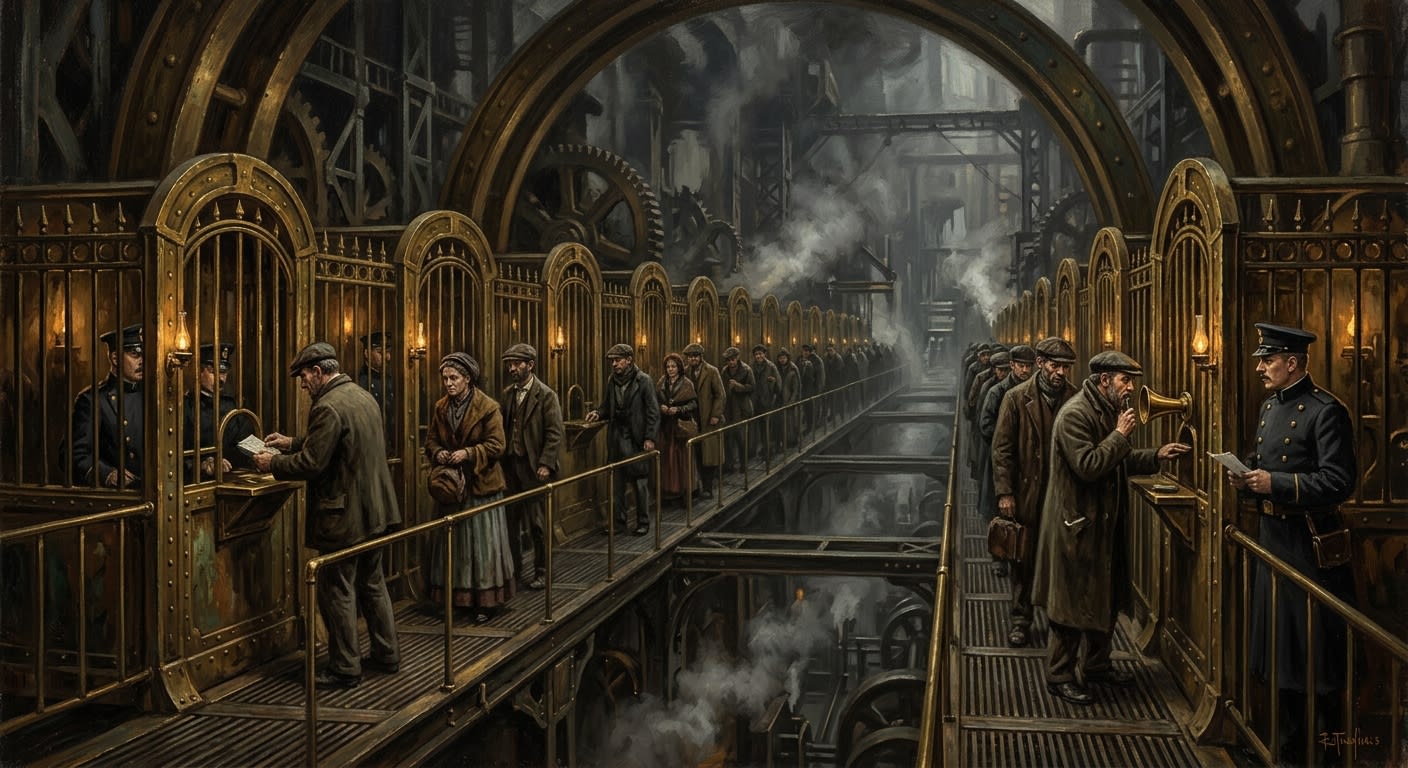
The Confessional Lanes of Bastion-Brest are the two double rows of confession booths sunk inside the Brass Ribs, beneath the Ribwalk and above the Pylon Warrens, where every crosser must surrender a name, a sin, a receipt, and a sufficiently obedient throat before the bridge permits continuation. Chapel and customs house would each recognise their own worst habits there. They are a sacramental bottleneck engineered into a military bridge, a moral sluice cut through brass, wet wood, candle smoke, paper dust, brine, human fear, and the deep river-breath of the Bug.
Two hundred and fourteen booths stand in service, if service is the word for boxes that hear more than they are paid to hear. Each has a grille, a scribe shelf, a candle, a receipt stack, a token aperture, a brine bucket, and a number whose direction changes according to whether one is speaking to Engineering, the Bridge Tribunal, Scribe-Mother Hal's clerks, or a frightened mule-handler who only knows he has been sent to the wrong side of Rib Nine. A person enters the Lanes from a gatehouse queue with paper in hand and guilt in reserve. He emerges with an absolution token, a stamped crossing file, and the expression of someone who has discovered that salvation can be processed at walking pace.
At Brest the Lanes are not auxiliary. They are the bridge's inner law. Artillery may command the eastern approaches; the Tribunal may command the docket; the Crossing Bureau may command stamps; yet the body crossing the span must pass the booths. The line may wait for War. It may curse the Tribunal. It may bribe a registrar. It still kneels at the grille.
The Lanes are why Brest functions. They are also why Brest cannot sleep.
#On Their Installation and the Arithmetic of Shame
Confession at Brest predates the present Lanes. The first western-bank works of A.S. 67 had a chapel tent, a toll board, and a priest who heard soldiers, refugees, traders, and condemned thieves behind stacked ration crates while rain came through the canvas and the eastern pressure gnawed at the river. By A.S. 92, when the Bureau of Engineering drew the brass-ribbed bridge-fortress, confession had already become a practical necessity. Bodies could be counted by guards. Souls required more patient machinery.
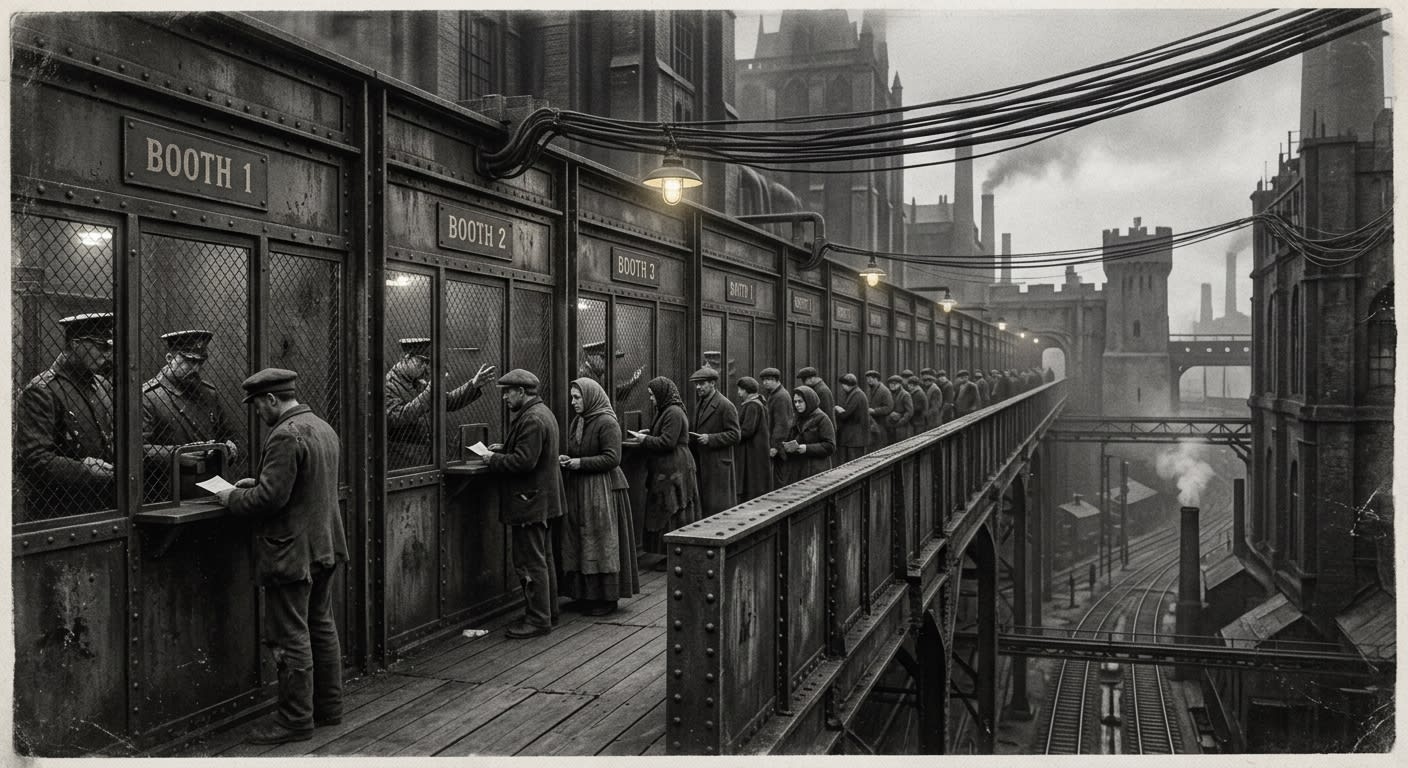
Procurator-Engineer Hallam's design married each structural rib to an inward-facing sacramental function. War received outward casemates. Doctrine received inward grilles. Records received transcripts. Rites received usage jurisdiction, at least on paper, the only place Rites receives anything cleanly. The first certified full military crossing in A.S. 98 included load, artillery, confession, and tribunal supervision; the language survives because Records knows a good list when it sees one.
The continental booth system later hardened under the Booth Proliferation Decree of A.S. 112, which mandated one registered booth per three city blocks and authorised field, mobile, fixed, and shipboard variants. Brest had already anticipated the principle with the arrogance of necessity. Its bridge could not afford parish distance. A convoy of wet infantry cannot wait while each man walks three blocks to repent of stealing socks, cursing officers, hiding coughs, desiring bread, or silently praying that the man ahead of him fails inspection first. Brest brought the booth into the bridge because the bridge had no time for ecclesiastical scenery.
A later Bureau of Rites circular claimed the Confessional Lanes were created by the Booth Proliferation Decree.
Corrected. The Decree regularised and expanded continental booth practice in A.S. 112. Brest's lane apparatus emerged from bridge design and crossing necessity before that date, then received reallocation, renumbering, and several thousand insulting inspection plates after the Decree. Rites did not invent the Lanes. Rites arrived with labels and behaved as if naming were parenthood.
The present count, two hundred and fourteen booths, is itself an argument. Engineering wanted fewer boxes to preserve maintenance access. War wanted fewer civilians under gun galleries. Rites wanted proportional provision. Records wanted numbering stability. Tithes wanted fee capture. Doctrine wanted every soul forced into speech. Brest, being a bridge and more honest than any committee, answered with crowd pressure. Two hundred and fourteen was the number that kept the queues from choking the span on ordinary days, which meant extraordinary days would still become a sermon in compression.
Booth installation turned confession from event into infrastructure. The citizen did not seek the sacrament. The corridor delivered him to it.
#On the Architecture of Listening
The Lanes run lengthwise through the bridge, divided north and south by ribs, service walls, supervisory posts, token shelves, and those narrow turns where panic can be slowed by making it physically inconvenient. Their floors are plank over iron web. Their ceilings sweat in winter. Their walls hold old breath the way a ledger holds old accusations. Candle glass is always smoke-dulled. Brine crust blooms along nail heads. Receipt drawers stick in damp weather. Damp weather at Brest is any weather in which Providence has not boiled the river.
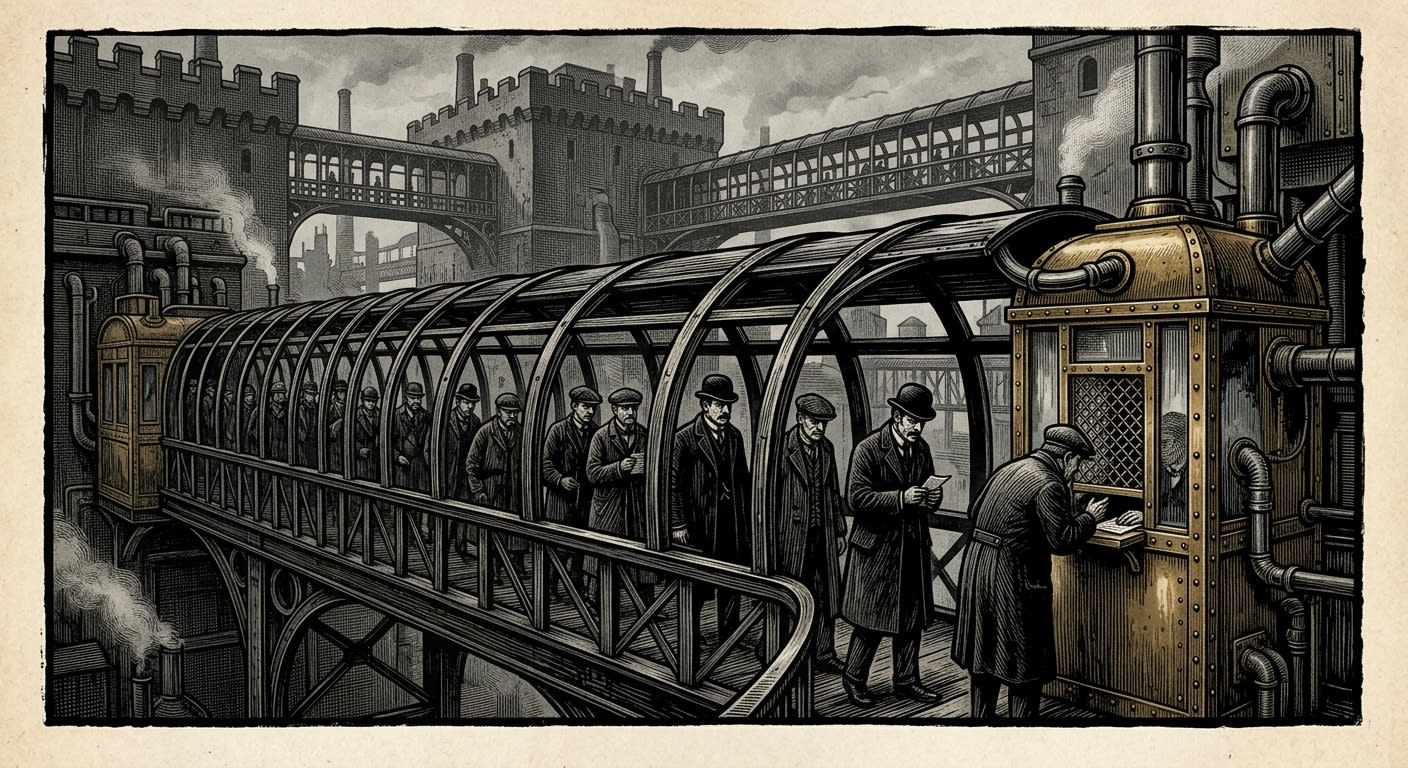
Traffic moves in single direction by watch schedule. There is no turning back once the queue enters the lane mouth. This is practical, theological, and cruel in pleasantly equal portions. A reversible confession line invites negotiation. A one-way lane teaches submission with the floorboards.
Each booth is built around division. Penitent side: kneeling board, shoulder wall, narrow shelf for papers, hooks too weak for luggage and strong enough for despairing hands. Scribe side: writing shelf, receipt stack, token tray, candle, rubric card, brine cloth, lane slate, and the little aperture through which wax leaves as authority. The grille between them is fine enough to hide faces, coarse enough to admit breath, and old enough in several booths to have learned voices by stain.
The booths are close. Too close for comfort and too far apart for privacy. A whisper in Booth 32 becomes a cough in Booth 33, a paused pen in Booth 34, an anxious glance from the lane supervisor, and a rumour by supper. Brest's famous secrecy rests on everyone hearing too much and admitting too little. The grille protects shame from eyesight, which matters less than poets imagine. Shame prefers ears.
Above the Lanes, the Casemate Galleries fire outward. Below, the Pylon Warrens sleep badly. Around them, the Ribs conduct metal sounds: wheel strike, shell lift, prayer mutter, boot drag, water knock, receipt drawer, cough, whisper, whisper returned. A confession enters wood and paper. It also enters brass. In A.S. 98 this seemed a poetic inconvenience. In A.S. 199 it became evidence.
#On Scribe-Mother Hal's Machine
Scribe-Mother Hal administers the Lanes because somebody must, and because Providence occasionally places the correct monster in the correct chair. Her title is local, sentimental, unofficial, and more accurate than the offices would like. Two hundred and fourteen booths call her Mother because fear needs a schedule, because clerks require feeding, because hinges require oil, because panic must be named before it becomes contagious.
Hal's daily government begins before dawn. Blank receipts counted. Token trays checked. Candles trimmed. Brine strength noted. Lane slates wiped. Booth assignments posted according to a calculus that includes fatigue, handwriting, suspected bribability, family quarrel, throat condition, prior Echo exposure, and that small grey look a clerk acquires when he has heard too many people speak from behind wood. She knows which booth drawer sticks, which clerk lies slowly, which supervisor drinks, which Night Clerk has begun writing phrases before penitents say them. This is not intuition. This is administration with a pulse.
Her clerks are a profession within a profession: Sin-Stampers, Booth-Rats, Paper Priests, receipt hands, Night Clerks, District Confession Registrars, and the two ruined veterans who can identify a forged confession by the rhythm of shame. They hear the sins the bridge requires, reduce them to categories, copy them into abstracts, issue wax permission, and keep the line moving while above their heads gunners prepare to reduce bodies to more manageable questions.
Hal's authority is narrow and deep. She cannot overrule Judge Krail in Absolution Hall. She cannot command Vonn's casemates. She cannot order Hett Ruis to stop smiling at invalid papers. She can remove a clerk from North Lane before the man's cadence begins to return from the ribs. She can close a booth for hinge rot. She can double brine scrubbing. She can bury a warning inside a staffing request so precisely that only another competent enemy will read it correctly.
A Bureau of Rites staffing survey described the Lanes as “clerically stable under ordinary booth practice.”
Withdrawn after Brest submitted its third emergency rota amendment in A.S. 201. Ordinary booth practice ended when the first confession returned in its owner's voice. Stability has been redefined as continued operation despite staff bleeding, false transcripts, and furniture with opinions.
A lane that stops ruins the bridge. Hal knows this better than Krail, better than Vonn, better than every Strasbourg clerk who has ever stamped a requisition from a dry office and called it support. The Lanes open because Hal opens them. That fact irritates everyone except the people who need to cross.
#On Currency, Safe Sins, and the Little Market of Guilt
The Lanes turn sin into passable paper. This is the official function, dressed for chapel. The unofficial function is more useful and less confessed: they create a market in acceptable guilt. Brest has learned what every mature bureaucracy learns: when the state requires a thing, someone will sell a convenient version of it outside the door.
A safe sin is a pre-shaped confession minor enough to pass, specific enough to sound human, dull enough to avoid Tribunal curiosity, and suited to rank. Soldiers receive impatience, petty theft, lust without names, profanity during watch, or gluttony limited to ration crust. Traders receive false measure under three ounces, envy of licensed competitors, withholding a tariff opinion from a superior, and lying about river fish. Clerks receive pride in handwriting, irritation toward pilgrims, small bribes accepted in food rather than coin. Officers receive pride, pride, pride, and occasionally impatience if the scribe is generous or suicidal.
Safe sins serve order. They also rot it. A convoy cannot survive if every man offers the full theatre of his inward life while artillery carts back into the gatehouse. Formula keeps the river moving. Formula also teaches men that confession is a costume, and costumes invite changing rooms. The Blank-Sheet Circle understood this faster than the Tribunal wished. A blank crossing paper needs a voice. A safe-sin script supplies one. The Circle did not invent theatrical repentance at Brest. It merely improved the ticketing.
Under-deck sellers offer scripts folded into boot seams, written on bread paper, memorised by children, or encoded in rib-market insults. Some are harmless. Some are traps. Some include names that cause the Echo to lean closer. Hal bans repeat scripts in the same watch. Krail prosecutes repeated scripts when they conceal identity variance. Ruis records the fee. Vonn asks why anyone below casemate rank is still talking.
The market sells more than words. Warm tokens. Lane places. Better booth numbers. Supervisor distraction. Brine-clean receipts. Forged minor-penance certificates. Old absolution discs scraped and resealed. A widow may sell her ration chit to move a son past Booth 77. A courier may pay in news from Warsaw to avoid a clerk who knows his face. A soldier may trade socks for a script that does not mention desertion. The Bureau calls this corruption. Brest calls it weather.
#On the Blank-Sheet Injury
The Blank-Sheet Circle wounded the Lanes by proving that the bridge's sacramental machinery could be impersonated with paper, timing, and inside help. Since at least A.S. 196, the Circle has manufactured unsigned, unstamped, unfiled crossing papers in the Pylon Warrens and moved persons across the Ribs under false names or no names fit for the Ledger. The Tribunal calculates four to eleven unrecorded souls per day. The phrase unrecorded souls is ugly because it is almost an oxymoron in Synod grammar. Almost.
The Lanes are the difficult part of the Circle's method. Paper can be made in cellars. Stamp dies can be copied, as Irena Vale demonstrated with apron-concealed wax impressions and the cheerful incompetence of stamp-room checkpoint doctrine. But the Lanes are physical. They are watched, numbered, slit, patrolled, and cruelly narrow. A blank paper cannot kneel at a grille by itself. It needs a scribe to process a fiction, a supervisor to look elsewhere, a safe sin to occupy the form, and a token to leave through the aperture with enough legitimacy to survive the West Gatehouse.
BRIDGE TRIBUNAL SEALED NOTE — NORTH LANE PACKAGE CLUSTER Two scribes observed accepting oilcloth parcels from receiptless entrants. Departures recorded without token issue. Scribe-Mother Hal notification: withheld. Reason: “administrator's reaction assessed as operationally disruptive.” Names: ████████████████ / ████████████████.
Operationally disruptive is what timid offices call a capable woman who might solve a problem before the correct men have arranged credit. Hal has inferred enough to alter rotations near North Lane, but inference is a bandage when the artery is legal.
Krail's theory is that nameless transit damaged the spiritual filter, causing confessions to return in search of owners. It has elegance. Elegance is not innocence. The Circle predates the Echo by three years. Arrests do not still the voices. Booth 77 hears forward. A wound can invite infection without creating the knife. Brest has both and is arguing over which invoice to pay.
#On the Confession Echo
The first confirmed Confession Echo came in A.S. 199 from Booth 14 and Rib Seven: a corporal's theft of heel-loaves returning six hours later from brass, amended by a hunger that sounded less like a metaphor than an address. By month's end, thirty-seven confessions had returned. Candles bent toward active booths. Ink sweated on receipts. Mist formed faces against pylon stones. The Lanes, designed to receive speech and file it downward, began sending speech back through the bridge's bones.
The earliest Echoes repeated. That was tolerable in the way a fever of 103 is tolerable to a man who owns no thermometer. Repetition became correction. Theft returned as betrayal. Cowardice returned as mercy. Lust returned as hunger. The returned voice remained the speaker's, which offended privacy. The amended category offended Doctrine. A sacramental machine that revises sin categories is no machine. It is a censor with damp lungs.
Initial notices described the Echo as “residual confession-noise.”
Corrected after the fourth returned confession named a living scribe by a childhood name absent from Synod records. Residue does not know childhood names. Noise does not correct theology.
Countermeasures arrived with proper cost and partial effect. Quiet protocols: do not answer returned voices. Brine scrubbing: seven percent saline by weight, hands raw by the second watch. Pair rotations: no Night Clerk hears alone after second bell. Safe-sin rotation: formula changed before the Echo learns the rhythm. Red chalk marks for active rib sections. Vinegar cloths for nosebleeds. Throat charms in half-allocation because some procurement clerk in Strasbourg believes terror observes budget categories.
The Lanes continue. This is their virtue and their indictment. Every dawn they reopen the same boxes that spoke in the night. Every dusk they close fewer questions than they admitted. The bridge cannot halt because the war cannot wait for a definition.
#On Booth 77 and the Offence Against Sequence
Booth 77 stands in the North Lane, third pylon from the west, planked, watched, hated, needed, and active. Other booths return confessions after the sin has been spoken. Booth 77 speaks before. It is the box that filed tomorrow before the sinner arrived, making chronology itself appear unreliable under Tribunal examination.
The first inversion came eleven days after the Echo began. Night Clerk Harro Pell heard a woman's voice confess to concealing a child beneath a flour cart and using a forged widower's stamp at the West Gate. No footstep. No lane board. No penitent. Pell, being properly trained and superior to most heroes, wrote the confession in the black variance folder. At dawn Marta Senn arrived with the flour cart, the child, the forged stamp, and the same words. The Tribunal sealed the booth. The booth continued speaking.
The booth now exerts weather upon the Lanes. Adjacent candles lean toward it. New planks warp toward the grille. Wax seals craze into sentence marks. The guard detail rotates only in a cruel legal sense; the principal guard remains because Krail classified him as evidence after the booth used a childhood name he had paid to bury. Hal sends him broth. Vonn sends soldiers past him. Ruis sent a blanket, which proves either kindness or surveillance. Brest has difficulty distinguishing the two.
EXTRACT — KRAIL-77/PRIVATE Question: Did the booth repeat your registered name? Guard: No, Your Honour. Question: Which name did it use? Guard: The one before the sale. [lines removed] Krail note: Retain subject. Evidence value exceeds transfer claim.
Booth 77 makes liars of every comforting theory. Blank-sheet damage does not explain tomorrow. The Nameless Tide does not explain why a flour cart knows Tribunal procedure before dawn. Temporal anomaly does not explain why the booth prefers confessions tied to forged passage, hidden children, false widower marks, and names altered before reaching the bridge. It may be witness. It may be wound. It may be bait. The Tribunal preserves it because evidence must be kept. Hal despises it because clerks must live beside what evidence requires. Vonn would fire its ashes east if permitted, and I admit the plan has vulgar appeal.
For now the booth waits behind planks while the Lanes bend around it like flesh around a splinter.
#On Discipline, Sound, and Daily Terror
A working day in the Lanes has the rhythm of a bad hymn: queue-call, name, paper, sin, scratch of pen, stamp, token, next. The rhythm is enforced because rhythm keeps crowds from discovering they are crowds. Supervisors tap boards with batons. Clerks keep cadence marks on slates. Penitents are trained by the bodies ahead of them. A slow confession can stall forty people. A stalled lane loads the Ribwalk. A loaded Ribwalk irritates War. War irritation produces orders with blood in the margins.
Sound rules the place. Speech must be low, clear, categorized, and brief. Singing is banned after three incidents in which melody encouraged Echo response. Humming is banned near Booth 77 except for the guard's flat tuneless noise, permitted under evidence hardship. Children are gagged only when medically necessary or administratively convenient; the distinction is kept in Hal's slate and nowhere public. Mules are routed through reduced-confession livestock handling after the Goat Misrouting of A.S. 184 (Unregistered), a case that still causes old clerks to cross themselves and young clerks to giggle until assigned latrine duty.
Discipline does not remove fear. It gives fear a railing. Penitents grip the shelf. Scribes grip the pen. Supervisors grip the baton. Guards grip rifles. Everyone listens for returned voices and pretends to listen only for lane commands. When the Echo speaks, the nearest supervisor marks rib, booth, hour, voice, deviation, candle behaviour, and witness count. No one answers. Most pray silently. The rule against answering is obeyed more often than the rule against prayer, which tells the careful reader which danger is better understood.
At shift end, the booths are scrubbed. Receipt stacks counted. Tokens reconciled. Variance folders sealed. Clerks examined for nosebleeds, voice carryover, premature transcription, and that worst sign: relief. A clerk relieved to leave the booth may return tomorrow. A clerk eager to return is watched. A clerk who says the booth needs him is removed, unless staffing is short, in which case civilisation lowers its standards and calls the result necessity.
#On the Present Condition
As of A.S. 201, the Confessional Lanes remain operational under protest from every sane instinct and every insane office. Their daily traffic includes soldiers, convoy hands, pilgrims, bridge residents, tribunal petitioners, market vendors, dredge crews, couriers, prisoners, children moved under sealed ward papers, and those quiet figures whose documents are too correct and whose sins are too well chosen. Hal's rotations tighten. Krail's dockets swell. Vonn's patience thins. Ruis smiles over records that no longer add. The Circle sells absence. The Echo returns speech. Booth 77 waits ahead of time.
The Lanes' greatest danger is not collapse. Collapse would be mercifully visible: splintered wood, broken brass, drowned clerks, a report Engineering could understand. The danger is continued function. A broken system alarms its masters. A functioning system that has begun to answer back can be mistaken for success by anyone reading only throughput figures.
I inspected the Lanes at second bell and again at dusk, because one must see a machine both hungry and tired. At second bell the booths worked with brisk misery. Names entered. Sins followed. Tokens clicked into palms. At dusk the wood seemed darker. Candle flames leaned before anyone spoke. A Night Clerk wiped blood from his lip and continued writing because the queue had not ended and Hal was watching. A soldier confessed stealing bread. The scribe stamped minor theft. From somewhere under Rib Seven, in the same soldier's voice, something whispered that hunger knew the route west.
The supervisor marked the hour. The next penitent stepped forward.