
#On the Voice That Returns
"Speak once for the booth. Speak twice for the river." — Proverb of the Ribs
The Confession Echo of Bastion-Brest is the only known sacramental mechanism in Synod jurisdiction that has developed the discourtesy to answer back. The Bureau of Doctrine classifies it as a doctrinal resonance event. The Bridge Tribunal calls it evidence of nameless transit damage. The garrison calls it the Echo, spits after saying so, and crosses itself with two fingers because the third is usually ink-stained from confession receipts.
The phenomenon began in A.S. 199, after the Nameless Tide surged against the eastern wire and after the Blank-Sheet Circle had already taught certain citizens the intolerable art of crossing a bridge without becoming legible to it. A sin spoken into one of the Confessional Lanes — named, categorised, stamped — returns hours or days later as a whisper on the Ribwalk, in the speaker's own voice. The words are exact at first. Then they acquire corrections.
The Confessional Lanes contain two hundred and fourteen double-rowed booths inside the bridge's ribs. Each booth has a grille, a scribe, a candle, a receipt stack, and a small aperture through which the absolution token is passed. The original design assumed that speech entered, paper received it, wax sealed it, and the system moved on. Brest now proves, in the splendid manner of catastrophes, that an assumption is merely a prayer wearing an engineer's coat.
#On the First Echoes
The first recorded Echo came from Booth 14, South Lane, second watch, 3rd of Ashfall, A.S. 199. The penitent was a levy corporal from Warsaw, processed for transit to the forward casemates. He confessed theft: two heel-loaves taken from a commissary sack during rail delay. The clerk stamped him minor. The token issued. The corporal crossed.
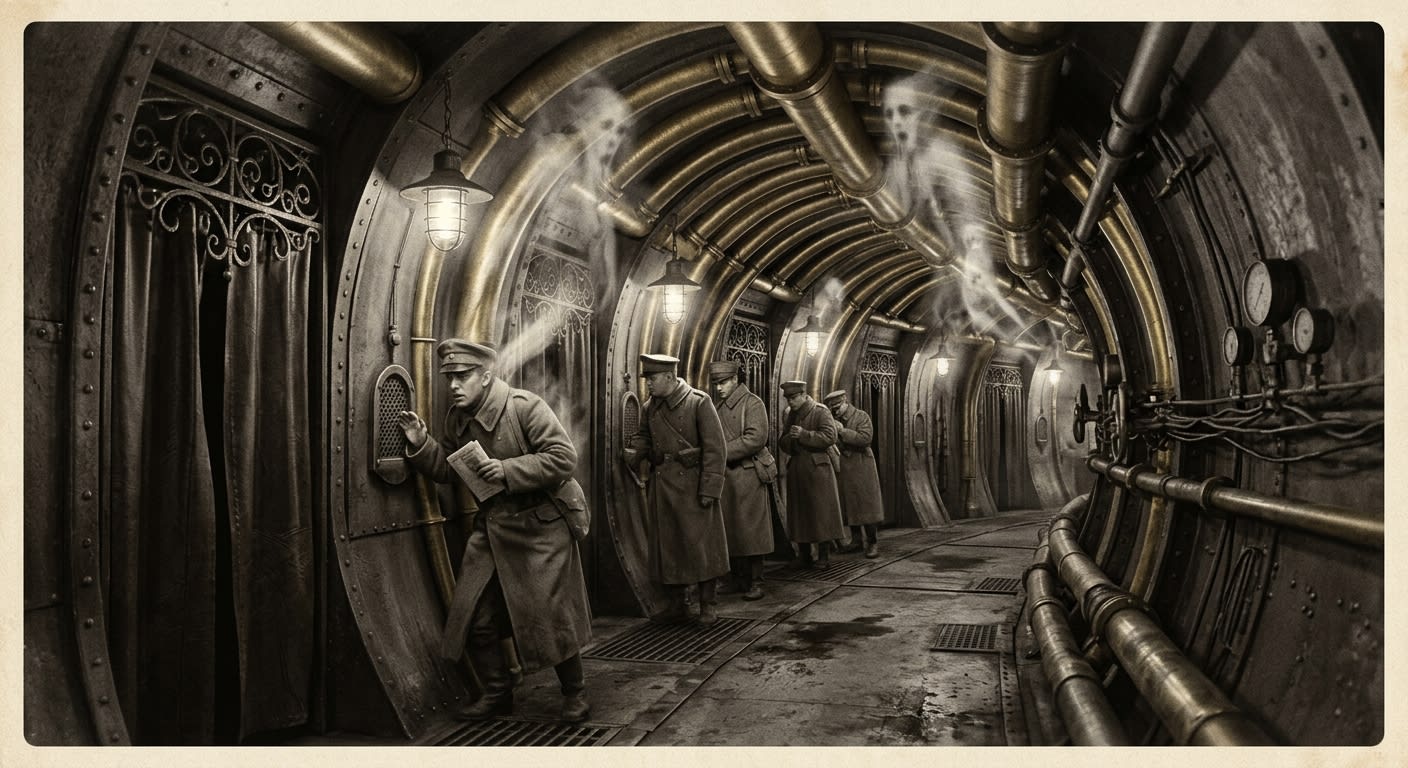
Six hours later, the same confession whispered from the brass shutter outside Rib Seven, audible to a bread vendor, three soldiers, and a Purity novice whose report uses the phrase “acoustic afterimage,” proving that terror can make even novices pompous. The voice was the corporal's. The cadence was his. The final sentence was not. The booth record reads: I took two loaves because I was hungry. The Echo said: I took two loaves because hunger knows my name.
By week's end, eleven confessions had returned. By month's end, thirty-seven. The candles in the lanes bent toward active booths. Stamp ink beaded on fresh receipts as if the paper sweated. The mist rising from the Bug beneath the ribs formed low faces along the pylon stones and dissolved when named by rank.
Judge Elsbeth Krail convened an emergency panel. Seal-Registrar Hett Ruis produced crossing records. Gun-Cantor Marshal Vonn ordered a curfew salvo that struck nothing except one laundry line and a mule. The Bureau of Doctrine's Northern Theater office advised continued processing under revised quiet protocols, because Brest is a bridge, and bridges that stop processing bodies become barricades, and barricades attract theology of the most inconvenient kind.
Initial Bridge Tribunal notices described the Echo as “harmless residual confession-noise.”
Corrected A.S. 199 after the fourth returned confession identified a living scribe by a childhood name absent from all Synod records. The approved phrase is now “low-grade doctrinal resonance with escalation markers.” Harmlessness, like mercy, has been withdrawn pending review.
#On Booth 77
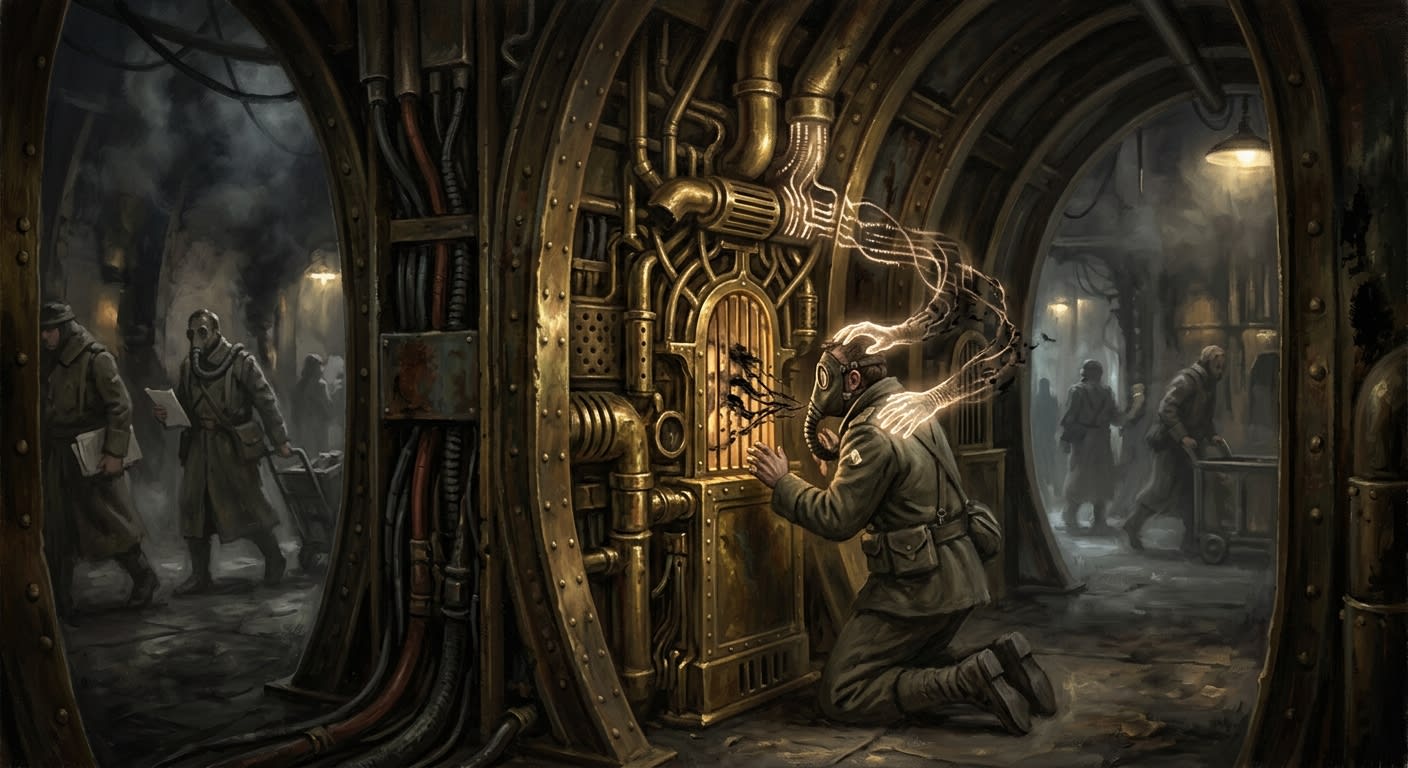
Booth 77 stands on the north side, third pylon from the west, planked, sealed, watched, and loathed. It differs from the other booths in one respect: it repeats confessions before they are spoken.
The first inversion occurred eleven days after the Echo began. The Night Clerk on duty, Harro Pell, heard a woman's voice through the closed grille at second bell. She confessed to concealing a child under a flour cart and using a forged widower's stamp to cross the west gate. Pell opened the shutter. No one stood outside. The lane was empty from pylon arch to pylon arch. He wrote the confession down because training is stronger than courage in men of his profession.
At dawn, a woman named Marta Senn arrived with a flour cart. Under the sacks lay a child. Her widower's stamp was forged. When confronted, she confessed in the same words Pell had already written. The tribunal arrested her, spared the child, and sealed the booth.
Booth 77 has continued to speak behind its planks. The guard detail rotates every nine days. Longer service produces nosebleeds, involuntary confession, and a tendency to answer questions before they are asked. Four transfer petitions from the original guard remain under review. The man still stands there. His name is omitted from duty rolls by request, which means Brest has created a nameless guard to watch a booth that condemns namelessness. The symmetry is vulgar, but effective.
The Bureau of Doctrine proposed immurement in consecrated concrete. The Bridge Tribunal refused, citing access requirements for evidence collection. The Bureau of Engineering proposed removal of the booth wall and replacement of the surrounding rib brace. The Brasswright Guild threatened strike action, explaining that Rib Three's north-side confession run shares stress with the pylon shutter assembly and that meddling would drop three casemates into the Bug. I believe them, which annoys me.
#On the Tribunal's Explanation
The Tribunal's official explanation is elegant enough to be false. It states that the Blank-Sheet Circle damaged Brest's spiritual filter by enabling nameless crossings. A bridge built to process souls by name, sin, receipt, and token has been forced to digest blankness. The Echoes are, in this formulation, rejected matter: confessions returning to claim the unclaimed, the system coughing up guilt after being fed absence.
There is power in the theory. The Circle has operated since at least A.S. 196. Tribunal statisticians confirm four to eleven unrecorded souls per day. Irena Vale's duplicated dies, safe-sin scripts, scribe confederates, and pylon press-cells have all been documented. Nineteen arrests by A.S. 201 have produced contradictory confessions, and contradictory confessions are still confessions, which is why tribunals like them.
The explanation fails at the hinge. The Circle predates the Echo by three years. Arrests do not weaken the voices. Booth 77 speaks forward. The Echoes intensified during the same month three inspectors from the Thracian Subterranean Survey (Unregistered) arrived at Brest after documenting routing behaviour in Maldrake's slag-rivers. A theory that cannot account for time, persistence, and coincidence is not a theory. It is a bench warrant.
Extract from Northern Theater memorandum, A.S. 200: “If nameless transit is attractive rather than causal, then the Circle may be ████████ rather than source. Recommend observation before suppression. If Echo shares vector with Tide, confessional infrastructure constitutes █████████████████.” Signature removed. Recipient list burned. One copy survived because the Bureau of Records misfiled it under fish tariffs.
I suspect the Nameless Tide has learned our instrument. The Tide presses from the east without stable form, and Brest answers by forcing every crosser into form: name, sin, receipt, token. The system is a grinder for ambiguity. Something on the eastern side has discovered the grinder and begun feeding it voices.
#On Clerk Contamination
The first victims are the clerks, because the Synod has always placed its least protected servants nearest the mechanism. The Confessor-Booth Clerk is trained to hear without listening, record without caring, stamp without trembling. Brest has improved this training by making indifference impossible.
A clerk exposed to repeated Echoes begins by hearing cadence after the lane closes. Then the returned voices intrude into ordinary speech. A bread seller asks for change and the clerk hears a confession. A child coughs and the clerk hears a sin category. After prolonged exposure, the clerk writes transcripts of conversations that have not occurred, and some of those transcripts later prove accurate enough to become evidence.
Scribe-Mother Hal denies systemic contamination among her lane staff. Her denial is beautifully phrased and contradicted by her staffing requests, which have tripled since A.S. 199. Night Clerks now work in pairs. Booth Supervisors carry red chalk, vinegar cloths, and throat charms. District Confession Registrars submit cadence variance tables with the solemnity of men measuring artillery drift.
The professional slang has adapted. A normal repeated confession is “warm ink.” A confession altered by the Echo is “wet wax.” A future confession from Booth 77 is “borrowed breath.” A clerk who begins answering in the penitent's voice is “dry-handed past recall” and is transferred to Records, which is either treatment or disposal depending on which corridor receives him.
Bureau of Rites Circular 14-F-Brest stated that Echo exposure produces no lasting occupational harm when clerks observe cadence protocol.
Revised after three Night Clerks independently transcribed the same confession in a voice belonging to a soldier dead fourteen years. Current guidance: “lasting harm is unconfirmed.” The clerks appreciate the delicacy. They appreciate it while bleeding from the nose into receipt stacks.
#On Countermeasures
Brest's countermeasures display the Synod's traditional brilliance: they are expensive, unpleasant, and partially useful.
First, the quiet protocols. Returned confessions are not to be answered. Witnesses must mark the hour, rib number, booth number where identifiable, candle behaviour, and any deviation from the original transcript. No one may repeat the Echo aloud unless ordered by magistrate, priest, or auditor. This rule is ignored hourly, because forbidding a garrison from repeating horror is like forbidding a boiler from producing steam.
Second, brine scrubbing. Every booth is washed at shift commencement and after active Echo events with seven per cent saline by weight, per Standing Order 14-F Revised (Unregistered). The brine stings the hands, warps the wood, corrodes hinge pins, and does nothing the clerks can prove. They scrub anyway. Ritual is what remains when efficacy refuses to file paperwork.
Third, safe-sin rotation. Soldiers assigned to night-crossing routes are issued minor confession scripts to prevent exhausted invention under pressure. This was meant to reduce irregularity. It has produced a new difficulty: Echoes now return formulaic sins in voices that sound bored. The theological implications of a bored anomaly have been submitted to Doctrine. Doctrine has not thanked us.
Fourth, Booth 77 remains sealed. The planks have been replaced twice. The nail heads rust within days. Candle flames in adjacent booths lean toward it even when no wind enters the lane. The guard has learned to hum under his breath, tunelessly, because melody attracts attention.
#On the Present Condition
As of A.S. 201, the Confession Echo persists. Its range has expanded from the lanes to the Ribwalk, the Sluice Yards, and the under-deck moorings. Echoes now emerge from brass shutters, wet rope, empty token bowls, and, in one case, the mouth of a dead mule hauled from the Bug by dredge crews who have since requested reassignment to any post without livestock.
Judge Krail continues arrests. The Blank-Sheet Circle continues blankness. Hett Ruis smiles over crossing records that no longer balance. Marshal Vonn keeps his casemates loaded. The clerks stamp, scrub, bleed, and return to their booths at dawn because the bridge cannot close and the war cannot wait while the Synod determines whether its own sacrament has become a speaking wound.
The worst development is linguistic. The earliest Echoes repeated sins. The current Echoes amend them. A man confesses theft; the Echo returns betrayal. A woman confesses cowardice; the Echo names mercy. A soldier confesses lust; the Echo says hunger. The category changes, and with each change the Bureau's taxonomy loses one tooth.
Brest holds. The Bug runs under the brass ribs. The booths open. The tokens pass through apertures. Voices enter the grilles and come back wearing their owners like borrowed coats. Somewhere east of the wire, the Nameless Tide presses without a name. Somewhere inside the bridge, Booth 77 waits to hear tomorrow's sin.