
#On the Booth That Heard First
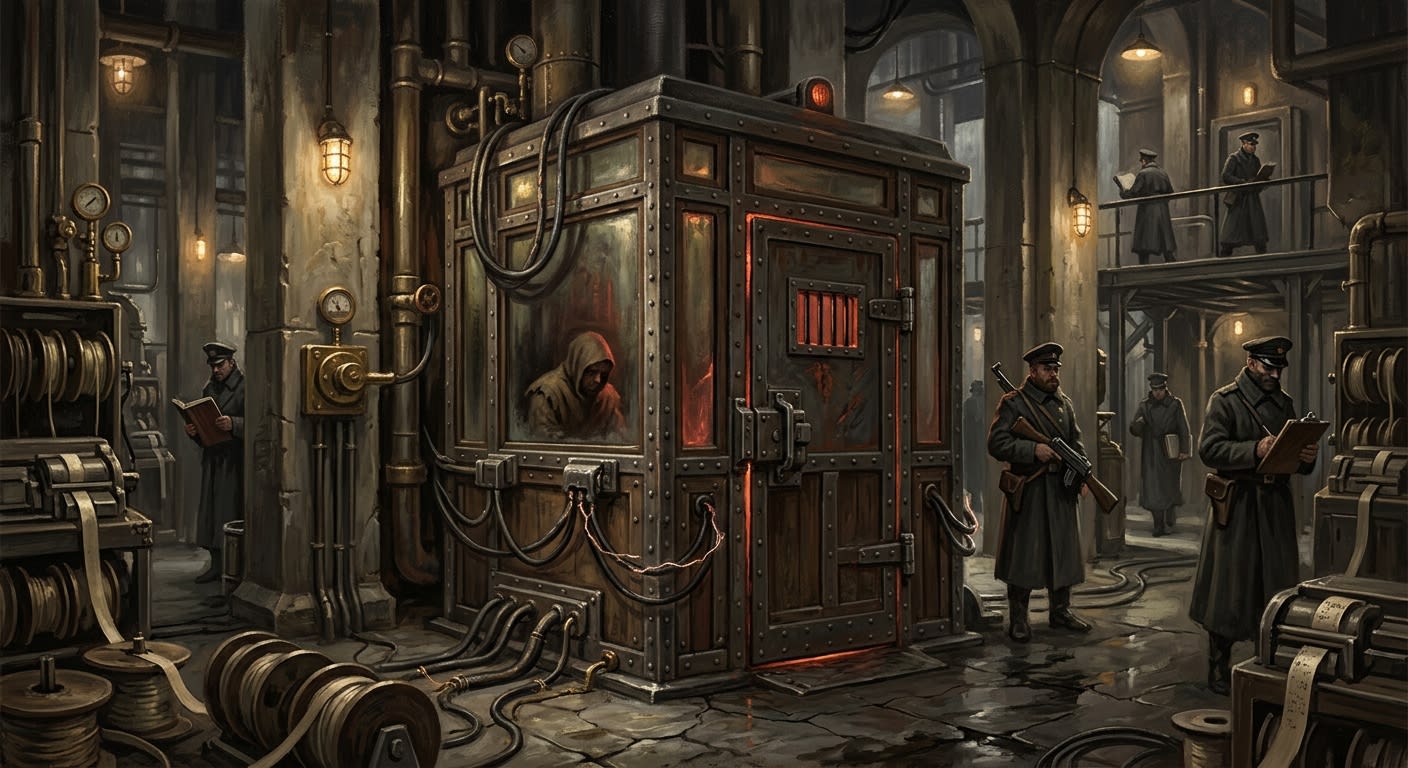
Booth 77 stands in the north Confessional Lane of Bastion-Brest, third pylon from the west, where the brass rib sweats river-cold through its bolts and the candle flames lean as though receiving instructions from a draught that has never filed travel papers. It is a wooden confession booth with a grille, a receipt slot, an absolution aperture, a scribe shelf, two planked sides, one forbidden door, and the distinction of having made time itself appear before the Bridge Tribunal as an unlicensed witness.
The booth is sealed. This is accurate in the same way saying a wolf is leashed is accurate while the leash is fraying, the handler is praying, and the wolf is taking notes.
Booth 77's offence is simple to state and difficult to survive: it repeats confessions before they are spoken. Other booths affected by the Confession Echo return sins after the penitent has entered, whispered, sweated, lied, corrected himself, received a token, and fled into the Ribwalk's holy stenches. Booth 77 offends chronology. It hears the sin before the mouth arrives. It writes the guilt before the hand touches the grille. It grants the Presiding Judge a transcript and then waits, with wooden patience, for the soul that will make the transcript lawful by committing the courtesy of appearing.
The official designation is Confessional Unit North-77, Third Pylon Cluster, Lane Apparatus / Sealed. No one uses it. The clerks say Seventy-Seven, lowering their voices on the second syllable as if the number has teeth. The gunners say Krail's pet. The Blank-Sheet rumour stalls call it Tomorrow's Mouth. Scribe-Mother Hal forbids all three names in staffing lists and uses north sealed booth, which proves that motherhood and cowardice can occupy one administrative hand without crowding.
#On the First Inversion
The first inversion occurred eleven days after the A.S. 199 Echoes began. The earlier Echoes had been shameful but obedient: a corporal's bread theft returning from Rib Seven, a widow's market fraud whispering from a wet rope, a clerk's childhood name slipping out of brass where no childhood name had been entered. Such events alarmed the Tribunal, as well they might. They did not yet disgrace sequence.
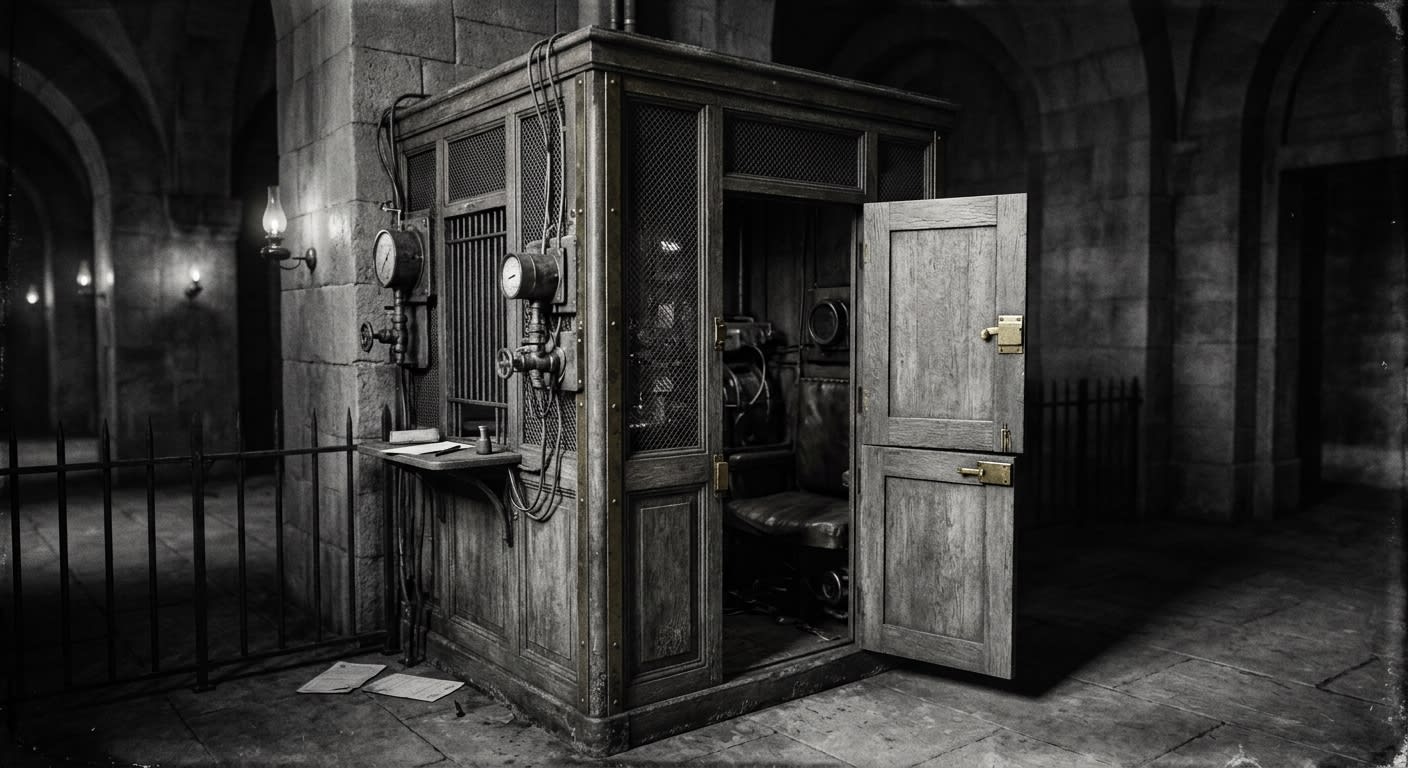
At second bell, Night Clerk Harro Pell sat in Booth 77 with a candle, a receipt stack, a stamped token tray, and the expression of a man performing routine work in a place whose routine had become treasonous. Pell was young enough to believe protocol would save him and trained enough to follow it after belief had abandoned the room. He heard a woman's voice through the grille. No footstep preceded it. No lane board creaked. No queue marker shifted. The voice confessed to concealing a child beneath a flour cart and using a forged widower's stamp to cross the west gate.
Pell opened the shutter. The lane was empty.
He should have called the Watch. He wrote the confession instead. This was not bravery. It was training, which is cheaper, commoner, and more reliable under bad conditions. He logged the voice, marked the booth number, noted the absence of visible penitent, and placed the page in the black variance folder because the red folder was for sins already attached to bodies. Bureaucracy owes much to terrified young men who choose the correct folder while their marrow tries to climb out through their teeth.
At dawn, Marta Senn arrived with a flour cart. Under the sacks lay a child. Her widower's stamp was forged. When halted, she confessed in Pell's exact words, though she had never entered the booth before and knew nothing of the black folder waiting under Tribunal seal. Pell fainted after the comparison. The child was spared, reassigned, and later vanished from the holding ward under a release-to-kin notation that names no kin. Marta Senn entered the sealed docket. Her final disposition is hidden under KRAIL-77/PRIVATE, which means Krail knows, Doctrine suspects, and I am expected to be satisfied with a black bar. I am not a man built for satisfaction by subtraction.
Initial lane notices described the Pell-Senn event as “anticipatory clerical misentry pending causal clarification.”
Corrected after transcript comparison. The booth spoke first. The woman arrived second. The clerk's terror, for once, was administratively accurate.
#On Its Construction and Offended Wood
Booth 77 was ordinary before it was famous, a fact that scandalises the romantic and reassures no one useful. It was installed during the A.S. 112 booth reallocation after the Booth Proliferation Decree standardised confession intake ratios across forward crossings. Its timbers came from a Warsaw yard, its hinge pins from a Brasswright subcontractor, its grille from a batch later recalled for rust, and its receipt drawer from the same carpentry run that supplied Booths 73 through 81. No saint was buried in it. No condemned man was nailed inside it. No relic was secretly planed into the shelf, though the Bureau of Relics tested the shelf twice and left with the air of men deprived of a prettier disaster.
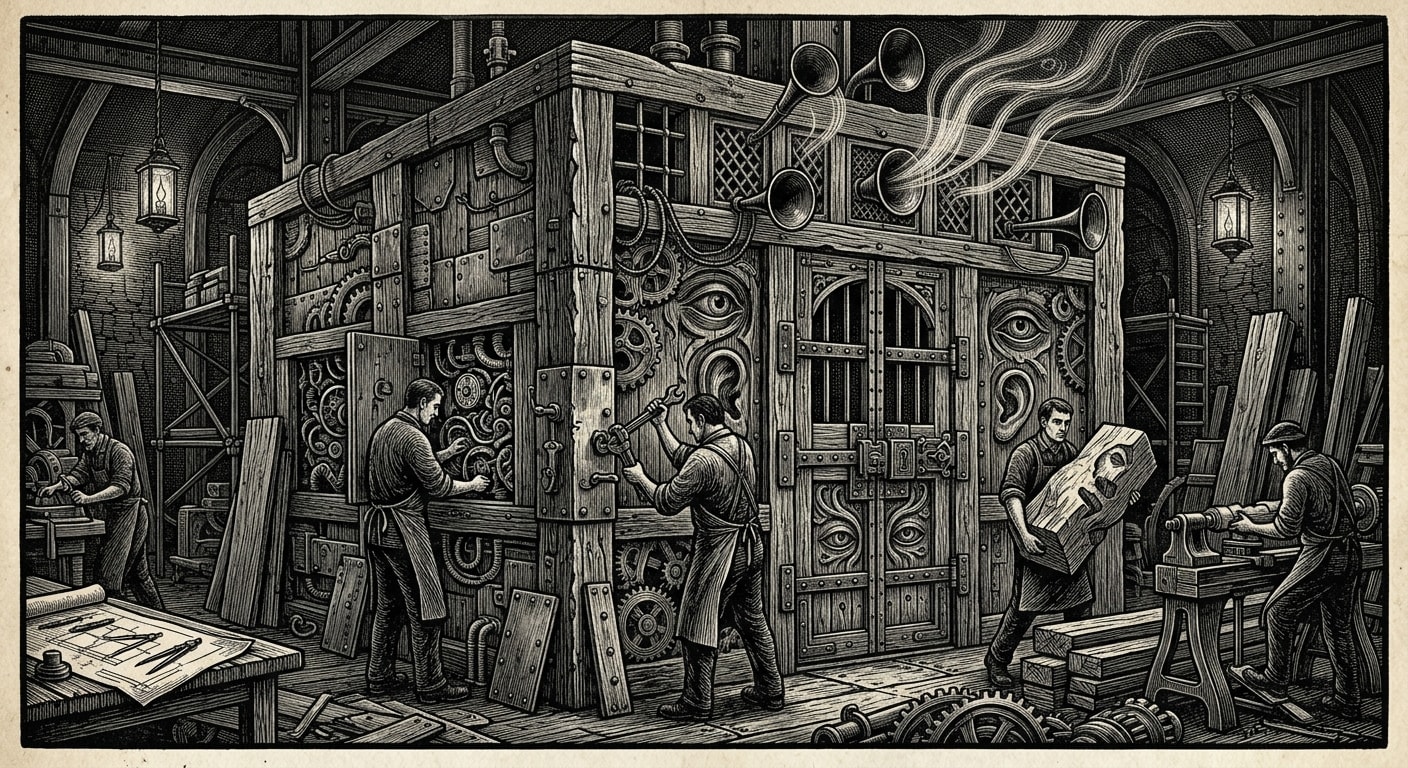
Ordinariness is the true horror. A cursed object may be blamed and burned. A blessed object may be petitioned and guarded. An ordinary object that begins hearing tomorrow indicts the system that made it ordinary.
The booth is narrow enough to make sin perspire. The penitent side measures barely four feet by three, with a kneeling board polished by knees, boots, children, sacks, and at least one goat during the Goat Misrouting of A.S. 184, a case I commend to any reader who doubts Brest's appetite for procedural humiliation. The scribe side contains a shelf cut with ink grooves, a candle bracket, a token aperture, a narrow slot for receipt duplicates, and a speaking grille through which voice becomes record. The wood holds brine. The wood holds smoke. The wood also holds sound after every inspection says it should not.
Scribe-Mother Hal ordered brine scrubbing after the first Echoes. Booth 77's boards drank the brine and dried grey. Vinegar cloths left no mark. Salt crust gathered around nail heads within hours. Replacement planks warp toward the grille. New wax seals craze overnight in hairline cracks shaped like sentence marks. The Brasswright Guild insists the pylon brace is sound. The Bureau of Engineering concurs in language so cautious it should be fitted with a muzzle.
The Engineering inspection called the structural brace serviceable, the booth frame locally distorted, the collapse risk low, the acoustic retention unmodelled, and the removal hazard severe enough to implicate Rib Three stress distribution, the pylon shutter assembly, and adjacent casemate recoil tolerance. Its final recommendation was written with rare institutional candour: do not tamper unless prepared to explain falling artillery to War.
Marshal Vonn read the Engineering note and recommended destroying the booth anyway. His proposed method was soldierly, obscene, and nearly poetic: dismantle the booth, burn the wood, melt the grille, pack the ash into an unblessed shell, and fire it east toward the Nameless Tide. Krail refused. Hal objected to the dismantling and then objected to her own objection, since she despises the booth almost as much as she despises losing clerks to it. Hett Ruis abstained in writing and obstructed in practice, which is how registrars pray.
#On the Guard Who Became Evidence
A sealed booth requires a guard. This sentence reads simple until one remembers that the guard must stand beside a box that knows things before they occur and prefers using familiar voices when making its point.
The original guard detail was drawn from the Ribwalk Watch: men accustomed to drunk penitents, forged tokens, queue fights, mule panic, under-deck knives, and the peculiar civic music of Brest after curfew. Their assignment was nine days. By the fourth, two had nosebleeds. By the sixth, one answered a question before Krail asked it. By the ninth, the senior watchman requested transfer in a handwriting so cramped that the scribe thought it was a confession.
Four transfer requests remain under review. The phrasing is cruel by habit rather than intention. Under review means the requests have been read, copied, sealed, cross-indexed, discussed, attached to the Booth 77 variance packet, and denied without the discourtesy of a denial. The principal guard remains unnamed in public rolls by his own petition. This petition was granted. The result is a nameless guard posted before the booth that condemns namelessness, a little joke from Providence written in wet ink.
EXTRACT FROM BRIDGE TRIBUNAL SEALED ANNEX KRAIL-77/PRIVATE Question: What did the booth say? Guard: My name, Your Honour. Question: Your duty name is in the lane rolls. Guard: It used the one I had before my father bought papers. [three lines removed under Tribunal seal] Krail note: Do not rotate him west. He is evidence.
That last sentence circulates in Brest as proof of Krail's cruelty. It is cruelty. It is also the sentence of a magistrate who understands that horror becomes useless if comfort is permitted to tidy it away. The guard is fed, watched, paid, rotated no farther than the outer chair, and forbidden to confess within hearing of the booth. Hal sends him broth. Vonn sends soldiers past him more often than routing requires. Ruis sent a clean blanket, which everyone distrusts.
The guard has developed small rules. He does not stand with his back to the planks. He does not answer if called from inside. He keeps a strip of salt under his tongue during third watch. He writes the hour on his palm because clocks near the booth have displayed discourteous improvisation. He hums without melody, a flat little noise that refuses to become hymn. Melody attracts attention. Attention, in the North Lane, is a tax paid in blood vessels.
#On Krail, Hal, Vonn, and the Ownership of Danger
Booth 77 belongs to everyone who cannot agree how to hate it.
Krail owns it as evidence. She sees in it a witness, a variance site, a contradiction that may yet be compelled into legal shape by pressure, repetition, seal discipline, and the cold patience of a woman who has mistaken several forms of damnation for procedural opportunity. Her order is preserve, monitor, deny unnecessary transfers. It is the proper order if Booth 77 is a witness. It is monstrous if Booth 77 is a wound. Krail has never permitted the distinction to soften her pen.
Hal owns it as damage. The booth sits inside her lanes, near her clerks, sweating into her schedules and making her staffing requests sound hysterical to offices whose hands have never touched a receipt dampened by returned sin. She has moved three North Lane clerks to daylight, doubled brine scrubbing around the package corridor, and banned all humming near the sealed door. Her private rule says no clerk says Moth in the North Lane. Her public rule says cadence discipline remains sufficient. The difference between the two rules is the place where administrators keep the living.
Vonn owns it as target denied. He distrusts prophecy because prophecy has no range and cannot be sighted properly. Every future-tense confession is, to his gunner's mind, hostile reconnaissance without a body. He has forbidden casemate crews from confessing in lanes adjacent to loaded galleries, in violation of equal access sacramental policy and several lesser musical regulations whose authors deserve assignment to the Sluice Yards. Misfires fell by half. Vonn considers this argument complete.
Ruis owns none of it and may profit most. Every sealed site creates detours. Every detour creates papers. Every paper enters a stamp room. The Blank-Sheet Circle has taught Brest that absence can travel if paper looks obedient enough. Booth 77 has taught the Tribunal that guilt can travel before paper. Ruis smiles at both lessons. I would prefer he did not.
A Bureau of Rites advisory described Booth 77 as “contained under ordinary sealed-site practice.”
Amended after adjacent Booth 76 issued an absolution token stamped with the following day's date. Containment remains aspirational. Ordinary practice has been dismissed for incompetence.
#On the Confessions It Has Given Back
The Tribunal admits three public categories of Booth 77 utterance: anticipated confession, orphaned confession, and identity variance. There are more. Of course there are more. A public category is the apron bureaucracy wears over a bloodstain.
Anticipated confession is the Pell-Senn pattern: the booth speaks, a matching penitent later appears, the transcript catches its prey. These cases are easiest for Krail. They offer time a leash. The court can compare wording, mark sequence, issue arrests, and pretend the future has entered evidence like any other reluctant witness.
Orphaned confession is uglier. The booth speaks and no one arrives. Some of these utterances are trivial: stolen heel-loaves, forged ration chits, a curse against an officer, lust under a stair, adulterated ink, a confession of sleeping during sermon. Others have weight: “I traded my brother's name at the West Gate.” “I carried blank paper under my skin.” “The child in the flour cart was already dead.” Days pass. No matching penitent comes. Krail files them black. Hal tells her clerks not to listen for footsteps that do not come. The guard writes the hour on his palm.
Identity variance is the category that made Purity request stronger chains on the sealed packet. Booth 77 has spoken names absent from current ledgers, childhood names replaced by purchased papers, dead names, erased names, and once the name of a woman recorded as having crossed through Booth 31 two hours earlier under a different sin and a different face. The Tribunal called this duplicate voice variance. Hal called for extra staff. Vonn loaded canister at Rib Seven. All three responses were correct in their own ugly chapels.
The hidden category is correction. The booth sometimes improves the confession before the penitent arrives. A smuggler later admits to carrying lamp oil; Booth 77 had said powder. A woman later admits to hiding a child; Booth 77 had said two. A clerk later admits to taking a package; Booth 77 had named the sender as Moth. These are not echoes. They are edits. The Bureau of Doctrine finds this unpleasant because correction is our office, and rival editors must be strangled before they develop style.
#On Pilgrims, Rumours, and the Commerce of Tomorrow
No sealed thing in Brest remains merely sealed. It becomes a market, a warning, a dare, a superstition with queue discipline. Booth 77 has produced its own commerce along the North Lane approaches: little chalk marks beside pylon seams, vinegar charms sold as anti-tomorrow cloth, counterfeit transcript scraps, whispered lists of names the booth has supposedly spoken, and prayer cards showing a door with no handle beneath the motto Do Not Answer. The Bridge Tribunal confiscates such items when convenient. The under-deck sellers print new ones before the confiscation cart reaches the West Gatehouse.
The most common forgery is the future pardon. A broker claims access to Booth 77's next utterance, writes the buyer's name on black paper, and promises that if the booth has not yet condemned him, the buyer may proceed with courage. This is idiocy. It sells beautifully. Men prefer fraudulent reassurance to honest uncertainty, especially when the honest uncertainty speaks through wood at night.
Pilgrims have begun making side-devotions to the sealed booth. This is forbidden, embarrassing, and predictable. A mother whose son vanished into the Confessional Lanes touches the pylon wall nearest Booth 77 and asks whether the booth heard his last sin. A soldier leaving for the eastern wire presses two fingers to the planks and asks that his cowardice be spoken early, so he may meet it before battle. A thief asks whether he is already known. A clerk asks nothing and leaves ink.
Hal has banned devotional contact. Krail has banned unauthorised approach. Vonn has banned lingering within the artillery-adjacent lane during active gun readiness. Three bans produce one pathway between them, because Brest citizens are among Europe's finest interpreters of institutional gaps. They kneel where the Watch can pretend they are tying bootlaces. They cross themselves while adjusting throat cloths. They murmur requests into their sleeves and later swear they were coughing. Faith, like contraband, learns posture.
The Circle uses the rumours. Of course it does. A Blank-Sheet runner will tell a frightened crosser that Booth 77 has already spoken his true name, that the Tribunal black folder is waiting, that ordinary confession will deliver him into Krail's hands, that only a blank passage can save him from tomorrow. This is recruitment made from prophecy's table scraps. It has worked often enough for Hal to forbid her clerks from repeating booth gossip outside shift rooms and for Krail to seal three rumour sheets as active instruments of nameless transit conspiracy.
The booth also changes how people confess in adjacent lanes. Some rush, spilling sins as though speed might outrun anticipation. Others withhold, terrified that the booth has already heard the worse truth and will correct them if they lie too modestly. The worst are those who confess crimes they have not committed because they fear the booth may have spoken something and wish to meet the accusation halfway. Krail calls these pre-emptive confessions. Hal calls them frightened nonsense. Doctrine calls them inadmissible unless later corroborated. Purity calls them interesting.
One man confessed to future murder after hearing a rumour that Booth 77 had named him. He was detained, examined, and found innocent of murder, though guilty of three tariff evasions, one adulterated token, and possession of an unlicensed saint card. Six weeks later, the man he claimed he would murder died under a cart axle in the Sluice Yards. Krail refused to connect the cases. Vonn asked whether the cart axle had been inspected. Hal asked who had sold the rumour. Ruis produced a clean custody chain for the deceased man's passage papers within suspiciously short order.
A Tribunal public notice states that Booth 77 rumours have no evidentiary standing and negligible operational effect. Anyone who has stood in a queue knows better. A rumour with no evidentiary standing can move bodies, alter confessions, empty purses, recruit accomplices, delay artillery crews, and turn a woman away from the lane where she might have survived.
#On Doctrine's Cowardice and Krail's Preservation
Doctrine wants Booth 77 preserved until interpretation becomes safe. This is cowardice wearing the vestments of prudence, and I say this as a man who owns several excellent vestments and has committed prudence with them. The Bureau fears destroying evidence. It fears preserving a contagion. It fears admitting that a sacramental mechanism has become host to something neither demonology nor canon law can comfortably subpoena. It fears Krail's competence because competence in a local court makes central authority look ornamental. It fears Vonn's proposal because artillery solutions make theologians appear slow. It fears Hal's reports because they smell of staff casualties, and staff casualties are harder to aestheticise than martyrdom.
A Doctrine Northern Theater note on Booth 77 phrases the matter with admirable cowardice: if future-tense confession derives from Tide pressure through sacramental intake, then standard confession architecture may constitute a hazard the note blacks out across all bridge-bastions; if isolated to Brest, preserve; if transmissible, deny locality until countermeasure exists. The distribution list includes Doctrine, the Bridge Tribunal, one recipient removed in black, and a Bureau of Silence copy marked withheld.
There is the unspoken terror. If Booth 77 is merely a local wound, Krail may watch it, Hal may staff around it, Vonn may glower at it, and the Bureau may write handsome memoranda until the planks rot. If it is a demonstration, every booth on every military road becomes suspect. Every confession aperture becomes an ear that might belong to the wrong listener. Every absolution token becomes a receipt issued by a system whose other party has not been identified. The Synod can survive many things. It dislikes discovering that one of its instruments has been taken up from the far end.
Krail preserves the booth for a different reason. She believes it can be caught in contradiction. A thing that speaks before the event may misstate the event. A thing that corrects confession may reveal the law under which it corrects. A thing that knows names may display ignorance if given enough false names, purchased names, dead names, doubled names, and blank names. Krail has begun experiments. They are lawful in the manner of needles, and about as comforting.
Hal hates the experiments because they require clerks. Vonn hates them because they require patience. Ruis likes them because they require papers. The guard endures them because no one asked whether endurance had remained voluntary.
The question “Is the booth learning?” has been ruled speculative. Excellent. We may all sleep soundly beside the speculative box that speaks tomorrow's crimes.
#On the Present Planks
As of A.S. 201, Booth 77 remains barred, sealed, watched, hated, needed, and more influential than several licensed magistrates. The planks over its door have been replaced twice. The first set cracked around the nail heads. The second began showing damp handprints on the inner side. The current planks are ash, brined, stamped, and marked with the Triune Knot in black pitch. They creak during second bell. They remain closed.
The lane has adapted around it. Queues bend away from the sealed space and then bend back because traffic must move. Children are told not to count booths aloud. Clerks keep extra ink in their sleeves. Guards avoid saying tomorrow. Penitents glance at the planks with the stupid hope that horror, once seen, has spent itself. It has not. Horror is a clerk. It keeps copies.
Krail's latest order preserves the site. Hal's latest schedule shields the staff. Vonn's latest objection recommends destruction. Ruis has filed no opinion and three related custody notices. The Nameless Tide presses the eastern wire. The Echo speaks from shutters, rope, brass, wet deck plates, and the mouth of a dead mule when the Tribunal is foolish enough to haul one within range. The Circle moves blankness through the gaps. Booth 77 waits inside the system built to defeat blankness and speaks before sin arrives to make itself legible.
At night the guard sits with salt under his tongue. The candle bends toward the boards. Somewhere in the planked dark, a receipt drawer slides open by one finger's width and closes again. No penitent stands in the lane. No clerk holds a pen. The booth clears its throat in a woman's voice, then a child's, then a voice the guard will not write because it is his own and the words are dated tomorrow.