
#On the Court Built Inside a Crossing
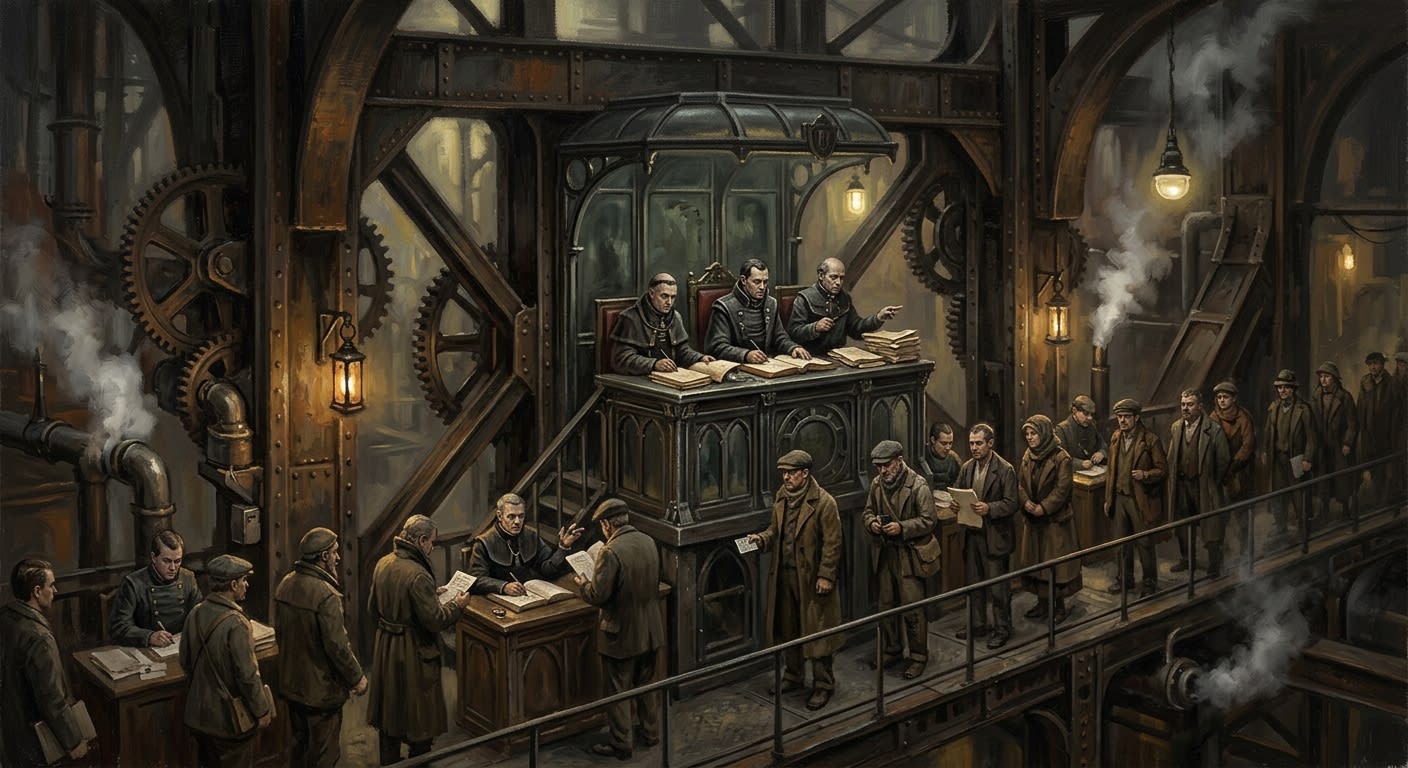
The Bridge Tribunal of Bastion-Brest is what happens when a bridge acquires a conscience and the conscience hires clerks. It began as an emergency bench after the first pylon catastrophes, when flood, panic, convoy crush, and name-disputes threatened to turn the Brass Ribs from chokepoint into slaughterhouse. It now sits mid-span in the Absolution Hall, where every footstep shakes with artillery above, every candle leans toward a booth that should have stayed silent, and every defendant learns that movement across eight hundred metres of iron can become a theological trial.
This is the Tribunal's founding proposition: every crossing is physical, juridical, and spiritual. A body that crosses carries a name. A name carries sins. Sins require receipt. Receipts require custody. Custody requires a court. The bridge becomes a courtroom with traffic.
Its seal shows a bridge, a key, a tongue, and a blank square. The bridge is jurisdiction. The key is permission. The tongue is confession. The blank square is the subject under review, though Krail has argued, in a sentence I resent for its excellence, that “the absence is jurisdiction.” She was correct. I have not forgiven her.
#On Its Machinery
The Tribunal hears crossing disputes at dawn, identity corrections before noon, confession irregularities through vespers, and sealed matters after curfew, when the Ribwalk empties and the casemate crews begin listening to the deck as if the brass itself were a witness. Its chamber is limestone faced in blackened metal. The bench is deliberately high. The petitioner's rail is deliberately low. Architecture is law with better manners.
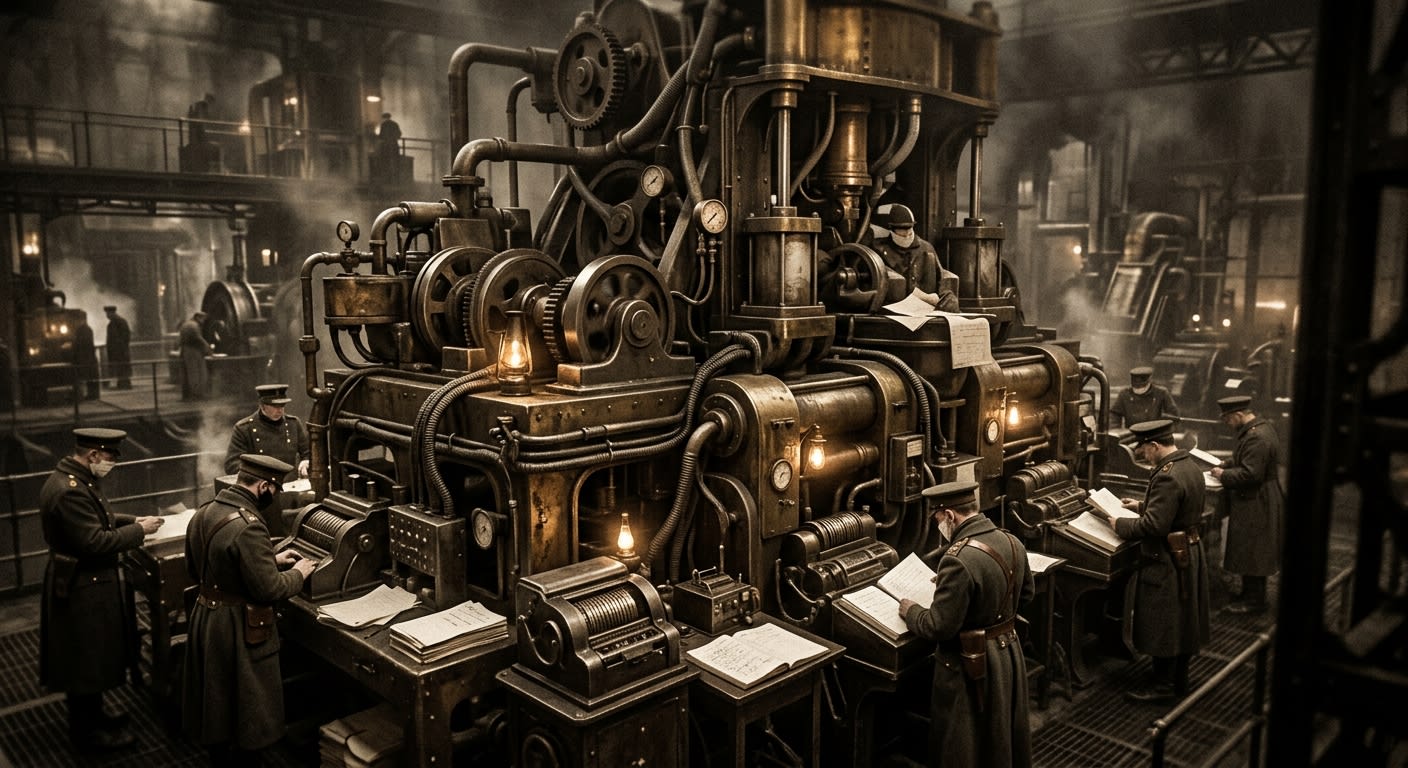
Behind the hearing chamber lie the transcript vaults. Every confession made in Brest's two hundred and fourteen booths is copied twice: once for the crossing file, once for the archive beneath the Absolution Hall. The vault clerks sort by booth, sin, declared name, token number, and variance. A variance is anything that makes a record misbehave. A widow using a husband's travel sin. A courier whose absolution token predates his confession by one hour. A child listed under two mothers. A soldier whose name has been crossed out in one ledger and underlined in another. The Tribunal calls these manifest irregularities. The people involved call them hunger, panic, or Monday.
The Tribunal can halt a convoy, seize papers, requisition rooms in the Pylon Warrens, interrogate Confession Scribes, revoke crossing files, seal booths, co-sign Purity actions, and compel Hett Ruis to produce stamp-room custody chains when the stars align and his excuses fatigue before the judge does. It cannot command Vonn's artillery, though it may object after the firing. It cannot repair Booth 77. It cannot make the Confession Echo shut its filthy little mouth.
A Strasbourg briefing once described the Bridge Tribunal as a municipal customs court.
Corrected. A customs court taxes cargo. The Bridge Tribunal decides whether a soul has crossed in the correct condition to remain a soul recognised by paper. The briefing clerk has been moved to grain weights, where his gifts can harm fewer metaphysics.
#On Standing Order 14-B
Standing Order 14-B is the Tribunal's sharpest instrument and the reason Strasbourg tolerates Brest's local insolence. Issued after the first confirmed Blank-Sheet Circle operations in A.S. 196, it grants immediate authority to seize papers, halt crossings, requisition Pylon rooms, interrogate scribe staff, and co-seal field actions with Purity without waiting for the capital to finish its sacred work of arranging adjectives around terror.
The order was born from blank paper. That humiliation must be savoured. The Synod built a bridge where crossing required name, sin, receipt, token, file, stamp, and supervised passage. The Circle answered with sheets carrying nothing. No name. No sin. No receipt. No identity trace. The Tribunal responded with a standing order thick enough to stun a mule. The Circle kept moving.
The phrase span-sovereign instrument has caused unnecessary irritation among offices that should have better uses for blood pressure. It means the Tribunal's seal cannot be casually broken by external clerks, even those clerks adorned with Doctrine's most tasteful authority. I attempted once. Krail informed me ugliness was not appellate grounds. I record this because History must learn even from my rare defeats, as peasants learn from eclipses.
#On Judge Krail's Use of It
Presiding Judge Elsbeth Krail did not invent the Tribunal. She made it colder. Under her hand the docket has acquired the chill elegance of a dissecting table. She arranges evidence by contradiction rather than date. She hears a confession, its echo, its duplicate, its denial, and the witness who swears he heard it before it occurred, then asks which absence all four statements are standing around.
This gift has made her useful. It has also made her nearly intolerable.
The nineteen arrests of A.S. 201 display her method. Nineteen prisoners entered the record under charges of proscribed documentation, nameless transit conspiracy, safe-sin routing, and allied offences. One named four conspirators. One named forty. Eleven mentioned Moth: six male, three female, two paper. Purity wanted a culprit shaped like a throat. Krail wanted the shape of the contradictions. The Tribunal's inner packet remains sealed, which means it is either empty, damning, or better written than my office prefers to admit.
BRIDGE TRIBUNAL INNER PACKET — 14-B / MOTH Witness Eight: “Moth was folded into the sheet before the stamp.” Witness Eleven: “Moth is what the blank remembers after writing is removed.” Review note: paper specimens retained against Purity burn request Distribution: Krail bench; Doctrine Northern Theater; █████████████
Krail's court broadcasts confessions from public trials into the Ribwalk as demonstration. This is a venerable practice: show guilt, display correction, let the crowd feel justice pass through its ears before returning to ration queues. In the Circle matter the practice has become stupid. The broadcast words — nameless, unwritten, free crossing, paper is the chain — move through the crowd like small contraband. The Tribunal has been conducting the enemy's catechism with excellent acoustics.
An A.S. 200 Tribunal circular described public Blank-Sheet confessions as “deterrent theatre.”
Clarified by Doctrine review. Theatre requires an audience. An audience repeats lines. The Tribunal has been instructed to distinguish deterrence from rehearsal.
#On the Confession Echo
The Confession Echo began in A.S. 199, three years after the Circle's first confirmed operations and two years before the current arrests. Sins spoken into the booths return from shutters, pylons, brass vents, wet deck plates, and once from a dead mule, a report sealed with such haste one hears the lid slam. Booth 77 is worse. Booth 77 repeats confessions not yet spoken.
The Tribunal theory is tidy enough to arouse suspicion. Nameless crossings damage the spiritual filter. The confession system, wounded by unrecorded souls, returns denied sins to the deck in search of owners. The Bureau of Doctrine Northern Theater office endorses this theory because it possesses symmetry, moral bite, and the appearance of administrative usefulness. Krail endorses it because it produces warrants. Vonn distrusts it because a clean explanation at Brest is usually a forged document wearing polished shoes.
The Tribunal sealed Booth 77 on grounds of temporal irregularity. Doctrine proposed consecrated concrete. Engineering warned that removal of the surrounding wall might disturb the rib brace. The Brasswright Guild threatened strike action. Krail nailed planks over the door and posted a guard. The guard has requested transfer four times. The requests remain under review, which is Bureau language for we have noticed your fear and filed it beneath furniture.
The Echo wounds clerks first. Scribe-Mother Hal knows this in her bones, which are more reliable than three circulars from Rites. Her memoranda defending her scribes sit in Krail's file: A.S. 199, A.S. 200, A.S. 201. The third is now dangerous because Shadows observed two North Lane scribes accepting packages from receiptless entrants. Hal was not told. The Tribunal's reason was operational prudence. Cowardice has many vestments; that one wears a hood.
#On Its Enemies Inside the Bridge
The Tribunal's rivals are not enemies of the Synod. That would be simpler, and Brest hates simplicity as a matter of civic pride. Vonn owns the guns. Ruis owns the stamps. Hal owns the intake cadence by which frightened voices become receipts. Krail owns the argument that makes all three lawful. Together they form a jurisdictional triad with the grace of a knife drawer during an earthquake.
Vonn hears the deck where Krail reads testimony. He knows when a crowd is about to become a stampede, when fear has tightened a gun crew half a note flat, when the mist under Rib Seven (Unregistered) gathers in bad eddies. Krail can halt a relief column over a smudged token. Vonn can answer legal ambiguity with canister. Their quarrel is productive because neither can win. Brest survives by preventing its rulers from achieving efficiency.
Ruis is worse. A corrupt registrar believes in the stamp as private weather. He smiles over custody chains, wax temperature, die cradles, and delays that arrive with clean hands. The Tribunal may overrule a stamp after hearing; the stamp decides whether the subject reaches the hearing. Krail knows this. Ruis knows Krail knows. The bridge creaks under the courtesy.
Hal contests Krail from below, where the Lanes sweat and the booths speak back. Their opposition is lock and key: each proves the other necessary while resenting the fit. Krail protects the record. Hal protects the mechanism producing it. The Echo has chosen the mechanism. The Circle has chosen the gaps. Ruis, appallingly, has chosen to remain useful.
#On the Tribunal Seal
A Tribunal seal at Brest behaves less like wax upon paper than like a local weather condition. Once set, it alters what may be touched, named, copied, denied, burned, or admitted to exist. Tribunal seals have blocked Doctrine access, Purity burns, Records corrections, and one Bureau of Engineering work order whose delay nearly dropped a pylon stair into the Bug (Unregistered). The Tribunal apologised after the stair fell. The apology was sealed.
The seal's authority derives from necessity, that most dangerous of sacraments. Strasbourg cannot process Brest in time. The bridge cannot wait while the capital debates whether terror should be filed under anomaly, heresy, or operational misfortune. Krail seals first and justifies later. This is formally improper, practically unavoidable, and spiritually nourishing to exactly the wrong kind of magistrate.
I have filed objections. They are handsome objections, composed in a style that would make lesser clerks weep and better clerks steal phrasing. The Tribunal received them, acknowledged them, summarised them, and returned a response so procedurally immaculate that complaint would require admitting the response was insufficient, which would require access to the sealed matter, which was the point at issue. Krail's trap is elegant. I hate it in the way a theologian hates a heresy with good grammar.
#On the Present Standing
As of A.S. 201, the Bridge Tribunal remains active, span-sovereign, and irritatingly necessary. It has arrested nineteen members or instruments of the Blank-Sheet Circle and has not arrested the Circle. It has sealed Booth 77 and has not silenced tomorrow. It has received Hal's memoranda, Ruis's custody chains, Vonn's objections, Shadows' partial notes, and enough contradiction to pave the Ribwalk in black ink.
The Tribunal's virtue is exactness. Its vice is the belief that exactness can become salvation if stamped hard enough. This belief is false, but useful, and the Synod has built larger institutions on worse material.
The Absolution Hall opens at dawn. The bench rises above the petitioner rail. The seal hangs behind it: bridge, key, tongue, blank square. Outside, the Bug moves under the pylons with the discretion of a river that has carried too many things downstream to gossip. The first case is called. A name is read. A paper is held up to the light. Somewhere below, Booth 77 waits for the confession before the mouth that will make it.