
#On the Dock and Its Work
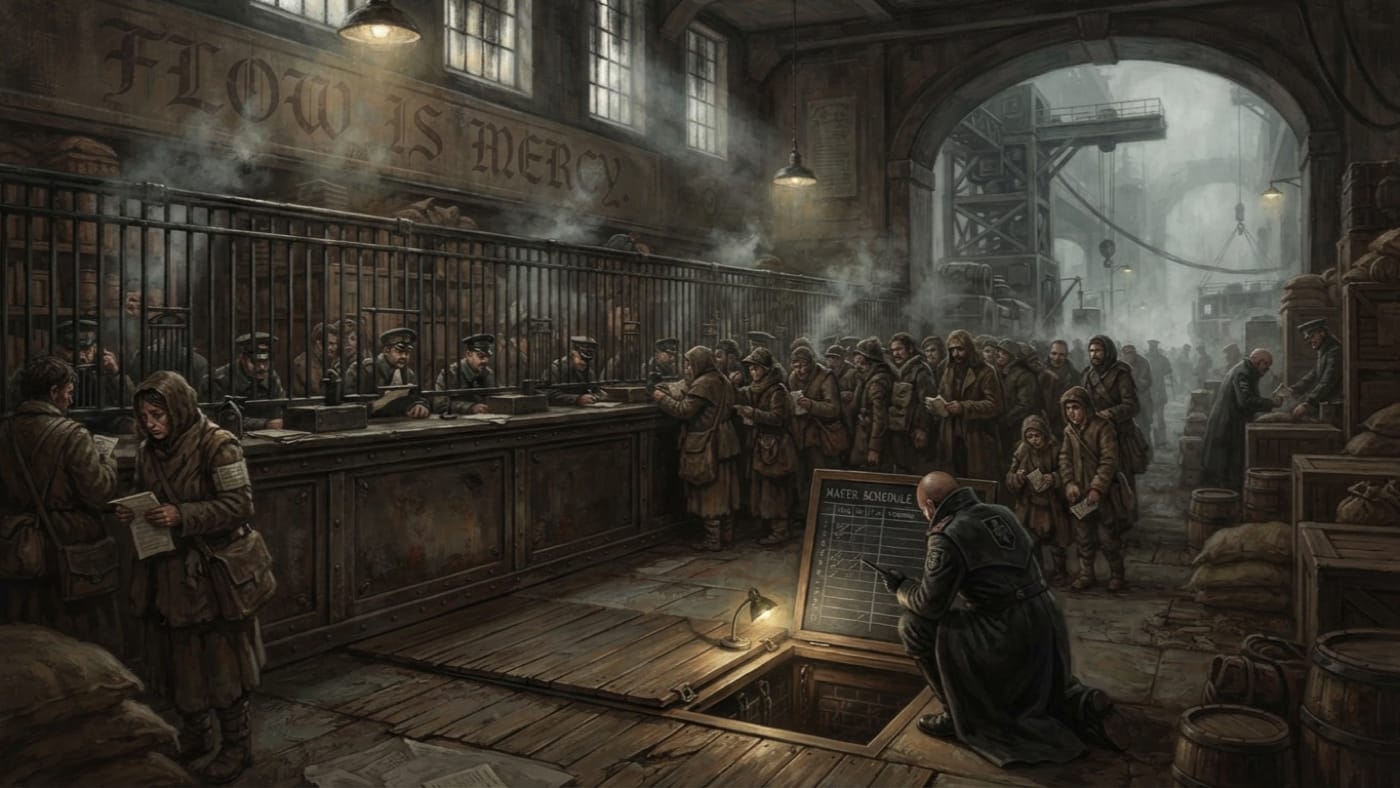
"Flow is mercy." — inscription above the Ink Dock
This is a survey of Ink Dock and of Ink Dock Hall, which stands within it, in their present condition in A.S. 201. Ink Dock is one of the eight named nodes of the Rope-Ferry Chain. It lies on the river belt where Heartlands supply passes toward the forward theatres. The Chain works twelve ferries along its length and Ink Dock is one ward among the eight. A clerk there will correct anyone who counts otherwise, and will stamp the correction.
The dock's work is permits and audits, and you can smell it before you see it. Upper Splice reeks of tar, and the Quarantine Piers of lye. Ink Dock smells of vinegar ink and of wool that has been wet since the autumn and will stay wet until it rots. The clerks wear it, the queue wears it and the ledgers absorb it. Paper kept at Ink Dock for a season curls at the corners as if it were ashamed of what it says.
The river's carters and ropehands keep the dock's arithmetic in one sentence, and it is the most orthodox thing said anywhere on the water: if paper stops, ferries stop; if ferries stop, food stops. Every barge, conscript and sack of grain crossing the Chain carries a document that was issued, checked or filed here. Ink Dock moves nothing itself. It simply holds the permission for everything else to move.
#On the Hall and the Slate
Ink Dock Hall is the seat of the Chain Superintendentate, the Synod Transit Office's administration for the whole route. Its public face is a row of barred service windows. Clerks sit behind the bars stamping slips. Civilians stand in front of them holding minute-block permits up to the iron the way a penitent holds up his hands. I give no dimensions for the building. No survey I was shown records them, and a man under detention does not pace out the room that is detaining him.
The public windows are the lesser half of the Hall. Under its floor is a floorbox, and in the floorbox is the master slate. It is a single piece of oak written in charcoal, and it records which nodes are open, which are closed and for how long. Every lesser timetable on the river is copied from it. The slate is kept by the current Chain Superintendent, Halvick Sorn, who holds the schedule and signs the closures. His career belongs in his own file. In this survey he matters for one reason: the hand that writes on that oak sits in this building, a few feet above the box.
Two things on the Chain are never for sale: an official closure order and the master slate. Forging the slate's mark is one of the few offences on the river that no fine can settle. The Hall therefore holds the only honest object at Ink Dock, and keeps it under the floorboards.
A closure entered on the oak does not stay at Ink Dock. The ration market downstream feels it first. The upstream queue swells next, and finally the provosts lose their grip on the lanes. Those are the consequences the Superintendent has spent his service arranging against. None has been recorded at Ink Dock this year. All of them can be reached from this room with a stick of charcoal.
#On the Purchase of Waiting
Nobody pays at Ink Dock to cross. They pay to wait. The clerks issue the time permit, a stamped slip that entitles the bearer to stand in the queue for a stated number of minutes. Queue folk call the minute-blocks minute-bread, because that is roughly what each one costs them. Permit fees in general they call the ink-tax. The Transit Office does not use either word, and so both are accurate.
What a minute costs depends on the season, the weather, the weight of the cargo, the quarantine status of the bearer and the mood of the clerk holding the stamp. I have no local tariff to print and I refuse to invent one. Clerks who answer to market conditions do not publish their conditions.
A traveller who cannot pay for his minutes falls into waiting debt. The debt compounds, and once it has compounded far enough it is collected in rope labour or in confiscated cargo. Confiscations are the province of Provost-Captain Merrow Venn, and her squads collect at Ink Dock as they collect everywhere on the river, with receipts.
The traffic coming off the Queue Road arrives already stamped by another regime. At Ink Dock it learns that a foreign stamp buys one place in line and nothing more. Among the counters move the Ferry Chokepoint Brokers, selling what the clerks will not sell openly: queue priority, a sympathetic window, papers that read better than the truth would. Formal authority belongs to the Transit Office. What actually crosses is decided by the broker's timing, the clerk's mood, Rope-Master Kett's supply of sound cable and the provost's patience. The Hall stamps whatever is left when all four have finished.
#On Discrepancies and Their Keeping
Cargo goes missing on the Chain. It is moved by human counters under constant bribery, so this surprises no one, and the Synod has built furniture for the purpose. Each node has discrepancy booths. A missing sack is taken to one, the person answerable for it confesses to the absence, and the confession slip is filed at Ink Dock.
Filing balances the ledger. The goods themselves are reclassified as offerings rendered unto Providence, and the account closes. The sack does not come back. The procedure makes one very particular promise: the record will be whole, and nothing is said about the warehouse. Auditors who confuse the two are reassigned to the Quarantine Piers, where confusion is better ventilated.
The slips stay at Ink Dock, and that is where their real career begins. Each one is a signed admission held in a damp cabinet near the river's only permit counter. A man with many slips on file has lost a great deal of cargo, and so he knows where cargo goes. His slips are bought and sold as currency, traded for favours, and produced at the right moment to persuade him back into cooperation. Weight turns into guilt and guilt turns into a lien. The archive at Ink Dock holds no grain at all and still governs a share of it.
#On the River's Copies
Ink Dock holds a third kind of record, and the Hall's clerks are careful to keep it apart from the other two.
When fog wets the mainline cable thickly enough, the River Ledger writes. The cable darkens from within and the darkening forms names, numbers, dates, cargo weights and tide-counts. These appear inside the fibres of the rope out on the river, and none of them is written in the Hall. The Hall's part is to receive copies.
The copy is made under three witnesses. They are a Transit clerk, a ropehand and one person taken from the queue, who is compelled to sign before being allowed to know what he has signed. Nobody from the queue volunteers. The witnessed copy is entered at Ink Dock. It is duplicated at the Superintendentate, and then it goes to Strasbourg with the monthly anomaly packet. Strasbourg receives the packets and files them, and when it answers at all it asks for clearer copies. The Superintendentate sits in the Hall, but entry and duplication remain separate stages with separate entries in the register, and the clerks keep them that way.
The three kinds of record at Ink Dock must never be confused:
- The ordinary paper: permits, manifests and confessions, issued and filed at the counters.
- The master slate: oak and charcoal, written by the Superintendent's authority and kept under the floor.
- The witnessed paper copies of writing that began in wet rope.
The slate decides when ferries move, and the copies only report what the rope has said. Whether the rope foretells, or provosts reading it first make it come true, is not settled in any file I was allowed to see. I do not settle it here.
The brokers sell another set of signatures, and they should not be mistaken for these. Witness crossing forms carry three names pledging that everyone aboard is present and accounted for. They are an approved countermeasure, they are sold at a discount, and they have nothing to do with the three signatures required to copy an entry from the rope.
#On the Present Condition
The Chain is operational, and permanently conditional. Over three seasons throughput across the whole route has fallen nine percent. That is a figure for the route, and Ink Dock's own counters have not been measured separately. The Splicehands are rationing sound rope. The quarantine cordons widen. The Queue Road keeps sending bodies at its old rate, and on heavy-fog days crews refuse crossings while provosts, choristers and brokers all shout at the same gantry. Every one of these pressures ends up at an Ink Dock window as a permit someone wants, a debt someone cannot pay, or a closure someone is asking for.
Route throughput on the Rope-Ferry Chain has declined nine percent over three seasons.
Reclassified by the Synod Transit Office, A.S. 201: throughput has been restructured to prioritise doctrinal cargo over civilian supply. The nine percent is unchanged, and Ink Dock stamps the restructured permits at the same windows.
The provosts have a maxim: control Ink Dock and you control the river. They mean it as an order of battle. On the Chain a siege needs no cannon, because one node failing will do the work, with shortages travelling downstream like contagion. If the Hall stopped stamping, nobody would need to cut a rope. Ferries would idle at their gantries with nothing authorising them to cross. Downstream ration markets would empty while cargo piled up upstream with no permit to move it. The queue, deprived of its minutes, would stop believing that waiting was worth paying for. None of this has happened. All of it is possible, and everyone at Ink Dock knows it, down to the clerk with the wettest sleeves.
The Hall stamps on. The slips curl in their cabinets. Beneath the floor the oak waits for its next line of charcoal.