
I checked the continuity file, the voice guides, the Rope-Ferry Chain lore and the River Ledger article. Here is the article.
#On the Office and Its Reach
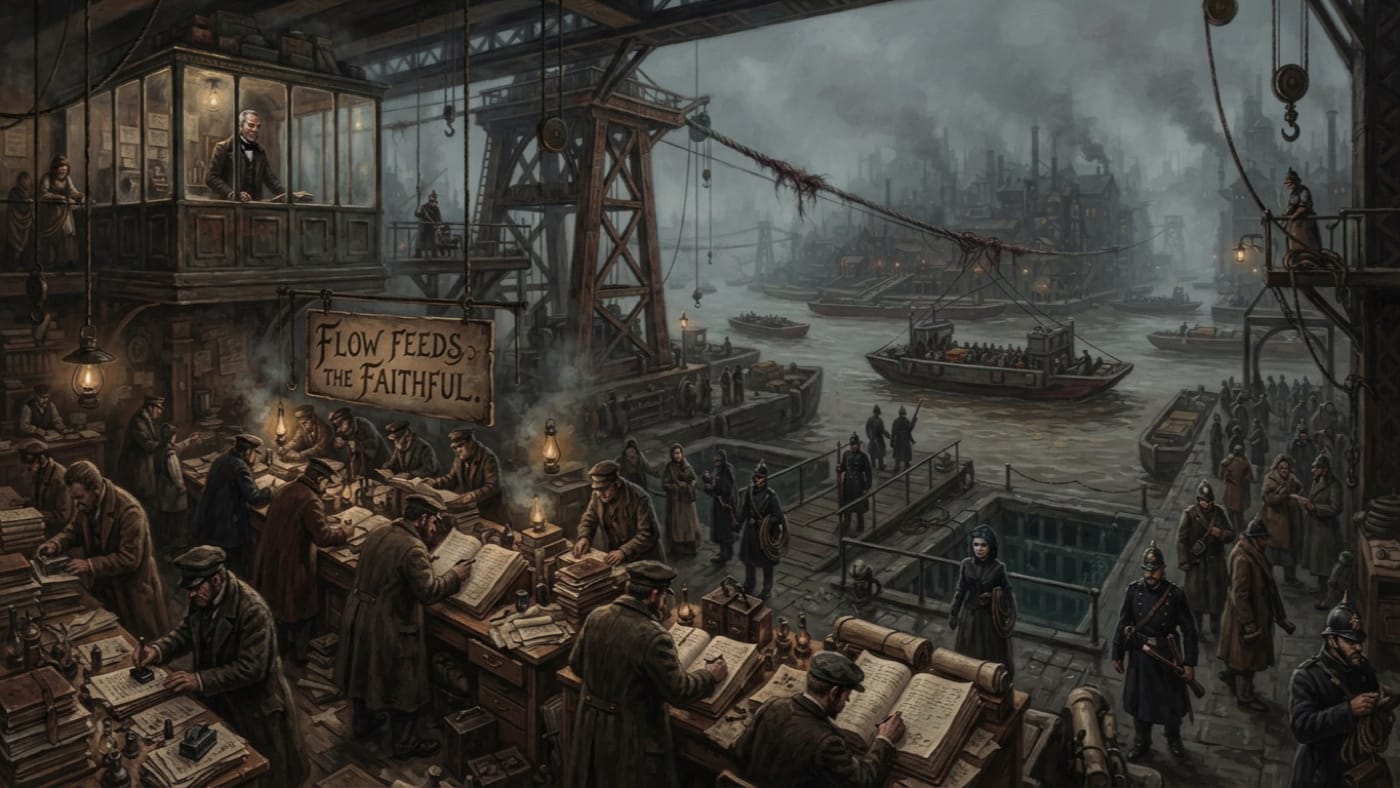
"Flow feeds the faithful." — Superintendentate placard, Ink Dock. Chalked beneath it, nightly: "Flow feeds the clerk."
The Chain Superintendentate is the administration of the Rope-Ferry Chain under the Synod Transit Office. The two names are used for one body so freely that any clerk who tells them apart is either new or angling for promotion. One Chain Superintendent administers the whole route. That means twelve ferries, the dock wards behind them, the queues in front of them and the river running through all of it at a speed no permit governs.
Its public duty is flow. Its instruments are schedules, closures, audits, dispatch orders and, when grain runs short, flow decrees. It sits at Ink Dock, in Ink Dock Hall. The building smells of vinegar ink and wet wool, and its one distinction is that nothing on the river moves until it has been written down there. If paper stops, ferries stop. If ferries stop, food stops. The Superintendentate has made a theology of this sequence, and I have heard worse ones preached from better pulpits.
#On Its Establishment
No charter hangs in Ink Dock Hall, and I have looked behind the stove. The Office tells its history in stages and gives no anniversaries. First came the bridge-collapse wars. After them the river belt was judged safer without permanent crossings, because anyone may use a bridge and a ferry waits for permission. Next a flood took three nodes at once and taught the route what a single break costs everyone downstream. The answer was the Superintendentate, with rope dues to feed it. Time permits came afterwards, then the licensing of the Splicehands, and each reform was announced as safety and collected as revenue.
The Office's histories credit the Synod with that first answer. Wherever the flood falls before the Concordat of A.S. 90, the credit is a courtesy extended backward, much as a prospering family paints its new crest onto the grandfather's cart.
#On Schedules, Dues, and Discrepancies
Passage begins in the queue lanes. Traffic off the Queue Road arrives already stamped by the Permit Directorate and learns there that another regime's stamp is worth exactly one place in line. The Superintendentate checks everything again. Transit clerks examine the paper, rope captains weigh the cargo and guards study the face, which is the one document no broker has yet learned to forge cheaply.
Waiting is sold in minute blocks, which the queue calls minute-bread. A traveller who cannot pay for his minutes runs up waiting debt, and the debt compounds until it is converted into rope labor or confiscated cargo. In a flow emergency the arithmetic is skipped and the man is simply recruited. Rope dues fund maintenance, crossing fees fund the crossing, cargo-weight tithes punish the heavy, and all of it together funds the clerks who explain it.
Missing cargo produces a discrepancy confession slip. The counter finds a sack gone, the carrier confesses to the absence in a booth built for the purpose, and the slip is filed at Ink Dock. There it waits patiently for the day someone needs a favor from the person who signed it. Weight becomes guilt, and guilt becomes a lien. I admire the economy of it.
Two things on the river are never for sale: an official chain-closure order and the Superintendent's master schedule slate. Nearly everything next to them is. Queue priority, a friendly clerk, a forged quarantine stamp and a berth on a ferry running black after curfew all have prices, and the Ferry Chokepoint Brokers will quote each one. The slate itself lies in a floorbox under Ink Dock Hall. Forging its mark is one of the three offences on the Chain that end in annihilation, with no fine available.
#On Those Who Govern the Crossing
Chain Superintendent Halvick Sorn controls the schedule and the closures. He is never off-schedule. He fears one thing with real devotion: a single snapped node bringing down the line, with starvation travelling downstream faster than any decree can follow. Speaking his first name is forbidden on the Chain. I have now printed it twice and expect a stern circular.
The rope belongs to someone else. Rope-Master Lysa "Splicehand" Kett controls rope supply and the maintenance crews, and her guild's licence decides who may lay a hand on a mainline. Her hands are black with tar to the wrist. When the Splicehands restrict supply, the Superintendent's schedule turns into a list of wishes.
The cages belong to a third party. Provost-Captain Merrow Venn commands arrests and confiscations. Her Dock Provosts work the Bend and the night patrol lanes with raids and drowning cages, and the dock wards say she smiles like a receipt.
That makes three hands on one rope, and I found no instrument that makes any one of them answerable to another. Others press in around them. The Lye Order's quarantine wardens control the cordons, washes and stamps at Quarantine Piers, and a cordon widened at noon can idle three ferries by dusk. The Schedule Choir sings the timing calls that keep the crossings in step and has lately begun singing omens too. A number beside a knot on the rope, they say, means closure. Sorn is the one who signs closures. The Choir merely makes it expensive for him to refuse.
#On Copies of the River Ledger
When the River Ledger writes, the Superintendentate copies. It is not the author of the writing, and it has no established power to stop what the writing describes. What it has is the paper. On the Chain that is usually enough, but here it is not.
Copying requires three witnesses: a Transit clerk, a ropehand, and one person compelled from the queue to sign before being told what he has signed. The copy is entered at Ink Dock and duplicated at the Superintendentate. It then travels to Strasbourg in the monthly anomaly packet, where it is received, filed and now and then answered with a request for clearer copies. The evidence is held at three points along that chain of custody, and none of the three can act on it.
Others read faster. Venn's skiffs are ordered to reach a manifesting node and read the names before the crews do. The brokers want cargo figures and tide-counts before the auditors see them, because a manifest known to be short by dawn can be insured, robbed and confessed, in that order. The Office files while the river market trades.
Sorn keeps a preserved segment of written cable in a locked cabinet. In the winter fog of A.S. 200 the rope at Node Seven printed fourteen names in a single event. Afterwards he asked permission to move the mainline thirty yards upstream, and permission was denied. The request concerned thirty yards of river and all the nerve one man had left. It was refused from a distance at which neither could be measured.
The approved countermeasures stand in his books: tar-sealing, bell-cards at gantry height, and witness crossing forms in triplicate. The approval is genuine, but nobody has shown that the protection works. The tar blisters, the cards ring once without wind, and the brokers have added the forms to their price lists.
Superintendentate duplicate of the Transit Office A.S. 201 circular: River Ledger frequency has not increased; only reporting diligence has improved.
Clarified under sealed annex. Diligence was offered three witnesses at Node Seven and still could not account for fourteen names on one cable.
#On the Present Condition
Throughput across the whole Chain has fallen nine percent over three seasons. The Splicehands are rationing rope, and old mainline stays in service longer than any Splicehand will admit aloud. Quarantine cordons are widening. The Queue Road still sends bodies in at the old rate to a route that now moves fewer of them. Heavy-fog crossings meet crew refusals, provost threats, choir objections and broker interference, often at the same gantry within the same hour. Meanwhile the wet, strained rope writes ahead of the schedule, and it has been known to write once on new rope.
The Superintendentate answers in the only grammar it has. It audits. It reads the schedule aloud at dawn. It stamps permits in Ink Dock Hall while the wool dries on the clerks' backs, and the Bureau of Purity burns whatever luck-knots were cut from written cable. On nights when the provosts are elsewhere, the Reed Mothers move children out of the queue lanes. The Black Ferrymen run the reed channels by lantern code, and their bribed clerks keep their own books. None of this appears in any figure the Office sends to Strasbourg. The Chain is legible exactly as far as the lamp on the clerk's desk can reach.