
#On the Quarter
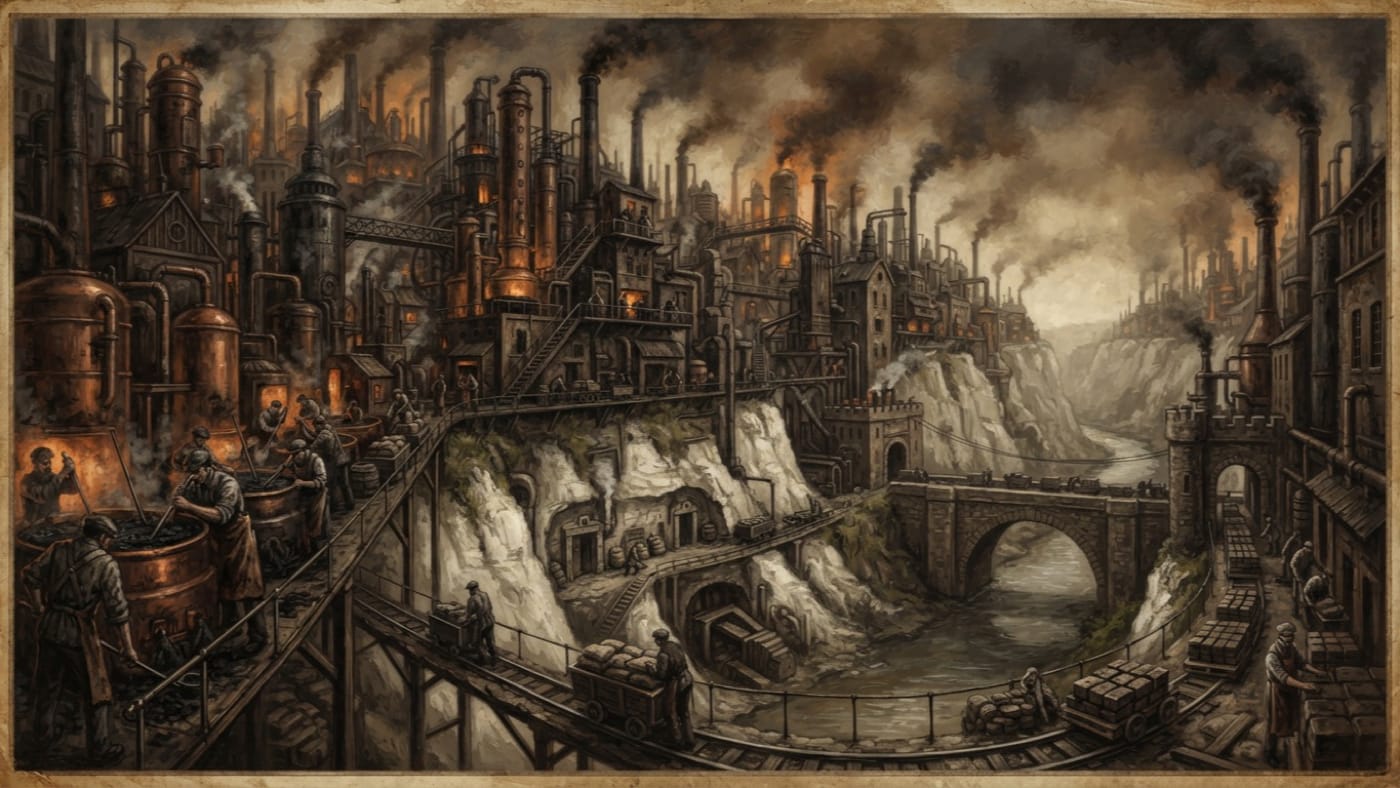
The Hollow-Script Scriptorium's copying halls sit above. The vaults that keep its originals lie below. Between them is a district of copper and smoke, and every decree the Chapterhouse issues passes through it as a liquid first. The Inkhouse Quarter brews the ash-ink. Upstairs, scribes spend it by the line. Downstairs, Abbot-Registrar Maelen Voss keeps what the ink has already made. The Quarter is the middle term of the syllogism. Like most middle terms, it is the one nobody troubles to inspect.
Nemea stands on a chalk ridge above a slow river, in Zone 2 of the heartlands, within courier reach of Strasbourg. It lies between the Rheinscarp supply corridor and the southern tributaries of the Queue Road. The town is stacked and burrowed, built up from the ridge and dug down into the chalk. The Quarter holds its place in that order the way an industry holds its place in a monastery: below prayer, and above the dead.
You smell it before the lane bends: tannin, smoke and iron, with vinegar underneath to make the eyes run. The copying halls smell of hot wax and soot. By regulation, the vaults smell of nothing. The Quarter smells of work.
The Bureau of Records needs an ink it can trust more than it trusts its clerks, and the Quarter exists to make it. Six years after the Concordat, Archon Veyrault commissioned a central archive-scriptorium. The Bureau's offices were old by then. What they lacked was a single house where contested records could be copied, corrected and, when required, destroyed. Nemea was raised in A.S. 96 to be that house. The town's certified history gives the Quarter no founding year of its own. It is counted with the Chapterhouse, as a hand is counted with the body.
#On the Brewing
The published base of ash-ink is plain enough to recite at a novice's intake. It is burnwood charcoal from the ash orchards ranked along the ridge, iron-gall, and a vinegar binder. These go into copper vats the size of confessionals. The comparison is the town's, and I have never bettered it. A man could kneel in one. Judging by the brewers' knees, several have.
Then there are the manifests. The supply rolls entering the Quarter carry a line the Chapterhouse calls mineral supplement. The street's name for it is blunter, and the Scriptorium entry has already printed it: the dead in liquid form. By that account the supplement is bone-dust from decommissioned reliquaries, ash from saint-cloth burned after failed certifications, and calcite scraped from the walls of consecrated vaults. The Chapterhouse denies it. The Chapterhouse denies it in writing, in ash-ink. I leave that sentence on the page without comment, because the Bureau's sister office in Doctrine has asked me to stop making that joke.
I will not record the proportions, the heat of the boil or the hours. Those belong to the brewers and the Chapterhouse. A recipe printed in the Codex is in every forger's satchel by the next feast-day. It is enough to say that the ink comes off the vats black. It binds to paper the way a vow binds a novice, and it does not consent to be scraped.
Finished ink leaves the Quarter as bricks: compressed, stamped, rationed, sealed. Any Bureau office on the continent that must correct an identity, amend a decree or certify an absence uses Nemea ink to do it. The wax that seals those documents is another of the town's trades, and the Quarter does not make it. The Quarter supplies only the thing the wax is there to protect.
#On the Hands
The day in Nemea begins in the Quarter. The town's order runs dawn ink boil, midday copying quotas, curfew bell, night correction, and the first of these belongs to the brewers. Before the copying halls have lit a lamp, the vats are already muttering.
Ash-ink brewer is a trade with a name in Nemea. That is more than the Novice Barrens can say for its people. They give up their birth-names at intake in exchange for archive designations, and the Chapterhouse calls the exchange archive safety. Not every brewer came in by that gate, and the records open to me do not count which ones did. The town's terms govern them all the same: vow contracts, quota penance and page debt. Page debt is owed work. It is paid in night shifts, in confessions, or by surrendering a family name to correction. A brewer in arrears is not fined. A brewer in arrears is shortened by a surname.
The body pays first. Ash lung settles in those who stand over the vats, and in the tea-stalls the cough arrives before the brewer does. Lime from the ridge pits burns wherever it touches. The Quarter's hands carry white scars and black stains together, like a decree that has been sealed and struck at once. The materials that make an ink indelible are not kind to the skin that handles them, and poison burns at the vat-rims are listed among the trade's ordinary hazards.
Brewers eat what Nemea eats: thin porridge, ash-bread and bitter tea. Where speech is unwise, they talk with their hands. The town performs its unsanctioned whisper plays in hand-signs, and the Quarter, having the most to complain of, is not short of signs.
Voss wears gloves wherever ink is present. In Nemea, ink is always present. His gloves are therefore his skin, and the brewers' skin belongs to the ink.
#On the Seal and the Road
The Silence Test Collegium distrusts whatever the Quarter makes. Silence-Master Rhu Tern governs verification at the gatehouses and in the testing rooms. Every document entering or leaving Nemea must pass a silence test, and the Collegium keeps its mirrors covered until the moment of testing. The full procedure is classified, and it stays classified on this page. Tern is no master of the Quarter. He is only the man who decides whether its ink has told the truth.
Voss holds the Chapterhouse seal and access to the originals. Between those two men, the brewers own nothing but their coughs.
Everything leaves by one road. The Inkhouse Bridge is a single stone span across the gorge below the ridge, and it carries all of Nemea's freight, couriers and intake. The bridge bears the Quarter's name. Paper, lamp oil, grain, rags, lime and glass come in over it. The sealed carts go out through the Courier Spur at the town's eastern edge. When blank paper runs short, the copying halls slow. When lamp oil runs short, the testing rooms cannot test. Either way the vats keep boiling, and the bricks pile up in the Quarter waiting for a verified page to be spent on.
"Sister" Halvein trades in redaction drafts and blackmail. She holds no charter, and she smiles when a name breaks. The Second-Draft Circle, a heretic cell working the crawl-shelves and courier tunnels, preserves originals and undoes erasures. Both have reason to want ink that is not rationed. I record no incident. I record the appetite.
#On Ink-Sickness
"Never sign under a fresh lamp — lamps make promises hungry." — Nemea saying
Scrape ash-ink, and the page does not come up clean. Words rise from beneath the fibres. The Scriptorium entry reports a case from A.S. 194. A junior scribe scraped one word from a correction order and found six beneath it. Together they spelled the scribe's mother's name; she had been dead eleven years and erased for nine. I cite that account as given and add nothing to it.
In A.S. 198 the Chapterhouse classified the Night-Rewriting Contracts. In Nemea, to classify a thing and to begin it are taken as one act. The Codex keeps them apart. Contracts kept in the vaults change overnight. Terms of service lengthen and debts grow. A guarantor's name moves from the witness line into the body of the text, and a witness wakes up a debtor. Every observed revision has increased an obligation. No one has shown that every fresh batch from the vats will do this, or that anyone can make a batch do it on command. I would be grateful if the forgers of the Courier Spur read that sentence twice.
Three parties dispute the cause. The Chapterhouse blames the Second-Draft Circle. The Circle blames the ink. In its correction to the Scriptorium entry, the Bureau of Doctrine ruled that the ink is performing its function of binding truth to paper. It also ruled that the gap between that truth and the stamped truth is a theological matter, and passed it to a sub-committee. Behind the ruling sits the fear the Chapterhouse will not write down: that sanctified residue, boiled in the Quarter, is trying to become true, and that the stamps are what is false. That is a fear, and the Church has named it heresy. The Creator has sent my office no ruling either way.
The contract-rewriting phenomenon has been attributed to residual schismatic interference and to a contaminated batch drawn from Inkhouse vat number seven.
CORRECTED. The Bureau of Alchemical Standards has found that vat seven produces ink chemically identical to every other Nemea vat. Vat seven is cleared. No other vat has been convicted in its place, and identical chemistry is not proof of identical conduct. The cause remains under classification.
The countermeasures remain in force. Salt-lamp circles burn through the night over sensitive documents. Mirror checks and silence tests continue, and the standing order to burn the second draft still holds. All of it is obeyed. The contracts still rewrite. The Collegium has asked for more mirror-pins. The Abbot-Registrar has asked for more gloves.
#On the Present Condition
Demand for ash-ink has not fallen, and it cannot. Every rewritten contract needs a correction, every correction needs ink, and the ink comes from the vats. The Quarter boils at dawn as it did before A.S. 198. The bricks go out over the bridge to offices that will spend them on certified absences, amended decrees and identity corrections. Those entries then pass toward the Great Ledger, which no one can yet tell which of its lines a clerk actually wrote.
Custody of the originals stays with Voss. Verification stays with Tern, limited by lamp oil and paper. Under the A.S. 201 assessment, Inquisitor-Corrector Sel Durn has been dispatched from Strasbourg. No arrival has been recorded, and no findings. The Bureau of Records continues to requisition bricks.