
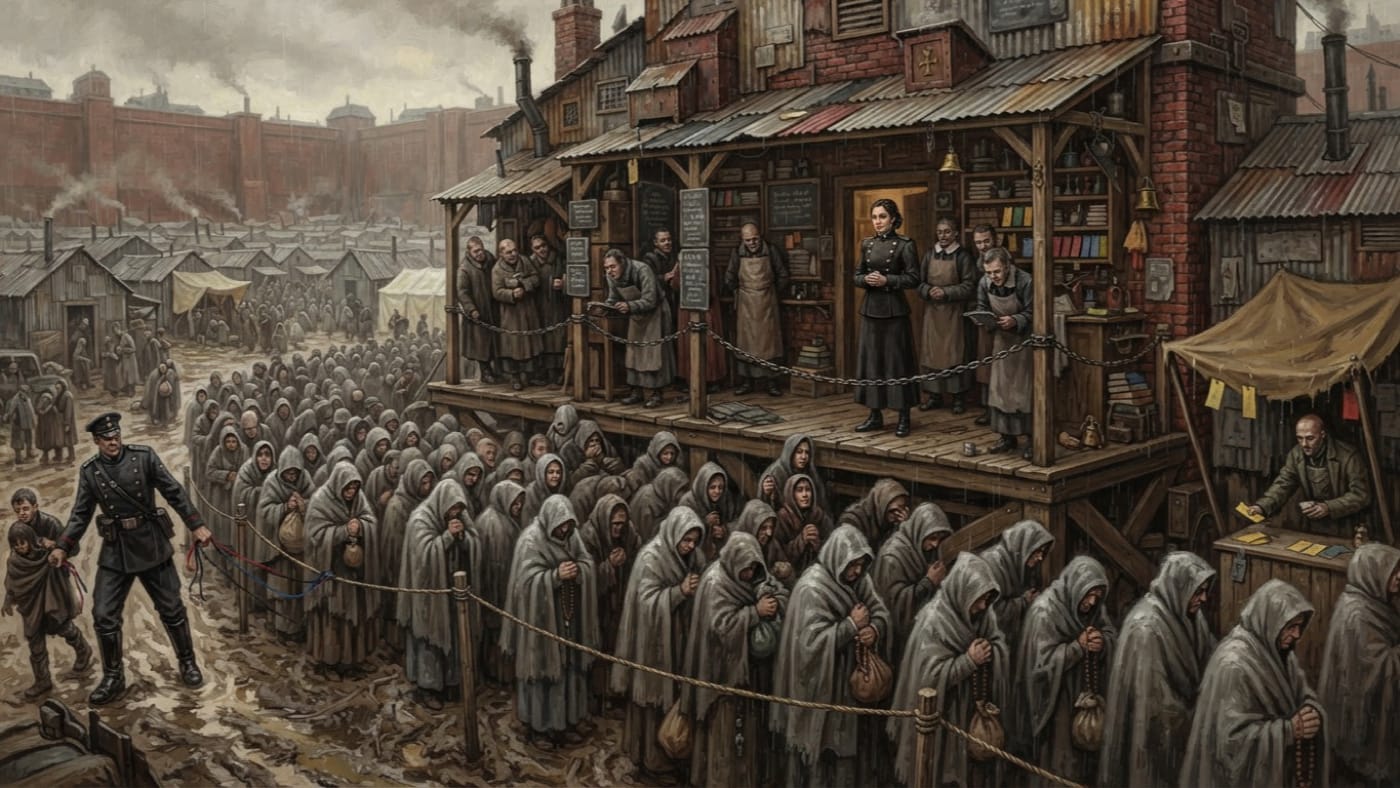
#On the Porch and the Yard
The Intake Porch is where the Lost Procession Yard finds its voice. The Yard is mud, chalk, wet wool and the steam of three hundred cloaks drying on the people inside them. The Porch is where that mud is addressed by name. Every column that comes through the Intake Gate of the Cloister of Miscounted Beads arrives facing it. Some come off the Queue Road, some down the waystation spur, some along the western approach with Strasbourg near enough to smell. Every arrival hears the Porch before understanding a word it says.
This office has not been asked to certify what the Porch is built of, when it was raised, or whose purse paid for it, and will not volunteer an opinion. The Porch is known by its use. Clerks stand upon it with slate-boards, and the Mistress of Intake presides from it. Rulings leave it on the boots of runners and reach the Yard as chalk, cord, lanes, and the sudden absence of a husband.
This plate accompanies the Yard survey of A.S. 201 and describes the Porch as that survey found it.
#On Names Called
The clerks call three kinds of name: parish names, family names and dead names. They read them off slate, in chalk already smeared by the last rain, and they read them loudly, because a clerk's lungs are the cheapest instrument the Chapter owns.
When pilgrims hear their names, they must answer. That is the whole liturgy. A hand goes up, or a throat croaks, or a neighbour who wants a better place in the lane shoves the named one forward. The clerk compares the face to the slate, the slate to the route tally and the tally to the bead string. If all of them agree, the pilgrim goes down into the Yard to be chalked and tagged, and is spoken of thereafter as a colour.
When they disagree, the Yard starts earning its rations.
Some names get two answers. Two women in the same column claim the same surname, the same parish and the same dead infant, and each of them weeps convincingly. Other names get none. The clerk calls three times and enters the silence as well. Then an Outer-Watch runner walks the lane with a slate in one hand and nothing gentle in the other. He reads wrists, lifts chins, and now and then finds that the silent man has carried another man's name under his tongue since the last waystation.
The runner moves disputed answerers out of the column, and he does not debate them. A family that came in as a family may leave the Porch as three tags in three colours: the mother blue for route contradiction, the father black because his string is a bead short of his story, and the daughter green, because with both parents held she no longer has a stable adult. A Procession Marshal who has kept cadence for a hundred miles hears his own name called in the same flat voice as everyone else's, and learns what his badge is worth.
A name, once answered, belongs to the Ledger. Every debt, sentence and fever written beside it now belongs to the throat that said here.
#On the Mistress of Intake
Jossa Rill does not shout. Her deputies shout, the clerks shout, the matrons shout across the berths, and the runners shout whenever their boots cannot get there first. Rill stands on the Porch with her hands folded and her eyes hard, and speaks at about the volume of wax taking a seal. Those soft hands are famous. They have tied tags on fevered infants without waking them. They have also taken a man's wrist so gently that the bruise turned up the next morning, like a memorandum delivered late.
She has seven words, and a runner carries each one into the Yard.
Supplementary: the pilgrim's existence is to be filed again, in better ink, at the Supplementary Entry Office. Awaiting: a place in the Dorm Rows until the Hall has room. Dorm: a berth assigned outright, with its rot and its lice. Chapel: custody for those who have answered something they ought not to have answered. Hold: stay in the Yard, in the rain, until someone decides. Expel: back toward the city with a corrected past and nowhere lawful to sleep. Red: the red lane, and after it the inquisitors.
Her authority ends at the first sorting. The twelve reconciliation desks of the Counting Hall decide whether a pilgrim's beads balance. Clearance seals belong to Prior-Scribe Erem Vale and to nobody else. Rill only decides where a body stands, sleeps or is thrown out while those gentlemen make up their minds. In the Cloister, where a dozen clerks can hold up thousands, the place a body waits is very often the place it stops.
The Mistress of Intake greets each arriving procession from the Porch in her office as welcoming officer.
Withdrawn, as it was withdrawn in the Yard plate. The Porch receives and the Mistress grades. Nobody is welcomed. The pilgrim guides that spread the phrase have been shelved next to the hymnals.
#On Tags, Berths and Sponsors
The Porch speaks and the Yard carries out the order. Whatever the Porch rules, an arriving body ends up with a mark on the shoulder and a card at the wrist. The colours are white for ordinary miscount, grey for illness, blue for route contradiction, yellow for sponsor interest, black for suspected counterfeit string, green for a child without a stable accompanying adult, and red for Purity review. The cards are stiff, the twine is poor, and the rain gets at both.
A procession that holds together goes on in twelves toward the Hall. A procession that comes apart under questioning is taken to pieces: leaders are split from followers, children checked, and packs emptied onto oilcloth to be searched for duplicate strings and permits scraped clean for reuse. The Bureau of Pilgrimage wants this done faster. The Bureau of Records wants the categories cleaner. The Chapter wants both, and wants them without new staff.
Grey goes north. The fever tents stand under the north wall and are washed with vinegar at dawn and at dusk, and the Porch can smell them whenever the wind turns. Rill's one recorded fear is having plague blamed on her Yard. A bright eye or a cough that comes in threes will stop a calling in mid-name.
Yellow costs money. The broker under the south awning sells introductions, never seals: a word in the right ear, a better berth, yellow twine where green would have been. Rill puts up with him because yellow tags move bodies faster than arguments do. What he cannot sell, and what nobody in the Cloister sells, is nullification of an anomaly once it has been declared active. A sponsor's coin buys a pilgrim a dry wall. It will not buy back a name that has started to do things on its own.
#On the Silenced Summons
Daylight calling is ugly but it works. Night intake is a different trade, and the Porch avoids it unless the Queue Road has sent more bodies than the city gate dares to keep. Under lamps the tags blur, fevers hide, and faces start to look alike. The clerks report that bead anomalies peak between the third and fourth bell. Their testimony, entered rather than endorsed, is that ink bleeds into letters nobody wrote, that dead names turn up on intake lists, and that a name called into the dark has sometimes been answered twice from the same lane, by voices that did not match.
This office does not rule on what answers. It rules on procedure.
When the Outer-Watch declares an anomaly week, the gates are locked, food runs short, and the Porch stops calling. The posted order is plain enough for a clerk to follow and short enough for a runner to remember:
After midnight the runners stop speaking altogether. They hold up a slate, point, and move off. A pilgrim who answers to a name that is not written on their tag is struck quiet and taken to the Chapel. A pilgrim who answers to nothing is held until morning, so the clerks can see whether the face is still the one that went to sleep.
It is a strange quiet. Six hundred people are packed into wet wool, nobody calls out, and beads click under the sleeves because pilgrims have never yet obeyed an instruction to stop counting.
#On the Present Condition
The Yard has been beyond design capacity since A.S. 198. In A.S. 200 it recorded an intake of fourteen thousand two hundred. Those are Yard figures, and the Porch has never been counted on its own. The only tally of its calls is kept in the clerks' throats, which by the end of the rain quarter sound as if someone has scraped them with a pumice stone.
Rill has asked for more awnings, more fever tents and more clerks. Requests of this kind usually come back as a single awning and a memorandum praising the Yard's adaptive spirit. Meanwhile the Porch calls longer days and carries more disputed answers into the lamplit hours, where it handles them worst. More two-answer names reach the Chapel and more silences reach the red lane. More green cords hang on more children than the Dorm Rows can house.
At dusk the clerks wipe their slates and chalk up the night lists, and Rill stands with her hands folded while the last legal arrivals push against the chain gate. A clerk lifts a board and reads out a family name. Somewhere in the wet crowd a hand goes up, and a runner sets off.