
#On the Registry and the Road
“The Bureau cannot touch mystery without tagging its ankle.” — the present writer, in an earlier and better-received article
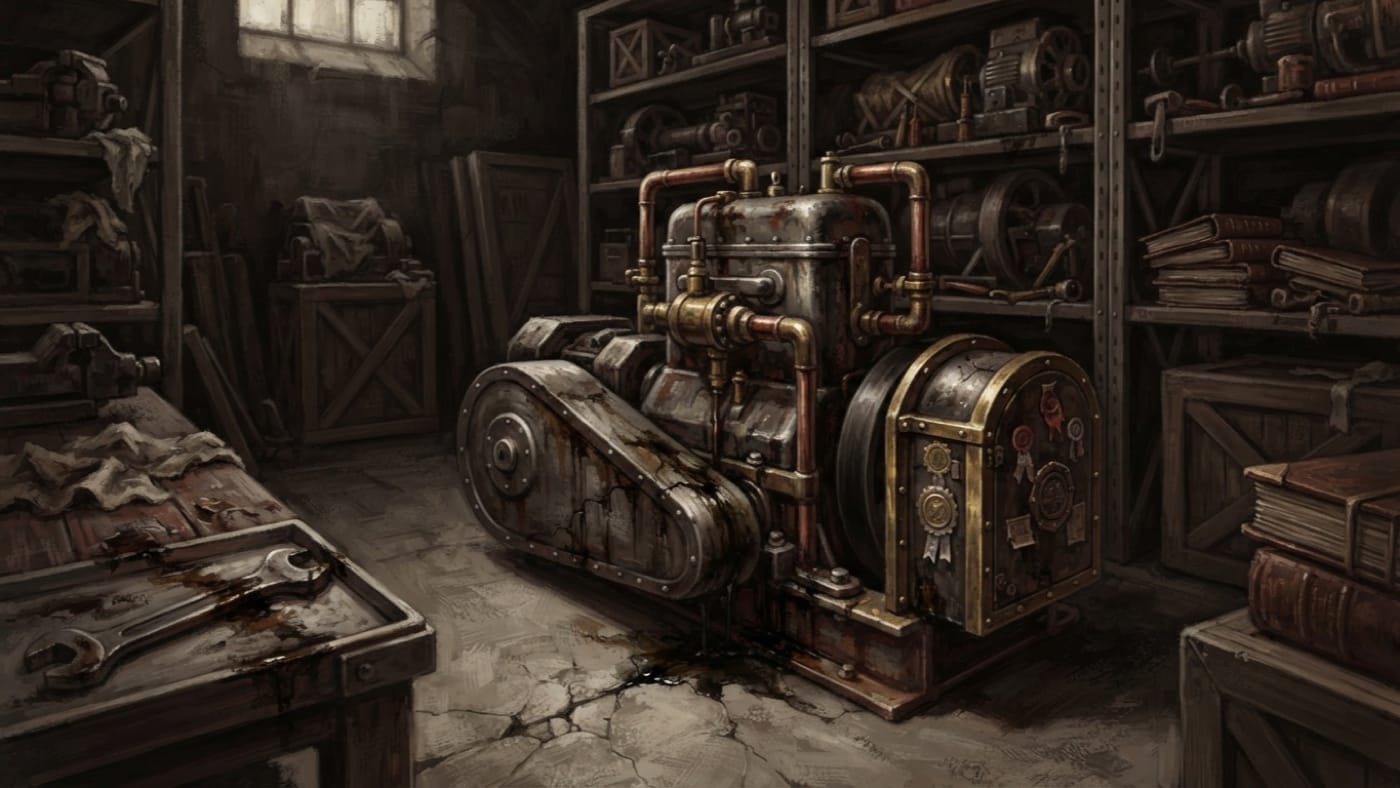
KAL-ROAD AUXILIARY 6 is the field generator that Saint Edrin of the Eight Strokes restarted on the Kalnik Road. He paid for it with his hands, his throat and, three days later, the rest of him. The designation came afterwards. Registry gave it once the machine had a reputation worth filing, in the usual Registry manner: a road abbreviated, a rank assigned, a numeral appended, and no poetry anywhere.
The numeral comes with a warning. Six is a filing number. It does not show five elder brothers on the road before this one, or a production series, or a foundry run of identical engines waiting their turn for sanctification. Pilgrims who go looking for AUXILIARY 1 through 5 will find clerks, and the clerks will find them tiresome.
This entry is indexed to A.S. 48 / 1758 CE. That year belongs to the failure and the restart. The machine's manufacture is unrecorded, its first commissioning is unrecorded, and its maker has no name in any surviving folio. The generator existed before the road. When and where it was built is the business of the Creator and the foundry, and neither has written to the Ledger.
During the Great Retreat a working generator was worth more than most officers and some bishops. It fed field lamps and a mobile pump, and on a retreat road at dusk those two duties decide who reaches the next station.
#On the Failure and the Eight Strokes
“First to wake fuel.” — opening of the hagiographic recension
The generator failed near dusk under the conditions of a retreat column: rain, smoke, pursuit, and no spare parts. Its flywheel seized and it spat oil. The crew opened the housing and found what the account lists in the flat order of an inspection: cracked insulation, fouled injectors, a bent timing pin, and a harmonic flutter that no surviving manual names. The gauge had cracked too, and with it any hope that the repair would go by instrument.
The column carried sixty-three wounded, two ammunition carts, a mobile pump, field lamps, and a reliquary chest. The generator hauled none of it. Its job was the lamps and the pump, and everything else on the road depended on those two.
Edrin was an engine hand attached to that column. He held no Bureau rank, because no Bureau yet existed to grant one. He wore no stole, and he held no certificate in a profession that would not be constituted for another forty-nine years. He calibrated by ear. He wiped the timing wheel with his sleeve and set the pin by thumb. He told the crew still standing to answer him only on the downward beat. Then he sang the Eight Strokes over the open casing, with his hands inside it doing the work.
The singing and the repair were one act. The cant kept the crew in time, and the hands did the work the cant was timing. Doctrine prefers to credit the result to the voice and Engineering to the thumb. A seized flywheel turned again, and each party reads that as its own vindication.
The engine caught and ran through the night. Lamps held. Pumps worked. The wounded crossed the ford, the ammunition carts did not sink, and the reliquary chest reached the next station. What became of each wounded man afterwards is not part of this machine's record. I decline to promote all sixty-three to old age for the sake of a tidy procession card.
Edrin died three days after the restart, of burns and a ruined throat. The details belong to his dossier at Saint Edrin of the Eight Strokes, and readers with strong stomachs may go there. This entry concerns the thing he saved, which outlived him by eleven years and never once asked after him.
Two older accounts cling to the restart and must be handled with tongs. The official Life, read in chapels as the Kalnik Restart, says Edrin touched the casing and heard the engine confess. Engineering copies leave the confession out. Operators repeat it anyway. A separate deposition was taken from a retreat engine-hand whose name the damp has eaten, and it was filed before the machine had a registry number. It says the casing answered in Edrin's voice before Edrin sang the seventh stroke. He struck the casing with his wrench and said something the file still blacks out, and after the eighth stroke the answer stopped. I enter both as testimony. Neither names the speaker in the casing. This entry will not name it either.
#On the Eleven Years Entered
After the restart the generator served three retreat stations, two pump sheds and a field chapel over eleven years. That is the whole of the surviving deployment record. It does not name the stations. It does not give the order in which the machine passed between them, or how long it stayed at each. I will not draw a route to please cartographers.
Eleven years is a long life for a field engine whose holy career began with a seizure and an oil bath beside a ford. Those years were also kept going by someone, through every season the retreat imposed. The folio does not list the hands that did it. Endurance of that kind is assembled daily by men with dirty sleeves, and clerks rarely ask their names.
The folio records no restart failure. It contains no surviving report of a foreign harmonic. It is missing two pages entirely. One replacement page survives, in a clerk's hand that trembles visibly on the word “acceptable.”
The devout read the clean entries as a blessing. The suspicious read the missing pages as a cover-up. Both are reading the paper. A ledger holds what was written in it, and a clean ledger and a clean machine are two separate inventory items, only one of which can be filed. Two lost pages could have held a disaster, a grease stain, or nothing at all. A trembling hand may mean fear, cold, drink or age. The record proves eleven years of service and shows how far its own paper reaches. It proves no miracle, no flawless run, and no culprit.
The custody note that summarises this service carries the heading of the Bureau of Engineering. That heading was added later. Whoever kept the folio in A.S. 59 kept it before any Bureau of Engineering existed under that name, and the formal Synod lay thirty-one years in the future.
#On the Housing and the Sealed Wheel
In A.S. 59 / 1769 CE the belt housing cracked, and the generator was decommissioned. A cracked belt housing is a mundane end, and a mundane end is the right one for an engine. Saints are entitled to martyrdom. Machines get a fault entry and a cold shed.
What remained was split three ways, and each part was judged separately.
The casing was retained. That is preservation, meaning metal kept back from the scrap cart. It certifies nothing. A retained casing is entitled to dust and an inventory line.
The timing wheel, the one Edrin wiped with his sleeve on the road, was sealed in a reliquary. It is venerated as the Timing Wheel of Kalnik. Relics grades its authentication as probable. Engineering describes it as “operationally resonant,” a phrase that has never been defined to the satisfaction of anyone who signs things. Neither finding certifies the generator as a whole, and neither declares the wheel miraculous. Probable is a grade. Resonant is an adjective.
The belt housing was the part that failed. It was declared unsuitable for public veneration because it seeps oil. Its theology is beyond reproach. Its gaskets are another matter.
The other objects in Edrin's cult are separate holdings. They include the Burned Wrench and its several claimants, the Throat Cloth, three disputed finger bones, and the Eight Slate Fragments. Their grades, quarrels and shrines are their own. None of them passes anything to AUXILIARY 6, and AUXILIARY 6 passes nothing back. A pilgrim who thinks the wrench and the casing are one relic because one man held both should be sent home with a pamphlet.
“The Bureau of Engineering canonised the engine, in its own way, by never decommissioning it.” — Litany-Engineer entry, as previously issued
Corrected. The generator was decommissioned in A.S. 59 after its belt housing cracked. Engineering's devotion consisted of keeping the casing instead of melting it down. That is a smaller sacrament, and a true one. The word “canonised” was my joke in the first place, and it remains a joke. No such rite exists for engines.
#On the Engine Made a Precedent
For half a century Kalnik was a shed story, told by men with oil in their cuffs to apprentices who had not yet burned anything important. Then came the Black Start Catastrophe of A.S. 97 / 1807 CE at Bastion-Brest. An uncertified operator restarted a harbour generator without the ignition cant. Half the port burned and forty-three men died. Standing Order 14-E followed: certified cant became mandatory, and the Litany-Engineer was constituted as a licensed vocation.
The Brest generator was the restart that failed without the litany. Kalnik was the restart that succeeded with it, and a Church that needed a precedent found one already rusting in custody. The Bureau of Doctrine took from it a lesson in obedience. The Bureau of War took a saint who could make frightened mechanics accept discipline. Engineering took a procedure, and copied it carefully.
As of A.S. 201, Edrin's feast is kept in licensed training sheds and generator vaults with eight hammer taps on a cold casing. The casing is whichever one stands nearest. No record places AUXILIARY 6 in service, under test or in procession today, and this codex claims none of those things for it.
Casing retained. Wheel sealed, probable. Housing leaking, refused. The engine is off. Leave it off.