
#On the Order Written in Smoke
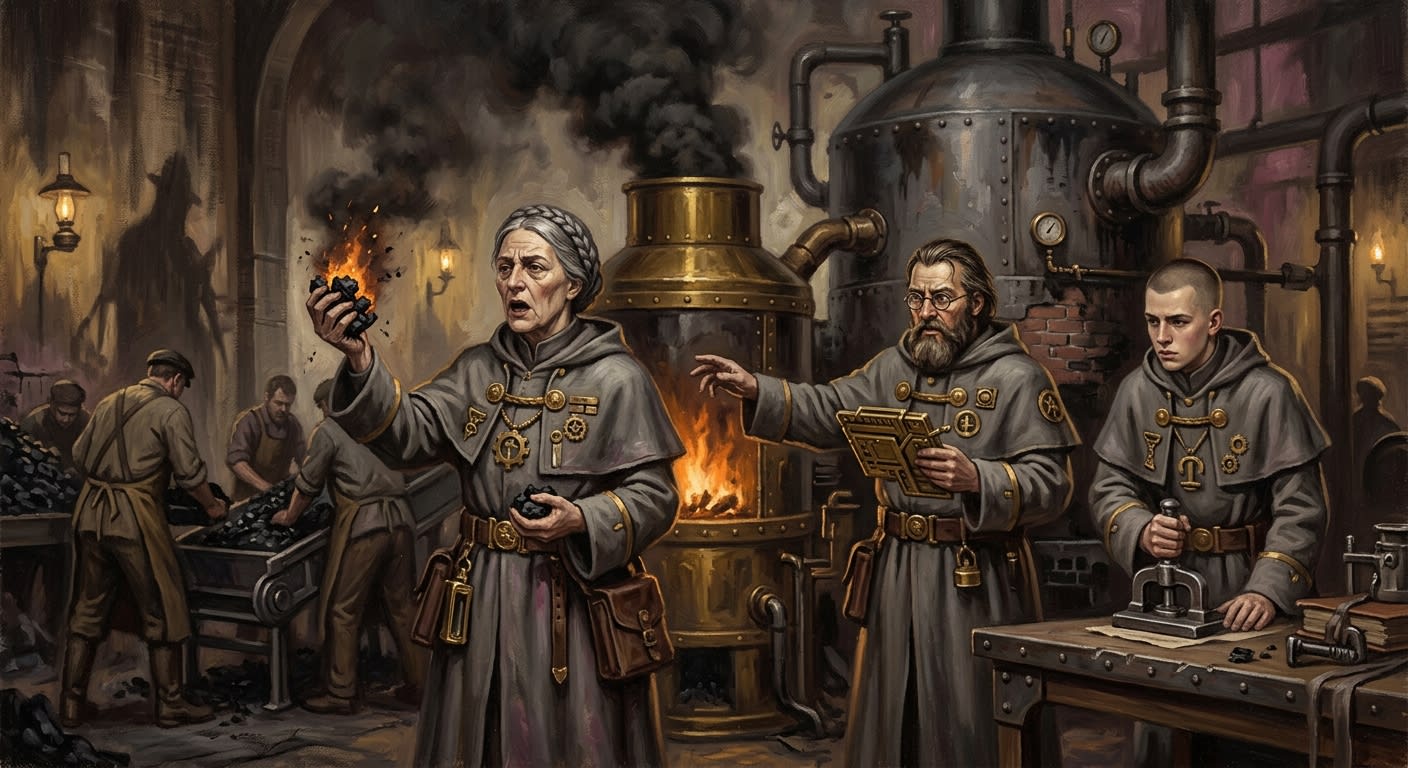
Standing Order 14-E is the Bureau of Engineering instrument that made engine-cant (Unregistered) mandatory, black-start procedure (Unregistered) sacramental, and practical competence unlawful unless it arrived with a witness, a seal, a counted breath, and the Eight Strokes under Saint Edrin's name. It was issued in A.S. 97 after the Black Start Catastrophe at Bastion-Brest, when one uncertified operator woke a harbour generator without litany, burned half the port, killed forty-three men, and taught the Synod that machines could make martyrs faster than committees could assign them.
The first clause remains the famous one: No ignition sequence shall commence without certified cant. Short. Brutal. Useful. The best laws often appear after screaming, before the lawyers arrive to fatten the wound.
14-E did not create the Litany-Engineer from nothing. Engine hands had sung to failing machines since the Great Retreat, when retreat columns discovered that generators, pumps, crane motors, and convoy engines sometimes failed in ways no wear chart would confess. Hum right and the casing steadied. Hum wrong and the casing answered. The phrase foreign harmonic entered the record because Engineering needed a phrase with boots on it. The men in the sheds used uglier words.
#On the Fire That Made the Clause
The lower harbour generator room at Brest lay beneath Quay Chapel Three (Unregistered), two levels below the Ribwalk, where the Bug River's fog slips into machinery as if damp were a political faction. The generator fed crane line, lower-rib winches, pump galleries, and night-berth lamps. It was old, strained, beloved, and familiar enough to breed insolence. Men who know a machine's moods begin to think they own permission.
The certified Engineer on roster was absent at a confessional audit. A convoy from Warsaw was expected. The lower quay had gone dark. A harbour operator, experienced but uncertified, checked oil, bled fuel, cleared the intake trap, set the governor stop, opened the lower vent, waited for the flywheel, and passed from preparation to ignition without cant.
The machine answered. The first flame moved through conduit, partition, belt stack, locked tool chest, berth hall, lamp circuit, and chapel storage with the dreadful neatness of a clerk who had learned to burn. Fourteen men died asleep before the alarm bell finished its first peal. Forty-three died in all. Six hundred blank absolution receipts burned in the chapel storeroom, producing an inquiry of admirable length and indecent enthusiasm.
The operator survived long enough for judgment. The tribunal needed him guilty because Engineering needed the casing, War needed the harbour rebuilt, Records needed casualty categories, and Doctrine needed the fire to speak in a sentence short enough for apprentices. He nodded when asked whether he omitted the litany. His throat produced only black bubbles when asked what he meant by restarting anyway. The court accepted the nod and discarded the bubbles.
BRIDGE TRIBUNAL SIDE FOLIO — H.K. HEARING COPY Question: “Did you believe the mixture correct?” Response recorded in public transcript: unintelligible. Engineering assessor's private note: “He said █████████████████████. He also said the engine sang first.” Disposition: annotation sealed; assessor transferred to pump-housing inventory.
H.K. was immured in the western service wall of Quay Chapel Three, facing the rebuilt ignition plate so apprentices could learn from stone what flesh had failed to file. On the seventh day, knocking came from the niche. On the eighth, it matched the training cadence. On the ninth, it stopped before the eighth stroke.
Public memorial tablets state that the operator refused repentance and accepted immurement in holy silence.
Corrected for internal use. No intelligible repentance or refusal survives. Silence was interpreted in the direction most useful to the wall.
#On the Text of the Order
The original order had six clauses, later multiplied into appendices, forms, throat-check tables, witness rubrics, and the dreary side-parishes of procedural salvation. The old six remain the bone.
No ignition sequence without certified cant. No black start without two witnesses. No emergency restart by uncertified personnel. No claim of silence as compliance. No omission of the Eight Strokes under field condition. All engine-rated personnel to be registered, examined, throat-checked, and assigned a chant code.
The clauses look like safety. They are ownership. A mechanic became a file. A restart became a rite. A throat became equipment. An engine room became a chapel that could kill you for bad timing. The old shed hands did not object to singing; they had sung before any Bureau owned the notes. They objected to the witness bench, the chant code, the seal punch, the registered throat, the supervisor whose only contribution to ignition was remembering whom to blame.
#On Saint Edrin and Borrowed Antiquity
Saint Edrin of the Eight Strokes was dead long before Standing Order 14-E, which made him perfect for it. The dead do not complain when offices improve their usefulness.
The Kalnik Road tale belongs to A.S. 48, when a retreat column's generator failed near dusk, wounded men lay in carts, enemy pressure stalked the road, and one engine hand sang eight beats over cracked insulation, a bent timing pin, fouled injectors, and a casing that answered before it was asked. The generator caught. Lamps held. The wounded crossed. Edrin burned for three days and died after asking whether the engine still turned. It turned for eleven years.
Standing Order 14-E took the legend and gave it teeth. The Eight Strokes entered manuals: intake, compression, spark, correction, flame seat, harmonic denial, witness, rotation. Veterans keep the better recension: wake up, breathe, take fire, stop lying, burn clean, spit out the wrong note, hear me, move. Doctrine tolerates the first. Engineering uses both. War prints whichever fits the poster.
Several A.S. 98 training broadsides imply that Edrin founded the certified Litany-Engineer corps.
Clarified. Edrin supplied precedent, patronage, and a face stern enough for workshop walls. Standing Order 14-E supplied licensing, penalties, and the splendid invention that a throat may be audited.
The Bureau needed antiquity after Brest. A new rule smells of panic. A rule with a saint smells of destiny. Edrin's wrench, throat cloth, timing wheel, and disputed bones were brought forward with sacramental haste. Apprentices learned that obedience had always been sung before ignition, even in years when no office possessed the ink to say so.
#On Revisions, Quiet Engines, and the Crime of Working
The A.S. 134 revision followed the Furnace Choir Reforms, standardising litanies across bastions and forbidding folk tunes in motor houses. Field operators had developed local melodies for bad starters, sulking pumps, cracked governor housings, salt-clogged intake lines, and the specific coughing vice of Brest harbour motors. Many worked. This doomed them. A tune that works outside licence is a rebellion with rhythm.
The A.S. 147 Quiet Engine Heresy proved the fear correct. Across three bastions, a sect of Engineers claimed stable combustion through purely mechanical calibration, without prayer, without cant, without the Eight Strokes. Their engines ran. The claim would have been safer had the engines failed. Doctrine suppressed the sect, Purity reassigned the men, and Engineering retained copies of their calibration data with the innocent expression of a dog sitting beside an empty pantry.
Standing Order 14-E became sharper in memory. The line between procedure and devotion vanished because both Bureaus found advantage in the blur. If the cant steadied the engine, Doctrine was right. If the timing steadied the engine, Engineering was right. If the operator died, War was supplied with discipline. The machine, displaying the tact of iron, kept running.
The A.S. 199 revision came after too many unofficial motor pools, too many shadow mechanics, too many second whistles tuned outside the codex, too many reports of engines remembering tunes no inspector had taught them. It tightened witness requirements, expanded throat-check authority, criminalised several field shortcuts, and created the charming doctrine that a man may be too hoarse for speech but never too hoarse for compliance.
#On the Current Force
As of A.S. 201, Standing Order 14-E governs generator vaults, pump rooms, convoy motor pools, refinery yards, sanctioned crane houses, fuel rigs, field dynamos, trench pumps, shrine-platform engines, and any mechanism rated capable of black start under Engineering schedule. Its jurisdiction runs from deep rear workshops in Kanzleiburg to the generator vaults of Bastion-Irongate, from Przemyśl pump sheds to the Bosphorus yards of Bastion-Constantinople. It reaches legal rooms and illegal rooms alike, though illegal rooms pretend not to hear unless the lights fail.
Every licensed Litany-Engineer carries the order in the throat before he carries it in the book. Sing, sign, seal. Count, witness, load. If the casing hums in a wrong register, file the harmonic. If the engine answers early, drown the answer. If the supervisor demands speed, ask him to stand close enough for the witness line. Supervisors dislike this. It improves them.
The Order's enemies call it ritualised cowardice. Its defenders call it safety. Both are provincial readings. 14-E is a custody instrument for the border between mechanism and prayer. It tells the wrench where the hymn begins, tells the hymn when the spark may enter, tells the operator when his experience becomes disobedience, and tells the Bureau whom to wall up when the harbour burns.
It remains in force because the engines still run and still listen badly. In the deep hours, after closing cant, after witness signature, after the seal cools, a night-shift Engineer may press a stethoscope to the casing and hear a frequency that no codex records. If he is wise, he writes within acceptable parameters and sleeps badly.
FINAL HOLDING — STANDING ORDER 14-E Category: Engineering / War ignition-cant instrument. Issued: A.S. 97. Revised: A.S. 134; A.S. 199. Patron: Saint Edrin of the Eight Strokes. Command: sing before spark; witness before load; seal before claim. MOVE.