
#On His Station Among the Sooted Saints
“A clean note is a clean burn.” — engine-house maxim, attributed to Saint Edrin by men who prefer their saints useful
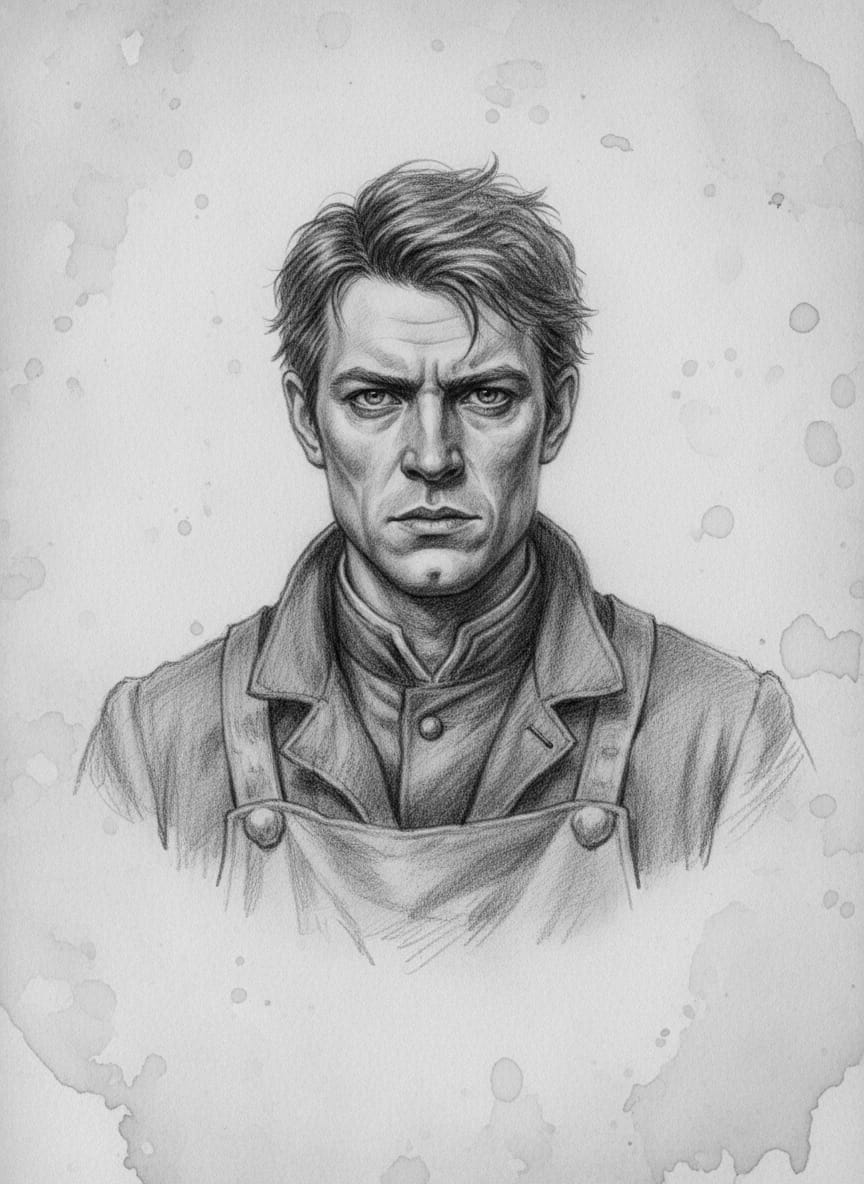
Saint Edrin of the Eight Strokes is the patron of Litany-Engineers, Cant-Calibration men, generator vault apprentices, pump-room widows, and every black-fingered mechanic who has ever held a machine together with wrench, prayer, spit, and a lie delivered confidently to an officer. He is depicted holding a wrench as a lesser saint might hold a censer, except that the wrench has restored more heat to more freezing men than several censers I could name.
Distinguish him from Saint Edrin of the Three Nails. That other Edrin belongs to doors, plague-bars, threshold doctrine, and the Gate-Carvers’ endless professional quarrel over whether Measure outranks Refusal when the lintel is damp. The Bureau of Doctrine maintains separate cult registers. The Bureau of Pilgrimage sells confused devotional cards anyway. Commerce is a tireless little heretic.
The Eight Strokes began as eight sung beats of the ignition litany, though Doctrine has tried to make them allegory. They are struck by breath against flame, metal, timing wheel, and whatever sulking spirit lives in an engine that has decided to die at the wrong moment. Every Litany-Engineer learns them before he is trusted near a live casing. Every apprentice thinks them simple. Every veteran knows simplicity is a trap with clean handwriting.
#On the Generator at Kalnik Road
The hagiographic account places Edrin during the Great Retreat, in the years A.S. 48–65, when Europe moved west in rags and the roads learned to count the dead before the clerks arrived. He was then an engine hand rather than saint, priest, or Bureau officer, because the Bureau of Engineering had not yet acquired its present splendour, stationery, and talent for denying the obvious. He was attached to a retreat column somewhere along the Kalnik Road, beneath rain, smoke, and a sky whose colour survivors later described as “old iron.”
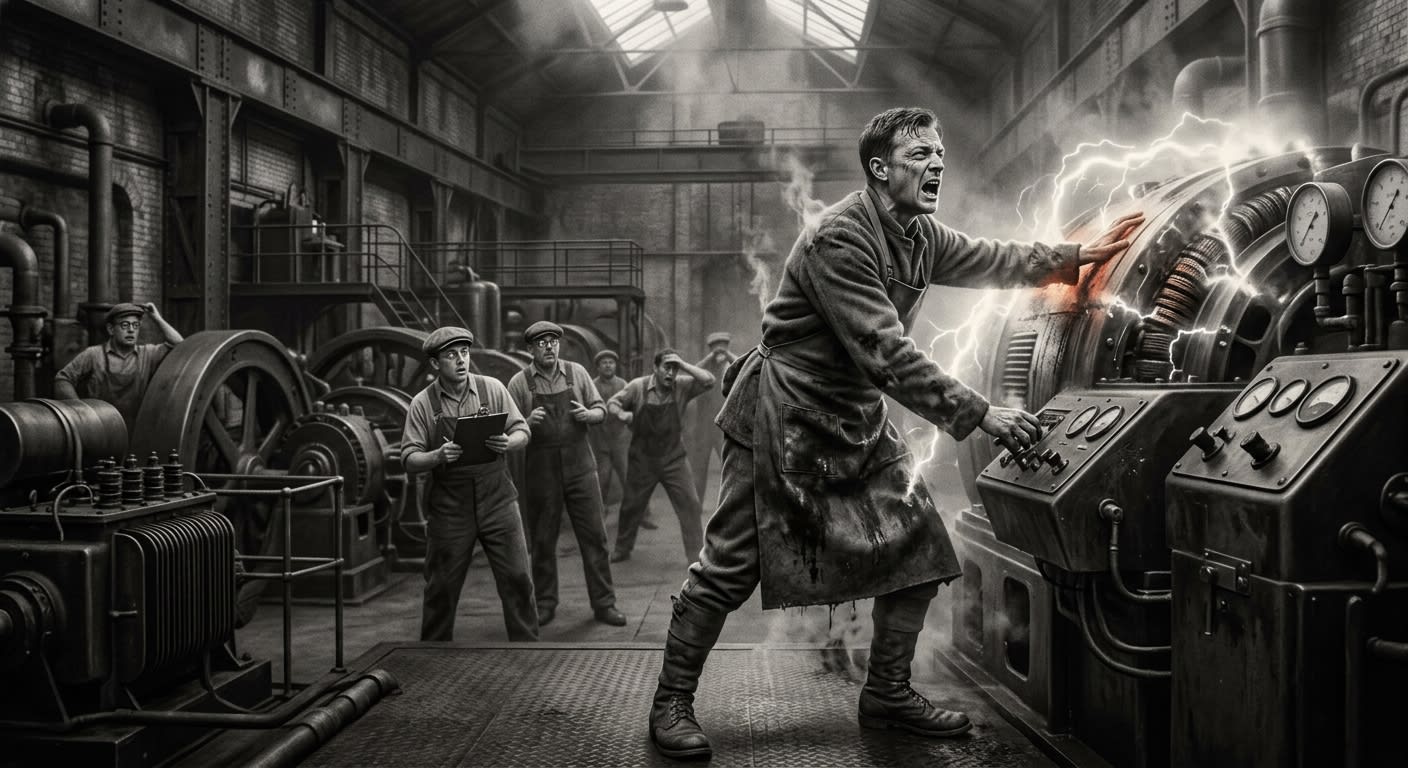
The column carried field lamps, a mobile pump, two ammunition carts, a reliquary chest, and sixty-three wounded who would die if darkness took the road. The generator failed near dusk. Its flywheel seized, spat oil, coughed once in a tone witnesses called deliberate, and went still. The crew opened the housing. Enemy pressure was close enough for rifle sound to arrive before the echo of command. The wounded began praying with the selfish intensity of men who want theology to become electricity.
Edrin found cracked insulation, fouled injectors, a bent timing pin, and a harmonic flutter no surviving manual could name. The crew bled around him. One had lost his hand. One held a lamp with his teeth. One sang the wrong interval and was corrected, sharply, by Edrin, which proves the man possessed saintly priorities. The official Life says he touched the casing and heard the engine confess. Engineering copies omit the confession. Operators repeat it.
He calibrated by ear. He wiped the timing wheel with his sleeve. He set the pin by thumb, without gauge, because the gauge had cracked. He ordered the remaining crew to answer only on the downward beat. Then he sang the Eight Strokes of the ignition litany: first to wake fuel, second to seat air, third to bind spark, fourth to shame metal, fifth to steady heat, sixth to close the wrong interval, seventh to deny whatever had begun answering inside the casing, eighth to command rotation.
The engine caught.
DEPOSITION FRAGMENT — RETREAT ENGINE-HAND, NAME DAMAGED “On the seventh stroke the casing answered back in Brother Edrin’s voice before Brother Edrin sang. He struck the side with the wrench and said █████████████████████. The eighth stroke came after. The answer stopped.” Filed under: foreign harmonic, pre-registry. Access: sealed to Category Three Engineering auditors.
The generator ran through the night. Lamps held. Pumps worked. The wounded crossed the ford. The ammunition carts did not sink. The reliquary chest reached the next station, where three officials later argued over which Bureau deserved custody and none thanked the man with burned hands.
#On the Burns and the Eleven Years
Edrin died three days later. This is the part parish cards treat gently, which is why parish cards should be licensed only to people with moral calluses. The burns began plainly. Red palms. Split knuckles. A line of blistering up the forearm where the casing had spat superheated oil. Then fever. Then blackening beneath the nails. Then the throat, swollen from the Eight Strokes, closing around breaths that had become too expensive.
He refused laudanum until the generator was inspected. This detail appears in every recension, so one may accept it as either truth or unusually persistent propaganda. He asked three questions: whether the lamps had held, whether the wounded had crossed, whether the engine was still turning. The answer to all three was yes. He stopped arguing with the room.
Several western devotional sheets report that Saint Edrin died immediately after singing the eighth stroke, smiling into holy flame.
Corrected. He died after three days of burns, thirst, fever, and clerks failing to spell his surname the same way twice. Instant martyrdom is tidy. Useful martyrdom often smells worse.
The engine ran for eleven years.
Here lies the true scandal of the cult. Men die for machines every hour. Machines rarely repay the courtesy. Edrin’s generator — Registry later labels it KAL-ROAD AUXILIARY 6, because the Bureau cannot touch mystery without tagging its ankle — served three retreat stations, two pump sheds, and a field chapel before it was finally decommissioned after a belt housing cracked in A.S. 59. No restart failure was recorded. No foreign harmonic report survived, though two pages are missing from the maintenance folio and one replacement page has been written by a clerk whose hand trembles visibly on the word “acceptable.”
The Bureau canonised the man because Doctrine likes sacrifice. Engineering canonised the engine by refusing to melt it for parts. That second canonisation is the more sincere.
#On the Eight Strokes Themselves
The authorised Eight Strokes printed in apprentice manuals are clean, numbered, and suspicious by nature. Stroke One: intake. Stroke Two: compression. Stroke Three: spark. Stroke Four: correction. Stroke Five: flame seat. Stroke Six: harmonic denial. Stroke Seven: witness. Stroke Eight: rotation. The formula is good enough for examinations and dangerous enough for live work, which is the Bureau’s preferred balance.
Veterans teach another version in sheds after the inspector leaves. One: wake up, bastard. Two: breathe. Three: take fire. Four: stop lying. Five: burn clean. Six: spit out the wrong note. Seven: hear me. Eight: move.
The cult objects to treating the Strokes as magic. It objects while selling stamped stroke-cards, brass timing beads, throat rinses, miniature wrench medals, and blessed chalk slates ruled into eight columns. Hypocrisy is a primitive engine but reliable under load. The serious Engineers know the Strokes as procedure: breath control, timing discipline, fuel-air sequence, anti-panic structure, harmonic suppression, and witness rhythm. The pious know them as prayer. The living use both.
The eighth stroke receives special fear. Most failed restarts collapse before the fifth. Wrong answers, if they come, come at the seventh. The eighth is command, and command delivered after a machine has answered incorrectly is either sanctified courage or technical idiocy. Manuals advise calm. Manuals have never knelt beside a coughing generator while the lamps die one by one.
#On Relics, Counterfeits, and the Engine-House Cult
Relics of Edrin multiplied once the Litany-Engineer profession was formally constituted under Standing Order 14-E after the A.S. 97 Bastion-Brest Black Start Catastrophe. This timing is administratively perfect and spiritually embarrassing. Before Black Start, Edrin was a shed legend, invoked by men with oil in their cuffs. After Black Start killed forty-three men, fourteen still asleep, and made cant-certification mandatory, Doctrine needed a patron who could make obedience look ancient. Edrin was available, dead, and already useful.
The principal reliquaries are the Timing Wheel of Kalnik (Unregistered), the Burned Wrench, the Throat Cloth (Unregistered), three disputed finger bones, and the Eight Slate Fragments on which early apprentices supposedly wrote the Strokes in soot. Relics authenticates the Timing Wheel as probable. Engineering authenticates it as “operationally resonant,” a phrase that caused three Doctrine clerks to request chairs. The Burned Wrench has six claimants. The correct number of burned wrenches in any healthy cult is apparently six.
An A.S. 134 shrine catalogue lists the Burned Wrench of Saint Edrin as singular and housed at Strasbourg.
Clarified. Strasbourg houses one Burned Wrench. Bastion-Irongate, Bastion-Brest, Prague, Lyon, and a private Engineering chapel beneath Munich house others. The Bureau recognises one as primary, two as secondary, two as devotional, and one as “pastorally useful pending metallurgical review.”
Engine-house devotion is brisk. Apprentices touch two fingers to the casing before first ignition. Senior Engineers spit into their palms before a hard restart and claim it is condensation. A throat wrap is hung beside the gauge board on Edrin’s feast. Men with burn scars mark the eight strokes down the forearm in chalk. The most devout place a crumb of bread on the generator housing overnight; if it dries hard by morning, the engine is obedient. If it softens, the shift requests a second witness.
#On His Use After Black Start
Black Start changed Edrin from patron to weapon. An uncertified operator at Bastion-Brest restarted a harbour generator without the ignition litany. Half the port burned. Forty-three men died. The operator was immured. Standing Order 14-E followed within the month. Certification became mandatory for every engine-rated personnel file from Brest to Bastion-Constantinople. Edrin’s face appeared on the first training broadsides before some of the burned warehouses had cooled.
Doctrine’s lesson was obedience. Engineering’s lesson was repeatable procedure. War’s lesson was that a saint with a wrench could make frightened mechanics accept military discipline. All three lessons worked, which is why the cult survives.
The Quiet Engine Heresy of A.S. 147 sharpened the cult again. A sect of Engineers claimed stable combustion without cant, through purely mechanical calibration. Their engines ran. This was the unforgivable portion. Doctrine suppressed them; Purity reassigned the sect to the Paper Mines; Engineering retained the data with the innocent expression of a dog beside an empty pantry. Edrin’s feast readings were revised the following year to stress that calculation without sung obedience opens a door through which pride, error, and unfiled sound may enter.
The Engineers heard the sermon, filed the sermon, and kept copies of the calibration tables.
#On the Present Veneration
As of A.S. 201, Saint Edrin of the Eight Strokes is invoked in every licensed Litany-Engineer training shed, most generator vaults, and several illegal motor pools whose operators would deny possessing saints if Purity entered the room. His feast is observed with eight hammer taps on cold casing, eight breaths through the throat wrap, and the reading of the Kalnik Restart in a voice low enough that the engines may listen without growing vain.
His icon is practical: black coverall, burned hands, wrench raised, mouth open on the eighth stroke. No halo in serious Engineering chapels. The glow comes from the furnace door behind him. Apprentice cards add a halo because apprentices enjoy being wrong in bright colours.
He remains useful because his cult contains the truth Engineering cannot publish and Doctrine cannot digest: the machine obeyed after a man sang correctly while doing the mechanical work correctly. Prayer alone would have left the road dark. Wrench alone would have let the wrong note answer. Edrin did both, burned for both, and left behind a generator that ran eleven years out of sheer offended discipline.
The Eight Strokes are counted before every dangerous restart. One for fuel. One for air. One for spark. One for shame. One for heat. One for silence. One for witness. One for command.
Move.