
#On the Kalnik Precedent
"Count it. Then earn it." (chalked over a training-shed door; author unrecorded)
The Eight Strokes are the eight counted, sung beats of the ignition litany. A Litany-Engineer sings them while both hands do the real work of making a dead engine live. They form a vocal sequence. They are no relation to piston strokes, bolt counts or any patented engine design, whatever the pilgrimage stalls tell provincial wives.
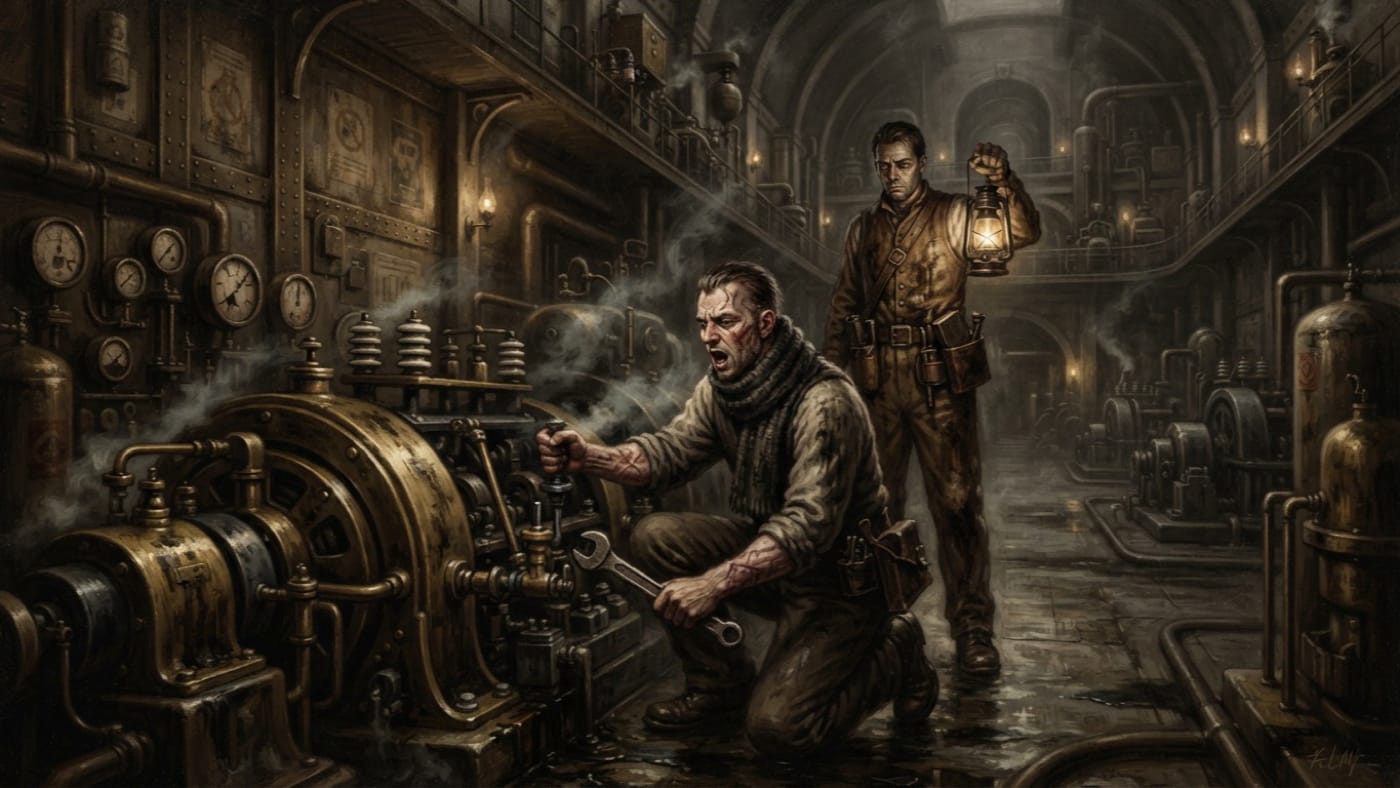
Their authority comes from one road. In A.S. 48, during the Great Retreat, an engine hand named Edrin knelt beside a failed generator on the Kalnik Road. His column waited to carry its wounded and its stores across a ford in the dark. The lamps and a mobile pump depended on that machine. He found cracked insulation, fouled injectors, a bent timing pin, and a flutter nobody could name. He corrected all of them and set the timing by ear after the gauge cracked. He told his crew to answer only on the downward beat. Then he sang. The engine caught and ran for eleven years. Edrin lived three more days.
Nothing establishes whether Edrin composed the sequence on that road or learned it in some unrecorded shed, and I decline to invent a christening for it. The Life of Saint Edrin of the Eight Strokes holds the biography. This tract concerns what the living do with his count.
Devotional sheets in circulation state that Edrin died at the eighth stroke, smiling into the flame.
Corrected. The published Life records burns, throat injury, and death three days after the restart. The eighth stroke killed nobody that night. It only sent the bill.
#On the Eight Counted Beats
The apprentice manuals of the Bureau of Engineering give the sequence in examination order: One, intake. Two, compression. Three, spark. Four, correction. Five, flame seat. Six, harmonic denial. Seven, witness. Eight, rotation.
Each beat governs the engineer's breath as much as the machine. Intake and compression teach the lungs to fill while fuel and air are admitted, so that nobody is gasping when the mixture needs judgement. Spark is struck on the count and never on a whim. Correction is the beat on which the hand adjusts what the ear has just reported, usually a quarter-turn at the timing or a pinch at the mixture. Flame seat holds steady while combustion settles into the casing. Harmonic denial shuts any interval the engine has no business making. Witness is the beat the second crewman answers, so that two throats and one log agree on what happened. Rotation is command. The engine turns, or the engineer explains in writing why it did not.
That is the clean version. It suits chalk.
The hagiographic account of Kalnik keeps a different eight: wake fuel; seat air; bind spark; shame metal; steady heat; close the wrong interval; deny whatever answers inside the casing; command rotation.
The veterans teach a third in the sheds after the inspector has gone to supper: wake up, bastard; breathe; take fire; stop lying; burn clean; spit out the wrong note; hear me; move.
Set the three side by side and the trouble sits at six and seven. The manual puts harmonic denial at six and the witness at seven. The Kalnik account closes the wrong interval at six and spends seven denying something that answered from inside the iron, so its seventh beat is a refusal where the manual's is a roll call. The veterans split the difference with "hear me," which may be addressed to the witness, to the engine, or to whatever the Life declines to name. The published sources record this variation and never explain it. No council minute, recovered original or sworn copyist accounts for how a beat of refusal became a beat of witness, or the reverse. The Ledger does not forge its own ancestry.
None of the three versions gives pitch, beat length, frequency or settings for any particular engine. Those belong to each engine's sanctioned operating band. An apprentice who sings Kalnik's tempo at a harbour turbine will deserve whatever the turbine says back. Nor are the Strokes the Counter-Sorcery Verses sung at a breach. One wakes a machine and the other is used against something trying to get in. Engineers who confuse the two tend to be listed afterward under one heading.
Engine-house lore, repeated in the parent Life and never tallied in any ledger I have found, holds that failed restarts usually collapse before the fifth stroke, and that wrong answers, when they come, come at the seventh.
#On the Witness and the Working Engine
The eight beats sit inside a longer discipline, and most engines are saved by that discipline. The engineer listens before touching a bolt, for drift, for knock, and for the foreign undertone that makes a veteran go quiet. Next comes calibration of timing, mixture, pressure, belt tension and valve clearance. After that comes the cant, matched to the operating band, and then the seals are verified. Then comes a load test under real draw, because an engine that holds a clean note at idle has proved nothing except its manners. Last, the ledger closes with measurements, cant code and the witness's signature. The Strokes occupy the third stage. An engineer who counts eight and skips the other five stages is a choir standing beside a fire hazard.
A witness is required. "Never restart alone" is the first rule every Litany-Engineer learns and the last one a tired engineer breaks. The second crewman answers on the downward beat, as Edrin's crew answered at Kalnik, and signs afterward. Nobody may hum a personal tune near a loaded engine. The shed says engines remember tunes, and I have read too many logs to call the shed foolish.
The throat pays. Engineers rinse with salt and ash before each shift, wrap the throat against the cold, and take eight preparatory breaths at the casing. By the third day after Kalnik, Edrin's throat had closed. In every engine house from Brest to the southern bastions a scarred throat outranks clean cuffs, and apprentices learn that before they can spell "compression."
On the question of what answered at Kalnik:
DEPOSITION FRAGMENT — RETREAT ENGINE-HAND, NAME DAMAGED (as quoted in the published Life) "On the seventh stroke the casing answered back in Brother Edrin's voice before Brother Edrin sang. He struck the side with the wrench and said █████████████████████."
We have one witness, a damaged name and a sealed sentence. The deposition does not say what answered, or why the eighth stroke silenced it, and I will not say either. Engineering files such sounds under foreign harmonics. Doctrine files them under the Great Deceiver. The man holding the wrench files them under get it running.
#On Compulsory Cant
For decades the Strokes were shed custom. Then came the Black Start at Bastion-Brest in A.S. 97. An uncertified operator restarted a harbour generator without the ignition litany. Half the port burned and forty-three men died. The operator was immured. Standing Order 14-E followed. It formally constituted the Litany-Engineer vocation and made cant certification mandatory before any ignition.
The Order's devotional appendix is stricter on one point, and the two rules should be kept apart. The general rule requires certified cant before any ignition. The emergency rule requires all eight Strokes, counted and witnessed, at exactly the hour when everyone present would like to skip three. No penalty schedule exists for a single missed stroke. Brest is considered illustration enough.
The Bureau of Doctrine drew obedience from Brest. Engineering drew repeatable procedure. The Bureau of War drew a saint with a wrench, useful for teaching terrified mechanics to stand still under fire. Edrin's face was on training broadsides before the warehouses had cooled.
Then, in A.S. 147, came the Quiet Engine Heresy. A sect of Engineers achieved stable combustion through mechanical calibration alone, with no cant at all. Their engines ran. Doctrine suppressed the sect, and Purity sent its members to the Paper Mines of Ulm. The Bureau of Engineering kept the data in a drawer and kept the drawer locked. The feast readings were revised the following year to warn against calculation without sung obedience.
The published account proves that some engines ran in silence. It does not prove that every foreign harmonic in every vault was a clerk's superstition. The crews who sing over harbour turbines have not asked for the experiment to be repeated in their own stations.
#On Present Engine-House Use
Apprentices learn the eight before they are trusted with a live casing. They learn them from stroke cards, from brass timing beads strung in eights, and from cheap slates ruled into eight columns and chalked until the grey gives out. They count while breathing, then breathe to the count, and finally forget they are doing either, which is the purpose of drill. The slates are ordinary workshop furniture. Pilgrim sellers call them relics. The Eight Slate Fragments in shrine custody preserve no recoverable original notation, whatever the price label claims.
Devotion borrows the number. On Edrin's feast a crew taps a cold casing eight times with a hammer and breathes eight times through the throat wrap. Neither observance replaces the sung sequence. An engineer who offers eight hammer taps at a live restart will meet an inspector, then a disciplinary board, then whatever trade remains for someone without a throat certificate.
Keep the rite and the engine apart. Eight strokes completed and logged prove that the cant was sung. Only load, temperature, pressure and a steady clean note prove the engine. Inspectors who confuse the two sign fine ledgers over dead generators.
Move.