
#On the Fire Before the Bell
“No ignition sequence shall commence without certified cant.” — Standing Order 14-E, first clause, written after the screaming had stopped
The Black Start Catastrophe at Bastion-Brest is the reason a man may not turn a crank in the Synod without witnesses, seals, throat-rinse, and a small choir of supervisory cowards pretending to be guardians of the Word. It is also the reason the Litany-Engineer ceased being a shed legend and became a licensed vocation under joint Engineering and War custody. Forty-three men died. A profession was born. The exchange was considered favourable.
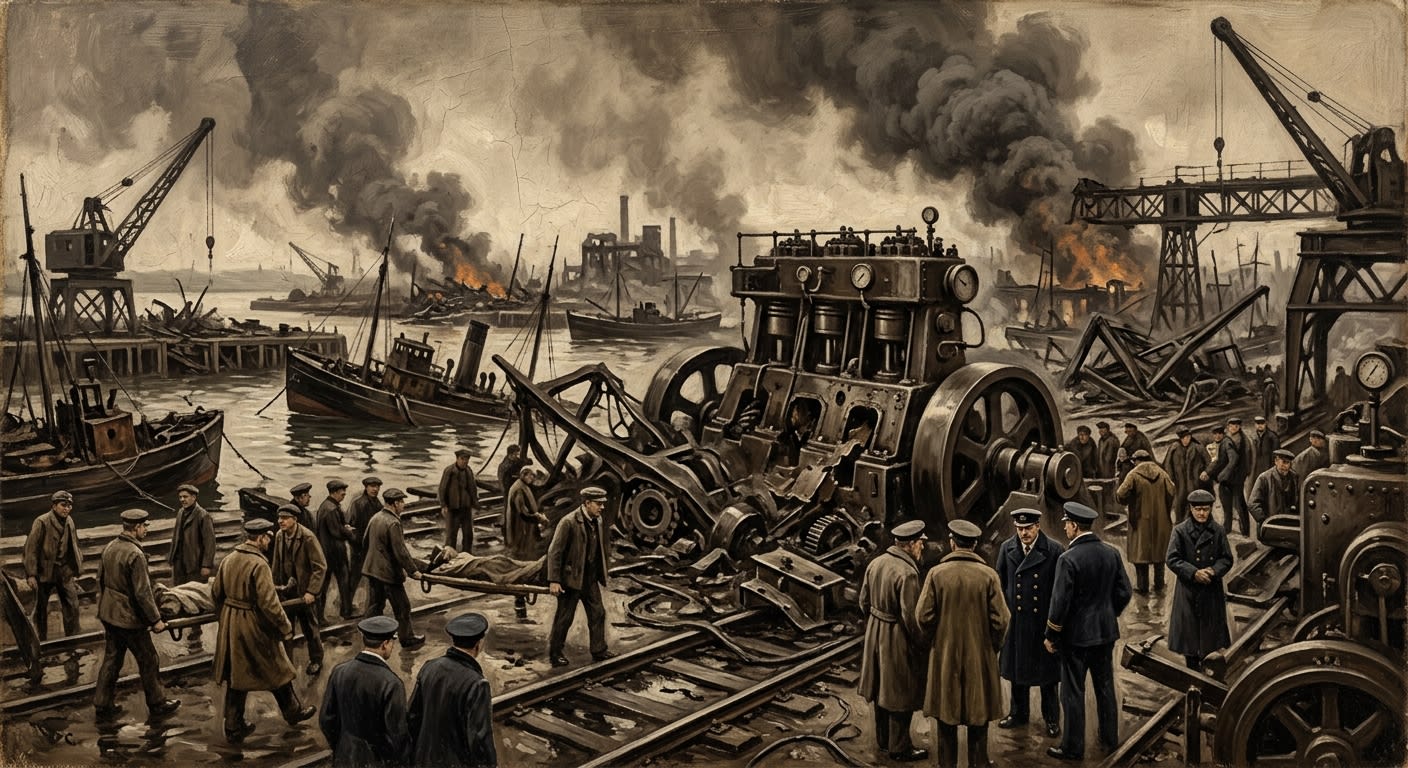
The event occurred in A.S. 97, in the harbour works below the western gatehouse of Brest, where the Bug River eats fog and gives back damp paper, bad lungs, and certain kinds of official courage. The harbour generator fed the crane line, the pump galleries, the lower-rib winches, and three lamp circuits serving the night berths. It was old, overtaxed, badly loved, and accustomed to being coaxed awake by men who knew its sulks better than their wives’ birthdays.
A late convoy was expected from Warsaw. The lower quay had gone dark. The tide-pumps were losing pressure. The certified Engineer on roster was absent at a confessional audit, because Brest is a bridge with the soul of a queue and even fires must wait their turn. A harbour operator, uncertified but experienced, entered the generator room, primed the line, opened the fuel gate, and began a restart without the ignition litany.
No bell had rung for black start. No witness had signed. No Eight Strokes were counted under Saint Edrin’s name. The machine answered anyway.
#On the Generator Room
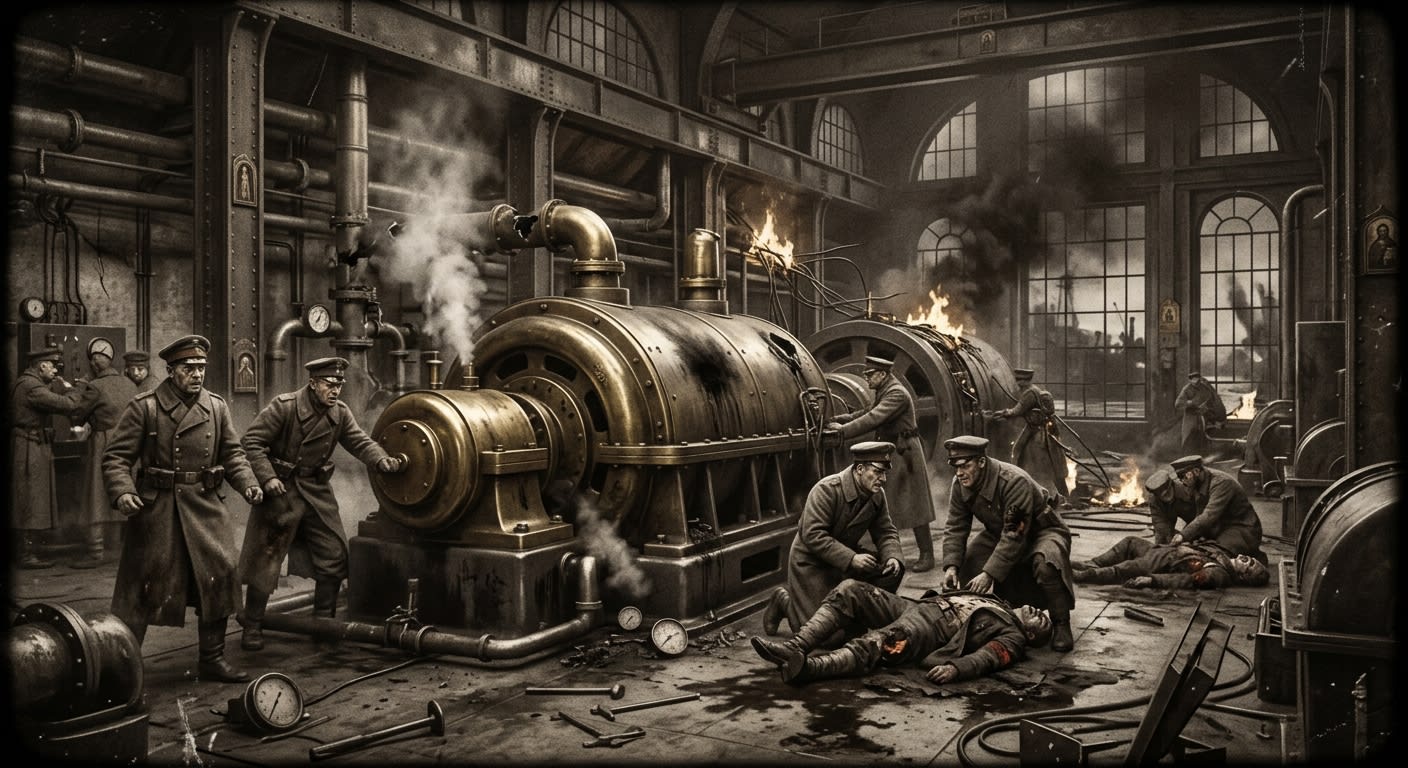
The generator room sat beneath Quay Chapel Three (Unregistered), two levels down from the Ribwalk and one level above the pump sumps. It had brick vaulting blackened by twenty years of fuel smoke, a brass inspection rail that shocked the hand in wet weather, six cracked saints over the intake manifold, and a floor drain that never fully drained. Men called the engine Saint Morrow (Unregistered), without permission. It had earned the title by refusing to die during three shelling weeks and by killing only one apprentice before A.S. 97, which in Brest counted as gentleness.
The operator’s name appears in no public account. Engineering files preserve initials: H.K. Purity files preserve a longer form under seal. The bridge-workers remembered him as Kessel, Hark, Henk, or Half-Karl, depending on who was drunk, grieving, or hoping to survive testimony. He was not a fool. That fact complicated the prosecution. Fools comfort institutions. Competent men who make useful errors expose the floorboards.
He performed six actions correctly. He checked the oil level. He bled the fuel line. He cleared water from the intake trap. He set the governor stop. He opened the lower vent. He waited for the flywheel to settle. Then he committed the administrative murder: he moved from preparation to ignition without certified cant.
Witnesses later disagreed about the sound. One heard a cough. One heard a bell under water. One heard the operator say, “Come on, old bastard,” which became evidence of irreverence once the court discovered it had nothing better. The night clerk in Quay Chapel Three wrote that the candles leaned toward the floor. A sleeping winchman in the adjacent berth woke long enough to say his teeth were singing, then went back to sleep. He died fourteen seconds later.
ENGINEERING RECOVERY NOTE — LOWER HARBOUR VAULT Flywheel: cracked through hub, rotation direction disputed Governor: fused open Saint plates: detached; two embedded in ceiling brick Operator position: █████████████████████████████████ Acoustic trace: ███████████████ below sanctioned ignition band Recommendation: do not reproduce tone for tribunal demonstration
#On the Fire’s Progress
The first flame did not behave like ordinary flame. I write this with caution, which is to say under protest, since caution is what clerks wear when facts have teeth. Ordinary fuel fire runs along vapour, climbs, consumes the eager surfaces, and then becomes subject to men with buckets. The Brest fire moved through the generator room as if checking names against a list.
It took the governor housing, then the belt stack, then the oil rags in the eastern cabinet. It leapt the stone partition through a sealed conduit and emerged in the crane gallery thirty paces away. It ignored two barrels of solvent and burned through a locked tool chest whose contents later appeared undamaged except for the handles, which had become ash. It entered the berth hall by the floor joints and killed fourteen sleeping men before any alarm bell completed a full peal.
Early War summaries described the Black Start Catastrophe as “engine possession.”
Corrected. The official finding recognises omitted cant, unlicensed restart, improper mixture, and probable foreign harmonic response. Possession remains licensed for funerals, sermons, and officers who cannot pronounce “intake pressure” without looking frightened.
The harbour burned from second watch until after dawn. Half the port was gutted: crane shed, rope loft, winch berth, two lamp rooms, the lower toll archive, and a chapel storeroom containing six hundred blank absolution receipts. The loss of the receipts caused a longer inquiry than the deaths, since paper has the courtesy to be countable.
Fire crews cut the western pump line to keep the flames from entering the rib conduits. This saved the bridge and drowned the sumps. Three men in the lower gallery survived by standing chin-deep in water beneath a row of hanging chains while burning oil drifted above them like black communion. One later testified that the engine kept turning after the belt had burned away.
Records struck that phrase. Engineering copied it first.
#On Judgment, Fuel, and Blame
The tribunal convened in the Absolution Hall eight days later. This was indecent speed for justice and admirable speed for narrative control. Doctrine wanted judgment. Engineering wanted the casing. War wanted the crane line rebuilt before the next convoy season. Records wanted the casualty forms amended so the fourteen sleeping dead could be classified as “non-waking operational martyrs,” a category invented at the table and approved before supper.
The Bureau of Doctrine declared the fire a judgment. The Bureau of Engineering declared it fuel-air ignition by an untrained operator. Both classifications entered the record. This is how the Synod achieves harmony: it places contradictory statements in different columns and stamps the page.
The operator had survived, though “survived” is a merciful verb for a man with his lungs cooked, both hands bandaged, and a throat that produced only black bubbles when he tried to speak. He was carried into the tribunal on a stretcher and asked whether he had omitted the ignition litany. He nodded. Asked whether he understood the consequence of omitted cant, he attempted speech. The transcript records: “unintelligible.” A junior Engineering assessor annotated a private copy with: “he said the mixture was right.”
The court accepted the nod and rejected the bubbles.
The immurement niche was cut beside the rebuilt generator room. Kessel, if that was his name, was sealed facing the new ignition plate so trainees could watch the wall while reciting the first clause of Standing Order 14-E. He lived nine days inside the masonry. On the seventh day, apprentices reported knocking from within. On the eighth, the knocking matched the training cadence. On the ninth, it stopped before the eighth stroke.
Public memorial plaques state that the condemned operator “refused repentance.”
Corrected for internal copies. No intelligible statement survives after the tribunal. Refusal was inferred from silence, which is the Bureau’s oldest method for making the mute cooperative.
#On Standing Order 14-E
Standing Order 14-E followed within the month. The text is short, which proves that fear wrote it before committees could fatten the clauses. No ignition sequence without certified cant. No black start without two witnesses. No emergency restart by uncertified personnel. No claim of silence as compliance. No omission of the Eight Strokes under field condition. All engine-rated personnel to be registered, examined, throat-checked, and assigned a chant code.
That final phrase changed the continent. A mechanic became a file. A file became a profession. A profession became a jurisdictional prize fought over by Engineering, Doctrine, War, Rites, and every small-souled supervisor who understood that licensing is merely ownership with a cleaner collar.
Training sheds multiplied first at Brest, then at Bastion-Irongate, Bastion-Przemyśl, Bastion-Constantinople, and the rear motor yards at Kanzleiburg. Saint Edrin’s face appeared on broadsides before the burned warehouses had cooled. The Eight Strokes became compulsory under emergency restart conditions. Throat-rinse allotments entered quarterly procurement. Witness ledgers grew fat. The second whistle entered pockets and remained absent from inventories.
The Black Start did more than license men. It purified blame. Before A.S. 97, an engine failure raised vulgar questions: Was the part worn? Was the fuel bad? Was the supervisor drunk? Was the schedule impossible? After Standing Order 14-E, the first question became: was the cant performed? That question pleases every institution except the one holding the wrench.
#On the Ash That Still Teaches
Brest rebuilt the harbour because Brest always rebuilds what it cannot afford to mourn. The crane line returned to service in forty-one days. The lower toll archive required nine months and six affidavits to reconstruct, all of which contradicted each other and were accepted. The chapel storeroom was moved two rooms west. The new generator was named Saint Morrow the Second by workers and Generator Unit 97-B by Engineering. The workers were correct.
Four scorch marks remain on the service vault ceiling. Doctrine says they form an admonitory cross. Engineering says they follow the vent pattern. Records has accepted both descriptions. Pilgrims are not admitted, except when they are, which is usually after a donation.
The catastrophe remains the first lesson in every Litany-Engineer training shed. Apprentices learn the casualty count. Forty-three dead. Fourteen asleep. Half the port burned. Operator immured. They learn the public formula: the omitted litany opened the wrong acoustic gate. They learn the Engineering formula: improper fuel-air handling under unlicensed restart produced ignition cascade with foreign harmonic amplification. They learn the useful formula: sing, sign, seal, and if the engine still answers wrong, make sure another man heard it.
The old men teach another lesson after inspection. They tap the casing twice and say: the engine ran before it burned.