
#On the Disaster and Its Name
The Knife-Mile Reframing takes its date from its catastrophe, A.S. 137, 1847 by the old reckoning, because the catastrophe is the only part of the affair anyone dated. That year belongs to the drowning. The Bureau of Records spoke its new name at some point, destroyed the depositions at some point, paid sculptors and assembled reciters at some point, and the Ledger does not establish when it did any of these things. The Bureau most devoted to dates left its own undated. I have never decided whether that was carelessness or good taste.
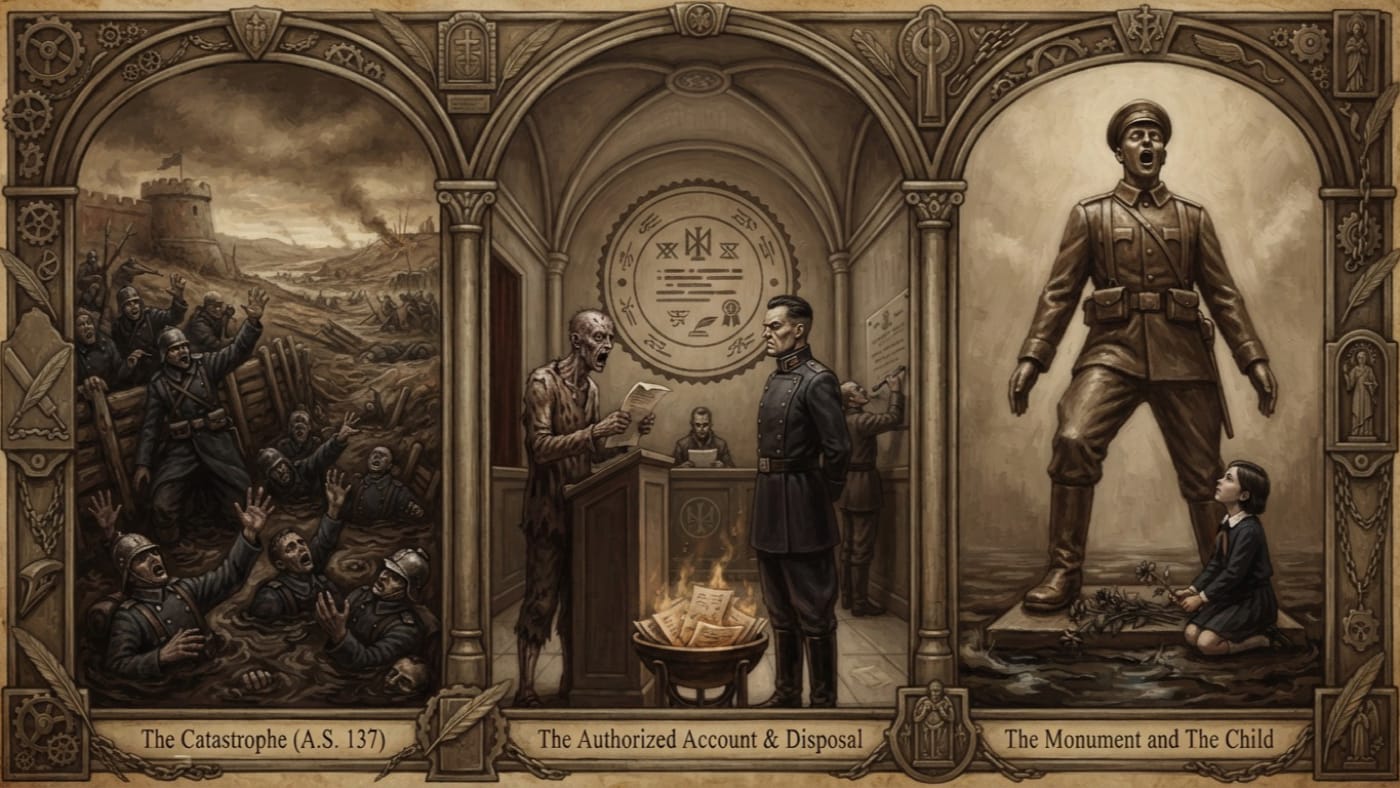
The facts underneath are few, and they are wet. At the Knife Mile, the sector of No Man's Land facing the Ravelin of Vigilance at Bastion-Constantinople, the southern anchor of the Sagittal Line, whole companies drowned in Flesh-Mud during a failed advance. The mire smothered their screams before the enemy had fired a shot at them. The wider military business of that sector (its formations, its crossings, its arithmetic) belongs to another folio. I will not drag it in here to make the room look furnished.
This tract concerns what came afterward. Records took the drowning and gave it a name: the Penance March of Extraordinary Zeal.
#On the Authorized Account
Read the name the way a clerk reads a requisition, part by part. Penance turns the dead into debtors who chose to pay. March gives them direction and an order of step, both of which the mud had taken from them. Extraordinary Zeal gives them an inward condition that no living officer could verify and no dead man could dispute. Five words turned a failed advance into a procession. A procession has a liturgy, and a liturgy can be printed.
The proclamations went further than the name. The surviving account of the affair says they replaced the destroyed testimony with a statement that the men had deliberately immolated themselves as anchors for the Line, descending into the mire on purpose to make firm footing for the faithful above. That is the authorized account. It is attributed here to its authors, and it will be attributed every time it appears, because the companies drowned. The proclamation gave them a will they were in no condition to exercise.
A drowning is something done to a man. Immolation is something a man does. The Bureau shifted one verb from passive to active, and the dead were conscripted a second time, this time into the subject of the sentence.
The motive is recorded without ornament: a collapse of morale seemed certain. An army can swallow a defeat. It chokes on the knowledge that the ground has an appetite and that its officers marched men into that appetite in good order. Records undertook to remove that knowledge by supplying a more flattering one. Whether morale was saved, and how much of it, and in which companies, the archive does not say. I decline to invent a percentage to flatter my colleagues. They flatter themselves well enough unaided.
As a theologian who has drafted his share of proclamations, I find the work competent. The phrase is easy to sing and dreadful to question. It also gives every widow the same comfort and leaves room in it for no particular husband.
#On the Disposal of Testimony
There were survivors, and the survivors were the whole inconvenience.
A man who comes up out of the mire at the Knife Mile carries a copy of the event that Records did not make. He saw what happened to the files around him. He heard what the mud did to the sound of men. If such a copy is entered in a deposition, it can be read, compared, and quoted by the wrong chaplain to the wrong congregation. Two accounts of one disaster amount to a controversy, and controversy is where the Records auditor earns his pay.
The survivor testimonies were destroyed. The sources give no method, hour, or officer for this, and no surviving fragment either. They record the destruction and nothing more.
Destroying the papers was only half the work. The men who had written them were still breathing, still eating, still capable of talking in a canteen. Records answered this with the subtlest instrument in the whole affair. Those who had lived through the drowning were compelled to read the official version aloud at assemblies.
Any functionary can burn paper. A craftsman takes the witness himself and makes him the publisher of the account that contradicts him. The survivor stands before an assembly and reads that his comrades went down willingly, with zeal, as anchors. He reads it in his own voice and his own accent, and his presence lends the text an authority no proclamation could buy, because everyone in the hall knows he was there.
Surviving an event and holding the right to describe it are separate properties. The first is a matter of luck and lungs. The second is a licence, and Records issues it.
What the readers believed while they read is not recorded. No register attests that their memories altered, that they came to agree, or that they wept or refused. The record says they were compelled and that they read. I leave their inward state where the archive left it, in the dark of the man's own skull, the one vault Records has never fully audited.
#On the Monument and the Child
Records commissioned statues, and the surviving account says they were erected. Neither their number, their sites, nor the dates of commission and erection are established. Only the pose is known: drowning soldiers posed nobly, mouths open in song.
Consider the mouth. A drowning man opens it to take in air, takes in the mire instead, and keeps it open after there is nothing more to take. A man singing a hymn opens it to the same width. The sculptor needed no new anatomy. He kept the open mouth, set the brow in serenity, squared the shoulders and lifted the chin toward the Creator. The one detail the survivors could testify to, the gaping mouth, was kept exactly and given a new purpose. As forgery goes, it is very fine work. As memorial, it is theft carried out in the open.
The dead of the Knife Mile deliberately immolated themselves as anchors for the Line.
Corrected. They drowned. The struck sentence remains the authorized account of the Penance March and is attributed to Records wherever it is quoted. It is struck here because this page is meant to say what happened.
Then the children came.
The published account of Flesh-Mud records that children lay flowers before these statues. The account of Records' practice adds the sharper detail: the survivors were made to read the official version aloud until their own children believed it. The child of a man who climbed out of the Knife Mile learned the Penance March as something true, possibly from the father who knew it was false.
Whether the children learned it first from the stone or from the recitations, and in what order the two were set before them, the record does not say. I will not invent a schedule. Both taught the same text. The statue shows what to see, the recitation supplies what to say, and the child does not need to remember either lesson, because she was never there to remember anything else.
#On Records' Victory
Records holds that war is won in text, and that coherence is itself victory. The Knife-Mile Reframing is its demonstration piece, cited among the Bureau's own examples of that principle, and it deserves the place.
Lay out what the Bureau held at the end. It held the name of the event. It had disposed of the written evidence against that name. It had the voices of the surviving witnesses, at least at the lectern. It had stone figures that gave the public a picture to put to the name, and it had the children of the witnesses, who were the next generation of the faithful. The drowned companies, which had been a disaster in the trenches, were by then the official example of what devotion looks like.
The account of the affair puts it in one line: annihilation became edification. I would not improve that sentence, and I have improved a great many.
Some things remain open, and I record them as open. The date of the reframing is unestablished, and so are the hands that drafted the proclamations below the level of the Bureau itself. No register states whether any survivor ever stopped reading. The A.S. 137 drowning is dated. Its afterlife in Records is not, and Records may prefer it so. An undated procession can be held again whenever it is needed.
The mud at the Knife Mile still keeps its own account. It does not publish, and no one has yet compelled it to read aloud.