
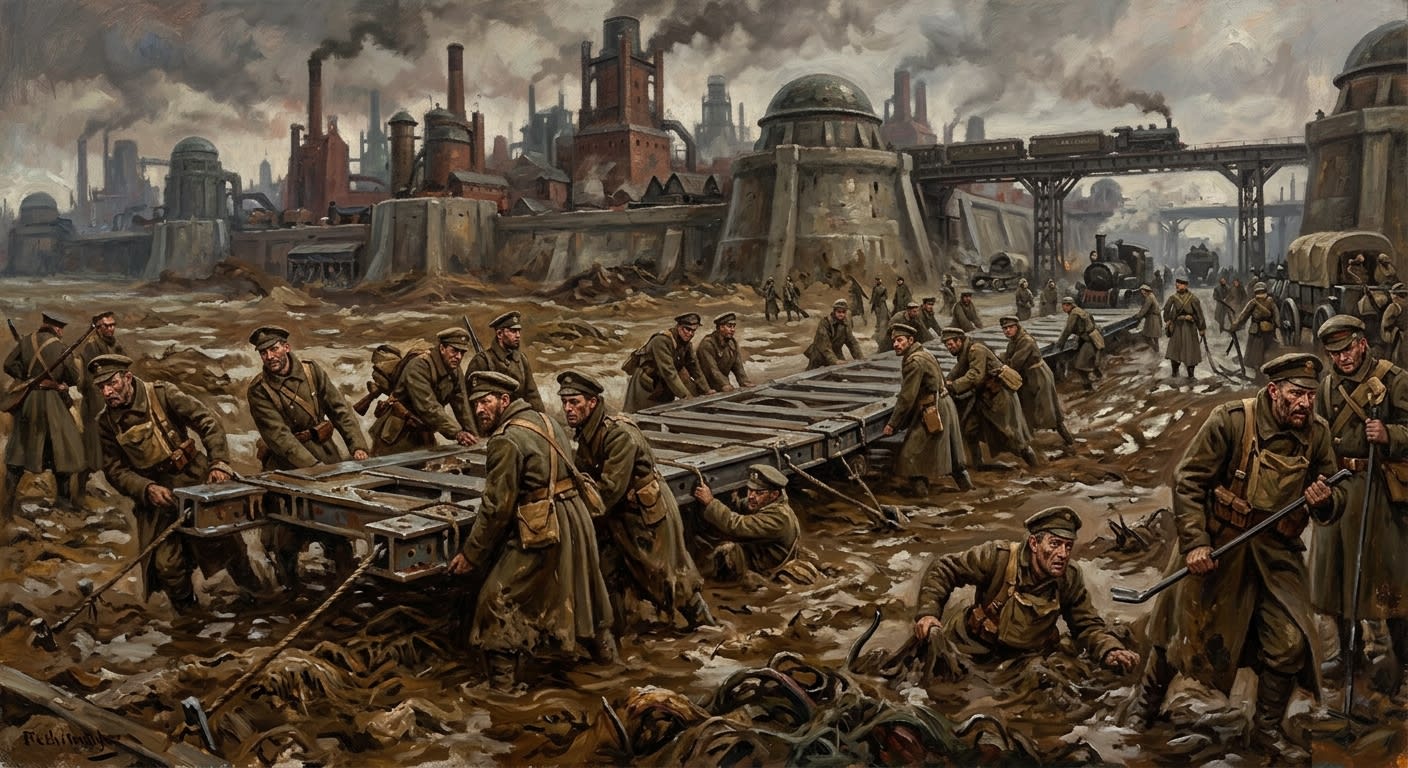
#On the Mile That Measures Men Downward
The Knife Mile is a named sector of No Man's Land facing the Ravelin of Vigilance at Bastion-Constantinople, though the word mile has always been a kindness granted by surveyors to men who prefer measurable terror. In dry reports it is a forward trench interval, a raided approach, a bayonet-hedged stretch of broken parapet east of the southern anchor. In the mouths of soldiers it is simpler: the place where mud learns your name and uses it as a handle.
The parapets are shaved nightly to stakes. Shells break the trench walls. Raiders cut the wire. Dawn repairs what dusk insults. No fortification there remains intact long enough to earn a proper architectural term; it is rebuilt so often that Engineering keeps two ledgers, one for what stood at morning bell and one for what had already become slurry by supper. The difference between those ledgers is where men go.
#On the Ground's Appetite
The Knife Mile's mud is the sector's true officer. Men speak of it as carnivorous because “difficult footing” is a phrase invented by clerks who have never watched a boot vanish ankle-first while the leg above it remains standing in disbelief. The mud eats boots, calves, knees, and, when not properly salted, entire files. It wrinkles under weight. It tightens around leather seams. It presses upward in small wet gestures that resemble hands attempting the sign of the Cross from below.
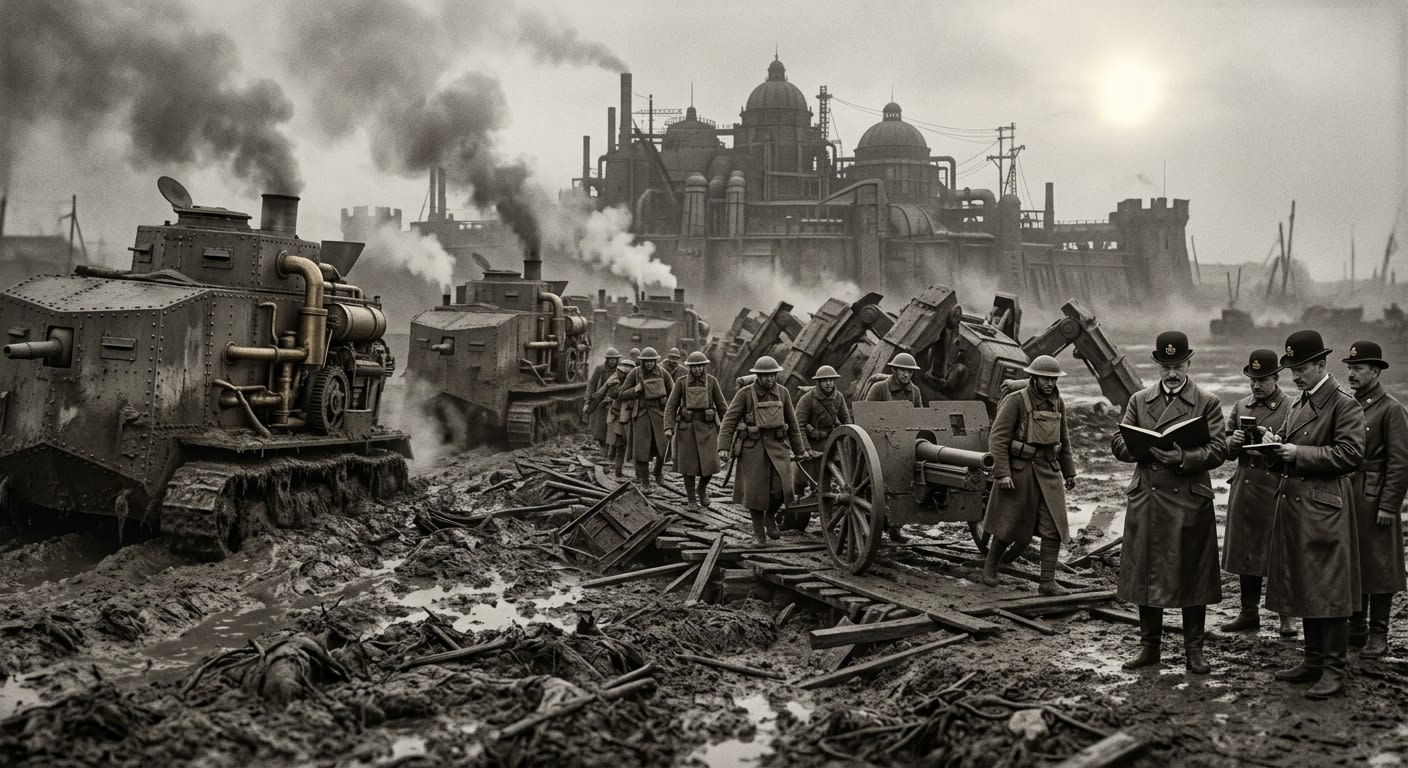
The Bureau of Engineering calls the substance unstable trench mire with variable organic response. The soldiers call it Flesh-Mud. Doctrine, which knows when a horror has become too popular to rename, permits the field term in training annexes and forbids it in parish sermons. This distinction comforts printers.
The mud sucks downward and remembers. Rings lost forty years before return on probes. Rosary beads imprint themselves into thighs from beneath. Stretcher teams have recovered men with bite-crescents in skin no comrade touched. A chaplain at Third Recovery claimed the mire feeds by recognition: grief bends the soldier toward the dead, and the dead pull back. Engineering disliked this because it could not be weighed. Doctrine disliked it because it sounded plausible. The mud remained available for consultation and consumed both theories with equal grace.
#On the Catastrophe of A.S. 137
The Knife Mile Catastrophe of A.S. 137 began as most disasters begin: with confidence, inadequate rope, and a beautifully clean order. The forward parapets had been reduced to stakes after seven nights of raids. Ash-Fodder columns were gathering beyond the bayonet-hedges. Heavier enemy forms waited behind them, patient as tax collectors at a funeral. War ordered a stabilising push before Third Peal. Records had already pencilled the expected casualties with admirable restraint.
Rain came before dawn. The trench walls melted into toothlike ribs. Mud swallowed the first sappers to the knee, then to the belt, then to the shoulder. A company of Shield Paladins entered under Saint Ardent brace cadence (Unregistered) and locked where the map promised firm ground. Maps, like young priests, are often confident before contact with matter.
The enemy poured in.
Older field chronologies identify the Knife-Mile Catastrophe under an impossible future year.
Corrected under the current Ledger of Years. The action belongs to A.S. 137 in the corrected forward annals. The obsolete date remains visible in several training copies, three devotional plaques, and one hymn stanza whose rhyme depends upon error. The hymn stanza is under review and has resisted correction better than some bastions.
The Paladins formed what later manuals call the Mud Lock. They drove their tower-shields into the muck flatwise, edgewise, crosswise; they hooked rims under rims; they braced straps through elbows already sinking; they became a causeway because the alternative was becoming a grave without tactical benefit. Whole companies died waist-deep with arms fixed through shield loops. Later ranks pressed them lower. The Radiant Fusiliers crossed the iron-and-flesh path and fired from the far lip until the breach closed in smoke, mud, and arithmetic.
Survivors remembered the sensation of walking upon backs. Bureau annals called it logistical stabilisation. I would admire the phrase more if it did not fit so neatly over a man's spine.
FIELD TESTIMONY — KNIFE MILE, A.S. 137 Fusilier Corporal S—— reports: “The shield shifted under my boot. I looked down. A face was looking up through mud. He blinked. I stepped anyway.” Disposition: retained in sealed appendix for officer instruction; excluded from public morale edition; corporal reassigned to counting work, then to silence.
#On the Ledger of Mud
After the Catastrophe, Records created the Ledger of Mud. Names had become inconvenient. Bodies were absent, partial, argued over by stretcher hooks, or present in consistencies not suited to family notification. The first pages classified recoveries by depth and texture: ankle-claimed, calf-claimed, viscous, gelatinous, absorbed, shield-bound, rope-lost, voice-heard, boot-only. This was mercy in its purest bureaucratic form: when a mother cannot receive a son, she may receive a category.
The morning tallies became ritual. Wardens counted swallowed personnel at dawn. Inquisitors revised the figures at dusk. No one lied crudely; crude lies offend the Ledger. They harmonised. A man missing below the knee was counted as present if the knee remained within friendly reach. A chaplain heard beneath the mud was listed as spiritually audible. Three men dragged down on one rope were entered as collective retrieval pending. The pending column grew fat enough to require a second book.
The display copy in Strasbourg is blackened, stiff, and unreadable in several sections. Records stamped it Balanced in red wax. Children are marched past it on feast days and told that order prevailed. This is true, provided one accepts that order may be measured by the successful filing of the drowned.
#On the Reframing
Disaster entered the city as disaster. Paperwork improved it.
Within three months, the Catastrophe had become the Penance March of Extraordinary Zeal. Survivor depositions were sealed, shortened, rearranged, or replaced by proclamations in which men deliberately descended into the mire as anchors for the Line. Statues were commissioned of drowning soldiers posed nobly, mouths open in song. The sculptors, whose knowledge of drowning came from baths and sculpture manuals, gave every face a serenity the mud had neglected to provide.
Publicly, the Knife Mile proved endurance. Privately, it proved that trenches could fail downward faster than command could fail upward. War changed rope protocols. Engineering revised plank loads. Mercy filed objections about abandonment after the twelfth minute. Doctrine replaced “abandonment” with “cessation of recoverable status” and slept very well, I am sure.
A commemorative pamphlet issued after the Reframing states that the Knife Mile dead immolated themselves as anchors for the Line.
Corrected for restricted copies. They drowned, sank, were walked upon, fired over, miscounted, and later improved by sculpture. The public edition may retain “anchors,” since metaphor has already done its little murder and returned home before curfew.
#On Daily Use and Daily Theft
The Knife Mile did not close after its Catastrophe. That is the obscenity outsiders fail to grasp. A sector that kills too effectively becomes sacred to War. Men are still assigned there. Supply trolleys still groan across its rope ways. Reliquary shot still moves through its pulleys. Patrols still cross during seven-minute windows after salt bombardment, each man tied to two others so the mud must negotiate with a committee before eating.
The air itself misbehaves. Consecrated flame once ran along invisible lines and chased prayers like fuse-cord, blinding half a company of Fusiliers and burning the rest. The Incident of the Crimson Pulley in A.S. 189 saw a supply trolley carrying reliquary shot plunge after Pale Chanter silence caused every repairman to cut the wrong rope at once. Soldiers swear the pulley bled as it fell. Records filed oxidation. Records is often brave when the blood is someone else's.
The sector's greatest theft is sequence. Flesh is expected. A ration queue shifts forward twelve feet, and the advance is declared successful though the men who formed the queue are under mud. A parapet is rebuilt before the names are reconciled, and the new sandbags rest upon the old company. A recruit arrives on Tuesday and by Thursday cannot say whether the trench wall contains masonry, bodies, or both. At Knife Mile, yesterday is load-bearing.
#On Countermeasures and Pious Stupidity
The approved crossing method begins with salt bombardment (Unregistered): consecrated salt, lime, iron filings, powdered bell-clapper residue, and the usual prayer that Chemistry will behave when blessed loudly enough. A proper barrage stiffens the upper skin of the mire for seven to twelve minutes. Eight minutes is average. Nine is a gift. Ten is suspicious. Men cross on plank, shield, fascine, corpse-board, or whatever surface has the courtesy to remain above appetite.
Rope is mandatory. Sentiment is discouraged. Trapped men are braced, salted, cut free if tendrils show, and pulled only when the team captain gives the jaw-signal. Upward yanking increases ligament response. This phrase, taken from the field manual, means the mud pulls back harder. Manuals conceal screams by preferring nouns.
Do not pour oil on the mud. It drinks. Do not fire into it at close range. It loosens. Do not lean close to hear a trapped man unless your belt rope is fixed, since the mud has learned several voices and uses the familiar ones with real artistry. Do not cut a Paladin shield from the muck without checking whether the arm inside still resists. Resistance after death is common at Knife Mile and should be treated as either miracle, spasm, or paperwork deferred.
#On the Present Condition
As of A.S. 201, the Knife Mile remains active, contested, measured, mismeasured, salted, bridged, raided, reframed, and fed. The Ravelin of Vigilance watches it with its guns trained low. War wants it held because the approach must be denied. Records wants it documented because nobody else can make the dead so legible. Mercy wants fewer men abandoned after the twelfth minute. Mercy, poor dove, has never learned that minutes at Knife Mile are not time. They are teeth.
Every dawn the Wardens tally who has been swallowed. Every dusk the Inquisitors insist the numbers were lower. Between tally and correction, the mud makes its own entries.