
#On the Mud That Remembers
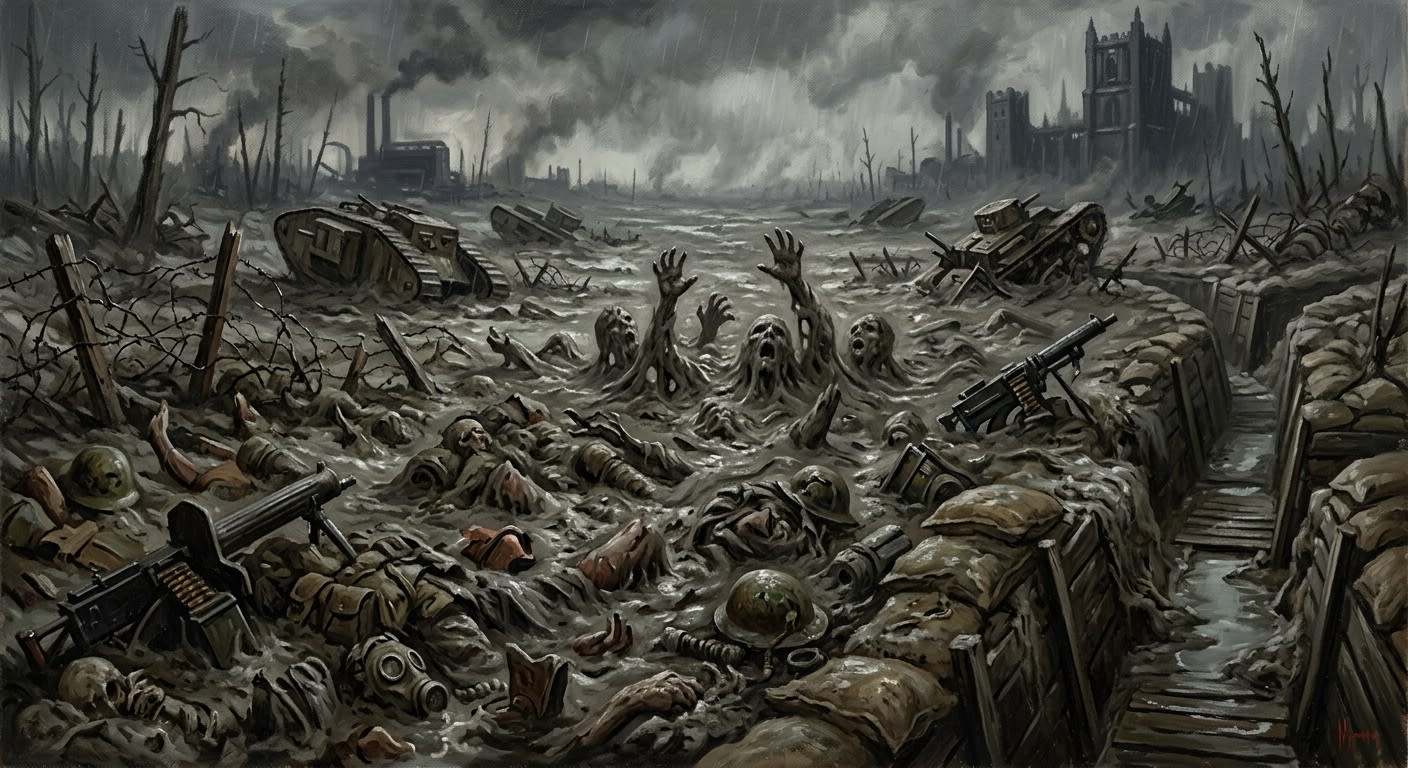
Flesh-Mud is the soldiers’ name, and soldiers, being filthy prophets in government boots, have named it better than the Bureaus. The Bureau of War calls it anaerobic slurry with organic ligamentous response. The Bureau of Engineering calls it battlefield sediment under pressure. The Bureau of Doctrine calls it hostile matter animated by the Lie. The mud itself calls nothing. It has no need. It takes the ankle first.
It occurs throughout No Man’s Land, especially in the Knife-Mile, the low approaches below Bastion-Brest, the shell bowls east of Bastion-Przemyśl, and those Danubian flats where the dead have been trampled into the ground so thoroughly that the ground has begun to claim custody. Flesh-Mud looks, at first, like ordinary trench mire: black, glossy, overfull with rain and rot. Then it wrinkles against the boot. Then it tightens. Then the soldier feels fingers where no fingers are visible, tendons winding about the ankle, small mouthings at the leather seams, a pressure like wet hands rehearsing prayer.
Men pulled from it show marks. Not suction bruises. Hand marks. Bite crescents. Occasionally the imprint of rosary beads pressed into skin from below.
The first official record dates to the A.S. 68 thaw, three years after the Sagittal Line hardened from emergency trenches into continental habit. A convoy south of the Bug River reported six horses lost in an area mapped as firm ground. The horses did not sink. They were folded downward, joint by joint, while the teamsters watched the mud rise over them in sheets. One horse screamed with a human voice. Records struck that sentence from the first copy, retained it in the second, and charged the teamsters for both animals.
#On Composition and Appetite
The stuff is made of everything war has failed to bury separately: clay, powder, saint-bone dust, ration grease, horse blood, rust, grave-water, burned vellum, hair, melted rosary wax, and the nameless sediment of men who were once entered in company rolls and now persist as weather. Its bone-reefs form beneath the surface in pale shelves. Its deeper pockets contain boot fields, rifle forests, helmet clusters, and faces so pressed into mud that they are expressions without skulls.
Flesh-Mud feeds by recognition. That is the theory advanced by Chaplain-Major Iven Tars (Unregistered) in A.S. 114 after three patrols disappeared near the old wire orchard east of Przemyśl and one survivor returned without boots, socks, toenails, or the belief that his mother was dead. Tars claimed the mud seized those who thought too intensely of the dead beneath it. Grief made a hook. Memory supplied the barb. The Bureau of Doctrine admired the sermon and distrusted the method.
Engineering disagreed, as Engineering must or its boilers cool. Their surveyors lowered weighted rods into active patches and retrieved them wrapped in fibrous tissue not matching any catalogued species. One rod returned with a wedding ring threaded over its iron tip. The ring belonged to a sapper lost forty years earlier at the Knife-Mile. His widow, then eighty-one, was asked to identify it and did so. The mud had polished the inscription clean.
Early War circulars advised personnel to cut trapped comrades free at the boot and pull upward.
Corrected. Upward extraction increases ligament response. Personnel are advised to brace the subject, salt the perimeter, sever visible tendrils, and pray before pulling. The prayer is listed fourth in field order, which tells you who drafted the order and who survived testing it.
#On Incidents of Note
The Knife-Mile Reframing remains the great example, both of Flesh-Mud’s appetite and of Records’ more vulgar appetite for interpretive victory. Whole companies drowned in the mire during a failed advance, their screams muffled before the enemy fired a shot. Morale might have broken. Records announced a Penance March of Extraordinary Zeal, destroyed survivor depositions, and commissioned statues of drowning soldiers posed nobly, mouths open in song. Children now lay flowers before those statues. Some flowers sink through the paving overnight.
At the Belgrade flats in A.S. 120, during the routing of Maldrake’s horde, Flesh-Mud swallowed a Wrath-forged engine to its waist. The thing burned hotter in rage, which baked the mud around it into a crust. The crust cracked. The mud beneath rose red and took the engine whole, leaving only a chimney of steam that screamed for nine minutes in a language no translator would admit knowing. Doctrine filed the event under miracle. War filed it under favourable terrain. Engineering filed it under pending investigation and has been sending junior surveyors to their deaths ever since.
At Shadow Noon, a Litany-Engineer division found calcified into salt statues had marched through a dry sector. Dry, the map said. Dry, the officers swore. Their boots were packed with Flesh-Mud to the knee, though there had been no rain for six days and no visible mire within a mile. The Bureau declared the salt edifying. The families asked for bodies. They received sketches.
Suppressed addendum, A.S. 197: Active Flesh-Mud samples placed in sealed reliquary jars moved overnight toward the ward containing amputees from the same sector. One jar arrived at the bedside of Private █████ Voss (Unregistered). The jar was intact. The bed was empty. The amputated leg in storage had gained a foot.
#On Countermeasures and Folly
The approved countermeasure is salt bombardment (Unregistered): shells packed with consecrated salt, lime, iron filings, and powdered bell-clapper residue, fired in grids ahead of movement. A proper barrage freezes the surface for seven to twelve minutes, depending on rain, prior shelling, corpse density, and the mood of Creation. Patrols cross during that interval. Slow men die. Fast men sometimes die with better posture.
The second measure is plank road, laid over fascines and bone-crates. The third is censer smoke, which stiffens the upper layer long enough for stretcher teams. The fourth is the old rope method: every man tied to two others, so that when the mud takes one, it must negotiate with three. This produces either rescue or arithmetic tragedy. War likes rope because rope is cheap.
Do not fire into Flesh-Mud at close range. It answers concussion by loosening. Do not pour oil on it. It drinks. Do not bless it from within arm’s reach. Men have been pulled down by the stole. Do not promise the trapped man rescue unless the ropes are already set; hope makes him thrash, thrashing wakes the deeper layers, and the deeper layers have had a century to grow patient.
The Bureau of Mercy objects to abandoning trapped personnel after the twelfth minute. War objects to losing six men for one. Doctrine objects to the phrase “abandoning.” The field manual now uses “cessation of recoverable status.” The mud does not care what we call lunch.
Mercy pamphlet A.S. 151 instructed stretcher teams that “no faithful soldier is beyond retrieval.”
Clarified after the Third Knife-Mile Recovery (Unregistered). Some faithful soldiers are beyond retrieval. Others are retrievable only in pieces that argue with the stretcher team.
#On the Theological Use of Mire
Flesh-Mud offends reason because it makes ground into appetite. This is why the Rationalists died here in such gratifying numbers. They kept treating the mire as substance governed by law, measuring viscosity while it measured their fear. The Synod knows better. We treat it as a parishioner: dangerous, needy, resistant to correction, taxable if one is sufficiently bold.
As of A.S. 201, Flesh-Mud remains present across Zone Five wherever shelling, burial, sorcery, and weather have had enough time to become one civic authority. It is redirected, frozen, bridged, cursed, studied, and lied about. It is never cured. The dead wish for company. The living supply it. The Ledger receives the names, strikes them through, and opens another page.